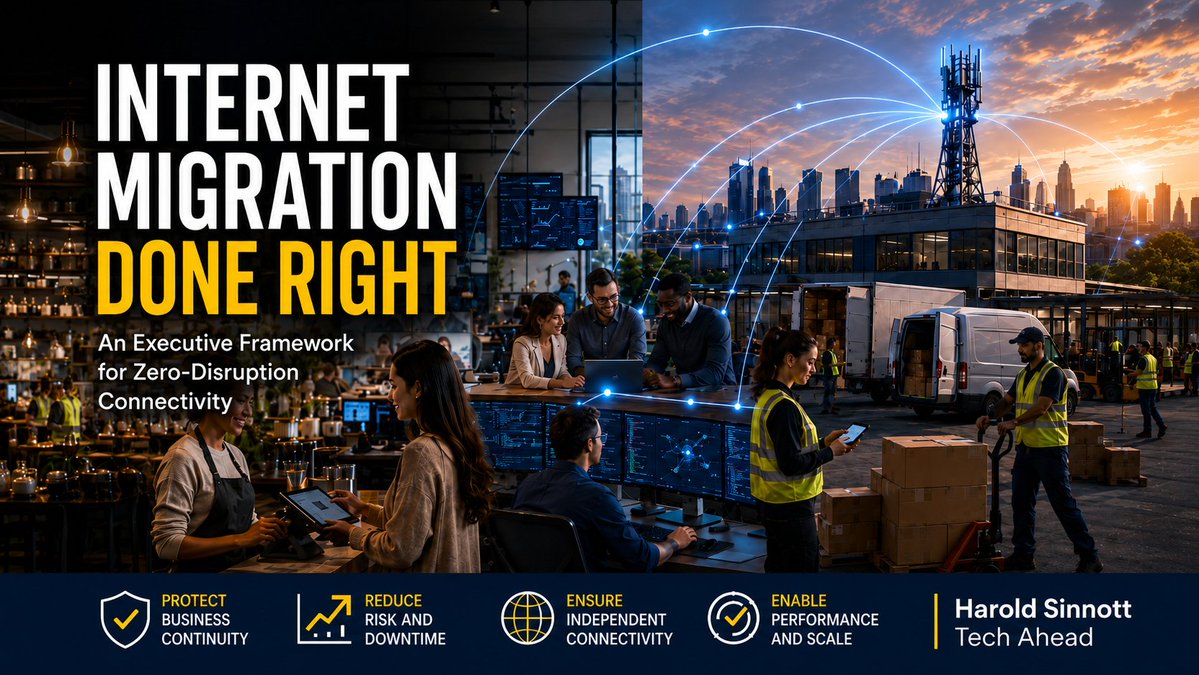
Two providers do not always mean true resilience.If both connections share the same physical path, one incident can affect both.
What matters is independent connectivity, and an operating model designed for continuity.
Full article:
🔗 https://t.co/U9bWy8agD2
@TMobileBusiness Partner #BusinessContinuity #NetworkResilience #5G
Most migration risk comes from how the transition is managed, not from the switch itself.
Keep the old and new services running in parallel. Test real workflows. Confirm failover and recovery. Move locations in controlled stages.
The goal: make change as operationally invisible as possible.
https://t.co/PtZg8Qa63W
@TMobileBusiness Partner #BusinessContinuity #NetworkResilience #5G
Changing business internet providers shouldn’t mean disrupting the business itself.
My new Tech Ahead article shares a practical framework to reduce migration risk, protect continuity, and build more resilient connectivity.
🔗 Read it here: https://t.co/U9bWy8agD2
@TMobileBusiness Partner
#BusinessInternet #BusinessContinuity #5G
Enterprise AI isn't a single model or a single agent.
It's an ecosystem of interactions.
The more connected that ecosystem becomes, the more important visibility, identity, and governance become, not to slow innovation, but to make it sustainable.
Additional background: https://t.co/9tCz3LSZHC
One point that didn't fit into the LinkedIn post:
Enterprise AI isn't just about governing models.
It's about governing every interaction, between agents, APIs, MCP servers, enterprise data, and people.
That's where visibility, policy enforcement, and intelligent routing become critical.
https://t.co/9tCz3LSZHC
Is connecting AI agents enough to scale enterprise AI?
Not anymore.
As AI agents interact with models, APIs, enterprise data, and other agents, security, identity, policy enforcement, and cost control become just as important as connectivity.
I explore why in my LinkedIn post with @GraviteeIO :
https://t.co/dElefssimz
#AI #AgenticAI #GraviteePartner #EnterpriseAI #ZeroTrust
Welcome to @X , @JensenHuang !
A strong opening message.
Open-weight models can accelerate innovation, broaden access, and give enterprises and nations greater control over how AI is built and deployed.
Looking forward to the conversations ahead.
https://t.co/TYDWfYDPs0
Jensen Huang's first post makes a compelling case for why open weights matter.
This isn't just a discussion for AI developers—it's relevant to policymakers, enterprises, and every industry building with AI.
Open-weight models aren't simply about openness.
They're about accelerating innovation, enabling AI sovereignty, strengthening security through transparency, and giving organizations greater control over how they build and deploy AI.
AI leadership won't be defined by a single model alone.
It will be shaped by the strength of the ecosystem—from models and infrastructure to applications, governance, and talent.
Well worth reading.
@JensenHuang@NVIDIA #EnterpriseAI
Telecom just became one of the most important infrastructure stories in AI, and it is still not getting enough attention.
As AI moves beyond centralized data centers, fiber, 5G, edge computing, and intelligent networks become part of the intelligence stack itself.
The next AI advantage may not only come from the model. It may come from the network behind it.
#AI #Telecom #5G #EdgeComputing #AIInfrastructure
Google is stepping up its AI cybersecurity game! 🛡️✨
@Google has just unveiled three new models designed to boost security and performance while keeping costs lower than rival offerings:
• Gemini 3.5 Flash Cyber
• Gemini 3.6 Flash
• Gemini 3.5 Flash-Lite
@GeminiApp #earlyaccess
Check out the full story here 👇
🔗 https://t.co/jtIS2OP5U9
🏆 SPAIN ARE WORLD CHAMPIONS! 🇪🇸
Spain defeat Argentina 1-0 after extra time in a dramatic 2026 World Cup Final.
Ferran Torres with the winner as Spain 🇪🇸 claim their second World Cup title (2010 + 2026).
An emotional night for Lionel Messi and Argentina as their reign comes to an end.
What a final. What a tournament.
Spain 1-0 Argentina
#FIFAWorldCup #WorldCup2026 #España #Messi
AI agents are changing what enterprises need to manage. It's no longer just APIs, it’s Agent-to-Agent interactions, Agent-to-LLM traffic, MCP, identities, and governance at scale.
Learn more: https://t.co/MMaE5MKPn9
#AI@GraviteeIO
One of the biggest shifts I explore in the article is that enterprises are no longer managing only APIs and applications. They're increasingly managing Agent-to-Agent interactions, Agent-to-LLM traffic, MCP servers, knowledge, identities, and event-driven systems.
More here: https://t.co/MMaE5MKPn9
#AI @GraviteeIO #EnterpriseAI
What happens when AI agents move from answering questions to taking action across enterprise systems?
I explored this in my new @LinkedIn post with @GraviteeIO : why the shift from API-first to agent-first will require stronger visibility, governance, security, and cost control.
Read it here: https://t.co/xqla3oWB37
#AI #GraviteePartner #AgenticAI
Can AI and Energy Scale Together?
AI is no longer only a software story.
It is becoming an infrastructure story, one shaped by electricity, grids, data centers, cooling, connectivity, capital, and long-term energy planning.
That is why the convergence of artificial intelligence, computing infrastructure, and energy systems is becoming one of the defining strategic questions of this decade.
Here are five reasons this matters:
1. AI growth is becoming an energy demand story
Every AI model, autonomous system, cloud platform, and intelligent application depends on physical infrastructure. As adoption accelerates, so does demand for reliable electricity, high-performance computing, cooling, and resilient power systems.
2. Data centers are becoming critical energy infrastructure
The next generation of data centers will not be planned in isolation. Their growth will depend on grid capacity, energy availability, permitting, location, connectivity, and long-term power strategies.
3. AI can also make energy systems smarter
AI is not only consuming energy. It is helping optimize it.
Across the energy value chain, AI can improve forecasting, predictive maintenance, asset performance, grid management, energy trading, infrastructure planning, and operational decision-making.
4. Energy security will shape the pace of AI adoption
The AI economy cannot scale on unreliable infrastructure. Countries and companies with resilient grids, diversified supply, flexible capacity, and strong digital infrastructure will be better positioned to capture the next wave of AI-driven growth.
5. Asia will be central to this convergence
Asia is already at the center of rising electricity demand, industrial expansion, data center investment, and digital infrastructure growth. The region’s choices around energy, computing, policy, and investment will influence the future of the global AI economy.
This is why Gastech 2026 and AIxEnergy arrive at such an important moment.
AI needs energy.
Energy increasingly needs AI.
The real opportunity is not simply to scale both independently, but to design them as one interconnected system.
Learn more about Gastech 2026 and AIxEnergy, and register as a delegate:
https://t.co/PhyuhvDyaD
#Gastech2026 #AIxEnergy #ArtificialIntelligence #AIforEnergy #EnergyInfrastructure #DataCenters #EnergySecurity #DigitalInfrastructure #PowerGrids #EnergySystems #Bangkok