This is huge.
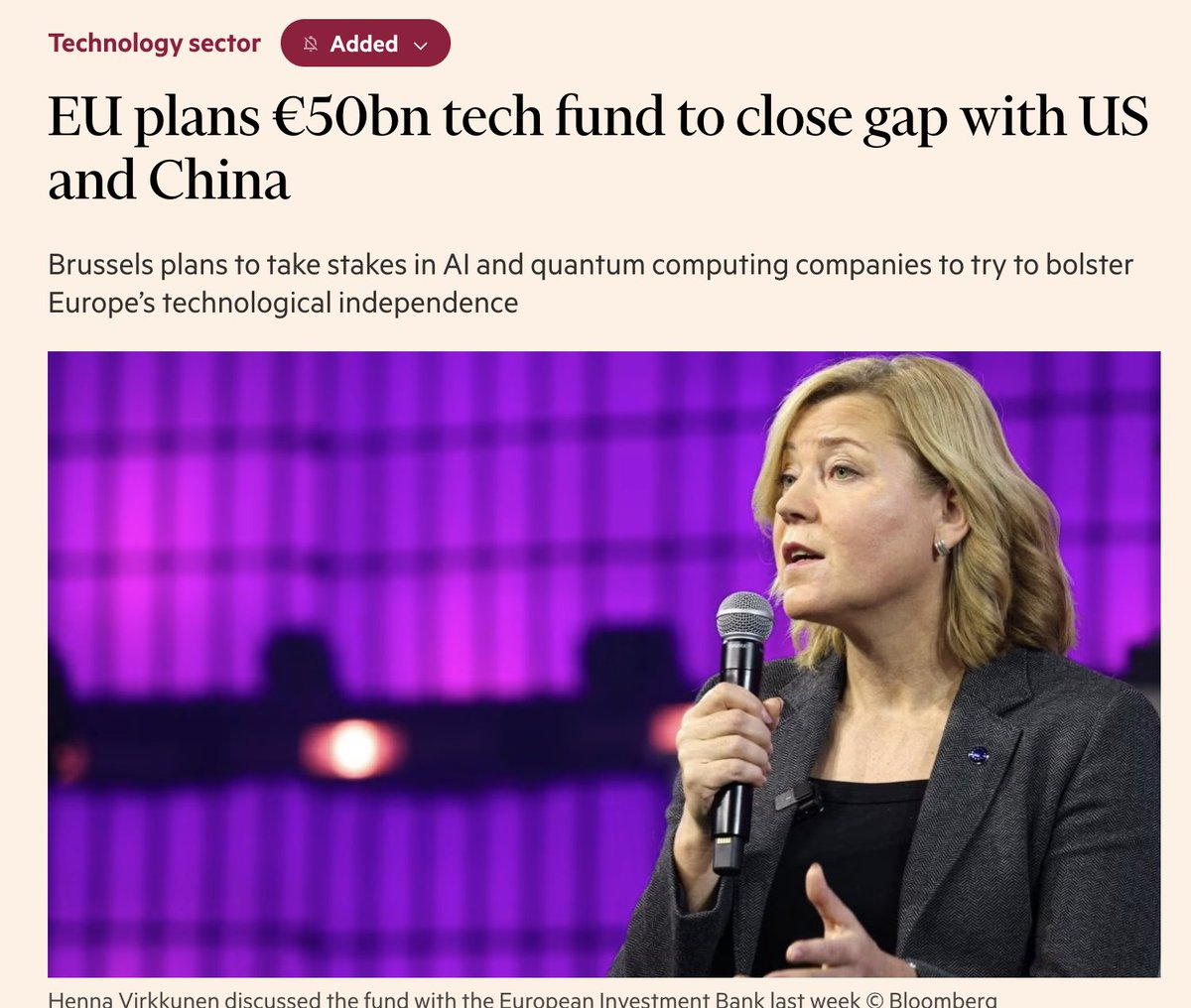
The EU is planning to launch a €50bn fund to invest in AI and Quantum companies.
Funded by a combination of public and private money.
Ultimate aim is to bolster "tech sovereignty"
The usual doomers will say its not enough money, but 5 years ago this would have been UNIMAGINABLE.
And remember, the first fund will always be the smallest.
The fund would be managed "by an independent fund manager" - VERY interesting. It's hard to imagine who could do this.
EQT manage the 5bn scaleup fund but this is 10x larger.
Overall this is amazing news and it's great to see the EU try and mobilise the huge capital base we have here.
https://t.co/r4pQlD6gLp
The European Parliament voted by large majorities to send seven proposals for the EU’s next long-term budget straight into negotiations with the Council, heading off a possible challenge from the far right. https://t.co/X1mgKiZf3C
8 lande bliver til 7 efter valget i 🇪🇸
👇 er et meget klart eksempel på hvorfor valget i 🇪🇸 er vigtigt for 🇩🇰
Læs mere her https://t.co/pl7UsJZ9hq
@alfredarnborg@MarieAlbers@thinkeuropa#eudk
Eight EU countries plead to save the ETS2 as political pressure mounts to dismantle it.
"It's clear that we have to reduce our dependence on imported fossil fuels to get out of our exposure to geopolitical tensions and price shocks".
Signed by 🇩🇰🇫🇮🇩🇪🇱🇺🇳🇱🇵🇹🇪🇸🇸🇪
It’s crunch time for the EU budget negotiations.
Over the weekend, European Council President Costa tabled a compromise proposal. Later this week, the serious haggling among EU leaders over the next seven-year budget begins.
Two thoughts on where things are heading:
Nyt interessant #MFF udspil i weekenden - der lægges op til:
- barbere det samlede budget
- der skæres mest på innovation og konkurrenceevne, mindst på landbrug
- der lægges op til at indføre nye egen ressources og
- udskyde tilbage betaling af gæld
@thinkeuropa#eudk
@LejeSvend@thinkeuropa mit gæt et: fordi det er svært i en forhandling både at have det som første prioritet at nedbringe den samlede budgetramme, og stå stejlt på, hvor der skal skæres.
Vil man - som 🇩🇰 - have et begrænset EU budget, så er der meget der peger på, at man kommer til at acceptere, at det er midler til fx #innovation og #konkurrenceevne der ryger
@thinkeuropa#eudk
EuCo President Costa has presented a compromise for the new MFF that cuts 204 bn euros from the Commission proposal - and none of these affect agriculture and structural funds (dark blue in the picture). Instead, money for innovation and global engagement gets chopped strongly.
European Council President António Costa aims to shave another €44 billion off the EU’s planned seven-year budget, according to a fresh set of numbers unveiled yesterday.
https://t.co/oUfSHcnbny
A sea of illuminating charts on pension spending from @jburnmurdoch
“If the France’s pension age had followed the same path as that of Denmark, France’s debt-to-GDP ratio today would be closer to 70 per cent than 120 per cent”
https://t.co/UUICUIZrSM
Fremtidens Europa - Tyskland og Nordeuropas fremtid:
Hvilken retning bevæger 🇩🇪 sig i - og hvad betyder det for resten af Europa? Det diskuterer @PNedergaardKU, Poul Fritz Kjær og @madsjedzini sammen med @DitteBrasso i morgen: https://t.co/BXTDSmWlGP
Today @EU_Commission proposed up to €45b in additional financial support to Ukraine in 2027.
Called Instrument for Coordinated Support to Ukraine, it would cover:
🔵 up to €25b for military assistance,
🔵 up to €20b as general budget support.
🔗 https://t.co/CaTf3vP7w1
By 2030, €152 billion of Germany’s annual new borrowing (70% of total) will finance military spending under the defence exemption from the debt brake. Defence-related borrowing increases interest expenditure, reducing the space available for other spending in the core budget.
🇪🇺 Christine Lagarde: Not all debt is the same. European joint debt for common projects is cheaper, more productive and sustainable. Much more than national debts.
To summarize: Investment will be done more and more through a European joint debt capacity. Europe simply cannot afford to be fragmented. And that's how federations are created (see the Hamilton moment in the US and Zolverein in Germany)
German politics is in flux: more volatile, more fragmented, and AfD now polling far ahead of any other party.
@jana_puglierin, @PiotrBuras1, @mehrer_angela & I have written a new @ECFR paper exploring what this means for 🇩🇪 's EU and foreign policy ⬇️
https://t.co/AxFGGWfzWk
The biggest political development at Wednesday's Independence March in Warsaw was Jarosław Kaczyński's call for a common electoral list with all three right-wing Confederation factions, including Grzegorz Braun's far-right Confederation of the Polish Crown.
This is a pretty seismic as Kaczyński has effectively confirmed what many observers of Polish politics have long suspected: that he is prepared to accept Braun as a political partner, potentially not only on a joint electoral list but also in a future governing coalition.
That's quite a reversal as in June, Kaczyński described Braun as "very dangerous" and insisted that he would rather remain out of power than govern with him.
According to Onet, Braun's associates are already talking about securing the deputy prime minister's post in a future government. Such an arrangement could also involve negotiations over powerful ministerial portfolios or the speakership of parliament.
For those unfamiliar with Polish politics, Braun is the politician who extinguished Hanukkah candles inside parliament with a fire extinguisher and later denied the existence of gas chambers at Auschwitz.
His political programme calls for Polexit, closer relations with Russia and the reopening of the Nord Stream gas pipelines. He has also described the American military presence in Poland in terms of an "occupation".
For more than three decades, Poland's main political parties have disagreed about almost everything except the country's fundamental place in the West. That consensus would face a challenge with Braun as a coaliton partner.
Of course, there's no agreement yet. And Braun, along with the other Confederation factions, may prefer to fight the election independently and negotiate the terms of any coalition afterwards. Current polling projections already give the combined right enough seats for a parliamentary majority.
But even if they don't run tgether on a single list, they could still form a coalition together.