@PeterObi Are you sure the Man is truly dead, cos it's hard to believe everything you say Mr Peter Obi. You might even come back to say it's a birthday party you attended 😌
Mr BankHead is the owner of one of the Beach Front Businesses called Truth Beach...listen to him.
Video 1: His Beach Front Company was demolished 4 days after they were given notice against more than 1 month theu gave Landmark Beach.
Video 2: 2 staff stole over N10m from him.
Video 3: "I use the Coastal Road today and I smile, because it's a beautiful project. As much as it hurt us when they were doing it, I see the future, I know what the plan is..."
Lagos is the best state in Nig
it is owned by the Yoruba people
it is surrounded by Yoruba states
it’s indigenous language is Yoruba
Lagos culture is Yoruba culture
Lagos ancestral roots can be traced to ile ife
If you’re not okay with this. Oya go and pai inside omi Osa
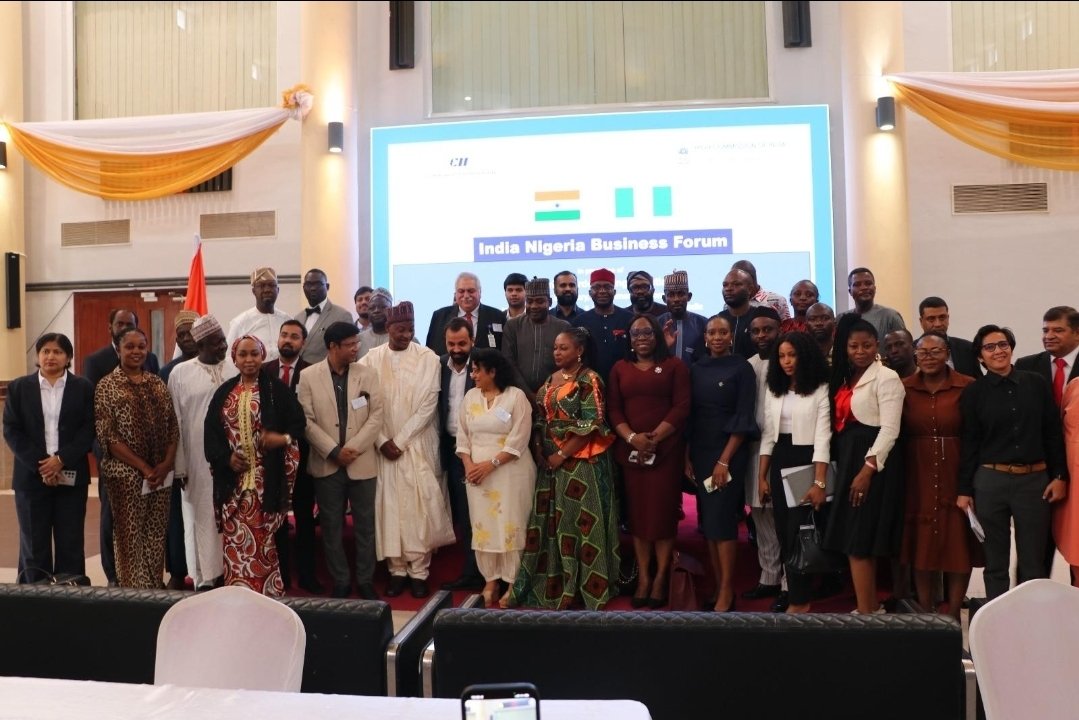
Nigeria–India trade has rebounded to about $9bn, up roughly 26% in a year.
If more Indian firms produce from Nigeria for Africa, that could mean new factories, more jobs and more exports from here.
Ladies and gentlemen, there’s hope.
The @WorldBankGroup said four things about Nigeria yesterday that should catch your interest as a Nigerian:
The Tinubu reforms are working, and Nigeria's GDP will continue to grow at over 4.4% through 2028.
Poverty is declining and will continue to decline as long as the reforms are sustained.
Inflation, which has already declined significantly, will continue to fall.
Any reversal of the reforms (such as returning to fuel subsidies) will destroy Nigeria's economy.
As a Nigerian, think long and hard about the above postulations. We are already benefiting from the reforms, and we are almost at the Promised Land. Keep faith with President Bola Ahmed Tinubu.
Bemigho Reno Omokri
A LETTER TO THIS GENERATION OF AREWA.
Will the North Miss History Again?
An open letter to the conscience of Northern Nigeria, its leaders, its elders, its intellectuals, its traditional institutions, and above all, its young people.
My dear people of Arewa,
There are moments in the life of a nation when silence becomes a burden on the conscience. There are moments when one must speak, not because speaking is convenient, but because keeping quiet begins to feel like an act of betrayal against the very people whose future one claims to care about.
For me, this is one of those moments.
I write this letter with a heavy heart. Not with the satisfaction of a man who believes he has all the answers, and certainly not with the arrogance of someone who imagines that the challenges of Northern Nigeria can be reduced to a few paragraphs. I write because the condition of the North has become too consequential for Nigeria, too painful for its people, and too dangerous for any patriotic Nigerian to ignore.
I write because I remember a North that carried itself with a certain confidence, a North whose social structure appeared more stable, whose communities possessed a stronger sense of collective direction, and whose future seemed to hold greater promise. I remember the idea of a North in which a child could reasonably aspire to a better life, where communal identity meant something beyond political mobilisation, and where leadership promised that the people would advance together.
Today, when I look at the scale of the challenges confronting Northern Nigeria, I cannot help but ask myself: What happened to us? How did we arrive at this point? And why have we not summoned the collective courage to confront those responsible for the decisions and failures that brought us here?
I cannot look at the child who should be in school but is not, and feel indifferent.
I cannot think of a farmer who should be cultivating his land but is afraid to return to his farm. This mother struggles to feed her children, the young man who has become vulnerable to recruitment into violence because opportunity has abandoned him, or the family forced to flee its home, and pretend that these are merely statistics.
Behind every statistic is a human being. Behind every percentage point is a life. Behind every development ranking is a child whose opportunities may have been narrowed before that child even understood what opportunity meant.
And behind the enormous human-development challenges of Northern Nigeria are questions of leadership, public policy, institutional responsibility, and the choices that generations have made or failed to make.
We must speak about these things.
We must speak because we cannot love Arewa and remain permanently silent about the things that are hurting her.
1. The pain of watching great people struggle
One of the cruellest things that can happen to a people is not merely to experience hardship. It is to begin to accept hardship as their natural condition.
It is when poverty becomes familiar, when insecurity becomes an ordinary feature of life, when children growing up without adequate education no longer provoke sufficient outrage, and when the absence of opportunity becomes something people are expected to endure rather than something their leaders must urgently correct.
That is the danger I see.
Northern Nigeria is not a land without people of intelligence, courage, enterprise, or ambition. It is not a region without history, culture, resources, or the capacity to produce extraordinary achievements. It is a region of immense possibilities, populated by people who deserve the same dignity, security, opportunity, and quality of life as any other citizen of this country.
Yet too many of its people remain caught in circumstances that deny them the chance to realise their potential.
How can we become comfortable with this?
Now Nigeria finds itself at another consequential moment under President Bola Ahmed Tinubu.
His administration has undertaken major economic reforms intended to address structural weaknesses in the economy. Those reforms have also brought significant immediate hardships, particularly for vulnerable households. Their long-term value must be established through implementation, measurable outcomes, and the extent to which the benefits of growth reach ordinary citizens.
This is precisely why the moment demands seriousness rather than reflexive political hostility or unquestioning loyalty.
The North must ask itself whether it can afford to stand outside every difficult national conversation, allowing political antagonisms to determine its relationship with policies that may have significant consequences for its future.
Must every initiative be rejected because of who introduced it? Must every opportunity be turned into a battle over political ownership? Must the ordinary Northern Nigerian once again become the casualty of a struggle among political elites?
How many more generations must pay for the inability of our political class to put the long-term welfare of the people above the immediate calculations of power?
That is the pattern we must break.
4. Arewa, do not allow your people to become instruments of elite survival
Let us speak plainly, but fairly.
Across our political system, regional identity can sometimes be used to protect leaders from the scrutiny they would otherwise face. Questions about performance are redirected into arguments about loyalty. Concerns about public services become accusations of political hostility. Calls for accountability are presented as attacks on a community.
This is a dangerous way to organise public life.
A leader who genuinely loves the North should welcome questions about schools, hospitals, roads, jobs, public expenditure, security, and the future of young people. Such questions are not an assault on Arewa. They are the beginning of taking Arewa seriously.
The people are not the property of their leaders.
The votes of the poor are not a hereditary entitlement. The trust of the vulnerable is not a licence to postpone their welfare indefinitely.
A mother who sends her child into an uncertain future deserves more than another speech about regional pride. A young person who has waited years for an opportunity deserves more than another appeal to political loyalty. A farmer whose livelihood has been disrupted by insecurity deserves more than assurances that everything is under control.
These citizens have lives to live. They have families to feed. They have dreams that are just as legitimate as the ambitions of those who occupy public office.
And they have every right to ask what their leaders have done with the opportunities entrusted to them.
Let nobody convince the ordinary people of Arewa that questioning a leader is equivalent to betraying the North.
Sometimes, the people who insist most loudly that they alone represent a region are the very people who should be asked to account most carefully for the condition of its inhabitants.
The issue is not whether every Northern leader has failed. That would be an unfair and inaccurate conclusion. There are public servants, community leaders, entrepreneurs, educators, and reformers working to improve lives across the region.
The issue is whether the overall record of leadership has matched the scale of the challenges, and whether the present generation is prepared to demand a substantially better standard.
That is the conversation we must have.
5. What does it mean to be a leader when the people are suffering?
Leadership is not the ability to command a crowd. It is your responsibility to improve the circumstances of the people who gather before you.
Leadership is not measured only by the offices one has occupied, the number of political followers one commands, or the frequency with which one’s name is mentioned in public.
Prophet Muhammad S A W said!
Whenever any of you picked up a clothe to put on shake it three times for you don't know if there's anything hiding in it that might harm you ( shake it )….
Hadith of the Day!!!!