We're launching a new weekly newsletter for serious income investors — built to capitalize on major market events as they happen.
Each week, we would deliver one high-conviction dividend stock idea tied to a timely macroeconomic event (rate changes, political shifts, energy disruptions, earnings surprises, etc.)
No clutter. No lists.
Just one event-driven income opportunity worth your attention.
It’s a newsletter designed to help serious income investors stay ahead of the headlines and position their portfolios accordingly.
- One high-conviction dividend stock pick with supporting proprietary quant ratings
- A brief written analysis
- One clear reason why this week
If interested, subscribe below.
https://t.co/NsTzvU54oG
$GOOD pays monthly dividends at a 9.69% forward yield with a 63% FFO payout ratio — which means the distribution is actually covered. 98.7% occupancy, 100% rent collection in Q1, and revenue up from $37.5M to $41.9M year over year. Not flashy. Just consistent.
$CI raised full-year earnings guidance after 16% EPS growth last quarter. They're also mid-transition to a more transparent drug pricing model — the kind of structural shift that usually dents numbers. Hasn't yet. Worth watching.
Some dividend-paying companies that investors can look into:
• NextEra Energy (NEE)
• Dominion Energy (D)
• Southern Company (SO)
• Enterprise Products Partners (EPD)
• Realty Income (O)
• WEC Energy (WEC)
Everyone is focused on AI stocks.
But the more interesting question is: who pays for all of this?
New data centers. New power plants. Grid upgrades. Trillions in infrastructure spending.
The AI boom is starting to spill into utilities, industrials, energy, and real estate. That's where some of the biggest opportunities may be hiding.
The most popular stocks on our site this past week are:
O – Realty Income
TSLA – Tesla
NVDA – NVIDIA
AGNC – AGNC Investment Corp.
PFE – Pfizer
KO – Coca-Cola
MO – Altria
ARR – ARMOUR Residential REIT
CVX – Chevron
PEP – PepsiCo
The Iran conflict is a market-moving event.
Oil prices. Defense stocks. Gold. Inflation expectations.
Here's how to position your portfolio right now
https://t.co/R0pTp3ervf
Regional banks are still getting painted with the same broad brush from the 2023 panic, but not all balance sheets are equal. F.N.B. Corporation ($FNB) just raised its dividend 8%, authorized a $250M buyback, grew EPS nearly 19% YoY, and still only pays out 29% of earnings.
A lot of investors are still ignoring high-quality regional banks with real cash flow and disciplined management.
Most viewed ETFs on https://t.co/frsueJ0EHr this past week
ITA — Aerospace & Defense
XLE — Energy
XAR — Aerospace & Defense
FRAK — Oil & Gas Fracking
RSHO — Short-Term High Yield Income
MINT — Enhanced Cash / Ultra Short Bonds
CHPY — High Yield Income
VCX — Venture / Private Markets Exposure
JEPQ — Nasdaq Equity Income
CWB — Convertible Bonds
Reliance $RS just posted record tons sold and landed government contracts worth up to $3 billion in potential revenue.
Meanwhile the company has only a 25% payout ratio 1.1x leverage and has raised its dividend for 16 straight years.
One of the more overlooked industrial dividend stories in the market right now.
This is perhaps why dividend stocks have quietly started outperforming a lot of speculative growth names again. When bond yields fall and stock/yield correlation turns deeply negative, investors start paying more for stable cash flow, predictable earnings, and income.
High-duration growth stocks still react heavily to rates, but quality dividend payers become a relative safe haven when bond markets start driving macro uncertainty.
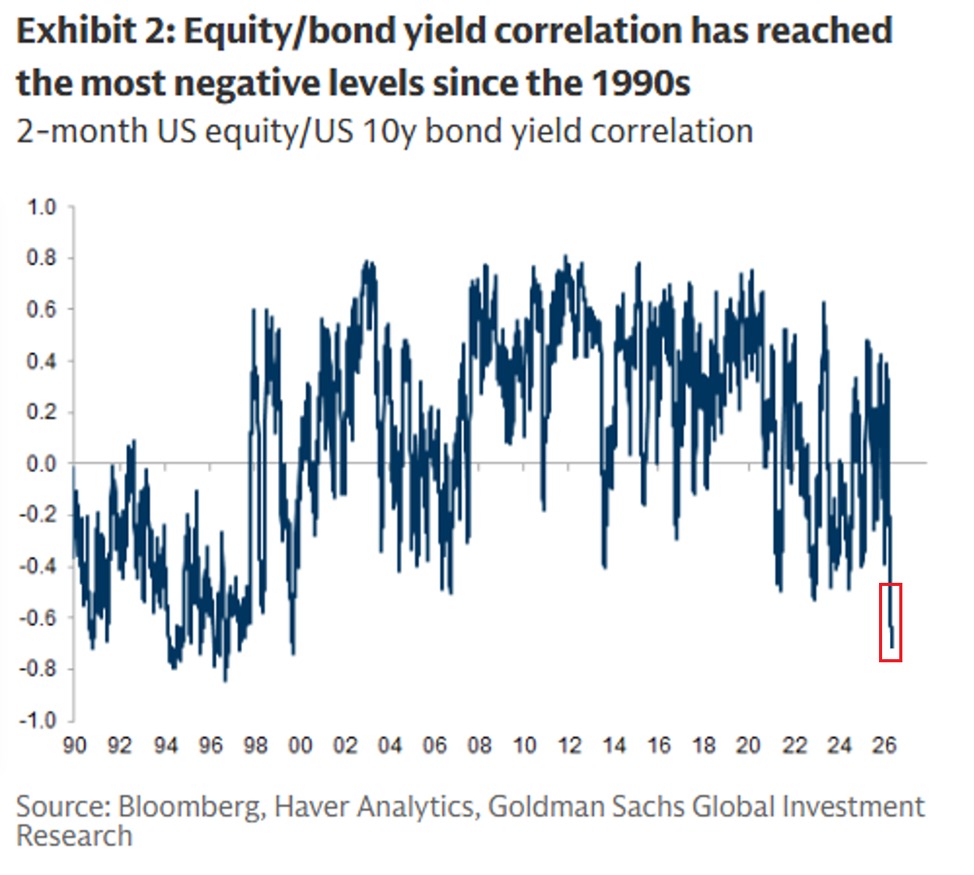
The stock-bond relationship is showing a rare pattern:
The 2-month correlation between US equities and the 10-year Treasury yield is down to -0.70, the lowest since 1999.
In other words, over the last 2 months, stocks and the 10-year Treasury yield have moved in opposite directions by the largest extent this century.
At the start of 2026, a positive correlation of 0.40 was observed, near the highest since 2023.
Additionally, the 30-day correlation is down to -0.68, also the lowest in 27 years.
Not even the 2022 bear market saw such a negative correlation, as the 10-year yield rose, driven by elevated inflation and Fed rate hikes, while stocks fell.
Bond markets are incredibly important right now.
This is exactly why dividend stocks have quietly started outperforming a lot of speculative growth names again. When bond yields fall and stock/yield correlation turns deeply negative, investors start paying more for stable cash flow, predictable earnings, and income.
High-duration growth stocks still react heavily to rates, but quality dividend payers become a relative safe haven when bond markets start driving macro uncertainty.
Last two days to save $30 on https://t.co/VBBbPSna0v Premium. Use code EARNINGS30 at checkout -- sale ends tomorrow!
🔗 Claim your discount here: https://t.co/by8rWVNtl6
Some Financial Themes That We're Seeing On X
Corporate layoffs are quietly picking up again
The Magnificent 7 is cracking — earnings dispersion is widening
Record Treasury issuance is flooding the bond market
Inflation isn't solved — it just moved to services
Earnings season is exposing real have and have-nots
AI infrastructure bottlenecks are back — chips, power, data centers
Consumer credit is tightening as delinquencies rise
Housing is frozen — rates stuck, inventory locked, buyers frustrated
Reliance $RS just posted record tons sold and landed government contracts worth up to $3 billion in potential revenue.
Meanwhile the company has only a 25% payout ratio 1.1x leverage and has raised its dividend for 16 straight years.
One of the more overlooked industrial dividend stories in the market right now.
Agree Realty $ADC just posted its biggest acquisition quarter since 2022 while keeping occupancy at 99.7%.
Monthly dividend growth continues, FFO growth is expected to nearly double the sector average, and the balance sheet remains conservative.
One of the cleaner long-term monthly income stories in REITs right now.
Bond yields at all time highs is one of the most important macro signals right now.
This isn’t just “rates up.” It’s a global repricing of government debt after years of ultra-low yields.
Higher yields = tighter financial conditions, pressure on equities, and a reset in how risk is priced across assets.
For investors, the key question isn’t just why it’s happening—it’s what breaks or reprices next.