I have tried doing something similar during the MSc. Software Engineering final project, that tooks me months in environment generation algorithm and via Unity, just this one is way more polished than I do. thanks to many more human behind it that make my day.
playing with coding in the antigravity, it's kinda delighting to see what Ai is capable of doing than what I have tried like more than a decade to complete a playable version.
Claude seems to be fixing a super annoying developer problem.
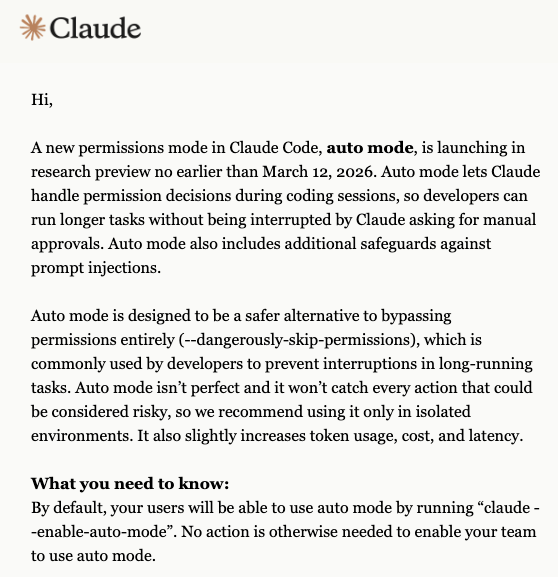
Anthropic announced a research preview feature called Auto Mode for Claude Code, expected to roll out by March 12, 2026.
The idea is simple: let Claude automatically handle permission prompts during coding so developers don’t have to constantly approve every action.
Sstops those annoying permission prompts during long coding sessions.
Before this, you had to use `--dangerously-skip-permissions` to work without interruptions.
That method worked fine but took away all your safety nets. This new auto mode gives us a smarter option.
Claude will take care of the specific permission choices on its own while still blocking threats like prompt injections.
You can finally let long tasks run without watching your screen the whole time.
Since it is still a research preview, you should run it inside isolated setups like sandboxes or containers for safety.
Expect a small jump in token usage and delay, because the model needs extra time to process the security checks.
Once available, you just type `claude --enable-auto-mode` to start.
If you manage a team and need people to manually approve actions, you can restrict this feature using Mobile Device Management tools like Jamf and Intune or through configuration files.
Part 2: The Two-Factory Model
Jensen's insight that changed how I see every business: "Every company in the future will have two factories."
Factory 1: Your actual product. Factory 2: The AI that powers it
Tesla gets this. They build cars and build AI brains for them...
Good news: We just open-sourced Geist, our official @vercel font → https://t.co/grG0V6QDbv
This is gonna be my new favorite font for all my future open-source projects 🤩
▲ ~/ npm i geist
Do you believe that Google, Meta, Uber, and Airbnb put almost all of their code in one repository?
This practice is called a monorepo.
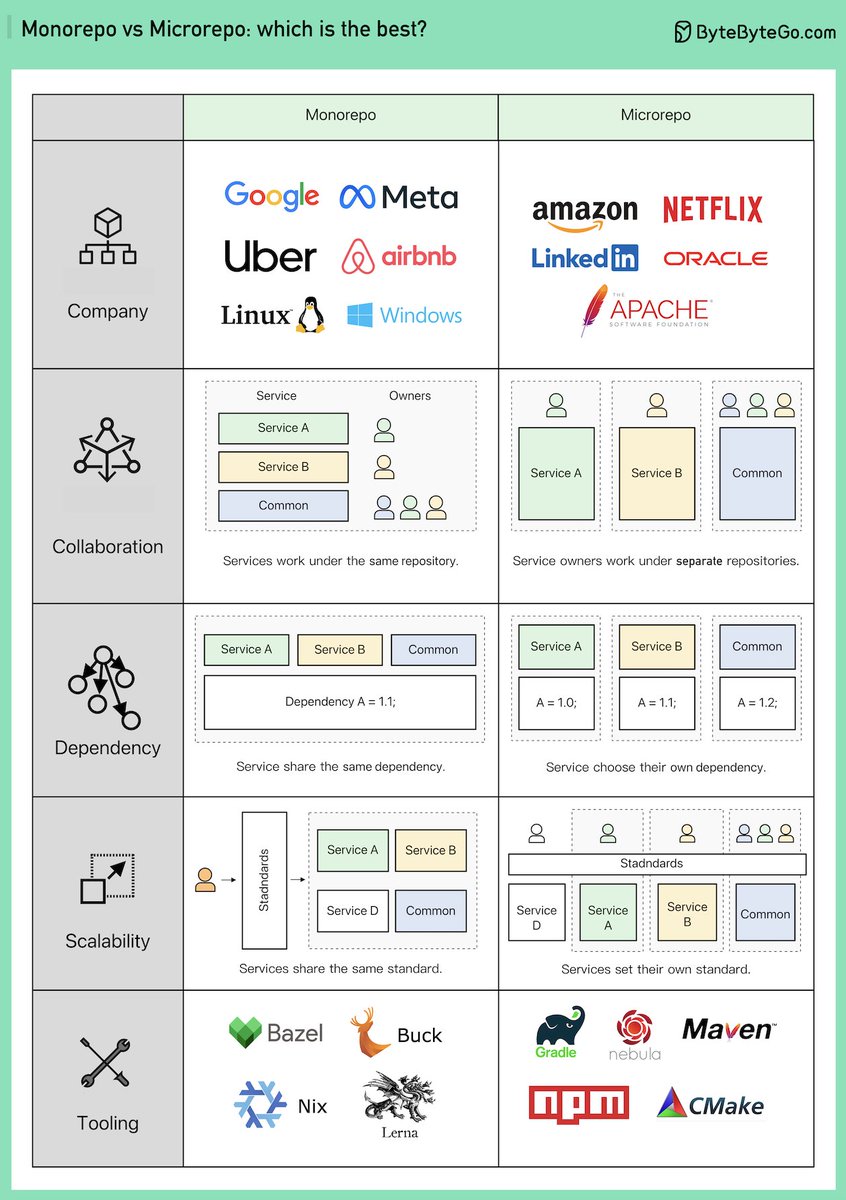
Monorepo vs. Microrepo. Which is the best? Why do different companies choose different options?
Monorepo isn't new; Linux and Windows were both created using Monorepo. To improve scalability and build speed, Google developed its internal dedicated toolchain to scale it faster and strict coding quality standards to keep it consistent.
Amazon and Netflix are major ambassadors of the Microservice philosophy. This approach naturally separates the service code into separate repositories. It scales faster but can lead to governance pain points later on.
Within Monorepo, each service is a folder, and every folder has a BUILD config and OWNERS permission control. Every service member is responsible for their own folder.
On the other hand, in Microrepo, each service is responsible for its repository, with the build config and permissions typically set for the entire repository.
In Monorepo, dependencies are shared across the entire codebase regardless of your business, so when there's a version upgrade, every codebase upgrades their version.
In Microrepo, dependencies are controlled within each repository. Businesses choose when to upgrade their versions based on their own schedules.
Monorepo has a standard for check-ins. Google's code review process is famously known for setting a high bar, ensuring a coherent quality standard for Monorepo, regardless of the business.
Microrepo can either set their own standard or adopt a shared standard by incorporating best practices. It can scale faster for business, but the code quality might be a bit different.
Google engineers built Bazel, and Meta built Buck. There are other open-source tools available, including Nix, Lerna, and others.
Over the years, Microrepo has had more supported tools, including Maven and Gradle for Java, NPM for NodeJS, and CMake for C/C++, among others.
Over to you: Which option do you think is better? Which code repository strategy does your company use?
–
Subscribe to our weekly newsletter to get a Free System Design PDF (158 pages): https://t.co/FIzCeaWsZV
7 must-know strategies to scale your database.
1 - Indexing:
Check the query patterns of your application and create the right indexes.
2 - Materialized Views:
Pre-compute complex query results and store them for faster access.
3 - Denormalization:
Reduce complex joins to improve query performance.
4 - Vertical Scaling
Boost your database server by adding more CPU, RAM, or storage.
5 - Caching
Store frequently accessed data in a faster storage layer to reduce database load.
6 - Replication
Create replicas of your primary database on different servers for scaling the reads.
7 - Sharding
Split your database tables into smaller pieces and spread them across servers. Used for scaling the writes as well as the reads.
Over to you: What other strategies do you use for scaling your databases?
–
Subscribe to our weekly newsletter to get a Free System Design PDF (158 pages): https://t.co/FIzCeaWsZV
Netflix's Tech Stack.
This post is based on research from many Netflix engineering blogs and open-source projects. If you come across any inaccuracies, please feel free to inform us.
Mobile and web: Netflix has adopted Swift and Kotlin to build native mobile apps. For its web application, it uses React.
Frontend/server communication: GraphQL.
Backend services: Netflix relies on ZUUL, Eureka, the Spring Boot framework, and other technologies.
Databases: Netflix utilizes EV cache, Cassandra, CockroachDB, and other databases.
Messaging/streaming: Netflix employs Apache Kafka and Fink for messaging and streaming purposes.
Video storage: Netflix uses S3 and Open Connect for video storage.
Data processing: Netflix utilizes Flink and Spark for data processing, which is then visualized using Tableau. Redshift is used for processing structured data warehouse information.
CI/CD: Netflix employs various tools such as JIRA, Confluence, PagerDuty, Jenkins, Gradle, Chaos Monkey, Spinnaker, Altas, and more for CI/CD processes.
after a while of linux desktop hunting, I realise, maybe RHEL, Fedora for workplace, or enterprise setup. For personal use, home environment, now I'm sticking with Ubuntu, the KDE Plasma desktop, the... Kubuntu.