🔥 JUST IN: @MultiversX activates Supernova on mainnet today, moving transaction execution outside the consensus critical path on a sharded network that has operated since 2020.
Supernova targets a 600 millisecond block interval, down from six seconds, while retaining deterministic transaction ordering and the existing minimum validator hardware requirements across more than 3,200 validator nodes.
The change creates a more responsive base for payments, markets, and programmable financial services.
https://t.co/Ig1spBCQoW
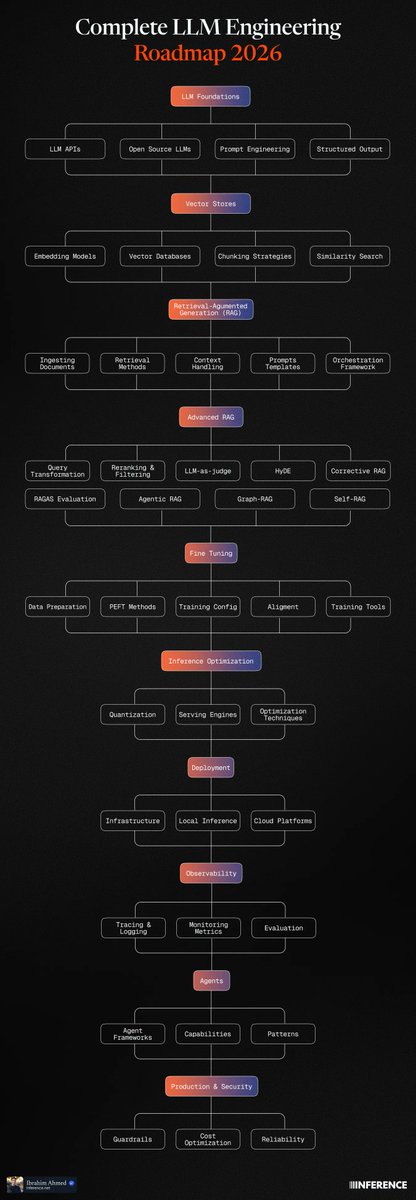
The LLM Engineering Roadmap.
If you want to start today, here's the roadmap👇
1️⃣ LLM Foundations
Start by understanding Python and LLM APIs and how they work.
Learn prompt engineering, structured outputs, and tool use.
↳ Python/Typescript Basics
↳ LLM APIs
↳ Prompt Engineering
↳ Structured Outputs
↳ Function Calling
2️⃣ Vector Stores
Before building anything, you need to understand how text becomes vectors.
Learn embedding models, chunking strategies, and similarity search.
↳ Embedding Models (OpenAI Ada, Cohere, BGE)
↳ Vector Databases (Pinecone, Qdrant, ChromaDB, FAISS)
↳ Chunking Strategies
↳ Similarity Search
3️⃣ Retrieval-Augmented Generation (RAG)
This is how LLMs answer questions using your data.
You learn how to retrieve context and feed it correctly.
↳ Orchestration Frameworks (LangChain, LlamaIndex)
↳ Ingesting Documents
↳ Retrieval Methods (Dense, BM25, Hybrid)
↳ Reranking
↳ Prompt Templates
4️⃣ Advanced RAG
This steps helps you understand how to make RAGs reliable and accurate.
↳ Query Transformation
↳ HyDE
↳ Corrective RAG
↳ Self-RAG
↳ Graph RAG
5️⃣ Fine-Tuning
Sometimes prompts are not enough for a specialised use case.
Fine-tuning will help you understand how models learn domain-specific behaviour.
↳ Data Preparation
↳ LoRA, QLoRA, DoRA
↳ SFT, DPO, RLHF
↳ Training Tools (Unsloth, Axolotl, HF TRL)
6️⃣ Inference Optimization
Once systems work, they need to be fast and affordable.
This step focuses on learning performance and cost efficiency.
↳ Quantization (GGUF, GPTQ, AWQ)
↳ Serving Engines (vLLM, TGI, llama.cpp)
↳ KV Cache
↳ Flash Attention
↳ Speculative Decoding
7️⃣ Deployment
Models are useless if they stay in notebooks.
Here you learn how to ship LLM systems to users.
↳ GPU Scheduling
↳ Cloud Platforms (AWS Bedrock, GCP Vertex AI)
↳ Docker, Kubernetes
↳ FastAPI, Streaming (SSE)
8️⃣ Observability
This step helps you track quality, latency, and cost.
↳ Tracing (LangSmith, Langfuse, Arize Phoenix)
↳ Latency (TTFT)
↳ Token Usage
↳ Cost Tracking
9️⃣ Agents
Agents allows LLMs to plan and use tools.
Learn them to understand how LLMs solve multi-step and complex tasks.
↳ Frameworks (LangGraph, CrewAI, Autogen)
↳ Function Calling
↳ Memory Systems
↳ Patterns (ReAct, Plan-and-Execute, Multi-Agent)
🔟 Production & Security
Production LLM systems can fail in subtle ways.
This step helps you prevent misuse, outages, and cost spikes.
↳ Prompt Injection Defense
↳ Guardrails (NeMo, Guardrails AI)
↳ Semantic Caching
↳ Fallbacks & Rate Limiting
♻️ Repost if you found this insightful
Follow us for more AI engineering content!
$TEL is now listed on Kraken.
“This listing gives Kraken’s traders access to the Internet of Money, and gives our community access to one of the most trusted platforms in the industry,” says Telcoin Association Founder Parker Spann.
https://t.co/cBDyFFP52e