I am super excited to share the first paper out of my PhD! Here, we chose D. melanogaster pigmentation as a model phenotype to study the nature and repeatability of complex trait evolution in the field . . .🧵
https://t.co/FF14PMhHrs
This new study from researchers at @PennBiology suggests that environment-dependent phenotypic plasticity, where organisms adapt to fluctuating environments, is mediated by epigenetic factors: https://t.co/Ua8iPRd9s7
Did you know that kinetochore proteins evolve rapidly, suggesting functional innovation?🤩
Check out our new computational tool FREEDA that detects protein innovation fully automatically - run it yourself and see if your favorite protein innovates too!
https://t.co/oH95xWr9S7
Did you know that kinetochore proteins evolve rapidly, suggesting functional innovation?🤩
Check out our new computational tool FREEDA that detects protein innovation fully automatically - run it yourself and see if your favorite protein innovates too!
https://t.co/oH95xWr9S7
#cellbio2022 come check out Lampson lab talks and posters! Minisymp cell division: @asdScott0331 , Sunday; Subgroup evo cell biology: @damian_dudka, Monday; Microsymp nuclear power: @das_arunika Tuesday. Check out posters from our lab and alum @TakashiAkera and @lab_zhang labs.
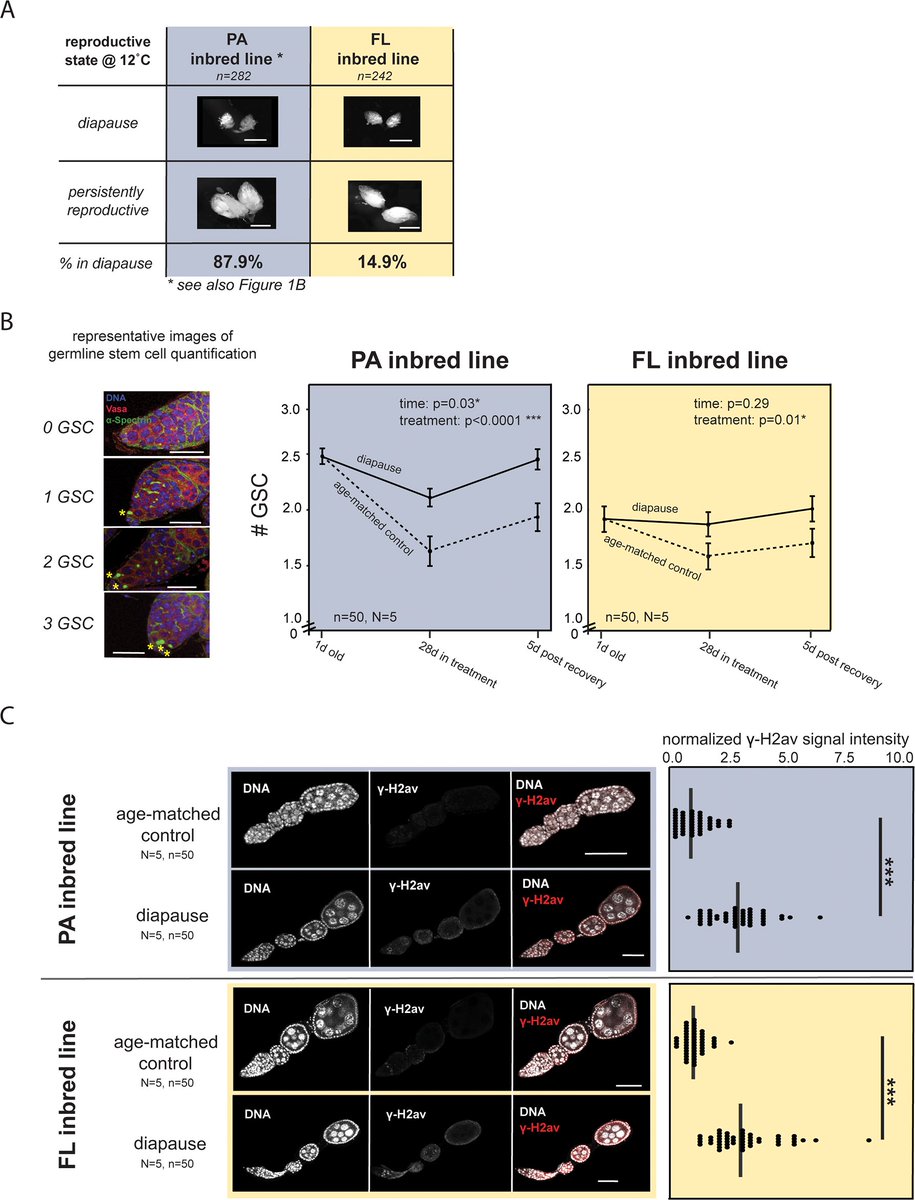
Excited to finally share my dissertation work on the chromatin determinants of reproductive arrest in Drosophila melanogaster. Eternal thanks to the wonderful @rfairbanks, @paulrschmidt, and my dedicated advisor @levine_lab
https://t.co/6MiwFmIEPD
@r_fairb @levine_lab So sorry for tagging you incorrectly, Regina!
We were so lucky to have you on this project with us and can’t wait to see what you do next!!
However, we found that in a tropical inbred line with low diapause plasticity, the same marks are not depleted. Further, this line has a distinct gene expression program associated with diapause, suggesting distinct regulation.