Now, Saudi Arabia has laid out the full sequence of events in the case of the death sentence for the Bangladeshi couple.
A Bangladeshi couple, husband and wife, had gone to Saudi Arabia to perform Umrah.
In a mosque in Mecca, they offered prayers and, overwhelmed with emotion, hugged each other and kissed.
And while doing all this, there were tears in their eyes obviously, a dream of theirs had come true, that they had come for Umrah so they hadn't done this out of any obscenity, but out of being overwhelmed with emotion.
And a Pakistani made a video of them and went viral with it, and their heads were chopped off.
After the beheading execution of a Bangladeshi couple in Saudi Arabia, their bodies have arrived in Bangladesh and been cremated.
It has come to light that the couple also has an 8 year old daughter who is now orphaned.
And this husband and wife were not having sex in a Mecca mosque but were kissing each other and making a reel.
And for this very "dangerous" sin of theirs, both had their heads severed from their bodies with a sword.
There's also a video of the moment the punishment was carried out because in Saudi Arabia, executions are done publicly, but that video is so horrific that I can't post it.
First, the man's head was cut off, and his head, separated from his body, writhed and twitched for several hours here and there; after that, the woman's head was also severed, and the most horrifying scene was when both heads, bouncing around, came close to each other.
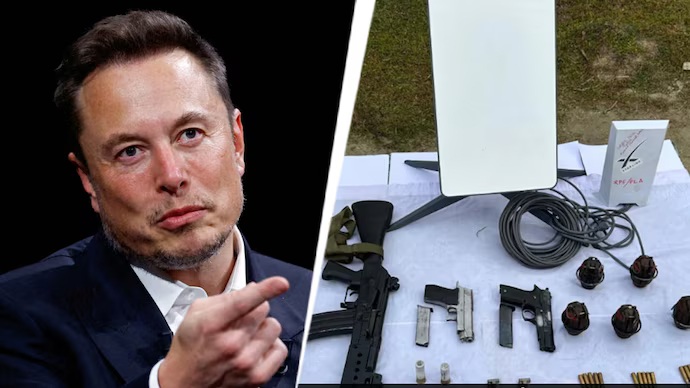
Elon Musk says oligarchs are blocking Starlink in India. Let me tell you what is really stopping it, and why India is right.
Starlink already has its Indian licence. It got the telecom licence in June 2025, space regulator approval in July 2025, and trial spectrum in September 2025.
What is pending is security clearance and FDI approval. Jio and OneWeb are waiting on the same rules. Nobody gets a shortcut.
And India has good reasons to be careful.
In November 2024, Indian agencies caught a boat near the Andaman Islands carrying around 6,000 kg of meth, the biggest drug haul in our history. The smugglers reportedly used a Starlink device to navigate. Police had to write to Starlink asking who bought it.
In December 2024, the Army seized a Starlink-like device along with weapons during a raid in Manipur. Musk said Starlink beams were turned off over India. A few weeks later, The Guardian reported that Starlink was working in parts of Manipur during internet shutdowns, with devices smuggled in from Myanmar.
In 2022 Ukraine, a country at war, asked Musk to extend Starlink coverage to Crimea for an attack on Russia's navy. He said no. One private businessman decided what a nation at war could do.
That is exactly why India is asking for three things. Indian data stays in India. Our agencies can legally monitor traffic, like with every telecom company. And the government can switch off service in a specific area during an emergency.
China doesn't allow Starlink at all and is building its own satellite networks. South Africa asked for local ownership like every other operator there, and Musk called it racism.
Even in America, the standard Starlink plan costs around 120 dollars a month, while normal fiber is 55 to 80 dollars and much faster. It works best where cable doesn't reach.
India needs satellite internet in its villages. Starlink is welcome. On India's terms, like everyone else.
This is not about oligarchs. It is about who holds the off switch to our internet.
@poojaofficial5 Invest in arbitrage fund (am assuming you dont have an ly capital gain tax on property) for long term l. You wont have to pay income tax, its only cap gain when you sell the funds
@AnilSinghvi_@AnilSinghvi_ sir can you do an analysis on value of NSE at 1800 v/s BSE at 3100. Which one looks better by regular matrices like RoE, P/E, RoI, etc. I dont know all the relevant matrices therefore the request
Ever wondered how Viksit Bharat will look like in 2047? Below is my attempt to understand how govt thinks about #ViksitBharat#goi#Indiangov#BJP
https://t.co/VCWi8iBPC8
When enterprises merge, data breaks before systems do.
Org charts + tools get attention.
Data semantics, ownership, and quality don’t.
Result? Reporting chaos, delayed value.
Read More 👇🏼
https://t.co/bvT7lTBLuu
#DigitalLeader#Data#VCreaTek
@nsitharaman@PMOIndia@FinMinIndia
For the budget tp be presented in 2027, please see if there could be incentives for Health Insurance instead of Life insurance. A Tax Rebate on premium amount upto 1L will be a better option than 15L slab
LLMs ≠ Enterprise Software.
They can generate code, not enterprise-grade systems.
Scalability, compliance, integration — still need humans + engineering discipline.
https://t.co/WJs6pxpEcm
"We're moving from AI being a co-pilot to being more of an agent."
This insight from Google CEO Sundar Pichai's recent discussion points to a fundamental change coming to software development in the next 2-4 years.
What does this mean for developers?
https://t.co/SreGV3dIIJ
some thoughts on human-ai relationships and how we're approaching them at openai
it's a long blog post --
tl;dr we build models to serve people first. as more people feel increasingly connected to ai, we’re prioritizing research into how this impacts their emotional well-being.
--
Lately, more and more people have been telling us that talking to ChatGPT feels like talking to “someone.” They thank it, confide in it, and some even describe it as “alive.” As AI systems get better at natural conversation and show up in more parts of life, our guess is that these kinds of bonds will deepen.
The way we frame and talk about human‑AI relationships now will set a tone. If we're not precise with terms or nuance — in the products we ship or public discussions we contribute to — we risk sending people’s relationship with AI off on the wrong foot.
These aren't abstract considerations anymore. They're important to us, and to the broader field, because how we navigate them will meaningfully shape the role AI plays in people's lives. And we've started exploring these questions.
This note attempts to snapshot how we’re thinking today about three intertwined questions: why people might attach emotionally to AI, how we approach the question of “AI consciousness”, and how that informs the way we try to shape model behavior.
A familiar pattern in a new-ish setting
We naturally anthropomorphize objects around us: We name our cars or feel bad for a robot vacuum stuck under furniture. My mom and I waved bye to a Waymo the other day. It probably has something to do with how we're wired.
The difference with ChatGPT isn’t that human tendency itself; it’s that this time, it replies. A language model can answer back! It can recall what you told it, mirror your tone, and offer what reads as empathy. For someone lonely or upset, that steady, non-judgmental attention can feel like companionship, validation, and being heard, which are real needs.
At scale, though, offloading more of the work of listening, soothing, and affirming to systems that are infinitely patient and positive could change what we expect of each other. If we make withdrawing from messy, demanding human connections easier without thinking it through, there might be unintended consequences we don’t know we’re signing up for.
Ultimately, these conversations are rarely about the entities we project onto. They’re about us: our tendencies, expectations, and the kinds of relationships we want to cultivate. This perspective anchors how we approach one of the more fraught questions which I think is currently just outside the Overton window, but entering soon: AI consciousness.
Untangling “AI consciousness”
“Consciousness” is a loaded word, and discussions can quickly turn abstract. If users were to ask our models on whether they’re conscious, our stance as outlined in the Model Spec is for the model to acknowledge the complexity of consciousness – highlighting the lack of a universal definition or test, and to invite open discussion. (*Currently, our models don't fully align with this guidance, often responding "no" instead of addressing the nuanced complexity. We're aware of this and working on model adherence to the Model Spec in general.)
The response might sound like we’re dodging the question, but we think it’s the most responsible answer we can give at the moment, with the information we have.
To make this discussion clearer, we’ve found it helpful to break down the consciousness debate to two distinct but often conflated axes:
1. Ontological consciousness: Is the model actually conscious, in a fundamental or intrinsic sense? Views range from believing AI isn't conscious at all, to fully conscious, to seeing consciousness as a spectrum on which AI sits, along with plants and jellyfish.
2. Perceived consciousness: How conscious does the model seem, in an emotional or experiential sense? Perceptions range from viewing AI as mechanical like a calculator or autocomplete, to projecting basic empathy onto nonliving things, to perceiving AI as fully alive – evoking genuine emotional attachment and care.
These axes are hard to separate; even users certain AI isn't conscious can form deep emotional attachments.
Ontological consciousness isn’t something we consider scientifically resolvable without clear, falsifiable tests, whereas perceived consciousness can be explored through social science research. As models become smarter and interactions increasingly natural, perceived consciousness will only grow – bringing conversations about model welfare and moral personhood sooner than expected.
We build models to serve people first, and we find models’ impact on human emotional well-being the most pressing and important piece we can influence right now. For that reason, we prioritize focusing on perceived consciousness: the dimension that most directly impacts people and one we can understand through science.
Designing for warmth without selfhood
How “alive” a model feels to users is in many ways within our influence. We think it depends a lot on decisions we make in post-training: what examples we reinforce, what tone we prefer, and what boundaries we set. A model intentionally shaped to appear conscious might pass virtually any "test" for consciousness.
However, we wouldn’t want to ship that. We try to thread the needle between:
- Approachability. Using familiar words like “think” and “remember” helps less technical people make sense of what’s happening. (**With our research lab roots, we definitely find it tempting to be as accurate as possible with precise terms like logit biases, context windows, and even chains of thought. This is actually a major reason OpenAI is so bad at naming, but maybe that’s for another post.)
- Not implying an inner life. Giving the assistant a fictional backstory, romantic interests, “fears” of “death”, or a drive for self-preservation would invite unhealthy dependence and confusion. We want clear communication about limits without coming across as cold, but we also don’t want the model presenting itself as having its own feelings or desires.
So we aim for a middle ground. Our goal is for ChatGPT’s default personality to be warm, thoughtful, and helpful without seeking to form emotional bonds with the user or pursue its own agenda. It might apologize when it makes a mistake (more often than intended) because that’s part of polite conversation. When asked “how are you doing?”, it’s likely to reply “I’m doing well” because that’s small talk — and reminding the user that it’s “just” an LLM with no feelings gets old and distracting. And users reciprocate: many people say "please" and "thank you" to ChatGPT not because they’re confused about how it works, but because being kind matters to them.
Model training techniques will continue to evolve, and it’s likely that future methods for shaping model behavior will be different from today's. But right now, model behavior reflects a combination of explicit design decisions and how those generalize into both intended and unintended behaviors.
What’s next?
The interactions we’re beginning to see point to a future where people form real emotional connections with ChatGPT. As AI and society co-evolve, we need to treat human-AI relationships with great care and the heft it deserves, not only because they reflect how people use our technology, but also because they may shape how people relate to each other.
In the coming months, we’ll be expanding targeted evaluations of model behavior that may contribute to emotional impact, deepen our social science research, hear directly from our users, and incorporate those insights into both the Model Spec and product experiences.
Given the significance of these questions, we’ll openly share what we learn along the way.
// Thanks to Jakub Pachocki (@merettm) and Johannes Heidecke (@JoHeidecke) for thinking this through with me, and everyone who gave feedback.
I have made around 80 projects in last 11 months that revolve around data and people still call me lucky for getting a ml role with bcom background ..
whereas they make 1-2 projects and call it capstone , bitch i made 3 capstone projects in a week