Very right empirically on US and UK imbalances. And yes, the last point Wolf makes is wild: the US capital surplus is as much a contributor to global imbalances as the Chinese trade deficit and it too is maintained by a highly imbalanced domestic political-economic equilibrium characterised by high rates of extraction which guarantees the high returns which have been the principal driver of in-bound financial flows and demand for dollar assets.
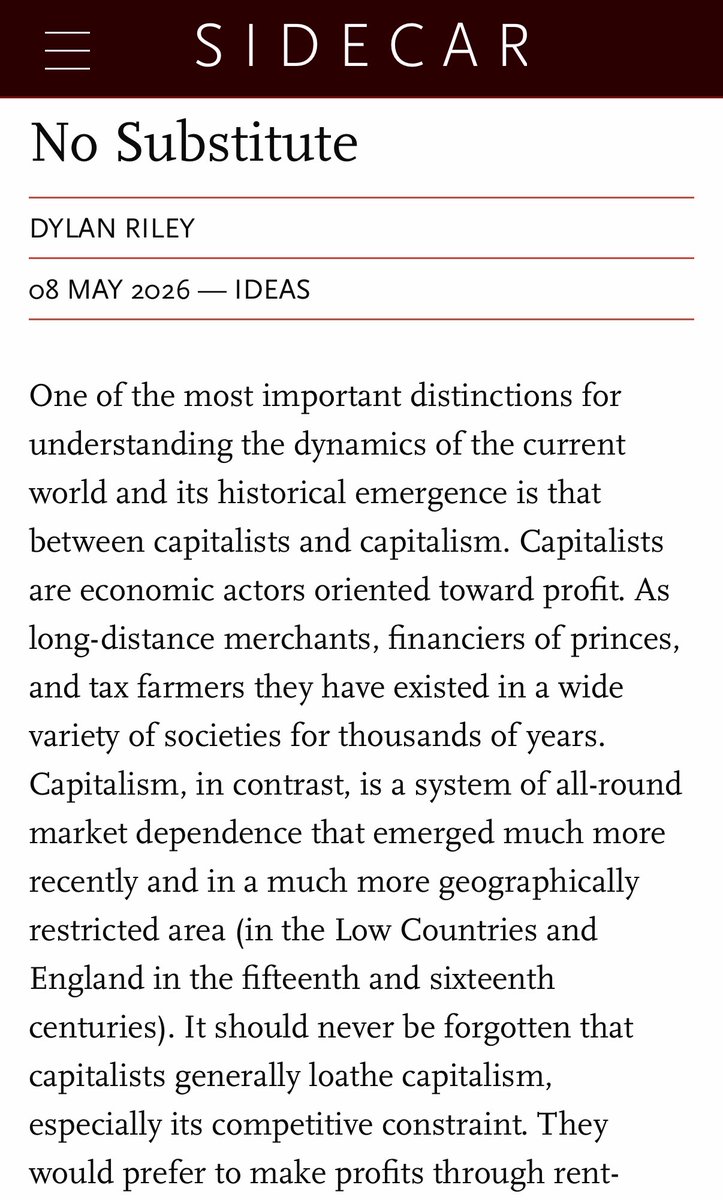
Corey Robin: “Dylan Riley in the New Left Review today stating crisply and cleanly, in three paragraphs, one of the major problems with Sven Beckert's book on capitalism, and the underlying worldview it expresses (though Riley doesn't say a word about Beckert):
"One of the most important distinctions for understanding the dynamics of the current world and its historical emergence is that between capitalists and capitalism. Capitalists are economic actors oriented toward profit. As long-distance merchants, financiers of princes, and tax farmers they have existed in a wide variety of societies for thousands of years. Capitalism, in contrast, is a system of all-round market dependence that emerged much more recently and in a much more geographically restricted area (in the Low Countries and England in the fifteenth and sixteenth centuries). It should never be forgotten that capitalists generally loathe capitalism, especially its competitive constraint. They would prefer to make profits through rent-seeking and political extraction without risking their wealth on uncertain investments. Indeed, the most obvious threat to capitalism today comes not from the working class, but paradoxically from capitalists who with increasing success have figured how to profit by plunder rather than productive investment.
These points are far from original, but they are not sufficiently recognized for two interconnected reasons. The first is the suspicion of comparison. For many scholars, even posing the question of why, for example, England and the Netherlands made the transition to market-dependent agriculture is a sign of incorrigible eurocentrism and a retrograde failure to grasp that capitalism was a globe-spanning system ab initio. That naturally leads to enormous pressure to describe all types of profit-making activity, especially merchant colonial activities, as an emergent form of capitalism. The second reason is a more specific pressure to describe various labour-repressive agriculture systems, especially slavery, as capitalist. To support this claim it is endlessly demonstrated that the agrarian elites of these systems kept careful books, were oriented to profitability and entangled in sophisticated systems of finance.
Both tendencies, the anti-comparative one and the recasting of capitalism as any economic system organized around profitability, derive from a position of political weakness. Capitalism seems immune to an immanent critique which takes as its starting point the system in its pure state and unfolds its inherently contradictory character as both social and anarchic; instead, capitalism is to be condemned in terms of its violent past and present, its entanglements with colonialism, racism and oppression, as in ‘racial capitalism’. Accordingly, the object of critique subtly shifts from the system – capitalism – to the actors: capitalists. But rage at rich people with dubious pasts is no substitute for an analysis of the dynamics of the system and the opportunities that its laws of motion open and foreclose."
https://t.co/W6QtrdKMbE
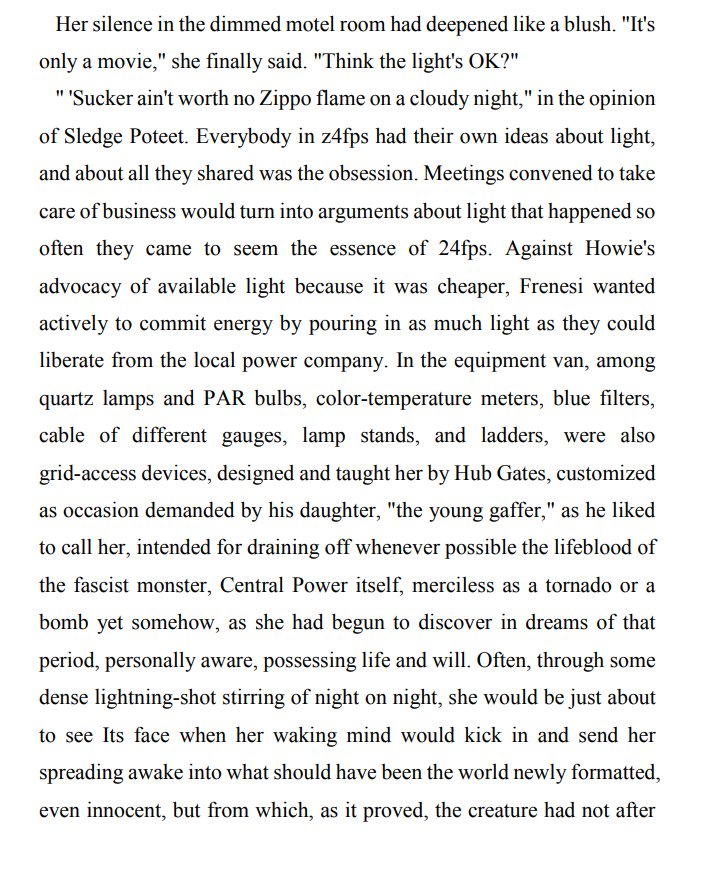
Absolute funniest and most thematically perfect end to Don DeLillo’s career would be his hockey sex novel becoming a TikTok sensation and outselling all his other books
https://t.co/3bmZrmncdP
There are millions or even billions of people in this world who fundamentally do not understand that children everywhere are the same. This precious child, the tens of thousands dead in Gaza—people don’t connect them to the idea of their own child being violently killed.
Liminality doesn’t quite describe these sections of the London Underground. It’s more aggressively purgatorial than that, you fell more like some cog in a subterranean industrial catastrophe
My weekend essay in @unherd on why central bank independence is a distraction. The real danger lies not with unelected technocrats but in the aggrandisement of power by authoritarians and the global financial sector—that’s true even for the Fed.
https://t.co/owoyAPuziL
Here’s the things about YIMBY. I support the notion that a key cause of the housing crisis is constrained supply. Thus, l support building housing en masse, which I think would be transformative, economically and politically.
But that’s not what YIMBY is. It is specifically the dual-notion that what supply is the only or the main thing that drives the housing crisis, and, crucially, what principally constrains housing supply is the government. The insidious part is that this sounds plausible because the government would indeed play a large role in remedying this problem. But that’s is emphatically not the same.
YIMBY like the more general abundance frame is therefore very cynical narrative- and policy space capture: to address the problem in a suboptimal way—insufficient emphasis on capital coercion and curbing demand for positional assets— but in a way which preserves the ‘Deutungshoheit’ of the very political framework and coalition which is ultimately responsible for much of this mess in the first place. It produces, quite deliberately, the perverse effect of progressives dismissing all-together the relevance of the housing supply and the regulatory dimensions of the problem.
One reason Don Draper is such a spectacular fictional character is that he accurately depicts what a true outsider’s idea of “social climbing” is (just class mobility) and when he’s presented with opportunities to do the real version he fucks it up massively or is like “ew, what”
Writing as a professor of macroeconomics: Never in the history of world economic growth have countries intentionally designed their macroeconomic growth regimes to ensure that they have positive feedback effects on the rest of the world.
people often post this stuff to imply that moral panics about the technologies of the past were quaint. But the past is full of reminders that we are on a long, slow march away from embodied experience, and that we’ve lost more of it than we can even remember
The post-WWII world is dead. The Pax Americana, growth liberalism, the rules based international order, the humanitarian limitation of state violence, the outlawing of ethnic and race-based group annihilation: Gaza is its graveyard. The arc of history bent back toward genocide.