🚨 **Mukul Agrawal Adds 7 New Stocks to His Portfolio!**
Ace investor Mukul Agrawal reportedly added these stocks in Q2 FY27:
1️⃣ Tega Industries
2️⃣ Innomet Advanced Materials
3️⃣ Apsis Aerocom
4️⃣ Safety Controls Devices
5️⃣ Recode Studios
6️⃣ Poojaa Precision Engineering
7️⃣ Anawil Wire & Engineering
📊 His portfolio moves are worth tracking, but always analyse valuations, fundamentals and risk before investing.
🔗 Source: Economic Times
https://t.co/Cztk8ea02n
⚠️ **Disclaimer:** For educational and informational purposes only. Not investment advice or a recommendation to buy or sell any stock. Please do your own research before investing.
Source:
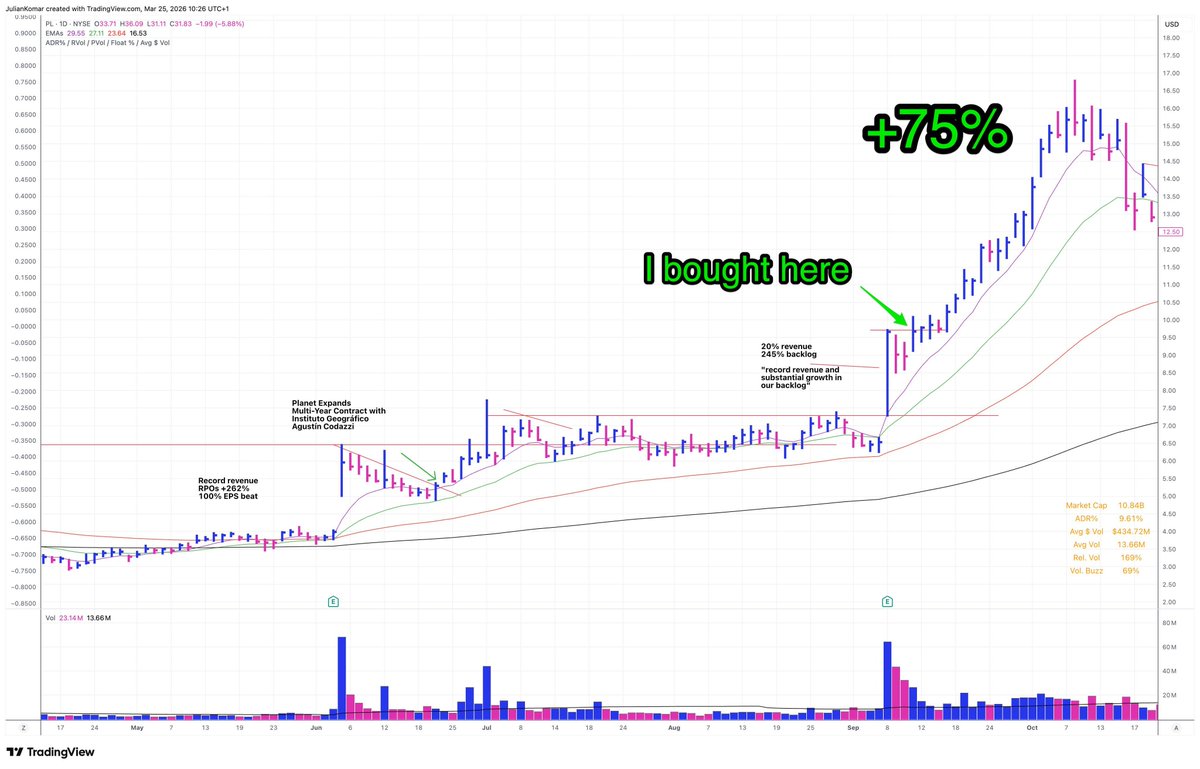
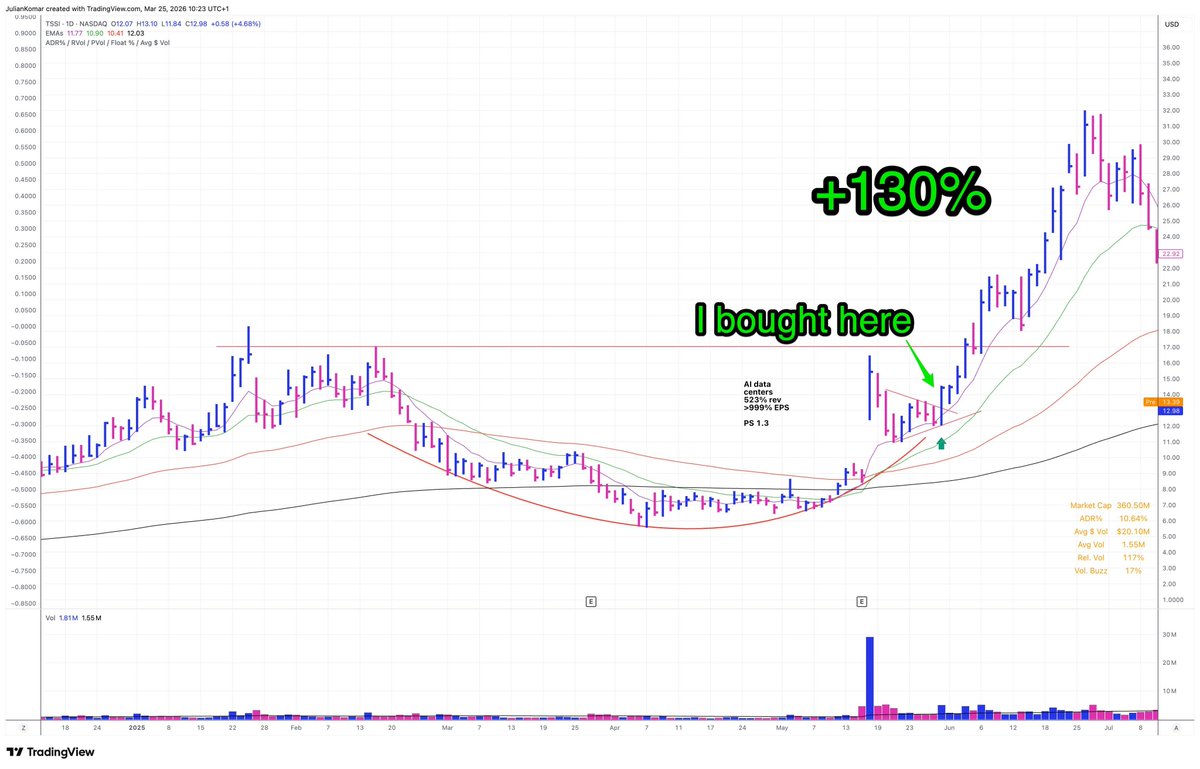
I rarely chase the initial gap-up.
I’m much more interested in what happens AFTER the gap.
Why?
The gap shows me interest.
What happens next tells me whether that interest is real.
My process is simple:
1. Find the big gap
A powerful gap on strong volume gets my attention. But I don’t need to be first.
2. Let the stock prove itself
Many gap-ups fade within days. I let those stocks eliminate themselves.
I’m interested in the ones that hold most of the move and refuse to break down.
3. Wait for the setup
The best stocks often start to tighten. Volatility contracts, volume dries up, and a clear structure develops over the following days or weeks.
Now I have something I can actually trade.
4. Define my risk
Instead of chasing a stock after a huge move, I can often enter from a tight area with a clearly defined 3–5% stop.
5. Trade the next move
I’m not trying to capture every dollar from the initial gap.
I’m looking for the larger move that can develop AFTER the stock has proven itself.
My routine:
Big gap → holds the move → tightens up → breaks out → manage risk.
I don’t care about being early.
I care about finding the stocks where the initial excitement turns into sustained demand.
Those are the gaps I keep watching.
Stop fixing your entries.
When the losses pile up, you tighten your stop, add another indicator, switch to a new setup, try a new entry trick.
That's working on the spot that hurts. And it makes things worse.
The entry isn't the problem. It's where the pain shows up.
The real damage happens upstream, in two places you never checked:
The market. You were buying while the index was falling.
The stock. You were buying stocks far below their highs because they looked cheap.
Your entry took the blame for both.
[This post shows up once. Bookmark it before your next losing streak.]
The 4-step losing-streak fix:
① Check the index before anything else.
Nifty below its 10-day and 20-day averages? No new buys. Not one. The weather decides first.
② Cut your size to a quarter.
Until the streak breaks, every trade starts at 25% of normal size. The stock has to earn the rest.
③ Look at your last 10 losers.
For each one, ask two questions. Where was the index? How far was the stock from its 52-week high? You'll see the pattern in 10 minutes.
④ Take the next trade only when both line up.
Index above its averages. Stock within 25% of its high, after a pullback of less than 20%.
And 3 rules so the streak doesn't come back:
・Don't quit. Step away for a few days, then come back small. Walking away for good teaches you nothing.
・Do your homework on Sunday. 20 minutes when the market is closed beats 6 hours of reacting while it's open.
・Sell into strength, not fear. Book part of the trade on the first 12 to 15% jump. Profits you've booked can't turn into losses.
I've traded full time for 6+ years and paid for mentorship to learn this. Every rule here came from a streak that cost me money first.
A trader from Hong Kong made 969.8% in one year and won the 2025 U.S. Investing Championship.
His go-to setup risks just 0.5% of his account per trade.
Small mistakes. Big winners.
Here's the 4-step playbook ↓
🚨Big Breaking: TradingView just moved its AI inside the chart itself.
No extension. No setup. It reads your chart and does the clicking for you.
Here are 7 things it can do for a swing trader ↓
If I had to learn swing trading from scratch and could only follow one roadmap for the next 1-2 years, this is exactly what I'd study.
You're unlikely to find almost every important swing trading concept organized in one place like this.
Bookmark it. Save it. Study it.
Enjoy the journey. Happy Trading!
1. Market Structure (The Foundation)
Understand market Cycles
- Bull, Bear & Sideways markets
- Expansion vs contraction
Stage Analysis (Stan Weinstein)
- Stage 1: Accumulation
- Stage 2: Uptrend (where we want to trade)
- Stage 3: Distribution
- Stage 4: Downtrend
Market Regime
- Breadth
- Follow Through Days (CANSLIM)
- Distribution Days
- Number of stocks making new highs
- Leadership quality
Sector Rotation
- Money rotates.
- Leaders almost always emerge from leading sectors and industries.
2. Build Your Trading Universe
Create a repeatable universe.
- Minimum turnover
- Market Cap
- Trade stocks that move cleanly.
- ADR
- Relative Strength
- New RS Highs before price
- 52 Week Highs
Fundamental Filters (Optional but powerful)
3. Trend Analysis
Stage 2 Moving Averages
Study:
- EMA alignment
- Slope
- Price interaction
- Support & resistance
- Trend maturity
4. Volume Analysis
Price tells you what happened.
Volume tells you who did it.
Learn to recognise:
- Accumulation
- Distribution
- Volume dry-up
- Pocket volume
- Relative Volume (RVOL)
- Breakout volume HVE, HVQ, HVY
- Selling pressure
5. Volatility
Volatility determines opportunity.
Understand:
- ADR
- Volatility contraction
- Volatility expansion
- Compression
- Expansion cycles
6. Base Building & Consolidations
Every big move begins with a period of rest.
Learn:
- Volatility Contraction Pattern (VCP)
- Flat Base
- Cup with Handle
- Double Bottom
- IPO Base
- Ascending Base
- Rectangle
- Darvas Box
- High Tight Flag
- Bull Flag
- Pennant
- Tight Range
Understand:
- Base depth
- Base duration
- Volume contraction
- Pivot quality
7. Entry Setups
Know multiple entry styles.
Classic Breakouts
- Pivot Break
- Buy Point
Early Entries
- Cheat Entries
- Low Cheat
- Pocket Pivot
- Early Pivot
Continuation Entries
- EMA Pullbacks
- Trendline Break
- Tight Pullback
Momentum Entries
- Earnings Gap
- Episodic Pivot
- Momentum Burst
- Opening Range Breakout
- Inside Bars
- NR5/7
- Three Tight weeks
- Shakeout + Recovery
8. Risk Management (Skill That Keeps You Alive)
Master: Position Sizing
- Percentage Risk
- R based Position Sizing.
Stop Placement
- Swing Low
- Base Low
- Day low
- ATR Stop
- Moving Average Stop
Portfolio Risk
- Risk per trade
- Total portfolio risk
Risk Metrics
- R Multiple
- Expectancy
- Profit Factor
- Win Rate
- Average Win
- Average Loss
Capital Preservation
- Max Drawdown
- Consecutive Loss Limits
- Daily/Weekly Loss Limits
9. Trade Management
Winning trades need managing.
Learn:
- Pyramid Buying
- Scaling In / Scaling Out
- Swing vs Core allocation
- Increasing size only after confirmation
10. Exit Strategies
Extremely Crucial to be successful
Study:
Technical Exits
- EMA Trail
- Moving Average Cross
- Structure Break
- Trend Break
Profit Taking
- Partial exits
- Fixed R exits
- Selling into strength
- Sell when extended
Time Stops
If a stock doesn't move...say 7 days
Capital should reduce / sell
11. Psychology
Markets reward discipline.
Master:
- Patience
- FOMO
- Revenge Trading
- Overtrading
- Confidence
- Conviction
- Thinking in probabilities
- Thinking in batches of trades
- Detaching from individual outcomes
12. Continuous Improvement never stop studying.
Read:
- William O'Neil
- Mark Minervini
- Stan Weinstein
- Nicolas Darvas
- Pradeep Bonde
- Mark Douglas
- Jesse Livermore
- Qullamaggie
- Martin Luk
Study charts.
Final Thought
The best traders spend most of their time building a better process.
Your process determines whether you can repeat it for decades.
Train your eyes to look for COILED price action:
-Volatility contraction
-Tight ranges
-Inside days
-Volume fades
The market moves in staircases
Compression --> Pressure building --> Expansion
The moment you start seeing setups like this, you will be a head of the moves to come.
📌This is the Summary of my Entire Swing Trading System👇
✅ Market Environment
🔵 Should be favorable for Swing Trading.
🔵 Green Zone (Ideally Young Fresh New Uptrend or Intermediate Uptrend)
✅Setups:
🔵Stage 2 Stock
🔵Big base Breakout + Strong Institutional Leg + Shallow Pullback + High Quality Tight Pivot
🔵Strong Buying Force + Shallow Pullback +High Quality Tight Pivot Near Recent Highs or 21 EMA.
🔵 Young IPO'S + Huge Liquidity.
✅Scanning:
🔵Scan for leading stock in Strongest Sector/theme.
🔵 25% Within 52 Week High
🔵 Young IPO
✅Entry:
🔵 Tight Pivot Breakout Entry
🔵 Gap up Opening
🔵 Breakaway Gap
🔵 Shakeout
✅Exit: -
🔵Stop loss at Pivot Low or Standard Stop Loss : 4%
🔵Trim into strength and move stop to even
🔵Use moving average to trail
✅Indicators:
🔵10/21Exponential moving averages
🔵Volume
My entire system comes down to these 6 things.
Minervini → VCP
O'Neil → Cup & Handle / Base Breakouts
Darvas → Box Breakouts
Qullamaggie → Bull Flags & Tight Ranges
Dan Zanger → Pattern Breakouts
Others use:
• Inside Bars
• NR5 / NR7
• Flags
• Tight EMA Pullbacks
Different names .Different frameworks.
But most momentum traders are looking for the same thing:
Contraction before expansion.
-Small candles.
-Tight ranges.
-Low volatility.
-Sellers drying up.
Then comes the move.
David Ryan broke one of his own rules for a year and watched his results fall apart.
Then he posted triple-digit returns 3 years in a row.
The 6 systems that fixed him 👇
Price lies to you. Volume only tells half the truth.
But there's a third number that quietly reveals when big money is loading a stock — days before it breaks out.
It's free. Most traders have never heard of it.
Here's how to read smart money's footprints ↓
Everyone hates the daily chart.
Too slow. Too boring.
I’ve traded 6 years in the markets and still find every setup on it.
Here’s how I use it unlike anyone else 👇
Every trader’s journey is unique, but often contains similar key ‘junctions’:
✅ The catalyst that kicks off your journey
✅ Those early signs you’re on a worthwhile pursuit
✅ The need for experimentation and setbacks, followed by that reality check
✅ The commitment to the long haul, prioritising skill development over immediate reward
✅ The moment ‘common wisdom’ goes from sounding cliché to clicking…
✅ …often going hand in hand with making THE tweak — the small change with the dramatic impact
That dramatic change might be digging deep into the maths of your trading, like @KaiHamill4, who then realised his biggest problem: selling too early. He then made the strategy changes that let his ideal (low) win rate and risk–reward play out, going from breakeven to profitable.
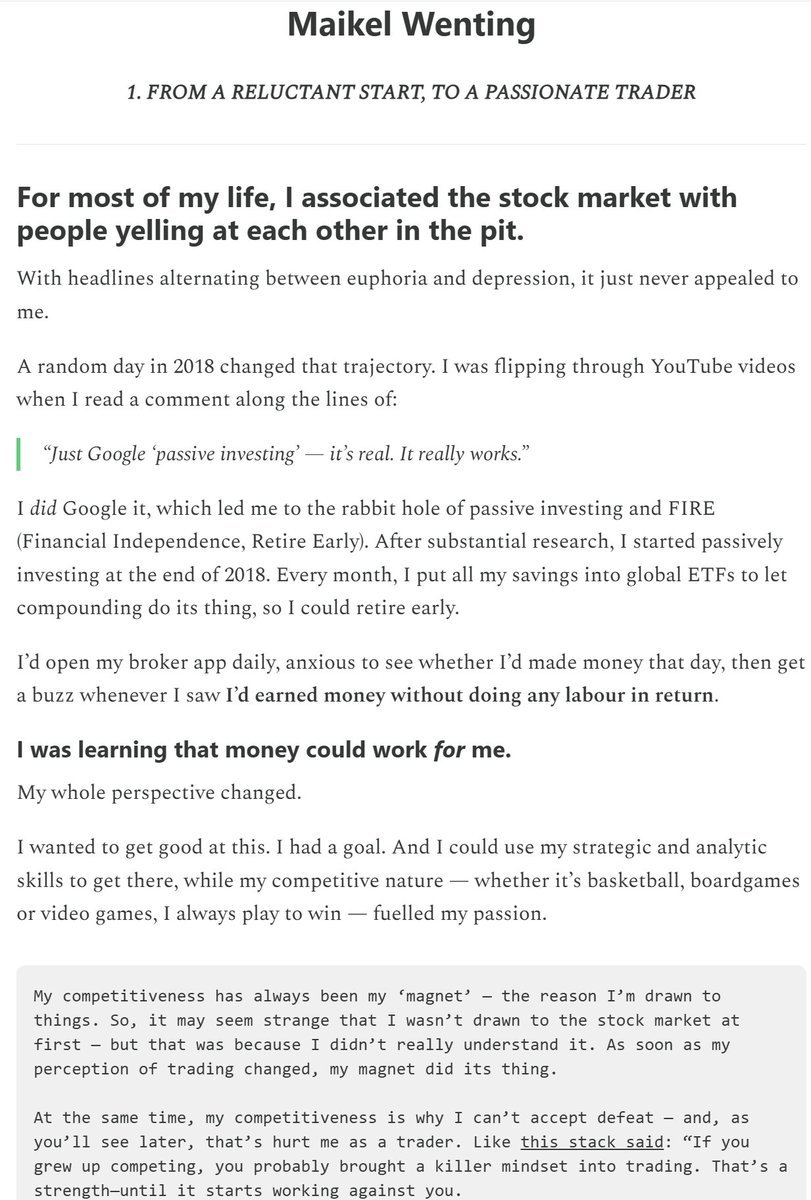
Or it might be addressing a trading demon, like @mkl85’s competitiveness making him unable to accept defeat. But by keeping and analysing his journal, then keeping an ‘injecting logic statement’ beneath his monitor, he was able to identify and kill that demon.
Both swing traders share their stories and methods behind their breakthroughs on TTRH this Saturday, 30 August.
I’ll then zoom out, and talk more about those key moments on most traders’ journey:
***
The Key Moments in a Trader’s Journey
Different paths, same junctions
🔗 https://t.co/PDjLofjvL9
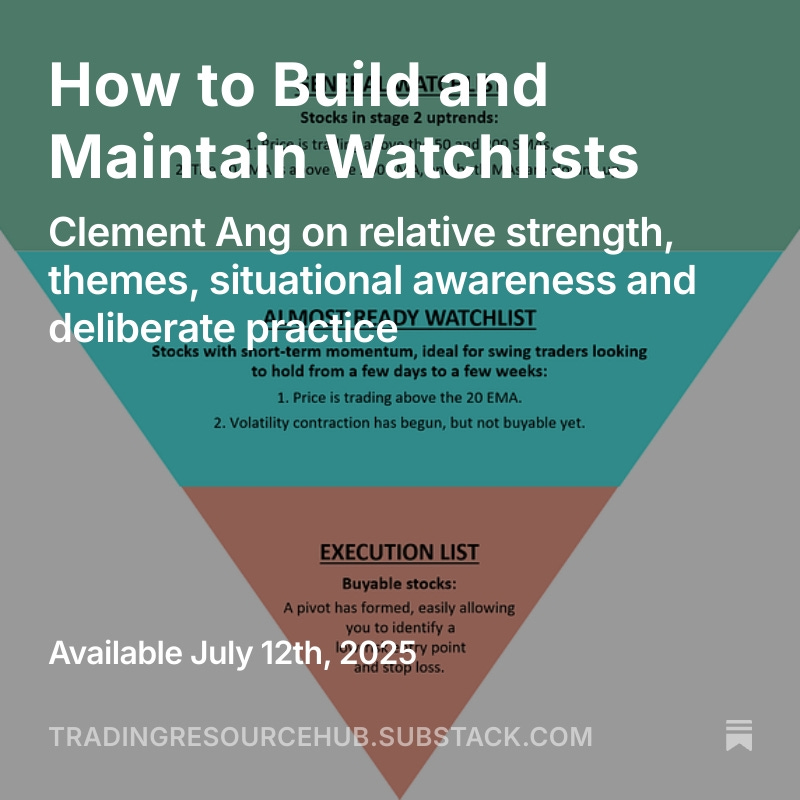
Inexperienced traders often think of watchlists as a set of trade ideas.
But the purpose of watchlists goes way beyond the superficial.
When it comes to situational awareness — one of the most critical factors for trading success — you’re really just looking to answer a fundamental question:
“WHAT ARE THE ODDS OF MY EDGE CURRENTLY WORKING?”
Clarity on your edge forms the backbone of your trading.
Because determining the market environment is only a useful exercise when established through the lens of YOUR strategy.
Seeing an index steadily pushing higher is all well and good…
…but that only tells you something about the general direction of the stocks which make up that index, and not:
🤔 How is your universe of stocks (‘opportunity set’) performing?
🤔 Are you seeing setups? What type? How many? Have they been working?
To answer such questions, watchlists are an invaluable tool.
Here’s how @Clement_Ang17 puts it:
“Think of watchlists as a ‘funnel’. Watchlists allow you to sieve through the noise and identify stocks with the highest-probability setups.”
Because watchlists should reflect YOUR universe of stocks, which you subsequently organise to give you vital information about YOUR current odds of success.
To maintain focus, develop market awareness, identify themes and relative strength, spot nuance and stay disciplined, a solid watchlist-building and maintenance routine is essential.
Clement shares a simple method to do just that, which works for part-time and full-time traders alike, on TTRH this weekend:
***
How to Build and Maintain Watchlists
Clement Ang on relative strength, themes, situational awareness and deliberate practice
🔗 https://t.co/fCh9AugfQR
One elite setup can pay for the entire month.
Yet traders keep funding mediocre trades that slowly bleed their accounts.
Before I risk a single rupee, the stock must pass these 6 filters 👇