Kanohar Electricals | Q2 FY27
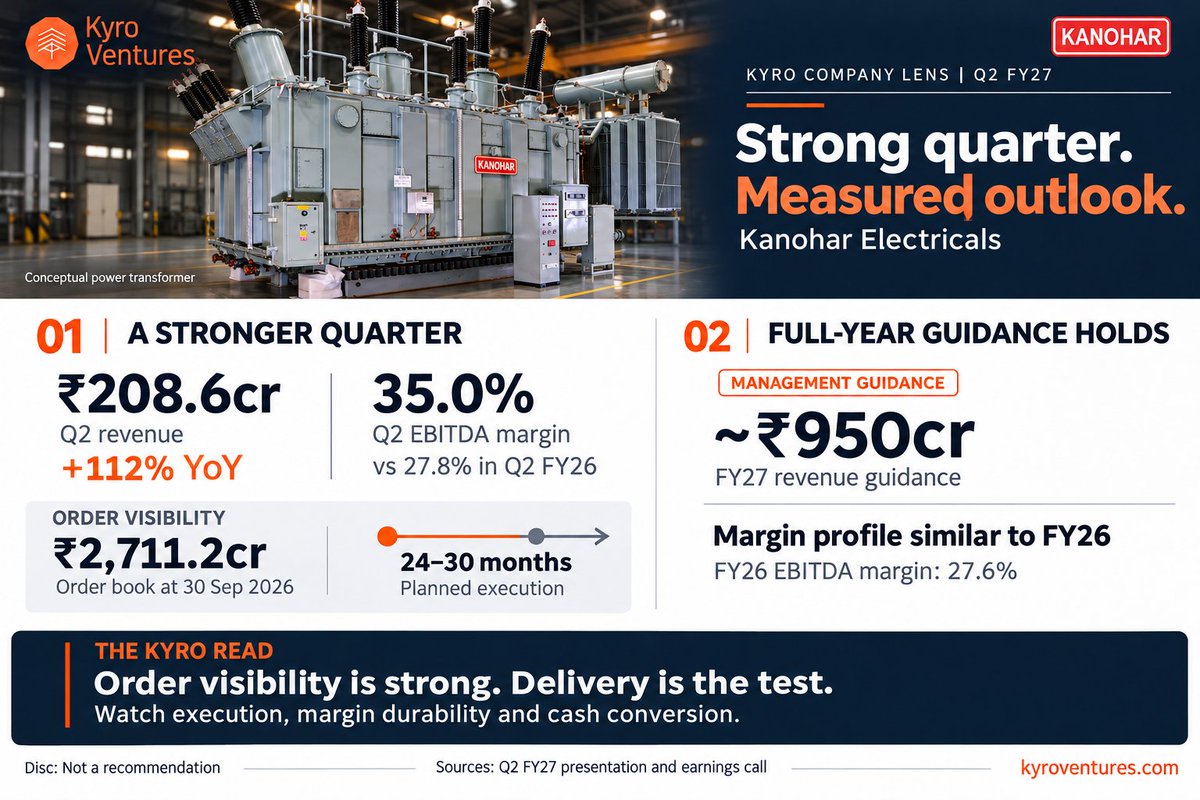
In our earlier Kanohar post, we focused on qualified supply, execution and cash conversion. Q2 brings a larger order book and a 35% EBITDA margin, while management’s full-year outlook remains measured.
Earlier post: https://t.co/rPiZVv1M96
The quarter
Revenue rose 112% YoY to ₹208.6 crore. EBITDA increased 167% to ₹73.1 crore, while PAT grew 180% to ₹53.9 crore.
Gross margin expanded by 2.7 percentage points to 45.8%. EBITDA margin rose by 7.2 points to 35%, showing operating leverage alongside a better business mix.
Business economics
Manufacturing contributed nearly 88% of H1 revenue, versus 76% last year. Management describes manufacturing as higher gross-margin than EPC.
Shunt reactors contributed around 22% of H1 revenue and roughly one-third of Q2 revenue. Products rated 220 kV and above contributed nearly 78% of H1 revenue, versus about 53% a year earlier.
Qualifications remain an entry barrier: major tenders require rating-specific testing and operating experience, not just factory capacity.
Orders and guidance
The September order book was ₹2,711.2 crore, up 34% from June, following ₹867.3 crore of Q2 inflows. Management attributed the 24–30-month execution window to larger orders and their delivery schedules, rather than capacity constraints.
FY27 guidance remains around ₹950 crore revenue and an EBITDA margin broadly similar to FY26’s 27.6%. H1 revenue of ₹345.7 crore leaves approximately ₹604 crore for H2 to meet that target, based on our calculation.
Management said there was no one-off behind the margin strength and no identified deterioration in gross margins. Its caution reflects variation between orders, quarters and full-year expenses. Crucially, the similar-margin statement about the order book refers to gross margins, not a commitment to sustain 35% EBITDA.
Capacity and industry
The 18,000 MVA Gangol expansion remains targeted for the beginning of FY29. It is intended for domestic demand. Management rejected assuming immediate 80% utilisation of the enlarged capacity.
The 765 kV opportunity still requires initial orders, deliveries and an operating track record. Management estimates that regular tender eligibility remains a three-to-four-year journey.
Cash conversion
H1 operating cash flow was ₹23.4 crore against PAT of ₹81.2 crore. Inventory rose to ₹196.8 crore from ₹114.2 crore in March, while receivables fell to ₹141.6 crore from ₹210.8 crore. Management linked the inventory build to planned H2 execution.
Kyro Read
Qualifications and the order book support growth visibility. The next test is converting that backlog into deliveries and cash while maintaining quality. The current margin strength is real; its durability should be judged across execution cycles rather than extrapolated from one quarter.
Disc: Not a recommendation
Explore more about us at https://t.co/E7oSZoMqFv