"...whether we can incorporate AI into our lives in such a way to dignify our humanity and flourishing. In other words, it is “a challenge that concerns what it means to be human in the age of AI, rather than just one about ensuring the continued survival of humanity.”
"A lab can train a flawless medical model tomorrow and still have no way into the physician's habit, or into the decision flow of UCSF, because trust is built slowly, on relationships, with user’s acquiescence, not gradient descent that erases them"
We should all strive to become someone who can use increasingly capable intelligence to understand reality, exercise judgment, work with others, and take responsibility for meaningful outcomes.
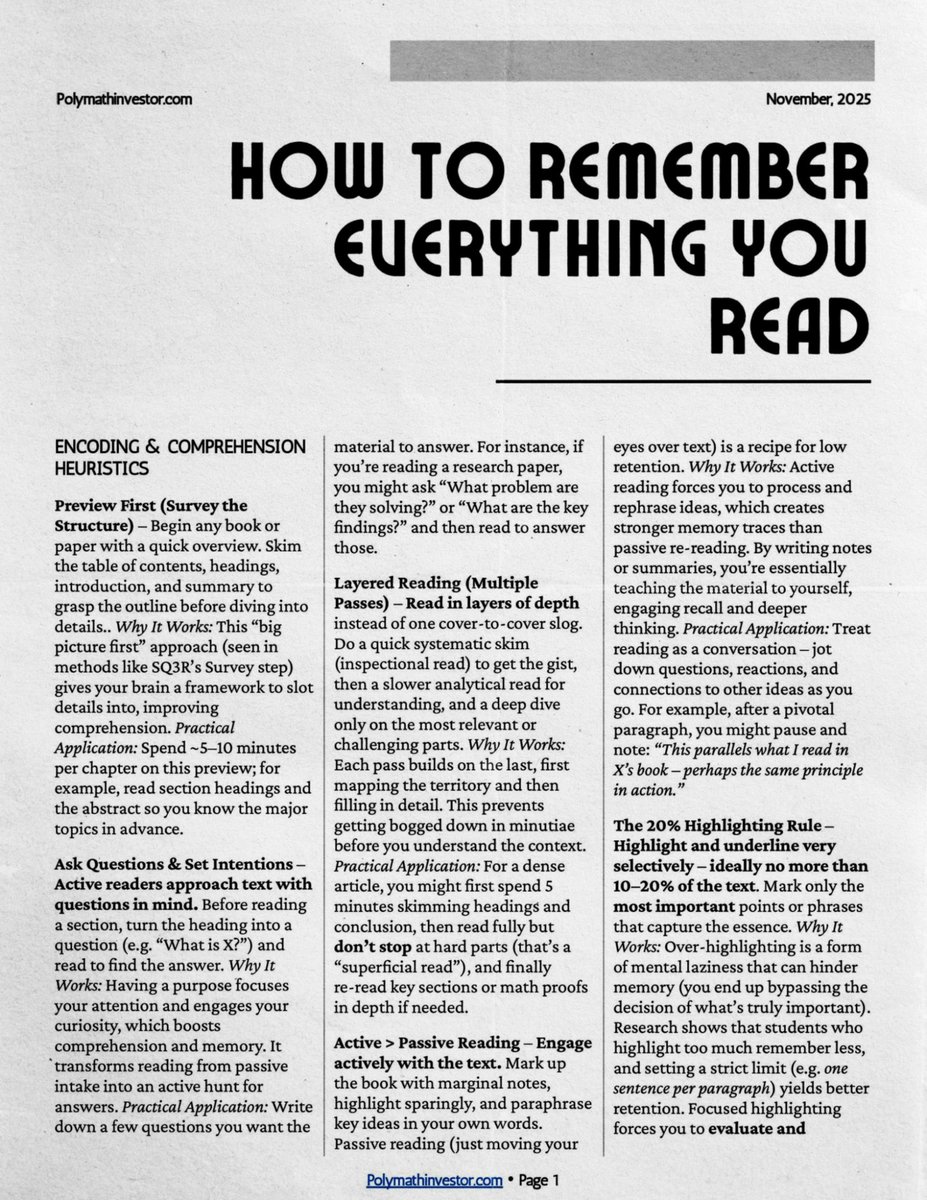
A few months back, I published this guide on how to remember everything you read.
Re-sharing it here for anyone who finds these protocols useful.
(1/11)
I'm a big fan of wispr & think it's sorta funny that it's the most useful when you're working alone. I aspire to comfortably talk out loud to my robot in public
Your brain doesn't age because of time. It ages because of repetition. The more predictable your days become, the faster your neurons quiet down. Your brain builds neural pathways based on experience. New experiences create new connections. Repetition strengthens old ones. But when you repeat the same patterns for years, your brain stops building. That's why time feels faster as you age. Your brain stops encoding new memories. It just references old ones. A year at 40 feels shorter than a year at 10, because at 10, everything was new. At 40, everything is familiar. But neuroplasticity doesn't stop. You can still grow new neurons. You can still learn. You can still change. You just have to break the loop. Your brain will wake up. And time will slow down again.
a writing tip I learned from Joan Didion that has truly changed the way I process and use words is she would write ‘xx’ if she couldn’t think of the precise word that belonged in a certain place and come back to find it later as to not interrupt the flow of what she was writing, this way the flow of the form could come out and the precise words—that are somewhere inside of you and simply taking longer to surface than the others—can come to you later, they are already there they are simply taking their time to arise and that shouldn’t interrupt the flow of language seeping out of you in a moment of inspiration
$1 million dollar prizes aside, I think there's been a quiet hunger for articles. The pendulum swung too far in the direction of TikTok and endless scrolling and the internet has a chance to self-correct.
I don't think the human brain was meant to be ripped in a thousand different directions as soon as you get on your phone. Too much chaos that has downstream affects on the quality of everyday life.
Long form content allows you to focus on set of ideas. It brings order to the mind. You learn more, you feel better, and usually you're left with something you can actually apply to your life, even if it's just a better way of thinking.
Especially with AI, we've gotten to the point where we think we want things as short as possible. We have this deranged desire to "get to the point" when the point is to sit with it. You can collect all of the tips and tricks you want but you're completely missing the context that allows you to turn those tips into results. A bullet list of actionable steps will do absolutely nothing for you.
Pre-2015 books are the best option, but articles are a great step in what I think is the right direction.
The antidote for brain rot is going back to longer formats: reading books.
Reading will help you rebuild your focus and attention. Pick ones that challenge you, satisfy your curiosity, or align with your interests today.
From Friday to Sunday, energy drinks, mattresses, computers and tech start-ups littered the floor and tables at the Palace of Fine Arts in San Francisco, where nearly 3,000 “hackers” competed in the 12th annual Cal Hacks, a three-day hackathon
https://t.co/tS8A3VFMMe
As this person says further down, the false promise of AI is that kids can learn and acquire skills without effort. But that's not how learning has ever worked, and the danger now is that the current generation of students will have no skills and know nothing.