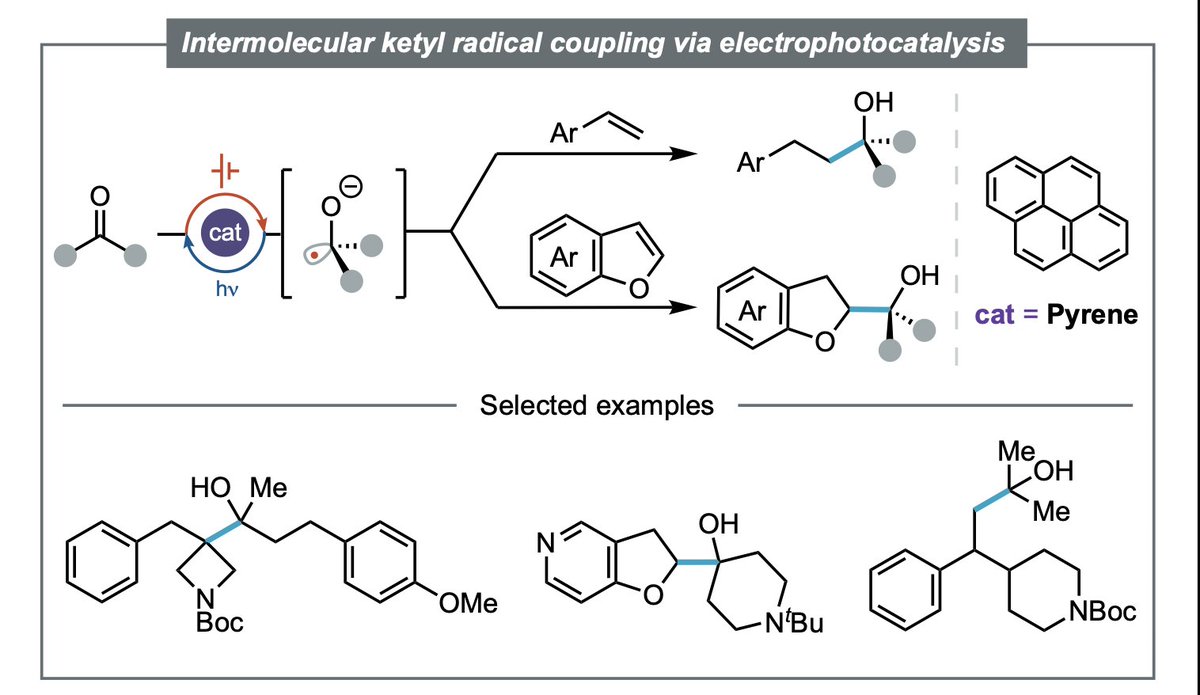
Check out our latest work @J_A_C_S leveraging electrophotocatalysis to access ketyl radicals! We found polycyclic aromatic hydrocarbons are a uniquely competent class of catalysts, which enabled our group's first non-fragmentation based reduction strategy https://t.co/MgGIXLjRJO
Check out our new hydrocarboxylation story! We found our previous system was ineffective for challenging unactivated alkenes but, using a mechanistically-guided approach, we develop a new catalytic system that unlocks this substrate class. Out in @J_A_C_S https://t.co/dQEtpOfNwp
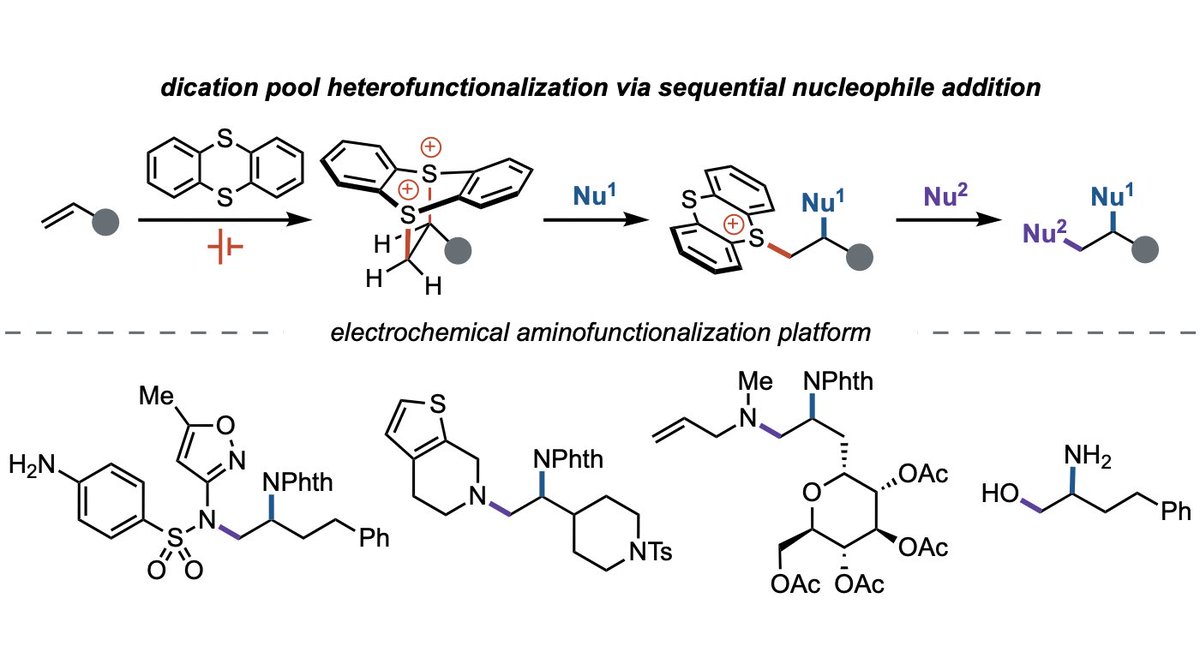
Check out our new platform for alkene aminofunctionalization! We found that dicationic adducts of alkenes and thianthrene undergo selective single substitution by phthalimide to provide a sulfonium salt that can be substituted with various nucleophiles. https://t.co/chJep7PmOU
Time to make more triangles! We introduce our new diastereoselective cyclopropanation protocol using the electrochemical dication pool strategy. Check out all the cool cyclopropanes you can now access at https://t.co/1JOHITedmL!
We’ve spent a lot of time trying to develop stronger reductants in my group but none of those systems were effective on their own. The trick to enabling this new deoxygenation reaction was working out that acids can protonate radical anion intermediates and promote C–O scission.
@OliverPWill and @AlyahChmiel introduce an alcohol deletion protocol using formate and light! But this time, potent reductants weren’t enough. We had to work out how to accelerate fragmentation after reduction. Spoiler alert: acidic promoters were key! https://t.co/orsQfmk51y