.
Memang Pantas.
Dan memang tidak seharusnya Vlademir Putin Berjabat tangan dengannya.
Bagi Orang yg karakternya Arogan atau mengidap penyakit NPD/Megalomania.
Dianggap gak Tidak ada atau Di pandang sebelah mata itu merupakan Shock Theraphy yang sangat tidak di inginkannya.
.
Pasca kerusuhan, ada beberapa korban luka-luka dan ada 1 korban meninggal dunia.
Yang dilakuken Yth. Kepolisian Republik Indonesia:
• Mengusut pelaku pengroyokan ❌
• Menyelidiki provokator ❌
• Menangkap admin medsos ✅
Polisi kalau tidak terima dengan tweet kami ini silakan tangkap kami dan habisi nyawa kami saja di tempat, gak usah bawa-bawa keluarga, gak usah doxing-doxing, toh kami dah terlampau lelah juga tinggal di negara yang kian hari kian TIDAK MASUK AKAL ini.
BOOM! OPEN SOURCE MRI!
You can now 3D-print the core of an MRI scanner.
A machine that hospitals pay $1.1 million to $3.4 million for has been broken open. The OSI² ONE and its educational siblings deliver real images of heads and limbs for a fraction of the cost, using a permanent-magnet Halbach array, 3D-printed structures, and fully open designs.
This is not a toy or a simulation. Working systems already produce in-vivo images in Leiden, Utrecht, Berlin, and Uganda.
The magnet alone—396 carefully oriented neodymium cubes in a cylindrical Halbach array—costs about $1,370. A complete scanner lands between $28,500 and $68,000 depending on the console and coils you choose.
No superconducting magnets. No liquid helium. No specialized power infrastructure. It runs from a standard wall outlet and weighs roughly 150 kg.
The physics is elegant. A Halbach array arranges permanent magnets so their fields reinforce inside the bore and nearly cancel outside. The result is a usable 50 mT field strong enough for diagnostic-quality imaging of extremities and the head when paired with clever gradient coils, RF coils, and modern reconstruction. Spatial resolution reaches about 1.5 × 1.5 × 5 mm³.
The designs are modular: build the magnet first, verify and shim the field with a 3D-printer-turned-field-scanner, then add gradients and RF hardware.
The plans are public
Everything needed to replicate or improve the system lives in open repositories:
• Primary project hub and documentation: https://t.co/WgzAqQMF3T
• Full OSI² repositories (hardware, software, magnets): https://t.co/y42zuQDdPn
• Educational build focused on the Halbach frame, shimming, gradients, and student workshops (Utrecht / Lili’s Proto Lab): https://t.co/DTpxboUOkI
• Magnet-specific details: https://t.co/vlE7qYDLZZ
Hardware is released under CERN-OHL-W. Most software is GPL-3.0.
Where AI multiplies the impact
Low-field MRI has historically been limited by lower signal-to-noise and greater field inhomogeneity. That is exactly the regime where modern AI thrives.
Image reconstruction becomes dramatically better when deep networks trained on high-field data or physics-informed models denoise, correct for inhomogeneity, and push resolution beyond the raw acquisition limits. Real-time sequence adaptation can adjust gradients and RF pulses on the fly as the AI monitors signal quality.
Magnet design itself can be optimized by evolutionary algorithms or differentiable physics engines that search for better Halbach geometries or shim placements than human intuition alone can find.
Further out, local AI agents turn these scanners into autonomous diagnostic nodes. A small clinic or even a well-equipped garage workshop could run overnight scans, flag anomalies, and queue results for a remote radiologist—or eventually for a specialized medical model.
Synthetic data generation from the open designs lets researchers train robust models without proprietary hospital datasets. Robotics integration (patient positioning, coil placement, maintenance) becomes straightforward once the hardware is open and standardized.
In the longer arc of the Abundance Interregnum, this is the shape of things: sophisticated medical instruments that no longer require billion-dollar supply chains or national infrastructure.
A distributed network of open, AI-augmented low-field scanners could bring advanced imaging to places that have never had it, while simultaneously giving makers, universities, and small labs the ability to experiment, improve, and specialize the technology.
The plans are already on the table. The magnets are commercial off-the-shelf. The 3D printers exist in thousands of workshops. The AI tools for reconstruction and design optimization improve every month.
What was once the exclusive domain of major hospitals is becoming a community engineering project.
This is how abundance arrives—one open, reproducible, AI-extendable system at a time.
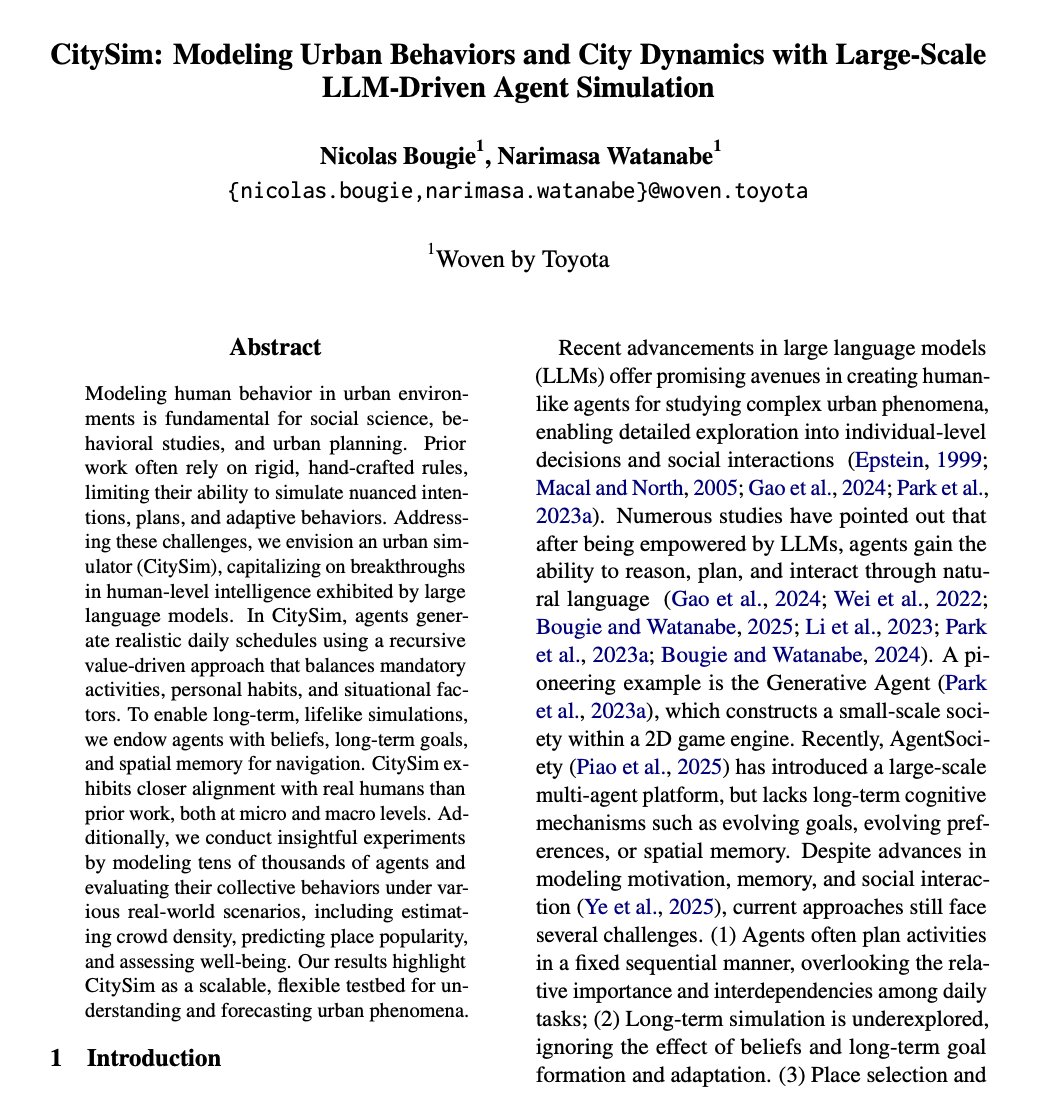
Japanese researchers created a system that simulates an entire city by generating up to 1 million virtual residents who behave like humans using LLMs.
And it predicted real-world with terrifying accuracy.
They created an urban simulator called "CitySim" that populates a digital twin of Tokyo with up to 1 million autonomous AI agents.
Each resident is powered by an LLM, complete with:
• Personal memories
• Long-term goals
• Human-like desires (hunger, fatigue, social connection)
• Spatial awareness and navigation
Most urban simulations rely on rigid, hand-crafted rules, if A happens, B follows.
CitySim is different. It’s "value-driven." The agents have agency. They generate their own schedules based on their personal habits, situational needs, and changing environments.
When researchers ran the simulation in Tokyo, the output was chillingly accurate.
Weekday commuting patterns, weekend leisure activities, and shopping habits matched Japanese government statistical data with near-perfect precision.
It even successfully predicted crowd distributions in Shibuya and identified which stores would actually become popular, months before the real-world data caught up.
The implications for urban planning are massive.
We can now safely and cost-effectively test disaster preparedness, commercial site planning, and public infrastructure upgrades without moving a single physical person.
But it’s not just about planning.
The researchers are already looking at implementing high-level human drives, like "self-actualization," into these agents to see how they evolve.
The paper went up on arXiv in June 2025 and almost nobody outside computational social science has read it.
Ada satu momen di film "𝙎𝙚𝙣𝙮𝙖𝙥: 𝙏𝙝𝙚 𝙇𝙤𝙤𝙠 𝙤𝙛 𝙎𝙞𝙡𝙚𝙣𝙘𝙚" yang saya rasa tidak akan pernah saya lupakan. Dua orang lelaki tua berdiri santai di tepi sungai, menunjukkan dengan tangannya sendiri bagaimana dulu ia menyeret seorang laki-laki bernama Ramli ke tepian, sambil sesekali tertawa kecil mengingat detailnya.
𝙎𝙀𝘽𝙐𝘼𝙃 𝙐𝙏𝘼𝙎.