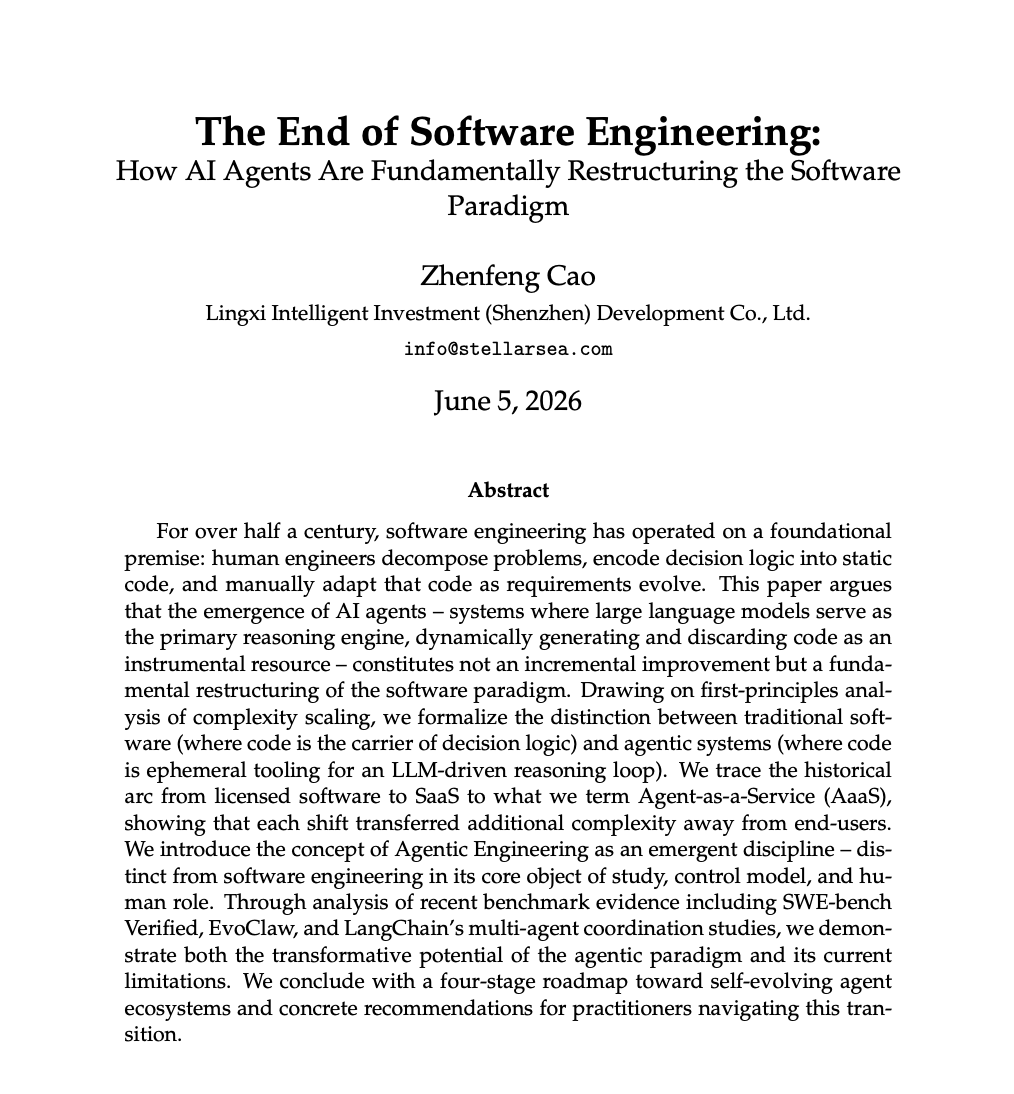
Chinese researchers published a paper with a devastating title: "The End of Software Engineering”
it argues software engineering is finished.
In traditional software, code is the carrier of pre-written human logic.
In agentic software, the AI agent is the software.
Code is no longer a permanent monument built by human hands. It is completely ephemeral, dynamically generated, executed, and discarded on the fly by an LLM-driven reasoning loop.
Think about how software delivery has evolved:
• Era 1: On-premise licensed software (you installed it locally)
• Era 2: SaaS (hosted in the cloud, managed by vendors)
• Era 3: Agent-as-a-Service (AaaS)
Each historical shift transferred complexity away from the user. But this latest shift transfers something entirely different.
It transfers decision-making complexity itself.
The paper argues that traditional engineering is hitting a hard complexity wall. Human brains can only hold so much state, manage so many dependencies, and debug so many lines at once.
LLM-based agents scale non-linearly.
They don't just write functions faster. They navigate architectural complexity by outsourcing reasoning to models that improve every single month.
Which means the role of the developer is permanently changing.
You are no longer a code author typing syntax line by line.
You are an intent architect.
Your job is no longer writing the implementation. It is specifying goals, designing multi-agent coordination loops, and auditing outcomes.
This is exactly right. Source code is on the verge of becoming like assembly.
The next step is getting rid of “source code” entirely and just making an efficient binary directly with AI.
What if we could remove the friction in the email → https://t.co/Xn4t0XWCMP
The proposed Email Verification API would let your site validate the email address right in the browser! No email sent, no confirmation click needed.
Finally, my skills are available as a Claude Code plugin!
claude plugins install mattpocock-skills
This means:
- No more manually syncing updates
- Aliases: mattpocock:code-review means no clashes with Claude built-ins
Perfect for folks tired of tinkering. Install once, never worry again.
> I don't even use the app anymore but just generate my own app to do things
I really think this is where we're going. It's not AI enabling "everyone to code". It's AI enabling anyone to "assemble software by asking".
We rethink the "unit of distribution"
Instead of only distributing apps, you distribute small, well-built, well tested blocks that an agent can put together. For you.
Yes. Personal Software.
We're not there for consumer apps but we might already be for developer tools/apps. people will pay for small parts that work well together. your agents will look for them.
Looking back, this is what we did with shadcn/ui. Changed the unit of distribution from a packaged component library to well-built components you assemble.
Same idea. Now at a much larger scale.
This is why I love GPT 5.6
I was building a self-improving diagnostic index with Fable something that maps endpoints through code to database objects. The first implementation looked impressive, but I asked GPT-5.6 to review it critically.
GPT-5.6 proposed a stronger design method scoped tracing, independent accuracy gates, drew a evidence graph, and a controlled feedback loop.
I took the findings back to Fable. Fable reviewed them, agreed, and implemented the improved design.
🤯
Did you know? Burning garbage at home is illegal in Sri Lanka and has been since 2017.
Under Gazette No. 2034/36 (dated 01.09.2017), open burning of waste, especially plastic, is explicitly prohibited nationwide. This falls under the National Environmental Act, enforced by the Central Environmental Authority (CEA).
Local authorities, Municipal Councils, Urban Councils, and Pradeshiya Sabhas, also have power to penalize open burning under their own bylaws.
The Pradeshiya Sabha Act and Municipal Councils Ordinance both carry provisions for this. #lka #SriLanka
I've been getting a TON done with Fable today and I'm not hitting rate limits. Wanted to share some tips on how I'm doing that
1. I only use Fable on "high" effort for now. xhigh is token hungry. max/extra is a furnace with worse outputs than lower options imo
2. I taught Claude Code how to use Codex as a fallback for lots of implementation tasks. GPT-5.5 is incredibly steerable, and Fable can learn how to steer it
3. I wrote up a big section in my CLAUDE[.]md on how to prioritize different models for different work when orchestrating workflows and subagents
4. Things that are unnecessarily token hungry (computer use, codebase analysis, etc), I do with other models and report results back to Fable
In light of the recent cybersecurity incident involving government financial systems, the Digital Trust Alliance, together with the key cybersecurity professionals bodies; ISACA Sri Lanka, ISC2 Sri Lanka Chapter, Cloud Security Alliance Sri Lanka Chapter, and BSides Sri Lanka, has formally written to H.E. President Anura Kumara Dissanayake and relevant officials.
The letter offers constructive professional support to strengthen cybersecurity governance and institutional resilience across Sri Lanka’s public sector.
This is a collective step taken in the spirit of professional responsibility and national service. Cybersecurity is now central to financial integrity, public trust, institutional continuity, and national resilience.
Sri Lanka’s digital trust must be built collectively, and strengthened before the next crisis arrives.
Introducing Tolaria! 💧
Today I am releasing a macOS desktop app for managing markdown knowledge bases, and helping both AI and humans operate them.
It’s free and open source, and always will be.
I have been working on it for three months, and I now use it to run my life and work. I personally have a massive workspace of 10,000 notes — the result of 6 years of Refactoring — which I now operate on Tolaria.
Tolaria is the main collaboration surface with my AI agents: they create new notes there, connect them to what exists, and edit existing ones. Everything is easy to understand for them, because it’s just markdown files. In a way, it’s my implementation of @karpathy's LLM wiki.
Tolaria is also the biggest experiment I have ever run about writing software with AI:
• 2000 commits
• 100K+ lines of code
• 3000+ tests / 85% coverage
• 9.9/10 code health
• 70+ architecture decision records
I am releasing it open source also to use it as a living artifact of how I do AI coding, so you can inspect at any time things like how I write docs, what's in my AGENTS file, what hooks do I run, and so on. You can find it below:
• Newsletter announcement: https://t.co/NFzPASLrNK
• Website: https://t.co/R9qTFAeQv9
• Github repo: https://t.co/ck9gfwpzZG
Let me know your thoughts!