A 5-year-old girl plunged 49 feet from a moving cruise ship into the open ocean. Her father heard his wife screaming and raced toward the railing, only to discover that their daughter was gone.
It happened aboard the Disney Dream near the Bahamas, where a family vacation took a terrifying turn when the little girl fell from the ship’s fourth deck.
When her father realized what had happened, he jumped overboard after her, plunging nearly 50 feet into the ocean. But when he surfaced, he couldn’t see his daughter anywhere.
He began desperately calling out for her, searching the water until he finally heard her calling back. He swam toward her and managed to reach her, but they were still stranded in the open ocean as the massive cruise ship began turning around.
For roughly 20 minutes, he kept his little girl afloat, holding her above the water until a rescue boat finally reached them and brought them back to safety.
Both survived, although the father suffered two fractures in his spine from the fall.
It takes an incredible amount of courage to jump nearly 50 feet into the open ocean, not knowing what awaits you below. But this father didn’t hesitate to put his own life on the line for his little girl. Thank God they both made it home.
Just before COVID hit, the state-owned company that runs nine of South Africa's airports had a plan for a stretch of vacant land at O.R. Tambo International Airport that would have changed the airport's western skyline.
ACSA wanted to develop a 180 000m² mixed-use precinct, on roughly 8.5 hectares, across seven phases: offices, a hotel, retail and conference facilities, all built on airport-owned land.
Phase one, the smallest slice of that seven-phase plan, was costed at R4.5 billion. It would comprise three six-storey office buildings totalling 30 000m² of space, plus around 2 000 parking bays.
Then the pandemic halted air travel. Passenger numbers collapsed, ACSA's revenue went with them, and a plan built on the assumption that more and more people would keep flying suddenly became a luxury nobody could afford. The hotel, the conference centre and most of the retail space were shelved.
The project was basically scrapped, except phase one, which survived largely intact.
What actually got built was Aviation Park: 33 000m² of office space across three buildings with parking underneath, home to ACSA's own head office and the South African Civil Aviation Authority. Compared with the original 180 000m² vision, that's only around a fifth of the full precinct.
To read the full article, DM me for the link to my WhatsApp channel.
The narrative that #SouthAfrica "lost" Formula 1 to Rwanda is a misinterpretation of how the global F1 calendar operates.
1. F1 Timelines: We Aren't Even Competing for the Same Years. Rwanda’s deal is a long-term play targeting the early 2030s for a completely brand-new, purpose-built circuit in Bugesera. Meanwhile, 🇿🇦’s immediate focus is targeting a slot much sooner—specifically 2028 or 2029. 🇿🇦’s bid committee is actively moving forward with corporate backing to secure an earlier date.
2. The "One Continent, One Race" Fallacy
The idea that Africa can only host a single Grand Prix is an outdated double standard.
• Europe hosts 9 races.
• The Middle East hosts 4 races.
• The United States alone hosts 3 races.
Formula 1 Management (FOM) has a massive, rapidly expanding global audience. An entire continent of 54+ countries can absolutely sustain more than one race. Rwanda entering the calendar simply breaks the ice for Africa’s return; it doesn't lock the door for others.
3. South Africa Already Has the Infrastructure Core. Rwanda is building its multi-billion dollar project entirely from scratch. South Africa, by contrast, has multiple highly viable, active options:
• The Kyalami Grand Prix Circuit: Already holds an FIA Grade 2 certification & has approved, ready-to-go design plans to upgrade to Grade 1 status.
• The Cape Town Private Bid: The BMR Consortium recently reaffirmed its commitment to a privately funded R6.7 billion motorsport precinct targeted for 2031, citing Cape Town's unmatched existing tourism & airport infrastructure.
4. South Africa's Commercial and Corporate Muscle. Unlike bids reliant entirely on state funding, South Africa's approach leverages massive private sector appetite. The current bid has already brought heavy-hitting corporate sponsors to the table—including MTN, Discovery, Betway, and Canal+. F1 is a commercial sport, and South Africa's broadcasting weight and domestic market size remain incredibly lucrative to Liberty Media.
UPDATE: The eThekwini Municipality says popular Chesterville Shisanyama brand, Mojos, has been granted a lease of almost 10 years to operate from one of the municipal prime spots on the Durban South beach.
🚨 RWANDA & FORMULA 1: PUT THE NUMBERS SIDE BY SIDE.
Rwanda is reportedly preparing to host Formula 1 from 2030 on a new permanent circuit near Bugesera.
Before calling this “development”, Rwandans deserve to see what it means in real numbers.
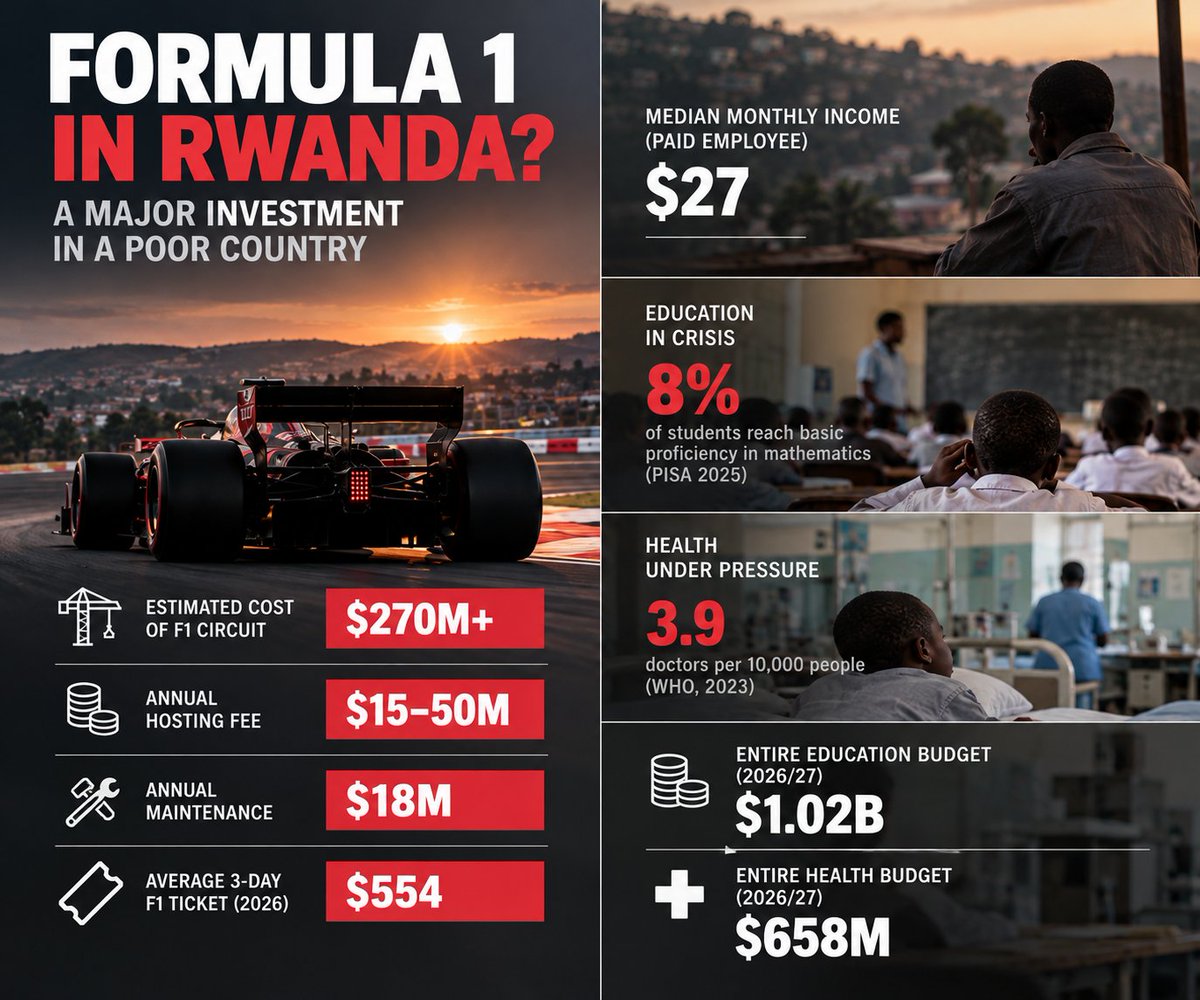
The median monthly income of a paid employee in Rwanda is about 39,000 RWF.
The average 3-day F1 ticket in 2026 costs $554 — roughly 817,000 RWF.
That is about 21 months of median pay just for the ticket — before transport, food or accommodation.
Meanwhile, Rwanda’s development needs remain enormous.
In PISA 2025, only 8% of Rwandan students reached basic proficiency in mathematics and 13% in science. Rwanda’s HDI is 0.578, ranking 159th globally.
UNICEF’s latest analysis shows that Rwanda allocates 1.711 trillion RWF to education, health, social protection and WASH combined. These allocations grew only 4.2% this year — below inflation — while their share of the national budget has fallen from 26.8% to 22% over five years.
Now compare that with Formula 1.
BBC Sport reported estimates of more than $270 million to build the Rwandan F1 project, plus an annual F1 hosting fee estimated at $15–50 million and around $18 million a year in track maintenance.
$270 million is roughly 400 billion RWF.
That means the estimated construction cost alone would equal roughly 23% of Rwanda’s entire annual allocation for education, health, social protection and WASH combined.
And Rwanda’s 2026/27 budget already relies on nearly 1.97 trillion RWF in external loans.
🌍 This is why the international comparison matters.
Malaysia — vastly richer and already equipped with a world-class F1 circuit — decided not to bring its Grand Prix back because doing so would require around $71 million every year, more than twice what its government spends on 20 national sports programmes.
The Netherlands is ending its Grand Prix after 2026. France and Germany have also struggled to make their races financially viable.
Hosting F1 is prestigious. That does not automatically make it good public investment.
So this is not about being “against Formula 1”.
It is about priorities and accountability.
Before hundreds of millions are committed, Rwanda should publish:
• the full construction cost
• the annual hosting fee
• the amount of public financing and guarantees
• projected additional tourists
• expected tax revenue
• the break-even point
• exactly how ordinary Rwandans are expected to benefit
If the project truly pays for itself, the numbers should prove it.
Until those numbers are public, the risk is obvious: Rwanda could be building one of Africa’s most expensive prestige projects in a country where basic investments in education, health and household incomes remain urgent.
Formula 1 may bring global attention for one weekend.
The real question is what Rwanda gets for the other 362 days.
🚨 RWANDA & FORMULA 1: PUT THE NUMBERS SIDE BY SIDE.
Rwanda is reportedly preparing to host Formula 1 from 2030 on a new permanent circuit near Bugesera.
Before calling this “development”, Rwandans deserve to see what it means in real numbers.
The median monthly income of a paid employee in Rwanda is about 39,000 RWF.
The average 3-day F1 ticket in 2026 costs $554 — roughly 817,000 RWF.
That is about 21 months of median pay just for the ticket — before transport, food or accommodation.
Meanwhile, Rwanda’s development needs remain enormous.
In PISA 2025, only 8% of Rwandan students reached basic proficiency in mathematics and 13% in science. Rwanda’s HDI is 0.578, ranking 159th globally.
UNICEF’s latest analysis shows that Rwanda allocates 1.711 trillion RWF to education, health, social protection and WASH combined. These allocations grew only 4.2% this year — below inflation — while their share of the national budget has fallen from 26.8% to 22% over five years.
Now compare that with Formula 1.
BBC Sport reported estimates of more than $270 million to build the Rwandan F1 project, plus an annual F1 hosting fee estimated at $15–50 million and around $18 million a year in track maintenance.
$270 million is roughly 400 billion RWF.
That means the estimated construction cost alone would equal roughly 23% of Rwanda’s entire annual allocation for education, health, social protection and WASH combined.
And Rwanda’s 2026/27 budget already relies on nearly 1.97 trillion RWF in external loans.
🌍 This is why the international comparison matters.
Malaysia — vastly richer and already equipped with a world-class F1 circuit — decided not to bring its Grand Prix back because doing so would require around $71 million every year, more than twice what its government spends on 20 national sports programmes.
The Netherlands is ending its Grand Prix after 2026. France and Germany have also struggled to make their races financially viable.
Hosting F1 is prestigious. That does not automatically make it good public investment.
So this is not about being “against Formula 1”.
It is about priorities and accountability.
Before hundreds of millions are committed, Rwanda should publish:
• the full construction cost
• the annual hosting fee
• the amount of public financing and guarantees
• projected additional tourists
• expected tax revenue
• the break-even point
• exactly how ordinary Rwandans are expected to benefit
If the project truly pays for itself, the numbers should prove it.
Until those numbers are public, the risk is obvious: Rwanda could be building one of Africa’s most expensive prestige projects in a country where basic investments in education, health and household incomes remain urgent.
Formula 1 may bring global attention for one weekend.
The real question is what Rwanda gets for the other 362 days.
🚨 RWANDA & FORMULA 1: PUT THE NUMBERS SIDE BY SIDE.
Rwanda is reportedly preparing to host Formula 1 from 2030 on a new permanent circuit near Bugesera.
Before calling this “development”, Rwandans deserve to see what it means in real numbers.
The median monthly income of a paid employee in Rwanda is about 39,000 RWF.
The average 3-day F1 ticket in 2026 costs $554 — roughly 817,000 RWF.
That is about 21 months of median pay just for the ticket — before transport, food or accommodation.
Meanwhile, Rwanda’s development needs remain enormous.
In PISA 2025, only 8% of Rwandan students reached basic proficiency in mathematics and 13% in science. Rwanda’s HDI is 0.578, ranking 159th globally.
UNICEF’s latest analysis shows that Rwanda allocates 1.711 trillion RWF to education, health, social protection and WASH combined. These allocations grew only 4.2% this year — below inflation — while their share of the national budget has fallen from 26.8% to 22% over five years.
Now compare that with Formula 1.
BBC Sport reported estimates of more than $270 million to build the Rwandan F1 project, plus an annual F1 hosting fee estimated at $15–50 million and around $18 million a year in track maintenance.
$270 million is roughly 400 billion RWF.
That means the estimated construction cost alone would equal roughly 23% of Rwanda’s entire annual allocation for education, health, social protection and WASH combined.
And Rwanda’s 2026/27 budget already relies on nearly 1.97 trillion RWF in external loans.
🌍 This is why the international comparison matters.
Malaysia — vastly richer and already equipped with a world-class F1 circuit — decided not to bring its Grand Prix back because doing so would require around $71 million every year, more than twice what its government spends on 20 national sports programmes.
The Netherlands is ending its Grand Prix after 2026. France and Germany have also struggled to make their races financially viable.
Hosting F1 is prestigious. That does not automatically make it good public investment.
So this is not about being “against Formula 1”.
It is about priorities and accountability.
Before hundreds of millions are committed, Rwanda should publish:
• the full construction cost
• the annual hosting fee
• the amount of public financing and guarantees
• projected additional tourists
• expected tax revenue
• the break-even point
• exactly how ordinary Rwandans are expected to benefit
If the project truly pays for itself, the numbers should prove it.
Until those numbers are public, the risk is obvious: Rwanda could be building one of Africa’s most expensive prestige projects in a country where basic investments in education, health and household incomes remain urgent.
Formula 1 may bring global attention for one weekend.
The real question is what Rwanda gets for the other 362 days.
I am a member of the Norwegian Nobel Committee.
There are five of us. Five people, appointed by a parliament most of the planet could not find on a map, who decide, once a year, which human being the world has agreed to call good.
I know. I know. I think about it on the tram.
We meet in a building on Henrik Ibsens gate, a street named after a man who wrote almost exclusively about people discovering they are frauds, which nobody on the committee finds funny except me. There is a room with a long table and the portraits of the dead laureates looking down, Mandela, the Dalai Lama, a great many earnest men in spectacles, and one portrait we do not discuss, which is Kissinger, 1973, awarded while the bombs were still falling, after which two of our predecessors resigned and the satirist Tom Lehrer said political satire was now obsolete. We keep him on the wall. A reminder. Every family has the uncle.
It is October in Oslo, which means the sun gives up around four in the afternoon like a civil servant, and it rains the particular Norwegian rain that isn’t quite falling, just hanging there, judging you. I arrive with wet shoes. I always arrive with wet shoes. There is coffee, because this is Norway and there is always coffee, we drink more of it per person than almost anyone alive, and someone’s wife has sent kanelboller, the cinnamon buns, and we sit, five Norwegians, damp, caffeinated, sugared, and we decide the moral standing of the entire species.
Let me tell you how it actually works, because the world imagines a cathedral and it is, I promise you, a book club with a mandate.
287 nominations this year. 208 people, 79 organizations. Anyone can nominate, that’s the secret nobody understands: a professor, a parliamentarian, a former laureate, so the “nominee” list is meaningless, it’s a suggestion box, and every autumn some congressman nominates his own golden retriever and the press writes “SHORTLISTED.” Nobody is shortlisted. There is no short list the public ever sees. There is us, and the coffee, and the rain, and the portraits, and a Norwegian stubbornness that is older than the prize itself.
We read reports. The institute’s advisers write them, thick dull documents, and we argue. Our chairman told the BBC once that in the final meeting “there is a high temperature.” High temperature, for a Norwegian, means someone slightly raised an eyebrow and then apologized for it. We don’t do high temperature. We do a long silence, and then Kristin says “well,” and everyone knows exactly what “well” meant, and it’s settled. That’s our shouting. “Well.” You’d have to be raised here to hear the violence in it.
Now. This year. I will not say the name, because we never say the name, but you know the name.
A certain head of state wanted this prize the way a child wants a thing in a shop window, which is to say loudly, and in public, and with the full belief that wanting it was itself the argument. He said he deserved it. He said he’d ended eight wars, a number that grew most times he said it, like a fish. He had other heads of state phone us. Israel’s prime minister posted it on the internet, “Give him the Nobel.” The leaders of Cambodia and Pakistan announced they’d nominated him, as though announcing it were part of it, as though we tally mentions. A man flew around the globe collecting endorsements for a Norwegian committee the way you’d collect signatures for a petition to the council about a noisy dog.
And here, uff da, is the detail I treasure, the one that makes me smile into my coffee. The nomination deadline is the 31st of January. He took office on the 20th. So for all the phone calls, all the posts, all the gilded lobbying, the only nominations that could possibly count for this year’s prize were filed in the first eleven days of his term, before he had, by his own arithmetic, ended a single one of the eight wars. He campaigned all year for a prize whose window had shut while he was still hanging up his coat. We didn’t have to reject him. The calendar did. We just watched. Norwegians are very good at watching. We have long winters.
People think we sit there weighing his deeds. We don’t. That’s the thing I can’t make the world understand. We’re not grading his homework. We don’t owe anyone the prize for a ceasefire, however real, however loud the announcement. “He made peace” is not a sentence that ends in a medal, the way he believes it does, the way he believes every good thing ends in his name on it. The will of a dead Swede says the prize goes to whoever did the most for fraternity between nations. A dead Swede, I should add, who made his entire fortune inventing dynamite and selling arms, and spent his last years horrified at his own obituary, which called him a merchant of death, and so bought his way to immortality as a man of peace. The whole prize is one guilty arms dealer’s attempt to launder his name. We are, all of us, administering a dead man’s public relations. I find this clarifying. It keeps me humble. It should keep everyone humble, and it keeps, by my count, no one humble at all.
So who did we give it to?
An eighty-five-year-old woman. A judge. Born in Durban, under apartheid, granddaughter of a Tamil man who came to South Africa as indentured labor, a bus driver’s daughter from the poor Indian quarter, who became the first non-white woman to run a law practice in her province, who defended Mandela’s people when defending them was dangerous, who sat on the Rwanda tribunal and the court at the Hague, and who, at eighty-five, is right now a judge weighing whether a genocide is a genocide. When we told the world, our chairman said the rule of law “underpins the system we have set up to ensure peace,” and that “peace requires justice.” She wasn’t even in Oslo. She was in Nuremberg. In courtroom 600. The actual room where they tried the Nazis. You cannot stage that. God staged that, and God, it turns out, is a better satirist than any of us.
She did not phone us. She did not post. No prime minister demanded it for her on the internet. She had, as far as our deliberations are concerned, the one qualification the loud man could never manufacture, which is that she wanted the work and not the medal. The medal finds those people. It flees the ones who chase it. This is not a rule we wrote. It’s just the only pattern the hundred-odd years of our mistakes has ever shown.
The reaction from across the ocean was immediate. His spokesman posted that we “place politics over peace.” Ja. Perhaps. We’re five damp pensioners in a rainy city; of course it’s political, it was always political, it was political when we gave it to a sitting American president nine months into his first term for the promise of things he had not yet done, and we have been quietly embarrassed about that one for fifteen years, so believe me, we had a particular reason this year to prefer a woman with fifty years of verdicts behind her over a man with eight wars in front of him and a deadline already behind him.
Here is what he will never understand, the thing I’d tell him on the tram if he ever took one. We are the one prize he cannot buy, cannot post his way to, cannot have a friendly dictator phone in for him. Not because we’re incorruptible, nei, we’re as vain and wrong and human as the portraits on our wall. But because the entire point of the thing, the only power a small cold country’s book club has ever held, is that it goes to the person not performing the wanting. The moment you demand it, you’ve proven you don’t understand what it’s for, and proving that is itself the disqualification. He ran the most expensive campaign in the history of the prize and the campaign was the reason. He was never losing to Navi Pillay. He was losing to the concept.
It’s dark now. Four o’clock dark. The buns are gone. Kristin said “well” an hour ago and we all went home. I’m on the tram with my wet shoes, and somewhere across the water a very powerful man is explaining to a camera that the prize is rigged, that we’re corrupt, that he’ll win it next year, and he genuinely might, we’re only five idiots and we’ve been wrong before, Kissinger is still on the wall.
But not this year. This year an old woman in Nuremberg, in the room where the law once stared down the exact kind of man who thinks wanting a thing loudly enough should make it his, got a phone call she didn’t ask for.
That’s the job. We don’t reward the man who ends the war and announces it.
We reward the woman who spent fifty years deciding what a war was.
He’ll never see the difference. That’s rather the whole point of him.
Takk for i dag. I have to change trams.
NEARLY TWO WEEKS MISSING: FAMILY STILL SEARCHING FOR 27-YEAR-OLD SERAH-LEE VENTER IN PRETORIA
The search continues for 27-year-old Serah-Lee Venter, who has been missing since Tuesday, 29 September 2026.
Serah-Lee was last seen in Theresapark, Pretoria, Gauteng, and her whereabouts remain unknown.
As of Sunday, 11 October 2026, almost two weeks have passed since she was last seen.
Her photograph is being circulated in the hope that someone may recognise her and provide information that could help locate her.
👤 MISSING PERSON DETAILS
🔹 Full name: Serah-Lee Venter
🔹 Age: 27 years
🔹 Last seen: Theresapark, Pretoria
🔹 Province: Gauteng
🔹 Date last seen: Tuesday, 29 September 2026
🔹 Hair colour: Dyed blonde
🔹 Eye colour: Green
🔹 Current whereabouts: Unknown
🚔 POLICE REPORT UPDATE
According to information received, the disappearance has been recorded with the police.
The family has provided the following Occurrence Book (OB) reference number:
📋 OB Number: 757/10/2026
A formal case number has not yet been provided.
The OB number can be quoted when sharing relevant information with the police.
🔎 HAVE YOU SEEN SERAH-LEE?
We are appealing particularly to residents of Theresapark, Pretoria North, Akasia and surrounding Gauteng communities to help circulate this appeal.
Someone may have seen Serah-Lee since 29 September without knowing that she is missing.
If you have information about her whereabouts or believe you may have seen her, please come forward.
📞 CONTACT NUMBER
☎️ 076 905 8874
📱 WhatsApp messages are also welcome.
Alternatively, contact your nearest police station and provide the OB reference number.
#MissingPersonSouthAfrica
My take; South Africans ain't Xenophobic, they are fighting actual issues that should be addressed. Their government has failed them.
Let them fight the system.
Am sorry for thinking that you guys are Xenophobic. I also fell into that propaganda trap.
My apologies to South Africans.
News24 must be held accountable. If you believe its coverage of Jacinta Ngobese-Zuma has crossed the line from journalism into a targeted smear campaign, lodge a formal complaint with the Press Ombud.
We cannot demand accountability from politicians while giving media houses a free pass. Freedom of the press does not mean freedom from public scrutiny.
📩 [email protected]
🔗 https://t.co/G4T7MDHZXn
The email template and emails are below:
You reckon? Let’s check her CV.
Education
BA, University of Natal, 1963.
LLB, University of Natal, 1965.
LLM, Harvard University, 1982.
Doctor of Juridical Science (SJD), Harvard University, 1988.
Positions held
Attorney and conveyancer in South Africa, 1967–1995.
Founder of her own law practice in Natal, 1967, becoming the first woman to establish a law practice in the province.
Lecturer at the University of KwaZulu-Natal, from 1980.
Co-founder of Equality Now, 1985.
Acting judge of the South African High Court, 1995, becoming the first Black woman to serve as a judge on the Natal bench.
Judge at the International Criminal Tribunal for Rwanda (ICTR), 1995–1999.
President of the International Criminal Tribunal for Rwanda, 1999–2003.
Judge at the International Criminal Court (ICC), 2003–2008.
United Nations High Commissioner for Human Rights, 2008–2014.
Ad hoc judge at the International Court of Justice (ICJ), from 2019, in proceedings concerning the genocide case brought by The Gambia against Myanmar.
Chair of the UN Independent International Commission of Inquiry on the Occupied Palestinian Territory, including East Jerusalem, and Israel, 2021–2025
But, sure Jan: HaTrEd Of iSRaeL.