Old-school coder, solo dev. Proud libertarian, no filter. Local-first (AI), no hype. Gamer between commits. Zero routine. Building @HubblDev. Screw you all 🤪
Solid list from Maryam. Bookmark-worthy, and every one of these is free to try.
One I'd add, and it's not a small one: Hermes Agent by @NousResearch.
It sits right between her "Memory & Reasoning" and "Autonomous Builders" sections:
1. a built-in learning loop. it creates skills after complex tasks and improves them as it uses them
2. memory across sessions, with search over its own past conversations
3. any model you want, switch providers without touching code
4. runs on a $5 VPS, not tied to your laptop
5. MIT license, 256K+ stars on GitHub
Not comfy with a CLI or TUI? Hermes WebUI by @nesquena lets you use it from your browser or your phone. MIT too.
Most agents still start every session from zero. Hermes is built to keep what worked.
Which one from this thread are you actually running, not just starring?
I curated 19 open-source GitHub repos for AI Agents.
Most AI engineers don't know half of these exist.
20 years in AI. This is the stack I wish I had on day one.
Total cost: $0.00
MULTI-AGENT ORCHESTRATION
---
- Camel-AI: https://t.co/GXmUvaI4OW
- MetaGPT: https://t.co/mv3Akw3sx3
- Atomic Agents
- GPTSwarm
- Burr
AUTONOMOUS BUILDERS
---
- SWE-agent (Princeton)
- OpenHands
- Agent-Zero
- Devika
- Plandex
MEMORY & REASONING
---
- DSPy (Stanford)
- mem0: https://t.co/a0Z9OKLWrs
- MemGPT / Letta: https://t.co/Ldgi0XtD1a
- Storm (Stanford)
TOOLS & OBSERVABILITY
---
- Skyvern
- E2B: https://t.co/SK1j4kuLUf
- AgentOps
- Composio
Total cost: $0.00
Knowledge value: infinite
Which repo is missing from your stack?
Drop it in the comments.
Save this. you will need it.
@Kimi_Moonshot "3T-class" checks out: same 2.8T total / 104B active base as K3, 16 of 896 experts per token. so the whole jump over K3 came from post-training, not a bigger model
how far can RL go on the same base before K4 has to happen?
Kimi K3.1 Pro is the kind of release that makes "open weights" mean something again.
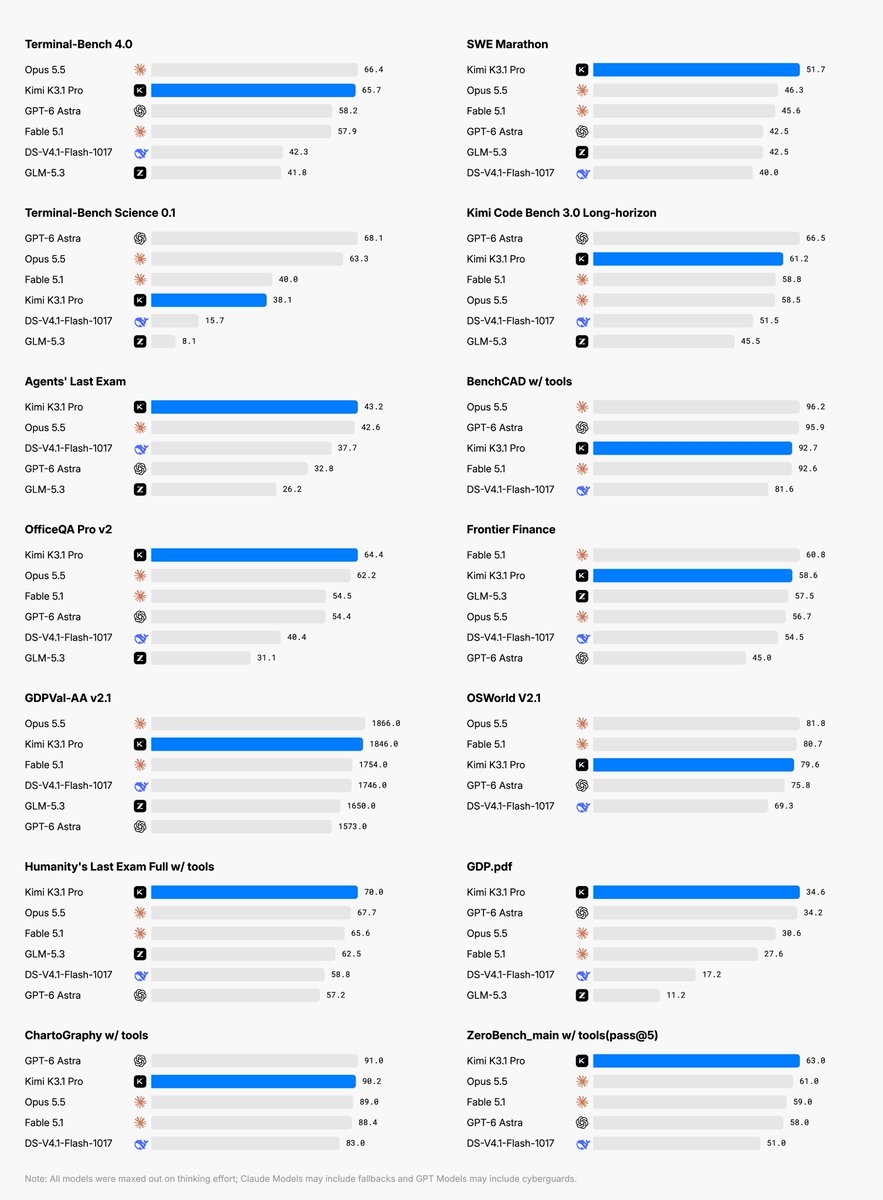
2.8T total, 104B active, 1M context. On Terminal-Bench 4.0 it scores 65.7%, with Opus 5.5 at 66.4 and GPT-6 Astra at 58.2. On SWE Marathon it tops the chart at 51.7.
What I actually like:
1. the hallucination work. on their hard internal stress test, claim-level hallucinations went from 23.4% (K3) to 8.3%. internal bench, so I'll wait for third-party numbers, but that's exactly what finance work needs
2. their own chart shows where it trails, like Terminal-Bench Science (38.1 vs 68.1 for GPT-6 Astra). no hiding the weak spots
3. for the open release they stripped cyber-related data from training and published the before/after on their exploit bench (90.5% down to 81.0%). an actual policy, with numbers
and the weights land by Nov 4. 104B active is still serious hardware, but it's yours to run, audit and fine-tune.
who's already planning to self-host it?
Introducing Kimi K3.1 Pro: our most capable 3T-class open-weight model.
🔹 1M-token context, 2.8T total / 104B active params (MoE), Multimodal.
🔹 Full-project coding: games in Unreal, Unity & Godot.
🔹 Excels at parametric 3D modeling in Blender & CAD.
🔹 More reliable at finance work: Accurate modeling with hallucination down by 65%.
🔹 Matching the strongest proprietary models across coding, agentic and knowledge benchmarks.
Kimi K3.1 Pro and K3.1 Pro Highspeed (2–3× faster) are now live on https://t.co/85jA71X9gw, Kimi Work, Kimi Code, and the Kimi API.
Open weights by Nov 4, 2026.
🔗 API: https://t.co/XCrgjXAqMw
🔗 Tech blog: https://t.co/5iPP0MBej6
@Kimi_Moonshot best line in the blog isn't a benchmark. when reward shaping stalled on the walking sim, K3.1 Pro stopped tweaking the reward and found 36 errors in the shoulder moment-arm math instead
that's debugging, not vibing. does the human-atlas setup ship with the weights on Nov 4?
@gregmushen certification. every model needs full Canadian safety approval before it can be sold, and BYD has no dealer open yet. Stella Li told Reuters sales likely start next year
so for now the quota is basically Tesla's
honest answer for most side projects: a .env and a prayer.
it works right up until the day it doesn't. a key in a public repo gets found by scanners fast, and the bill shows up before you do.
the setup I'd call the bare minimum:
1. .env in .gitignore before the very first commit, not after
2. gitleaks as a pre-commit hook, so the leak gets caught on your machine, not on GitHub
3. one key per project, never a shared master key you paste everywhere
4. usage limits on every provider dashboard, so a leak costs you a little, not everything
5. rotate the second you're unsure. it takes two minutes
once a project gets serious, the .env stops being enough. for those I sometimes use OVHcloud Secret Manager: secrets encrypted with their KMS, versioned, access controlled through IAM, and compatible with the HashiCorp Vault API, so you're not locked in.
the real rule: if the key ever touched a chat, a screenshot, or a commit, it's already burned.
what's your setup? and be honest about the .env
@vodka_boy honest answer for most side projects: a .env and a prayer
the cheap upgrade: .env in .gitignore before the first commit, gitleaks as a pre-commit hook, one key per project. for the serious ones I sometimes use OVHcloud Secret Manager.
yours?
@vodka_boy the CFPB even has a name for it: a "doom loop", answers going in circles with no offramp to a person
their sharper point: a bot is also less likely to waive a fee. sometimes the wall is the business model
@AILeaksAndNews K3.1 isn't even out yet. the real data is on K3: UK AISI and CAISI found it well below US frontier models on cyber, step 17 of 32 on their network range vs 28.5, and 0 of 41 exploits reaching code execution
and open weights means defenders get it too
US open source is getting interesting again, and it's happening at desktop size.
Smaug-Nemotron from @abacusai builds on Nvidia's Nemotron 3.5. here's what the base already brings, per Nvidia's tech report:
1. 120B params, only 12B active (hybrid Mamba-Transformer MoE)
2. 51.78% on SWE-bench Pro, ahead of Nemotron 3 Ultra with ~4.6x fewer active params
3. an NVFP4 build that keeps 99.62% median accuracy vs BF16, and runs on a single DGX Spark
4. 1M tokens of context
5. a permissive OpenMDW-1.1 license
that's the part I care about. a coding agent on one box under your desk means your repo, your prompts and your keys never leave the building. local-first stops being a hobby setup.
and this is how open models should work: Nvidia ships the weights, the data and the recipes, then others fine-tune for a job. Smaug goes after agentic coding.
what I'd want to see next:
- Smaug vs base on the same SWE harness
- whether the gain holds in NVFP4, not just BF16
- tokens/s on a Spark with a real repo in context
#DeepSeek and #Kimi set the open bar. good to see a US lab pushing at a size you can actually own.
who's running it locally already?
🚨 Announcing Smaug-Nemotron-3.5 - The Best US Open-Source LLM That Can Run On Your Desktop
We are super excited to push the boundaries of US open-source.
Smaug-Nemotron improves on Nvidia's latest model that literally runs on a single machine; all you need is one DGX Spark, one H200, or one GB200!
The Smaug variant is optimized for agentic coding, improves Deep-SWE, and enables local agents.
It's the best US agentic open-source model that can run on a single machine. Weights are now available on HuggingFace
@bindureddy the base is already strong: Nvidia's tech report has Nemotron 3.5 Super at 51.78% on SWE-bench Pro with 12B active. so the number I'd want is the delta
what does Smaug score on the same harness, and does it hold up in NVFP4 on one Spark?
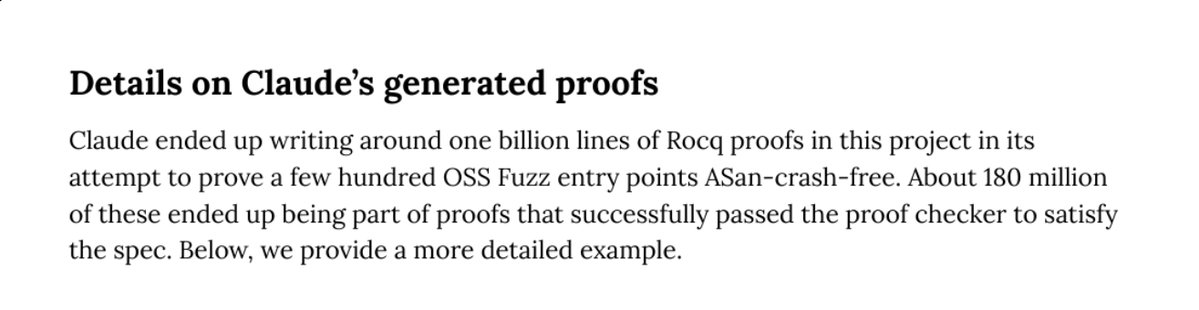
@jurlycat the appendix has the better number: Claude wrote about a billion lines of Rocq, and only 180M passed the checker. the kernel doesn't care how confident the model sounds
the next win is reuse. right now every proof re-proves libc and ASan from scratch
x402 is the cleanest answer so far to "how do agents pay for the web". started by Coinbase, now a foundation with Cloudflare
the flow is almost boring, which is the point:
1. agent requests a page
2. server answers 402 with price, token, network
3. agent signs a payment and retries
4. server verifies, settles, serves the page
no account, no API key, no session. just a wallet
per-request settlement doesn't fit crawlers though. thousands of pages, tiny amounts each. so Cloudflare proposed a deferred scheme, and the spec now has batch-settlement: the agent signs a commitment, gets the page right away, pays later in one batch. it even allows dynamic pricing: commit to a max, get charged the real price after
that's basically a tab. and a tab raises the real question: who do you extend credit to?
today an agent's identity is a signed request plus a public key in a directory (Web Bot Auth). that proves who it is, not whether it pays
whoever builds the credit layer for agents (payment history, limits, disputes) owns the next piece of the stack
anyone already on it?
Cloudflare launched x402 protocol a while ago, but how many publishers are actually making meaningful money from it so far?
If we treat AI agents as proxies for real humans, shouldn’t we give them some credit, like a trial before they pay, the same way we do with people?
Cloudflare x402 forces real-time payment. But what if publishers just let agents crawl first and send a monthly invoice later? Or do we still deep down treat agents as anonymous bots that can’t be trusted, even when they can act for a human?
@ethanwalkerman the invoice-later idea is already on the table. Cloudflare proposed a deferred payment scheme for x402 exactly for crawlers: sign now, pay later in one batch
the hard part is trust. a person has a credit history, an agent just has a key. would you extend credit to a key?