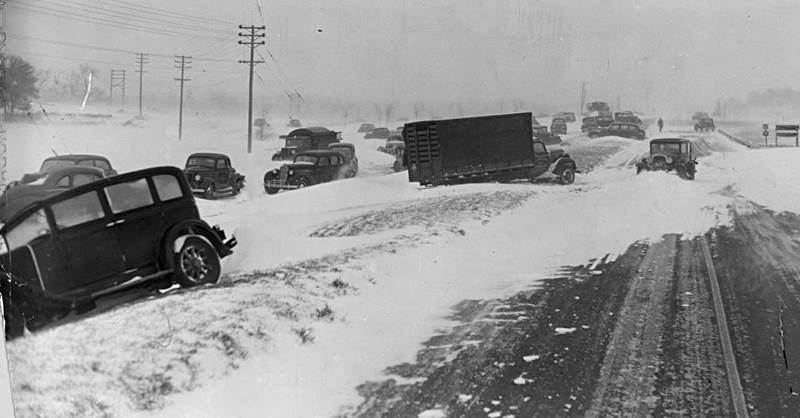
On Armistice Day 1940, duck hunters headed out to the Mississippi River in short sleeves.
By the next morning, some of them had frozen to death on little islands in the river.
November 11, 1940 started like a gift. A long Indian summer. Blue skies. Temperatures in the 40s and 50s across the Upper Midwest. A lot of folks had the day off for the holiday, and the forecast just called for colder weather and a few flurries.
To a duck hunter, that's a perfect setup. A cold front pushes birds south. So men and boys headed for the marshes and backwaters along the Mississippi, many dressed for a pleasant fall day.
Then the front hit.
Rain turned to sleet, then snow. Winds of 50 to 80 mph. Snow came down 3 to 4 inches an hour at its worst. Overnight the temperature fell into the single digits.
And here's the cruel part: the ducks came. Survivors said they'd never seen so many, thousands of birds pouring south ahead of the storm. Some hunters stayed out too long because the shooting was the best of their lives.
Hunters who tried to cross open water in the wind capsized and drowned. Others hunkered down on islands in wet canvas and wool. Some of them didn't make it through the night.
The next day, a Winona, Minnesota pilot named Max Conrad and one of his flight instructors, Bob Bean, flew low up and down the river, spotting survivors and dropping supplies.
One of the lucky ones was a 13-year-old Bud Grant, the future Minnesota Vikings coach. He and two friends couldn't find shelter until he heard a train horn, followed the sound to the tracks, and found a gas station to wait it out.
When it was over, the National Weather Service counted 154 dead across the Midwest, including 49 in Minnesota and dozens of sailors lost on Lake Michigan. Collegeville, Minnesota got 26.6 inches of snow. Drifts hit 20 feet. More than a million turkeys died.
What I take from it:
The nicest day of the fall can be the most dangerous. A warm morning ahead of a front is a warning, not a gift.
Dress for the worst weather of the day, not the start of it. Keep a dry layer and a way to make fire in your bag.
Know when to quit, even when the hunting is good.
We get those warm November days here in the Ozarks too, right before a front comes through.
What's the worst weather you ever got caught out in?
@EchoesofWarYT Most of the Andersonville dead have names on their graves because of Dorence Atwater, a young Union prisoner who secretly copied the death register while working as a clerk there. In 1865 he went back with Clara Barton to mark the graves.
@Jason_R_Burt A lot of these came home and ended up in closets and attics all over the country. Worth having one looked at if it's in your family. Many were mass-produced Army swords, but some had much older blades remounted in military fittings.
@EchoesofWarYT Berlin actually wrote the first version in 1918 at Camp Upton for his Army show Yip Yip Yaphank, then shelved it for 20 years. He later put the royalties into a fund for the Boy Scouts and Girl Scouts.
@EchoesofWarYT Easy to forget the frontier war kept going after Yorktown. And George Rogers Clark's kid brother William would head west about two decades later with Meriwether Lewis.
@kershaw_alex Footsie Britt was an Arkansas boy, raised in Lonoke. Played for the Razorbacks and the Detroit Lions before the war. Lost his right arm at Anzio, came home, and later served two terms as Arkansas lieutenant governor.
On the night before World War I ended, U.S. Marines were ordered to cross a river under machine-gun fire.
Everyone knew peace was coming in the morning. They went anyway.
It was November 10, 1918, the Marine Corps' 143rd birthday. The 5th Marines were in the woods above the Meuse River in France, worn down from months of fighting. One battalion was down to about 300 men out of 1,200.
They got a hot birthday meal that day: coffee, French canned meat and black bread. And rumors. A runner named Elton Mackin later wrote, "There was also talk of Armistice on the morrow. The fellows didn't really want to fight again."
The orders came anyway. Cross the Meuse tonight and take the high ground on the far side.
The river was about 60 yards wide. On the other bank, roughly a thousand German soldiers waited with 36 machine guns, with artillery on the hills behind them. Army engineers had built footbridges out of scrap lumber from old barracks, lashed with rope and floated on empty metal drums.
After dark, in rain and fog, the Marines moved down to the water. German shells knocked out bridges before most men ever reached them. At the crossing near Letanne, one bridge was left.
Men crossed single file, 15 to 20 feet apart, because the sections sank knee-deep under too much weight. Bullets churned the water to froth. Mackin watched the second man ahead of him get hit, sink to his knee and slide face first into the river.
When his men hesitated, Captain Charley Dunbeck shouted, "I am going across that river, and I expect you to go with me," and stepped onto the bridge.
They made it. By dawn two battalions held the east bank. Then a runner came across the footbridge with a message: cease hostilities at 11:00.
A few minutes after 11, a German soldier walked out waving a white flag. Soon both sides were mixed together, swapping souvenirs. Mackin said he lay down on his rifle and fell asleep.
The crossing cost the 5th Marines 32 killed and 148 wounded, all on the last night of the war.
Their general, John Lejeune, wrote afterward: "On the night of November 10th, heroic deeds were done by heroic men."
Happy 251st birthday to the Marine Corps.
Would you have stepped onto that bridge?
#USMC
@EchoesofWarYT Those blocks were on purpose. The Bureau of Reclamation figured that if the dam had been poured as one solid mass, the concrete would have taken about 125 years to cool. They ran cold water through pipes inside it to speed it up.
@Jason_R_Burt The man who picked him was Sgt. Edward Younger. In France that October he walked past four identical caskets and set a spray of white roses on one. That's the one lying in the rotunda here.
@Jason_R_Burt Those were Darby's Rangers, and William Darby was a Fort Smith, Arkansas boy. He was killed in Italy in April 1945, just days before the Germans there surrendered. Arkansas is still proud of him.
@kershaw_alex Both Gott and Metzger got the Medal of Honor for staying with that plane. Gott was 21, a kid from Arnett, Oklahoma. Hard to read without getting a lump in your throat.
@Jason_R_Burt And the name is just the initials. C.B., for Construction Battalion. A lot of the early ones were experienced tradesmen the Navy pulled right off civilian job sites. Can Do.
In 1861, ten Union soldiers took over an abandoned newspaper office in a little Missouri town and started a paper that's still going 165 years later.
You've almost certainly heard of it. Almost nobody knows where it was born.
It's Stars and Stripes. And it started in Bloomfield, Missouri, down in the swamp country of Southeast Missouri.
Here's how it happened.
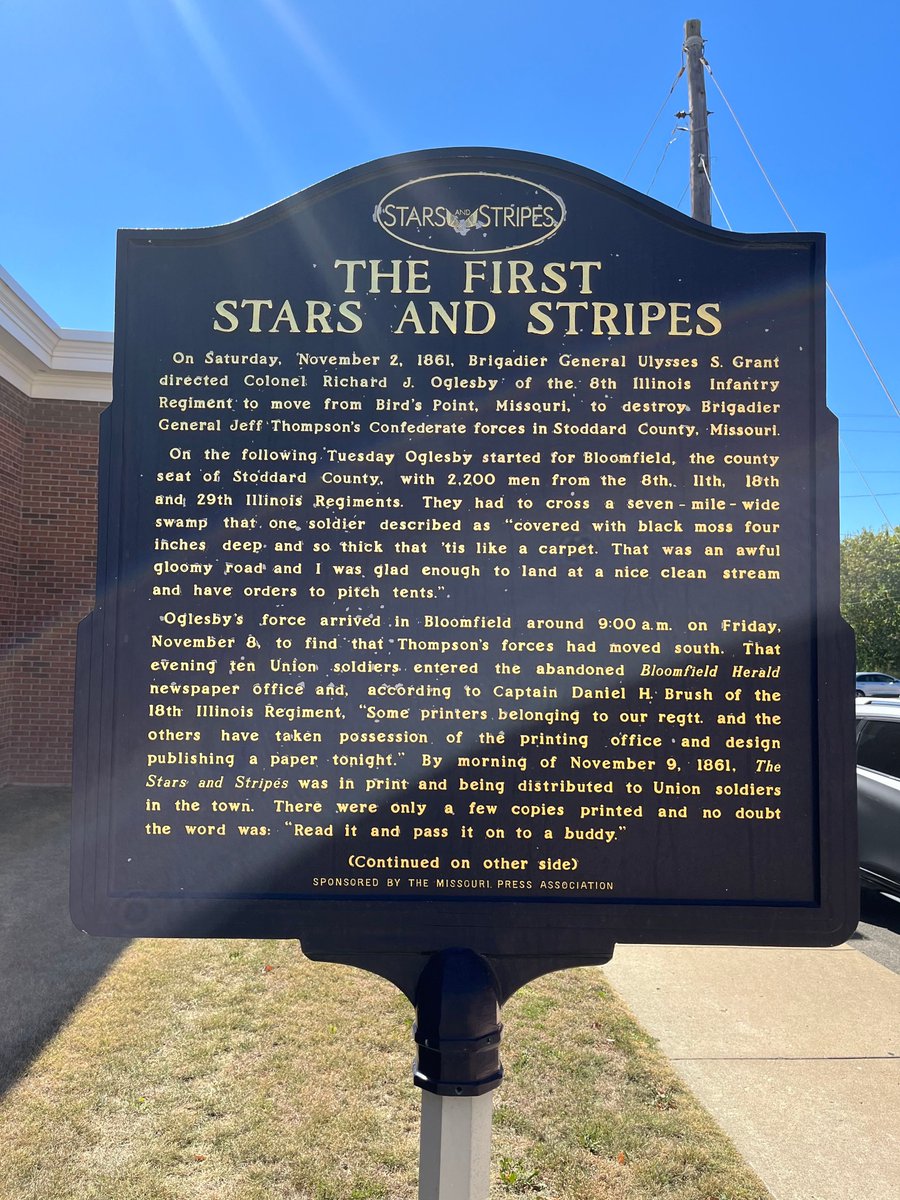
In early November 1861, General Ulysses S. Grant sent Col. Richard Oglesby out of Bird's Point, Missouri, with about 2,200 men from four Illinois regiments. The job was to run down M. Jeff Thompson, the Missouri State Guard general folks called the Swamp Fox.
To reach Bloomfield, the column crossed a swamp seven miles wide. One soldier wrote that the ground was "covered with black moss four inches deep and so thick that 'tis like a carpet. That was an awful gloomy road."
When they marched in on the morning of Nov. 8, Thompson's men were gone. So was most of the town. Some of the troops went to looting the stores. One soldier listed women's bonnets, flat irons and looking glasses three feet long. Oglesby had to send men to put a stop to it.
But ten of them found something better: the office of the Bloomfield Herald, left behind when its editor went south with Thompson's forces.
Those ten were printers and newspapermen back home in Illinois towns like Fairfield, Carmi, Shawneetown and Peoria. That night they set type by hand, one tiny metal letter at a time, backward, and ran off a paper of their own.
They called it The Stars and Stripes.
By the morning of Saturday, Nov. 9, 1861, it was being handed out to soldiers around town. Nobody knows how many copies they printed, but with 2,000-plus men in camp, you can bet they got passed hand to hand.
Then the army moved on, and the press stayed behind.
The name came back in Paris in 1918 for the doughboys in France. It came back again in a London print shop in 1942. And it's been serving American troops ever since.
Three months after that night, several of those ten printers were wounded at Fort Donelson. One was later wounded and captured at Vicksburg.
Today there's a Stars and Stripes National Museum and Library in Bloomfield, and it holds a copy of that first issue.
Not bad for a few boys with ink on their hands and a press nobody was using.
Did you know America's most famous military newspaper started in a Missouri swamp town?
#History
@historyinmemes Such a simple trick for something that big. A few smoke trails and you can actually see the shock wave hit. Old school engineering at its best.
@EchoesofWarYT Same week out west, Grant fought at Belmont, Missouri on Nov 7. The next day Union troops marched into Bloomfield, Missouri, and some Illinois printers in the ranks started the very first Stars and Stripes there.
@EchoesofWarYT Before all that he was Captain Harry Truman, commanding an artillery battery in France in WW1. Missouri farm boy turned president. We claim him proudly down here.
@Jason_R_Burt That same ship had a heck of a career. FDR met Churchill aboard the Augusta for the Atlantic Charter in 1941, and Truman rode her to Potsdam in 1945.
@Jason_R_Burt Torch put Americans ashore in North Africa just 11 months after Pearl Harbor. A lot of those boys had been civilians a year earlier. Hard to imagine climbing into those boats.
The biggest diamond ever found in the United States came out of a farm field in Arkansas.
And the farmer who found the first diamonds there has been called a fool for over 100 years. The records say otherwise.
His name was John Wesley Huddleston. Pike County farmer, outdoorsman, sometime prospector. In July 1905 he and his wife Sarah paid $2,000 for 243 acres of wooded hills and gullies south of Murfreesboro.
In August 1906 he spotted two odd crystals along a road that ran through the property.
Experts in Little Rock and New York said what they were. Diamonds.
He was soon recognized as the first person outside South Africa to find diamonds at their original volcanic source. His land sat on the worn-down top of a volcanic pipe almost 100 million years old.
Word got out fast. By September, Little Rock businessmen came calling. Huddleston took $360 cash up front for an option on a $36,000 sale, paid out over almost ten years.
Here's where the legend kicks in. For generations it got told like this: dumb backwoods farmer sells a diamond mine for chump change and blows it all.
That's not what happened. The family bought clear title to other land and moved to Arkadelphia in 1908 so their daughters could have the benefits of city life. He bought a car. A newspaperman who visited in 1920 found him "a wealthy man, as wealth goes in this remote region."
What wore him down came later. His wife died in 1917. A bad second marriage. Then the Depression. By 1936 he was drawing a $10-a-month old age pension. He died in 1941.
And the diamond mine? It never made anybody rich either.
Companies spent decades trying. A boomtown called Kimberly sprang up. One night in January 1919, mysterious fires wrecked one mining company's buildings and equipment.
In 1924 a worker named Wesley Oley Basham, nicknamed "Uncle Sam," dug out a 40.23-carat diamond. Still the largest ever found in America.
But the deeper rock never paid. The U.S. Bureau of Mines tested it during WWII. A big test in the 1990s came up short too. Arkansas finally banned commercial mining there for good.
So now it's Crater of Diamonds State Park, billed as the only diamond mine in the world open to the public. Pay a small fee, dig in the plowed field, and you keep whatever you find. Visitors turn up one or two diamonds a day.
I used to own 160 acres in Arkansas with an old lead and zinc mine on it, so I know the feeling of walking ground and wondering what's under it.
Huddleston took the sure money and lived well for years.
Would you have sold for $36,000 in 1906, or held out?
@Texas_Twins_Dad Yes, it got me a $1200 refund from VRBO in the first week, has saved thousands in attorney fees, hundreds in payroll per week, and more importantly right now (for me), untold hours of time savings. I’m in at about $150 for grok bot so far over the past month. It’s life changing.