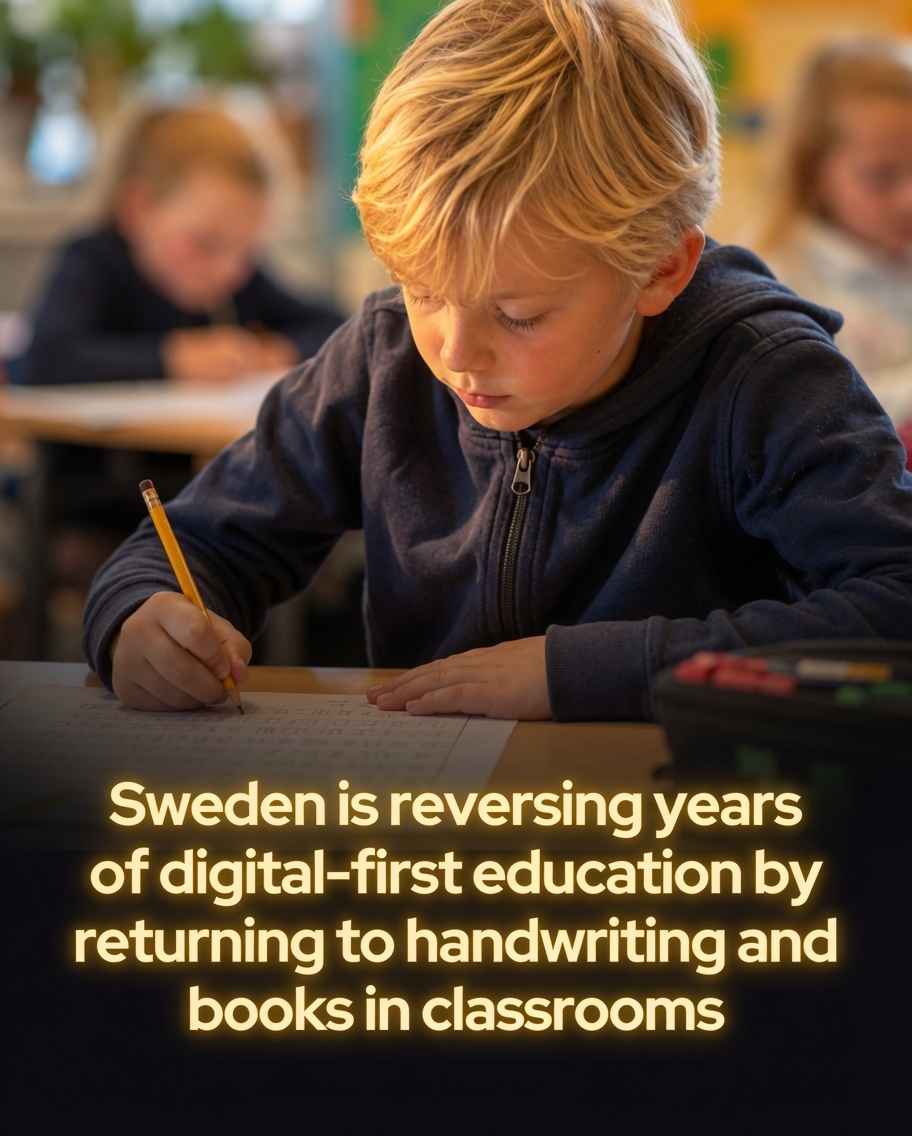
Sweden is reintroducing printed books and handwriting into its classrooms. Once celebrated as a leader in digital education, the country is now directing significant resources toward traditional textbooks while limiting the use of tablets and screens, particularly for young students.
Swedish authorities attribute this policy shift to mounting evidence that excessive screen time may have harmed reading proficiency and basic skill development. The government has also announced plans to ban digital learning tools for children under six years old.
Scientific research on handwriting provides insight into the rationale. When children write by hand, they engage multiple brain areas responsible for motor control, visual processing, memory, focus, and language. Unlike typing, this process demands precise coordination of fine movements alongside letter recognition and word formation. Studies indicate that such multisensory engagement enhances letter knowledge, spelling, reading acquisition, and memory retention.
Printed books may similarly promote stronger comprehension. Research shows that people often retain information more effectively from physical pages than from digital displays. The tangible nature of paper offers spatial references that aid memory organization. In contrast, screen based reading, especially when interrupted by notifications or hyperlinks, can fragment attention and reduce deep focus.
This approach does not reject technology entirely. Computers and tablets continue to serve important roles in research, group projects, accessibility features, and interactive exercises. Education specialists emphasize the need for thoughtful integration, applying digital resources where they prove most effective while safeguarding core practices such as handwriting, printed materials, and direct teacher instruction.
Sweden's policy change mirrors growing international discussions about optimal screen time in schools. As educators worldwide evaluate the benefits and drawbacks of digital tools, many are reconsidering when traditional methods may better support fundamental learning.
We are supposedly at war to stop Iran from enriching the uranium we “obliterated” over a year ago.
Yesterday we signed a deal to help Saudi Arabia enrich uranium.
The first time the United States has ever helped another country enrich uranium on foreign soil.
The Saudis refused the inspection protocol 140 other countries accept. Too intrusive, they said.
Trump agreed. He signed a national security waiver to get around the rule.
The Saudis paid Kushner $100 million. They put $2 billion into his firm. They put another $6 billion into LIV Golf, which pays Trump properties to host its tournaments. They signed ten billion dollars in Trump-branded real estate deals in Jeddah and Riyadh. All in just the last few years.
But sure. My paintings.
I’m old enough to remember when Republicans were losing their minds that a Muslim was being elected to head NYC just 25 years after 9/11. Now they are literally handing nuclear secrets and technology to the country that raised the attackers because Trump’s family is bought and paid for by the Saudi Royal family. This corruption is beyond measure and the Republican Congress is screaming about “communists” and threatening Cuba.
I don’t know how you argue that Saudi Arabia can have a nuclear program, but Iran can’t. The majority of the 9/11 hijackers were from Saudi Arabia. This is insane to me.
This is hilarious. 😂
🇺🇸 Trump: "We started this war to stop Iran's authoritarian regime from getting nuclear weapons."
🇺🇸 Reporter: "Then why are you giving 🇸🇦 Saudi Arabia—another authoritarian regime—a green light to build a nuclear program that could pave the way for nuclear weapons?"
🇺🇸 Trump: "...Next question." 🤣
No one exposes Trump's logic better than Trump himself. 🤡
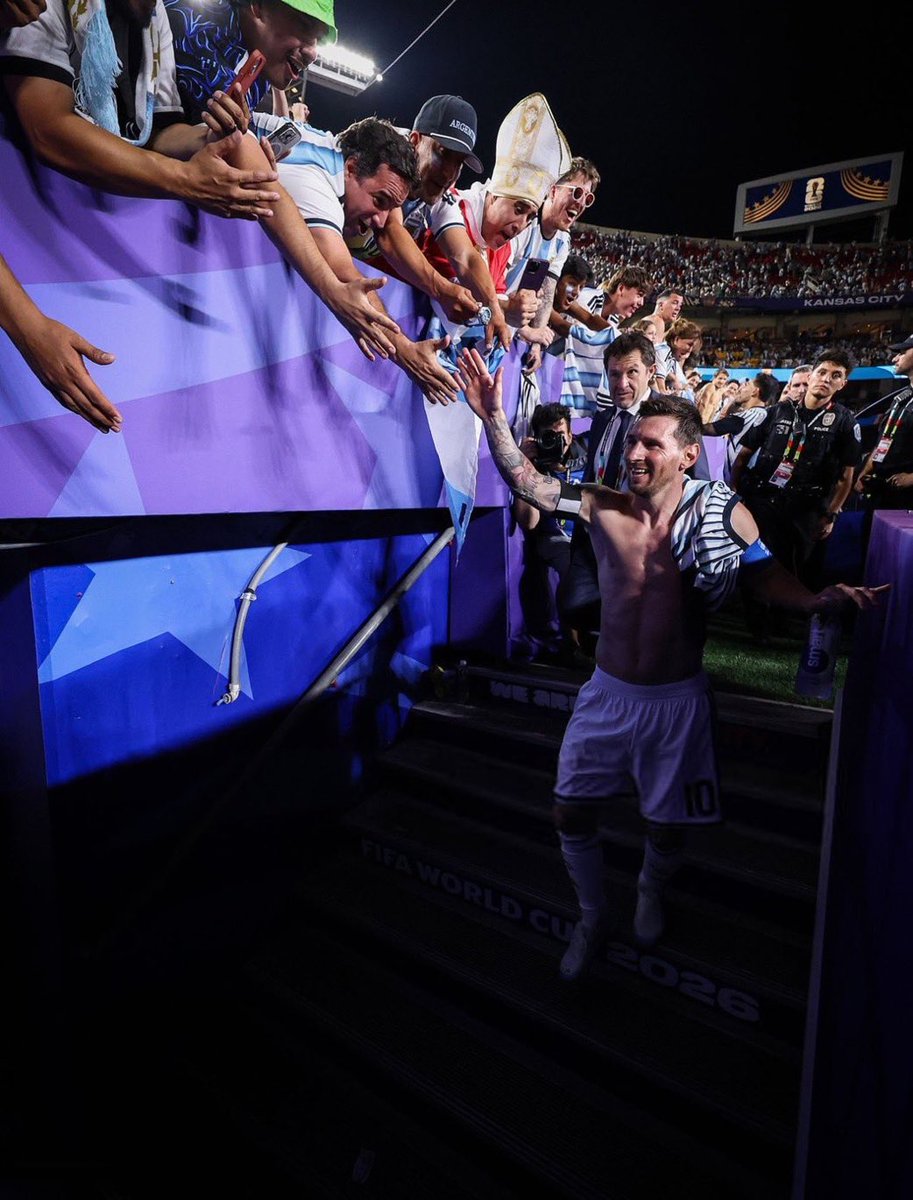
The only piece worth reading about Messi and Argentina right now. From the start, the hate campaign felt inorganic—and this exposes why. The implications are frightening, reaching far beyond one athlete, into how narratives are manufactured and public opinion weaponized.
ترك بيليه لعشاقه غصة عدم تحقيق دوري أبطال أوروبا
ترك كريستيانو رونالدو لعشاقه غصة عدم تحقيق كأس العالم
ترك مارادونا لعشاقه غصة عدم تحقيق كوبا أمريكا ودوري أبطال أوروبا
أما ميسي… فلم يترك أي فراغ في مسيرته
حقق كأس العالم، وكوبا أمريكا، والفيناليسيما، وذهبية الأولمبياد، ودوري الأبطال، والدوريات والكؤوس المحلية، إلى جانب الكرة الذهبية، وجائزة الأفضل، والحذاء الذهبي، وسجلًا فرديًا يصعب تكراره
مسيرة مكتملة… ولذلك انتهى الجدل منذ أن اكتملت كل صفحاتها.
#messi
#Argentina
this is when Messi couldn't hold back his tears after hearing his chants. And not just Argentina fans, even Spain fans were chanting his name. This is what he has achieved. People will forever love you GOAT 🐐🩵
Spain’s players refused to celebrate with Trump after the U.S. president attempted to insert himself into the middle of their victory photo. He was politely pushed aside.
Javier Mascherano on why Lionel Messi broke down in tears after the final whistle against Spain in the FIFA World Cup final.
🗣️ Javier Mascherano: “After the match, I went straight to Leo. I hugged him and didn’t say anything for a few seconds because I knew there were no words that could take away that pain. When he finally spoke to me, he said something that broke my heart.”
“He told me, ‘Jefe, these tears aren’t because we lost the World Cup. Of course losing hurts, but that’s not what’s breaking me. I’m crying because this might be the last time I ever wear the Argentina shirt. That’s the pain I can’t accept.’”
“When he said those words, I couldn’t hold back my own tears. People think footballers only cry because they lose trophies. They don’t understand. Sometimes you’re crying because you know a chapter of your life the most beautiful chapter is coming to an end.”
“I’ve known Leo for almost my entire career. I’ve seen him lift trophies, lose finals, face criticism and silence the world. But I’ve never seen him look the way he looked that night. It wasn’t the face of a man defeated by Spain. It was the face of a man saying goodbye to the jersey he loves more than anything.”
“He kept looking at the Argentina badge on his chest. He touched it, kissed it and whispered, ‘I gave you everything I had.’ There wasn’t a single person in that dressing room who could look at him without crying.”
“If that truly was his last match for Argentina, then the world didn’t witness the end of a football career it witnessed the final page of the greatest international story this sport has ever known. No trophy can measure what Lionel Messi gave to his country. He didn’t leave with just tears in his eyes; he left having given every last piece of his heart to Argentina.
Lamine Yamal consolando a Lionel Messi tras el triunfo de España sobre Argentina en la final de la Copa Mundial de la FIFA.
🗣️ Lamine Yamal: “Ganar la Copa del Mundo debería haber sido el momento más feliz de mi vida, pero cuando vi a Leo allí de pie después del pitido final, se me rompió el corazón. Por unos segundos, olvidé que éramos rivales. Solo vi al hombre que me hizo enamorarme del fútbol.”
“Me acerqué a él porque ninguna leyenda debería abandonar un escenario así sintiéndose sola. Este es el mismo Lionel Messi que inspiró a toda una generación a soñar, el mismo hombre cuyo nombre gritaban todos los niños mientras jugaban en la calle. Verlo con el corazón roto no fue nada fácil.”
“Le dije: ‘Gracias’. No por esta noche, sino porque sin ti, no sé si hoy estaría aquí. Antes de que tuviera la edad suficiente para entender el fútbol, tú ya habías cambiado mi vida. Les diste a chicos como yo la oportunidad de creer que la magia era real.”
“A los 39 años seguía cargando con Argentina, seguía pidiendo el balón, seguía decidiendo partidos y seguía atemorizando a los mejores defensores del mundo. A la mayoría de los jugadores se les recuerda por lo que hicieron hace años. Messi seguía haciendo historia en el presente. Eso merece mucho más que aplausos; merece un respeto eterno.”
“El mundo celebrará a España, y debe hacerlo porque nos ganamos este título. Pero no permitan que un solo resultado les haga olvidar todo lo que Messi le dio a este Mundial. Cada vez que tocaba el balón, sentías que algo imposible estaba a punto de suceder. Ese es un regalo que muy pocos futbolistas le han dado a este deporte.”
“Cuando lo abracé, no estaba consolando a alguien que había fracasado. Estaba abrazando al mejor jugador que ha visto mi generación. Las finales se ganan o se pierden, los trofeos cambian de manos, pero una grandeza como la de Lionel Messi le pertenece al fútbol para siempre.”
“Algún día la gente me preguntará cómo fue enfrentar a Lionel Messi en una final de la Copa del Mundo. No empezaré hablando del trofeo. Les diré que compartí la cancha con mi ídolo, que lo miré a los ojos después del pitido final y que le di las gracias por cambiar el fútbol para siempre. Ese momento permanecerá conmigo el resto de mi vida.”
𝗥𝗲𝗮𝗹𝗶𝘁𝘆 𝗕𝗲𝗵𝗶𝗻𝗱 𝗠𝗲𝘀𝘀𝗶-𝗬𝗮𝗺𝗮𝗹 𝗣𝗵𝗼𝘁𝗼𝘀𝗵𝗼𝗼𝘁:
Many people have wondered how five-month-old Lamine Yamal, born into an ordinary, working-class family with no influential football connections, ended up in a photoshoot with Lionel Messi.
The answer is beautifully simple: PURE CHANCE
In late 2007, the Spanish newspaper Sport and UNICEF were producing a charity calendar featuring Barcelona players with babies. Yamal’s parents entered him into a public raffle, and he was among the children randomly selected. Messi, then a shy 20-year-old rising star, happened to be the Barcelona player assigned to their session.
The shoot took place at Camp Nou, where photographer Joan Monfort captured Messi holding and gently bathing baby Lamine as his mother watched nearby. Nobody involved knew that the child would later join Barcelona, wear the iconic No. 10 and become one of football’s biggest stars.
The photos remained largely forgotten until Yamal’s rise brought them back into the spotlight. Now, nearly two decades later, that anonymous baby and the young footballer holding him will lead Spain and Argentina against each other in the 2026 World Cup Final.
No influence. No special connections. Just a raffle, a charity photoshoot and a coincidence that now feels like destiny.
#Fıfaworldcup #lionelmessi #lamineyamal #ARGvsESP
Lionel Messi was asked why he broke down in tears after Argentina defeated England to reach the 2026 FIFA World Cup Final.
🎙️ Reporter: “Leo, the cameras caught you crying after the final whistle. What was going through your mind?”
🗣️ Lionel Messi:
“I wasn’t crying because we won a football match. I was crying because I remembered every sacrifice, every criticism, every painful moment that brought us here. When the final whistle blew, it all came back at once.”
“England made us suffer. They fought for every ball, they chased me everywhere, they tried to close every space and never gave me a second to breathe. There were moments when I could barely turn without two or three players around me. But that’s what a World Cup semi-final is. You have to suffer before you can celebrate.”
“There was one moment where I looked at the clock and said to myself, ‘Leo, this could be one of your last chances to take Argentina to another World Cup final.’ That thought stayed with me for the rest of the match. I wasn’t going to leave that pitch with any regrets.”
“When I made those two assists, I didn’t think about records or individual awards. I thought about the little kids in Argentina wearing this shirt, dreaming the same dream I had when I was their age. If we can give them one more night of happiness, then every drop of sweat is worth it.”
“After the whistle, I looked at my teammates. Some were on the ground crying. Some couldn’t even speak. I saw our coaching staff with tears in their eyes. Then I looked into the stands and saw thousands of Argentine supporters crying with us. In that moment, I couldn’t hold my emotions anymore.”
“I want to thank every Argentine who has stood by us. You have carried us through difficult moments with your love and your belief. Every time we step onto the pitch, we feel an entire nation pushing us forward. This victory belongs to you as much as it belongs to us.”
“But please don’t celebrate as if our story is finished. We haven’t achieved our dream yet. We’re one match away from history. One more battle. One more sacrifice. I promise you this team will leave everything on that pitch because wearing this shirt is the greatest honour of our lives.”
“For Argentina… for our families… for everyone who never stopped believing we will fight until our very last breath.”
In December 2007, a Barcelona newspaper ran a charity raffle to pick a local baby for a UNICEF calendar shoot.
The winning family brought their 5-month-old son.
The 20-year-old Barca player assigned to bathe him was Lionel Messi.
The baby was Lamine Yamal.
Nobody thought about the photo for 15 years.
Then the baby debuted for Barcelona at 15. Won the Euros at 16 while still doing homework. Took over Messi's number 10 shirt.
On Sunday they meet in the World Cup Final.
Messi is 39. It's likely his last one.
Yamal turned 19 two days ago. It's his first.
The baby Messi held in his hands is now trying to take the trophy out of them.
July 1799. A French officer named Pierre Bouchard is supervising repairs on a crumbling fort near the town of Rashid, in the Nile Delta. Napoleon had invaded Egypt the year before and dragged along 150 scholars, because of course he did.
The soldiers are tearing into an old wall. Someone pulls out a slab of dark granite, broken at the top, chipped down the side. It had been sitting in that wall as construction filler for centuries. Recycled rock. Nobody's treasure.
Bouchard looks at it and notices something. There is writing on it. Three different kinds of writing.
Here is why that mattered.
Egyptian hieroglyphs had gone completely dark. The last person who could read them died sometime around the 5th century. Fourteen hundred years of silence. Europe had spent centuries staring at temple walls covered in birds and eyes and squiggles, inventing nonsense about mystical symbols, because the actual sound values were gone. An entire civilization left thousands of pages of writing and nobody on earth could read a word of it.
Now look at the slab. Hieroglyphs on top. Demotic in the middle. And at the bottom, Greek.
Greek. A language scholars read perfectly well.
Same text. Three scripts. A key.
The British beat the French in Egypt two years later and took the stone as a spoil of war. The French general tried to claim it was his personal property. It did not work. To this day you can read the words painted on its side in the British Museum: captured in Egypt by the British Army, 1801.
But the text had already escaped. Ink impressions had been pressed and mailed to scholars all over Europe, including the French ones. The British got the object. Everyone got the puzzle.
It still took twenty years.
Thomas Young cracked part of it. Jean-Francois Champollion finished it in 1822, realizing hieroglyphs were not pure symbols and not pure alphabet but both at once, sound and meaning braided together. When it clicked, he ran to his brother's office, said "I've got it," and passed out cold on the floor.
And the message that reopened three thousand years of human history?
A tax deal.
It is a decree from 196 BC, signed off by a council of priests for a 13 year old king named Ptolemy V. Temple funding. Debt forgiveness. Amnesty for prisoners. Grain allowances. Politics.
The best part is the ending. The decree instructs that it be carved in all three scripts and placed in every major temple in the land.
The stone contains the order to create the stone.
A bureaucratic memo about priestly tax breaks, written in triplicate so everyone could read it, then thrown in a wall and forgotten. And that is the thing that gave us back Tutankhamun, the pyramids, the Book of the Dead, and every name in every tomb.
Civilizations do not die when the last person dies. They die when the last person who can read them dies.