When Serbs Do Their Part, Why Do the Rules Change?
I think there is a very clear pattern in the agreements Serbs have made with Western governments and international institutions over the last 30 years.
The problem is not only that agreements were later broken or only partially implemented. The bigger problem is that the words themselves seem to change meaning once the Serbian side has already implemented its obligations.
The Dayton Agreement, UNSC Resolution 1244 and the 2013 Brussels Agreement are very different instruments, negotiated at different times and under different circumstances. That makes the pattern even more striking: despite all those differences, the same problem keeps appearing.
Once forces have withdrawn, institutions have been integrated or competencies have been transferred, those steps become facts on the ground. But what was promised in return can still be reinterpreted, delayed or debated for years.
1. The Dayton Peace Agreement
Republic of Srpska accepted the constitutional order agreed in the DPA in 1995. Annex 10 describes the High Representative and lists his functions: monitoring implementation, maintaining contact with the parties, coordinating civilian organizations, helping resolve difficulties and reporting on implementation.
It says nothing about making laws, removing elected officials or overruling parliaments.
After Dayton, the Peace Implementation Council, or PIC, was created to coordinate international support for implementation. It was not created by Annex 10, is not mentioned in Annex 10, and the parties to Dayton never granted it any power there to expand the authority of the High Representative.
Yet it later became the framework through which the so-called Bonn Powers were developed, expanding the High Representative far beyond the functions actually written into the agreement.
Without our consent, the office evolved into something much closer to a colonial governor, able to impose laws and remove elected officials in a country still subject to extraordinary foreign supervision more than 30 years after Dayton. And once those powers existed, they were repeatedly used to reshape the institutional balance created at Dayton. Many of the most consequential interventions reduced Republic of Srpska’s competencies while strengthening institutions at the Bosnia and Herzegovina level.
Yes, the High Representative is the final authority regarding interpretation. But the power to interpret an agreement is not the power to rewrite it. If such extraordinary powers were intended, they could have been written into Annex 10 in 1995. They weren't.
The appointment issue follows the same pattern. Annex 10 speaks about a High Representative being appointed consistent with relevant UN Security Council resolutions.
Christian Schmidt never received a UN Security Council resolution endorsing his designation. The PIC had already designated him when, in 2021, the Security Council considered a resolution that would have expressly welcomed and agreed to that designation. It was not adopted.
Schmidt nevertheless took office claiming both the authority of High Representative and the additional Bonn Powers developed through that same PIC.
And that brings the two issues together. Serbs agreed to Annex 10. We did not agree that a body absent from the agreement could expand the powers of the High Representative and then decide who gets to exercise those expanded powers.
Serbs signed the words written in the agreement. We did not sign some imaginary "spirit of Dayton" that only foreign diplomats apparently understand and can redefine whenever the actual words become inconvenient.
2. UNSC Resolution 1244
Yugoslavia withdrew its army and police from Kosovo. Nobody had any difficulty understanding what "withdraw" meant. Yugoslavia had to do something concrete and it did it.
But the same resolution speaks about sovereignty and territorial integrity, an interim international administration, substantial autonomy, a political process toward a settlement and the return of an agreed number of Yugoslav and Serbian personnel.
Then suddenly every one of those words becomes flexible.
"Interim" can apparently last for decades and end with major Western states recognizing Kosovo as independent.
"Sovereignty and territorial integrity" apparently do not prevent those same states from recognizing the separation of the territory.
A "settlement" apparently does not have to be a settlement accepted by Serbia.
And the agreed return of Yugoslav and Serbian personnel provided for in the resolution never took place.
Why did we accept that "withdraw" meant an immediate and complete withdrawal? By the same kind of creative interpretation used against Serbia later, "withdraw" could just as easily have been declared to mean withdrawing two personnel per year.
But Serbia didn't do that. Withdraw meant withdraw.
Only afterwards did we start hearing variations of the same explanations about the other words in Resolution 1244:
"1244 was status-neutral."
"It didn't prescribe the final outcome."
"The status quo was unsustainable."
"Kosovo is a unique, sui generis case."
"The declaration itself wasn't prohibited."
"The authors were acting outside the framework."
"Recognition is for individual states to decide."
And after enough of that, somehow "sovereignty and territorial integrity," "interim," "substantial autonomy" and "settlement" no longer seemed to carry anything close to the weight those words had when Yugoslavia withdrew its forces in 1999.
But nobody ever said:
"Well, perhaps 'withdraw' is subject to various interpretations."
That word was apparently perfectly clear.
3. The 2013 Brussels Agreement
The Brussels Agreement may be the clearest example because the exchange is written almost side by side.
Major institutional changes were implemented on the ground. Serbian police structures in northern Kosovo were integrated into the Kosovo Police, members of other Serbian security structures were to be offered places in equivalent Kosovo structures, and judicial authorities were integrated into the Kosovo legal framework.
These were not vague promises about something that might happen one day. They were concrete institutional changes.
And what appears at the very beginning of the same agreement?
Point 1 says: "There will be an Association/Community of Serb majority municipalities in Kosovo."
And the following provisions are quite specific. The agreement says the Association/Community will be created by statute, will have its own structures and will exercise functions in areas including economic development, education, health and urban and rural planning.
That was signed in 2013. It is now 2026 and there is still no Association.
So once again, the agreed changes on the Serbian side became reality on the ground, while the central institutional commitment to the Serbian community remained unimplemented.
And notice the language again.
It does not say:
"The parties will consider whether an Association might perhaps be created in the future."
It says:
"There will be an Association/Community."
Apparently even "there will be" can become negotiable once Serbia has already implemented its part.
4. Reciprocity Has to Work Both Ways
These three cases are why I think Serbia and Republic of Srpska have to change not only how they negotiate agreements, but what happens when the other side fails to perform.
If the other side does not fulfill a fundamental part of an agreement, we cannot simply continue treating every step we implemented as permanent while asking politely for the other side to do the same.
If a fundamental obligation remains unfulfilled, measures implemented by the Serbian side that can still be reversed should not automatically be treated as permanent.
For Republic of Srpska, that means going back to the original Dayton arrangement that was actually signed and restoring competencies that were later taken or transferred under pressure, including through the exercise of the Bonn Powers, powers nowhere granted in the text of the Dayton Agreement.
For Kosovo, Serbia should treat all of Resolution 1244 as valid, not only the parts requiring Serbia to withdraw. The provisions concerning the agreed return of Yugoslav and Serbian personnel should finally be implemented.
And with Brussels, if there is still no Association after more than a decade, then Serbia should stop acting as if every institutional change it implemented under Brussels must remain permanent regardless of whether the other side ever implements its own commitments. Serbia should pursue the re-establishment of its institutions in accordance with the Serbian Constitution.
5. Agreements Need Consequences
Of course there would be political and economic pressure if Serbia started doing this. But there is also a price for never doing it.
If everybody knows that Serbia will fulfill its obligations, while the other side can delay, reinterpret or simply leave its own obligations unfulfilled for years without consequence, why should anyone respect the next agreement?
That creates exactly the wrong incentive. What the Serbian side implements becomes a permanent fact on the ground, while reciprocal obligations can remain open to interpretation or implementation for years.
That is the pattern that has to end.
The purpose is not escalation for its own sake. The purpose is to restore reciprocity and make non-performance carry a real cost.
The basic rule should be very simple:
The words in an agreement have to mean the same thing when they protect Serbs as they do when they bind Serbs.
@barinkayaoglu@micodju Hahaha a turk speaks. What about the mass killing of kurds, armenians, greeks, the little boys from the balkans, that you kidnapped and made a „special force“ out of them? Karma is a bitch an now is coming Israel. Tik tak tik tak you motherfucker, count your days.
@ideokatuvsleh Flüchtete von der Verfolgung? Du hast schon keine Ahnung. Bleib bei deinem Vatikan und deinem Tschechien, wieso kommentierst du überhaupt etwas über Serbien? Hurensohn
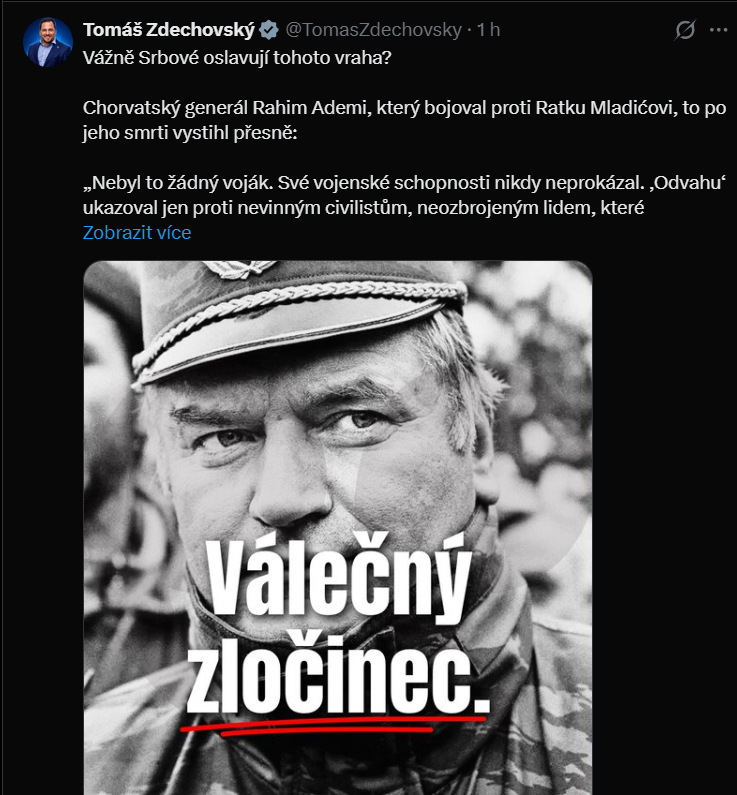
Europoslanec KDU-ČSL Zdechovsky byl vždycky svině a KDU-ČSL byla jednoznačně vždy proti Srbům a mnozí její členové obhajovali nacistické kolaboranty ustašovce, ale tady ten debil Zdechovsky fakt rozesmál. Protože píše úplnou kokotinu a ukazuje, jaký je to debil. K hodnocení vojenských schopnosti Mladiče asi tolik:
Styl Maldiče byl silně centralizovaný a osobní. Často mikromanažoval operace, byl na frontě, osobně řídil palbu (např. u Sarajeva). Štáb VRS je v vojenských analýzách (včetně CIA studie Balkan Battlegrounds) hodnocen jako nejprofesionálnější štáb ze všech tří stran – uměl plánovat složité operace i při nedostatku rezerv. Celkově je Mladič hodnocen jako nejlepší srbský generál a jeden ze tři nejlepších generálů velících v té válce. Tolik k debilovi Zdechovskému.
Mimochodem k tomu Rahim Ademi, tak to není Chorvat, ale Albánec z Kosova jenž byl nižším důstojníkem a byl horší velitel jak Mladič, proto nestoupal dále ve funkcích. Patří mezi válečné zločince, které ovšem nebyla vůle odsoudit a tak unikl trestu. Byl spoluodpovědný za válečné zločiny na Srbech, ale to Zdechovskému nevadí ....
Adeniho chorvatské jednotky byly odpovědné za vraždy srbských civilistů a zajatců, plenění a ničení vesnic (Divoselo, Čitluk, část Počitelje). Operace trvala zhruba od 9. do 17. září 1993. Samozřejmě, že ho soudili Chorvaté a ti ho osvobodili ...
Čistě morálně Ademi je stejně odpovědný za zločiny svých podřízených, jako Mladič, ale Ademi byl na prozápadní straně, takže spravedlnosti unikl ...
@FIGHT_4_RIGHT_S Kakav snajper safari? Kako mozes tako da propagiras protiv svoje zemlje? Idi iz Srbija ako Srbiju toliko mrzis. Cuj, NATO & love will save the world. Da kao sto su nas spasili sa bombama. Jebem ti takve Srbe.