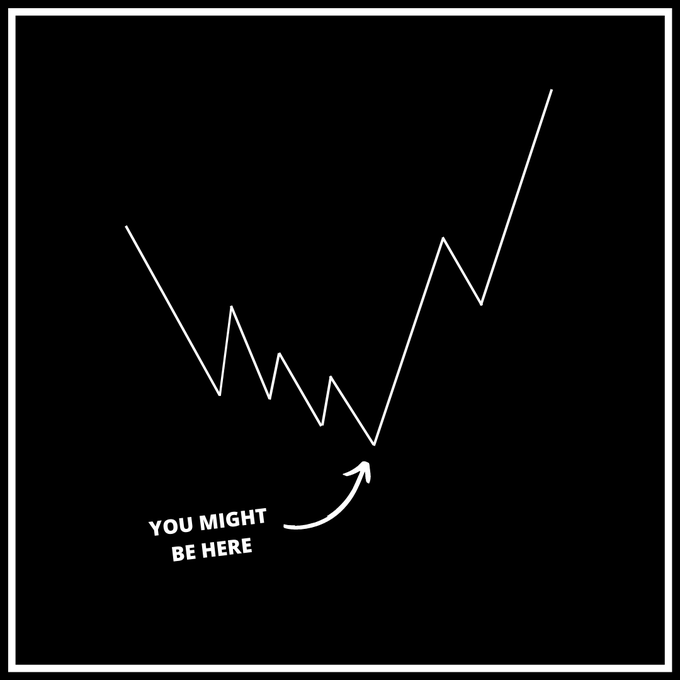
A crash is significantly easier to trade than the chop we are seeing right now. In a crash, nothing sets up, so you simply step aside and sit in cash. This tape, however, is a psychological trap. It offers just enough random movement to tempt you in, only to sell breakouts on contact and squeeze shorts with violent, stop-hunting ramps. Our tradeable universe is shrinking as the market actively hunts liquidity in both directions. Trading serious size in this environment is a losing proposition. Don't take the bait.
When you're going through a tough time or feel like you're getting all the bad breaks, don't ask, "Why is this happening to me?"
Ask, "What can this do for me?"
What can I learn from this? What opportunity might this create? What door could this be opening that I just can't see yet?
And if it feels like every door is closing, then ask yourself one last question: What's the lesson?
There's always a lesson. If you learn from it, the setback wasn't a waste. It was a gift.
Stop being ungrateful when you get gifts in disguise. Say, thank you teacher.
Learning to be a trader and learning trading are two distinct activities.
Learning trading is not that difficult, you learn about the basics: markets, products, risk, analysis, systems, execution, etc. - It takes a while, but nothing is too complicated.
But learning to be a trader is a very different challenge. - It requires developing the persona and resilience needed to succeed in a world of extreme complexity, radical uncertainty, and randomness, where your internal sense of balance and self-esteem are constantly challenged, and the very core of your identity is under almost total attack.
Because of that, your ability to execute on what you learn about trading becomes incredibly hard to reliably and consistently put into practice.
Trading is really simple, You just need to:
1. Stop needing excitement.
2. Stop trying to force daily income.
3. Accept that no setup is certain.
4. Build rules before emotions appear.
5. Reduce size.
6. Respect risk.
7. Understand survival is the real edge.
8. Learn patience before strategy.
9. Learn discipline before size.
10. Learn boredom before profitability.
11. Stop chasing candles that already left without you.
12. Stop confusing boredom with a signal.
13. Stop confusing activity with progress.
14. Stop looking for dopamine in candles.
15. Stop expecting trading to save your life right now.
16. Define exactly what your edge is.
17. Define exactly what invalidates it.
18. Ignore noise outside your model.
19. Ignore opinions during execution.
20. Ignore social media traders promising quick gains.
21. Understand that consistency looks boring.
22. Accept that most days are average.
23. Accept that most trades are forgettable.
24. Accept that losing streaks are temporary.
25. Accept that winning streaks are temporary.
26. Stop worshipping big wins.
27. Fear large losses more than missed gains.
28. Respect asymmetry.
29. Think in probabilities.
30. Think in samples.
31. Think in decades.
32. Detach from single trades.
33. Detach from needing immediate results.
34. Detach from validation.
35. Stop checking PnL every minute.
36. Focus on execution quality instead.
37. Journal your emotions honestly.
38. Study your worst behaviors.
39. Study your impulsive moments.
40. Find your destruction pattern.
41. Remove it ruthlessly.
42. Trade less than you think you should.
43. Wait longer than feels comfortable.
44. Enter only when conditions align.
45. Skip mediocre setups.
46. Protect mental capital.
47. Protect emotional stability.
48. Protect confidence carefully.
49. Sleep properly.
50. Eat properly.
51. Train your body consistently.
52. Reduce overstimulation.
53. Reduce screen addiction.
54. Reduce emotional volatility.
55. Learn how greed feels in your body.
56. Learn how fear affects decisions.
57. Learn how tilt begins.
58. Stop revenge trading immediately.
59. Stop increasing size emotionally.
60. Stop gambling after losses.
61. Stop fantasizing about jackpots.
62. Respect statistics over feelings.
63. Respect your historical data.
64. Respect your drawdowns.
65. Respect your limits.
66. Build routines that remove chaos.
67. Keep risk consistent.
68. Keep expectations realistic.
69. Keep emotions small.
70. Learn to do nothing.
71. Learn to watch opportunities leave.
72. Learn to miss trades peacefully.
73. Understand that FOMO never ends.
74. Understand uncertainty never disappears.
75. Accept that discomfort is permanent.
76. Backtest deeply.
77. Forward test slowly.
78. Scale cautiously.
79. Stay humble during hot streaks.
80. Stay calm during drawdowns.
81. Stop trying to predict everything.
82. Focus on reacting correctly.
83. Focus on process quality.
84. Focus on long-term survival.
85. Avoid strategy jumping.
86. Avoid indicator addiction.
87. Avoid over-analysis.
88. Avoid overconfidence.
89. Avoid emotional sizing.
90. Avoid “ALL IN” thinking.
91. Trade one system long enough to understand it.
92. Build trust through repetition.
93. Build confidence through evidence.
94. Build emotional control intentionally.
95. Stay consistent when bored.
96. Stay disciplined when emotional.
97. Stay patient when nothing happens.
98. Let probability play out.
99. Let time compound your edge.
100. Stay alive long enough for the math to work.
FRIDAY CLOSING LOSS RULE
My trading policy is to liquidate any trade that shows a loss on a Friday for two reasons
1. Enjoy a weekend without sweating a loser
2. Friday losses often get worse the following week
Rules rule
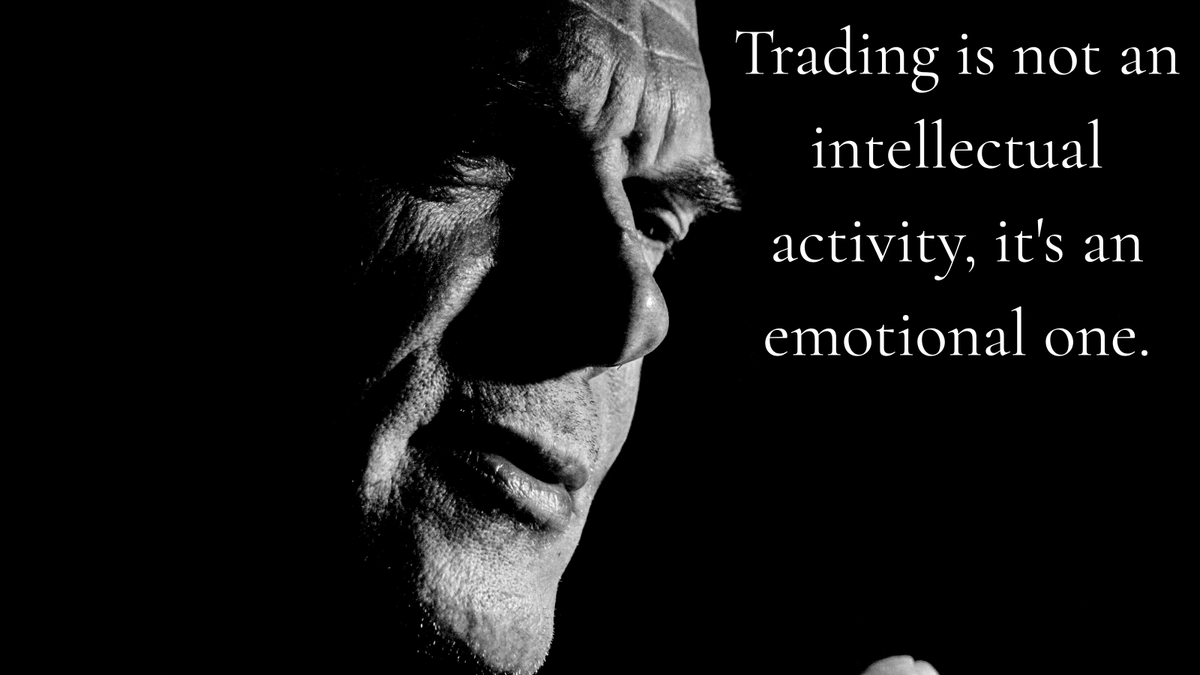
Trading is not an intellectual activity. It's an emotional one.
The decisions that cost you money aren't analytical failures. They're emotional ones. Fear. Greed. Ego. The inability to pull the trigger. The inability to let go.
Over-intellectualising pulls you toward analysis and perfectionism and away from the one thing that actually matters: taking risk.
The best traders don't eliminate the emotional side. They learn to work with it. Ignore it at your peril — it's always there, and it will always find you.
Taking a profit is often a "damned if you do, damned if you don't" dilemma.
While taking a profit is always better than taking a loss, there are times when taking a profit can create anxiety and outright regret.
Let's say you buy a stock at 50 with a mental target of 100 and maybe the possibility of 150.
Next let's say the stock goes to 100 but you do not take profits.
Next let's say that your trailing stop (if you use these) takes you out of the trade at 80.
Do you then regret not taking profits at 100? Of course you do if you are even part human being.
But what if you would have taken profits at 100 but then the stock kept running? Chances are you would have also regretted the decision to take profits at 100.
You see, taking profits is a damned-if-you-do-damned-if-you-don't business.
I hate regret. I decided many decades ago in my 50 year career that regret is something a trader needs to avoid. Living in a cycle of regret is not healthy for trading will sooner or later come back to bite you.
So I made a decision to create rules and stick by them. Rules created process for me so that my emotions were not led around by my last or current trade.
I take profits at targets when I have a light position on. If I take a heavier position I will then take profits at the initial target on a portion of my trade and hold out for a 2X profit on the other portion.
Do I miss the occasional rocket-ship market by taking profits? Of course. There is no perfect trading plan.
There is an alternative way that from time to time I will employ in a trade. That is using a simple moving average on a partial position so that I adopt a trend following approach on some of the risk I take.
In a trade following approach inevitably the top cannot be picked so some money is given back at the trend change or major correction. But again, there is no perfect model.
My recommendation to new traders is to commit yourself to the path of least regret, whatever that might be.
After a market correction is over, don’t be too quick to sell the stocks that rally first and show the strongest relative strength.
That is not always “risk management.”
In many cases, it actually increases the risk of missing a potentially massive winner.
Even today, I still make this mistake sometimes.
Why?
Because the stocks that recover first after a correction are often not just random bounce plays.
They are usually the names where money is flowing back first.
They show relative strength before the crowd fully realizes the market has turned.
They may be the next leaders of the new uptrend.
Real risk management is not selling a strong stock simply because it has gone up.
Real risk management is managing position size, knowing your invalidation level, and watching whether the price action actually breaks down.
If a stock remains strong, money is still flowing in, and the fundamentals and narrative are still intact, selling too early can actually be poor risk management.
So the key is not “never sell.”
The key is:
Don’t sell the strongest market leaders too easily just because you are afraid of giving back existing profits.
Many times, what truly changes your trading return curve is not taking small profits again and again.
It is whether you can sit through the right leaders long enough during a real market uptrend.
One of the most important things you can do as a stock trader is to be patient with yourself and allow yourself time to grow. Not all flowers bloom at the same time, and not every journey unfolds on the same schedule. It may take you longer than someone else to develop the skills, discipline, and understanding needed to succeed, but that doesn't mean you're any less capable.
Avoid measuring your progress against others. Everyone learns at a different pace and reaches important milestones at different points in life. Trading is a personal journey, and your timeline is your own.
I know this firsthand because I was a very slow starter. It took me six years before I even became profitable. There were many times when I could have concluded that I simply didn't have what it takes. But persistence, patience, and a commitment to continual improvement made all the difference. Most of all, I knew that those who succeeded were just men like me, and if they did it, then so could I.
So give yourself space and grace. Give yourself time. Stay committed to the process and focus on getting a little better each day.
Above all, be patient with yourself—the big rewards come to those who refuse to quit before their time arrives. If I could do it, so can you.
https://t.co/JXzFFTmMtn
A harsh reality
Are you out to turn a little into a lot in a hurry?
Look folks, there has been tons of research done on the success rate of retail traders. By exchanges, regulatory agencies, brokerage houses, trading platforms, academic researchers and the like.
The numbers are in and you are a fool to begin with if you think your are an outlier -- although all retail traders think they are outliers (and they usually are on the left side of the bell curve distribution).
Expectations and eagerness to trade for the sake of money are inversely correlated with success. Sorry, but true (of course except for in your dream world).
You want to turn $50k into $5 million in five years? Well, go for it if you that is your dream. But know that professional career traders in zero-sum markets (like futures, day trading anything and crypto) plead with you to trade their asset class. Please, I beg you to trade futures (my asset class).
Fresh meat is always welcomed.
Maybe you are among the 2 in 1,000 that can with a few years of experience achieve back-to-back-to back-100% years. I do not want to do anything to prevent your effort. I wish you well. In 50 years I've witnessed many try.
Or, do you have realistic profit expectations and want to become excellent in some niche of market speculation?
Then you have a chance.
But your chance depends on your ability to protect your capital and avoid big losses.
Here is the reality folks -- the real world where 99% of us live.
Pick your asset class. Now have adequate capital (the amt is disputable but I use the figure of $50k). Next know that no matter what you do it will take three to five years to even pick up the scent of where your excellence might be hiding.
Your challenge will be to develop some scheme or system or approach that is repeatable. Every successful trader has a different method. No exceptions. You cannot copy anyone. There are reasons why I won't go into.
You might have to try a few different approaches to find what methods are suitable to you.
But here is the HUGE challenge you face.
You will have to keep your capital intact (relatively speaking) or have deep pockets to get through the three to five years of the steep learning curve.
You will also need to avoid the fast talkers who want you to believe they have your answers.
Following are appeals I received via email in just the past week from "reputable" trading services (these are verbatim):
-$10,000 into $30,417. 14 out of 20 trades doubled
-that's a 1,004% return in 6 days, turning a $605 bet into $6,684
-1004% on UMAC
- +100% on BBAI in a day
-See how stock flips could have made $92,000 in one year!
-Soured 1,025% in just six months
-convinced this could be this year's next 1,000%
You fall for these lines, you are done for. Another reality is that not everyone is made for crazy success in trading. Most people would be better off living frugally and putting as much money as they can into a 50% SPY, 30% fixed income, 10% energy and 10% precious metals portfolio and let it work over time. Then pursue a day job that excites you.
So, don't be conned by the circus acts that promise you the moon. Trading is hard work. Tedious. Boring often. Stressful.
My standard recommendation to most young people is to get an education in a field that you like and where jobs are available. Like welding. Or supply chain management. Or engineering.
98% of you young folks will thank me for this advice someday.
Conclusion:
🧩 Trading is simple, but not easy
⚖️ Success comes from execution, not excitement
🚀 Master the basics and the results compound
Do the boring things better than everyone else.
Quote of the Day:
"Focus on tight ranges. Doesn't matter what time frame. Tight ranges is all you should focus on. Wide and loose is for losers and tight is for winners."
— @Qullamaggie
Process > Outcome.
At a certain point in every trade, you have zero control. None. The market does what it wants.
For the biological brain, this feels like an existential threat. Our hardware is wired to equate control with survival. When you let go, your amygdala screams "danger" and triggers a fight-or-flight response.
The market doesn't care about your survival instincts. It only cares about the math. Your biology wants you to "do something" to feel safe, but the winning move is almost always to stick to the pre-defined entry and exit rules.
Ignore the lizard brain. Trust the process. Real progress requires overriding the primitive self.
- 13 Stop Loss Rules Smart Traders Never Break -
RULE #10
🚨FOR BEGINNERS: USE AUTOMATIC STOP ORDERS.
Your stop loss plan was made before you entered— when your mind was clear and emotions were out of the equation.
Once your stop is set, stick to it.
For beginners, the simplest approach: use an automatic stop order. Let the price run if it goes up, and let the stop take you out if it hits. Just follow the plan.
RULE #11
🚨STOP LOSS GOES UP, NEVER DOWN.
Your stop loss should only move in one direction — up, as the trade moves in your favor.
Lowering it is just giving yourself more room to lose, unless you have the experience to read price action precisely.
A truly good trade tends to work right away — it shouldn't keep asking you to absorb more pain.
RULE #12
🚨KNOW YOUR MAX LOSS. NEVER CROSS IT.
Legendary investor William O'Neil recommended keeping total account drawdown within 5–8% of starting capital — and when in doubt, go smaller.
The market has tail risks that can wipe you out overnight.
A hard drawdown limit is what gets you out automatically before the damage becomes permanent.
RULE #13
🚨STOP LOSS RULES. NO EXCEPTIONS.
A new product launch, a big contract, a press conference, a hot new trend — none of it is a reason to skip your stop loss.
The rules apply in every situation, no exceptions.
Because the first job of every trader is to survive — and you can only win if you're still in the game.
🆕 Champion’s trading method — now on IG too.
👉 Follow us: IG@jlawstock2