Parliament has passed the Community Service Bill, 2026, introducing community service as an alternative to imprisonment for persons convicted of specified categories of offences.
The new legislation establishes a National Community Service Secretariat and provides a legal framework for non-custodial sentencing, with the aim of reducing overcrowding in Ghana's prisons and promoting offender rehabilitation.
Under the law, courts will have broader discretion to impose community service instead of custodial sentences in eligible cases.
[📸: JoyNewsOnline]
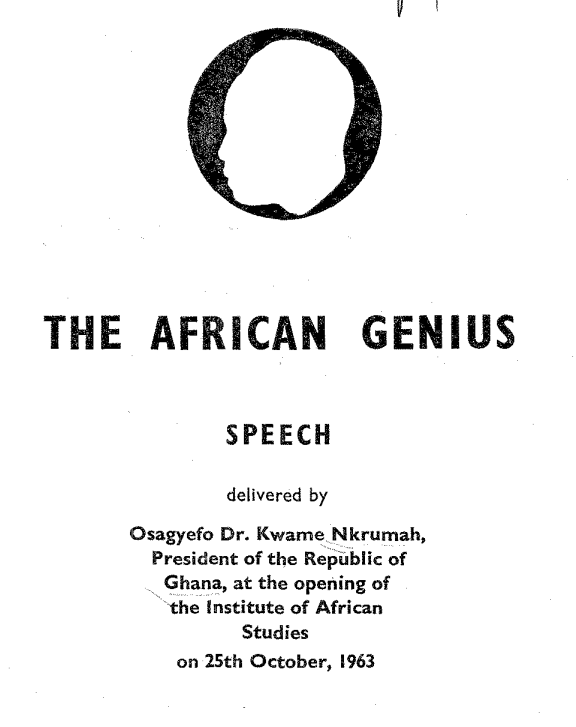
"The educated man should be so sensitive to the conditions around him that he makes it his chief endeavour to improve those conditions for the good of all."
@mytheoz Awesome work!! Amazed at how seamless the economic team makes this progress look. Only God knows the immense hard work behind the scenes.
Paid: $2.1B over 1.5 years 🇬🇭
QQ: how much debt is left to be paid to this lender?
Breaking News: The Supreme Court said a Rastafarian whose dreadlocks were forcibly shaved by prison guards could not sue them for money. https://t.co/wiJuvxa9Hq
Jeff Bezos: "If I do my job right, the value to society and civilization from my for-profit companies will be much, much larger than the good that I do with my charitable giving."
Winston Churchill fought his depression with bricks. He'd lay them for hours at his country home in Kent. He joined the bricklayers' union. And in 1921 he wrote about why it worked. It took psychology another 75 years to catch up.
He called his depression the "Black Dog." It followed him for decades. His method for fighting it back was as basic as it sounds: laying brick after brick, hour after hour.
Churchill spelled out his theory in a long essay for The Strand Magazine. People who think for a living, he wrote, can't fix a tired brain just by resting it. They have to use a different part of themselves. The part that moves the eyes and the hands. Woodworking, chemistry, bookbinding, bricklaying, painting. Anything that drags the body into a problem the mind can't solve by itself.
Modern psychology now calls this behavioral activation. It's one of the most-studied depression treatments out there. Depression sets a behavior trap. You feel bad, so you stop doing things, and doing less means less to feel good about. Feeling worse makes you do even less. The loop tightens until you can't breathe inside it.
Behavioral activation breaks the loop from the action side. You schedule the activity first, even when every part of you doesn't want to. Doing it produces small rewards: a wall gets straighter, a painting fills in, a messy room gets clean. Those small rewards slowly rewire the brain. Action comes first, and the feeling follows.
Researchers at the University of Washington put this to the test in 2006. They studied 241 adults with major depression and compared three treatments: behavioral activation, regular talk therapy, and antidepressants. For the people who were most severely depressed, behavioral activation matched the drugs. It beat the talk therapy. A 2014 review of more than 1,500 patients across 26 trials backed up the result.
Physical work like bricklaying does something extra on top of this. It crowds out rumination, the looping bad thoughts that grind people down during the worst stretches of depression. Bricklaying needs both hands and gives feedback brick by brick: each one is straight or crooked. After an hour you can see exactly how much wall you built. No room left for the mental chewing.
The line George Mack used in his post, "depression hates a moving target," is good poetry. The science behind it is sharper. Depression hates a brain that has somewhere else to be.
US health deal: The MoU included provisions that would allow drugs approved by the U.S. Food and Drug Administration to enter the Ghanaian market without undergoing test by the FDA -JoyNews Sources say
Follow our WhatsApp channel for all the breaking stories: https://t.co/MP3C3k9yWq…
#JoyNews #Viral #Explorepage #Ghana #JoyFM #GhanaNews #Ghana #NewsUpdate #Africa #GhPolitics #News #AfricaNews #CurrentAffairs #vlog
Game theory explains why working harder inside a broken system is the worst response to that system. Because a system is never truly broken. It's just producing exactly the outcomes its own incentive structures were designed to produce, whether intentional or not. Working harder inside this system increases your output in the payoff matrix, but it simply won't change the actual structure of the system's matrix. Thus, the correct response is not more effort. Instead, you must aim to identify whose interests the current structure serves and position yourself in favor of those interests rather than against them. Change the game, or play the game that is actually being played. Either way, you must stop optimizing for the game you wish it to be and start acting realistically.


![SIKAOFFICIAL1's tweet photo. Parliament has passed the Community Service Bill, 2026, introducing community service as an alternative to imprisonment for persons convicted of specified categories of offences.
The new legislation establishes a National Community Service Secretariat and provides a legal framework for non-custodial sentencing, with the aim of reducing overcrowding in Ghana's prisons and promoting offender rehabilitation.
Under the law, courts will have broader discretion to impose community service instead of custodial sentences in eligible cases.
[📸: JoyNewsOnline]](https://pbs.twimg.com/media/HMuwEHtXEAA5CeC.jpg)




![SIKAOFFICIAL1's tweet photo. Parliament has passed the Community Service Bill, 2026, introducing community service as an alternative to imprisonment for persons convicted of specified categories of offences.
The new legislation establishes a National Community Service Secretariat and provides a legal framework for non-custodial sentencing, with the aim of reducing overcrowding in Ghana's prisons and promoting offender rehabilitation.
Under the law, courts will have broader discretion to impose community service instead of custodial sentences in eligible cases.
[📸: JoyNewsOnline]](https://pbs.twimg.com/media/HMuwEHwWsAA4MdV.jpg)