LandBriefing is live: a free national land opportunity watchlist for developers and investors.
14 metros. Ranked on momentum, employer catalysts, affordability, and supply risk. Adjustable weighting sliders. Real underwriting discipline, not a static report.
Story: https://t.co/Rx3kvNiD9m
Go look: https://t.co/lnsR8qa4Zd
Where should you actually be looking for land right now?
I built LandBriefing to answer that. Opportunity scores across U.S. metros, ranked by momentum, catalysts, affordability, and supply risk.
Free to use. Drag the sliders, run your own thesis.
https://t.co/pFNvBVyvkT
Gary, Indiana is about to demolish 7,000 blighted properties as part of an $80M blight campaign. Nippon Steel already put $950M into the mill. Population decline has slowed, crime is down, and there’s a real master plan behind it.
Same setup Detroit ran a decade ago. Full thesis here:
https://t.co/aQlJ8vg2kg
J.P. Morgan just put $750B behind American housing through 2035. 1M affordable units. 500K homebuyers. A 40% jump over the prior decade.
I broke down what it actually means, and where I think the money does real work.
Kaufman & Company is proud to be part of this one.
https://t.co/ibOtONSsZl
USA TODAY just covered Spreadsight, the autonomous AI wholesaling platform we built through Kaufman Real Estate & Consulting and funded through Kaufman Ventures.
Here is the idea in plain terms. Most wholesaling tech stops at a scored lead and hands you back to the phone. Spreadsight does not stop there. It finds the opportunity, calls and negotiates with the seller, underwrites the deal, ranks it against your cash buyer network, and gets the contract signed.
One engine, running around the clock.
We did not launch this on a pitch deck. We field tested it first. The engine sourced 500 opportunities, made over 1,100 calls and emails, surfaced 900 sellers, and closed 211 wholesale deals worth more than 26 million dollars in total deal value, generating over 2 million dollars in profit. That is a 42 percent close rate from opportunity to closed deal.
Real estate wholesaling has run on cold calling teams, skip tracing subscriptions, and a dozen disconnected tools for a long time. Spreadsight consolidates that entire stack into one system that actually acts on your behalf instead of just organizing your leads.
Proud of what the team built and grateful to see it recognized by USA Today. Full story linked below, and a live demo is up now at https://t.co/DxI5Q54RwN.
Read the feature: https://t.co/MlO9xprGty
#RealEstate #AI #Wholesaling #PropTech #KaufmanVentures #Innovation
2019: we bought a century-old brick factory in Jacksonville's Springfield district, plus the empty lot across the street.
2026: the brick building gets 3 new stories. The lot gets modular workforce housing built with Oldivai — an iteration of Project Zero.
One block, two solutions.
What should anchor the ground floor? Reply below.
#Jacksonville #AdaptiveReuse
Nantucket is 55% vacation homes. Median listing: $4.9M. The nurses and teachers who work there can’t afford to live there anymore.
Same story in 9 other U.S. towns. Here’s the data, and what we’re doing about it: https://t.co/jjc3MdU6Jp
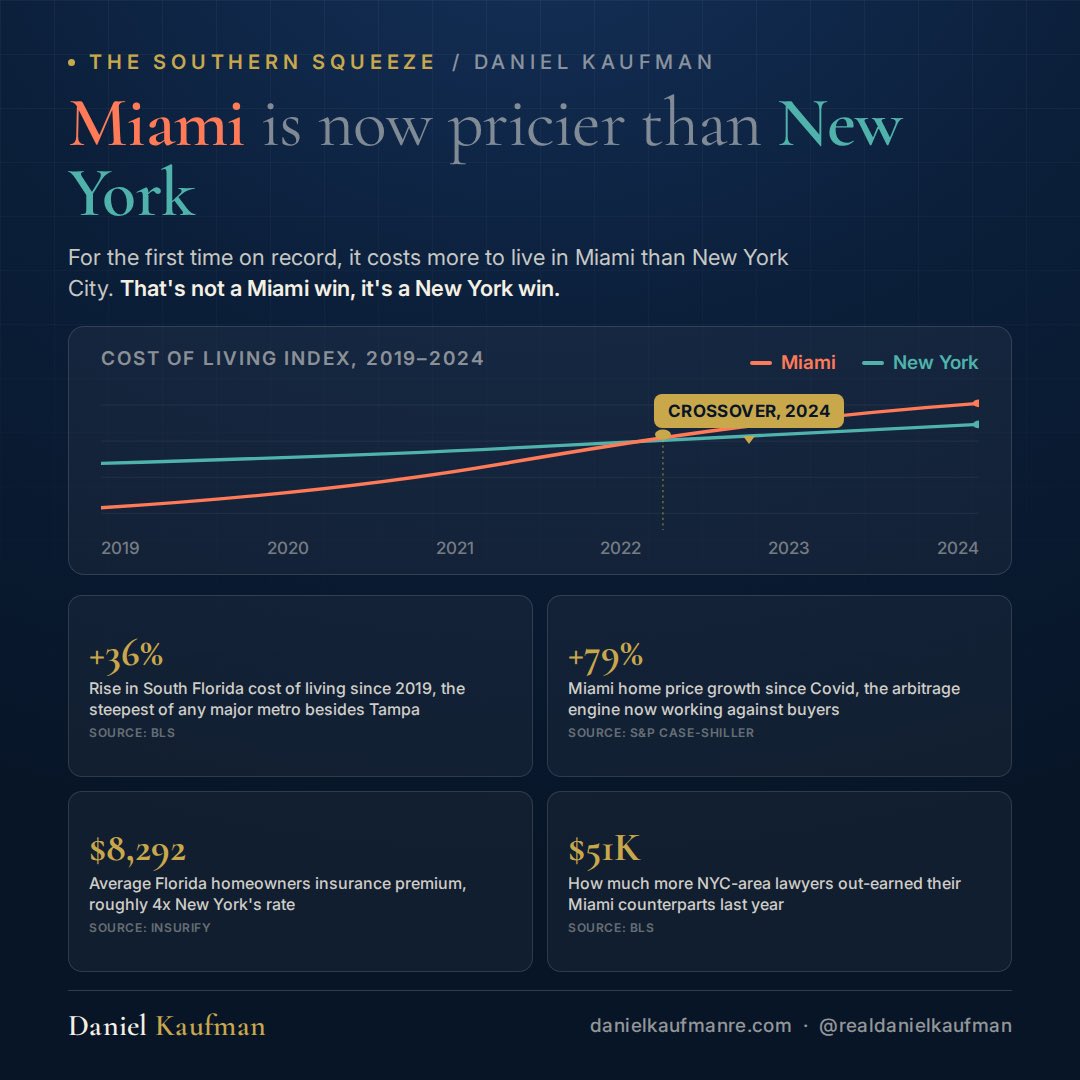
Miami just became more expensive than New York for the first time on record.
That’s not a Miami win. It’s a New York win.
The whole “Wall Street South” trade ran on one thing, a cost gap. That gap just closed.
https://t.co/YPOjJfOTIZ
Toledo is beating Austin in rent growth by more than 8 points.
The rebalancing we called is here. Supply discipline wins.
Full breakdown, plus how we are positioning capital for the next phase of this cycle:
https://t.co/nGtuYVrgmX
We broke ground on two hyperscale ServerDome data centers, one in Utah and one in Texas.
When the planning board saw the dome design, it changed the whole conversation. Not another big box. Infrastructure communities actually want.
Full story in @USATODAY: https://t.co/KPB5XbK8w9
New York just froze all new data center construction for a year. NY has ~130 data centers. Virginia and Texas have 500+ each.
This isn't a pause on data centers, it's New York opting out of having them. Full breakdown: https://t.co/co2wYVLQcN
The most significant federal housing law in a generation just took effect, and nobody wanted their signature on it.
The headlines say Washington cracked down on corporate landlords. The fine print says they built a fence and left the gates open.
My full read, after 25 years in housing: https://t.co/52tl4fFEjV
The biggest housing bill in decades just became law without a presidential signature, and if you build, lend, or invest in housing, you should care a lot less about the political theater and a lot more about the 40 plus provisions that are now federal law.
I published a full breakdown this morning on what actually made it in: the institutional single family buyer limits, the single stair multifamily permitting guidelines, the manufactured housing provisions, and the pieces that will actually move underwriting versus the ones that are press release material.
My short take: the drama around the signature is a footnote. The substance is the most meaningful federal housing supply push since 1990, and the developers who read the provisions now will be positioned before the guidance even drops.
Full analysis at the link. This one is for paid subscribers, and it's the kind of piece the subscription exists for. https://t.co/tKkAhzQcIn
#Housing #RealEstateDevelopment #HousingPolicy #Multifamily #CRE
Most firms pick a lane. We built a platform.
Kaufman & Company operates across four disciplines that rarely live under one roof: real estate development, private credit, venture investment, and infrastructure. Today the platform exceeds $2 billion in project value across ten operating companies.
DEK Builds carries homes, resorts, and commercial projects from first sketch to finished property. Kaufman Development leads our AI infrastructure and data center pipeline. DanReDev drives modular and mixed use development from Dallas. FORGE Development Partners and Design Build Affordable deliver affordable and workforce housing where the need is structural, not cyclical. Oldivai brings modular construction to workforce housing at scale. LoneStar Kaufman handles ground up development partnerships. Kaufman Real Estate & Consulting provides advisory and capital strategy. Kaufman Ventures makes early stage investments. Convivium Living builds community centered residential.
The common thread is operator discipline. We have been developing for years , and every position we take, whether equity, credit, or ground up, is underwritten by people who have actually built.
If you are working on something in AI infrastructure, affordable or workforce housing, design build, or private credit, our door is open.
https://t.co/1iYQ3ogfDo
The most important housing story right now isn’t a new tower. It’s the backyard.
24 states have legalized ADUs. 11 in the past two years alone. The cheapest housing America can build, on land that’s already paid for.
My full analysis: https://t.co/diXKDRBA3d
Builders hit pause. Apartments benefit.
1.18M housing starts, weakest since 2020
Completions down 16.8% YoY
NYC vacancy headed to 2.4%, lowest in the US
Supply decisions made today show up in fundamentals two years from now.
My full breakdown: https://t.co/lL5b6a072s
Impressive? Yes. Enough? Not close.
The metro is still short roughly 400,000 homes. Median one-bedroom rent just hit a record $4,000. At 2025’s record pace, it would take a decade just to catch up to today’s demand. Not tomorrow’s. Today’s.
I broke down the full story in my latest piece, including three takeaways I think most coverage is missing:
https://t.co/ZXorEis98g York’s formula is not magic. Rezonings opened the land. The 485-x abatement fixed the capital stack. Remove either one and NYC looks like the rest of the country.
2.The Sun Belt is not the opposite story, it is the same story on a lag. Today’s supply glut in Austin, Nashville, and Tampa is masking a 2027-2028 affordability crunch. The Southern Squeeze is still coming.
3.Record years built entirely at the luxury tier do not solve a workforce housing problem. The 80 to 120 percent AMI band, the teachers, nurses, and first responders, remains the most undersupplied segment in American housing. That is the gap we are attacking at Oldivai with employer-anchored land and modular delivery.
A record year that covers less than 10 percent of the shortfall is not a victory lap. It is a diagnostic.
Full analysis here: https://t.co/W9NjJxrroQ
What is your read, is New York’s surge sustainable once the incentive cycle matures, or was 2025 a pull-forward?
#RealEstate #Housing #Multifamily #CRE #WorkforceHousing #NewYork
Bloomberg called it the “Southern Squeeze.” I’ve watched it from the ground as a builder/investor in these markets.
Nashville, Atlanta, Charlotte sold a decade-long story: cheap land, low taxes, room to grow. That story’s over — prices doubled, costs are squeezing the people who built these cities.
This isn’t market failure — it’s a structural gap that didn’t fill fast enough. One of the clearest signals I’ve seen in years.
Full breakdown ⬇️
🔗 https://t.co/RdhPTOZUfP
#RealEstate #SunBelt #WorkforceHousing
Chicago missed the tech boom.
Quantum computing is its second chance — and we've been positioned in this market for 2 years.
$30B in data centers. $250M in federal quantum funding. The largest quantum hub in North America building now.
Here's the full breakdown 👇
https://t.co/MBouz7wDzc
89–10.
That's how many U.S. Senators just voted to pass the most significant housing legislation in a generation.
I've been building workforce housing for 25 years. I've watched a lot of bills die quietly. This one is different — and I want to explain why, including where it still falls short.
Three things stand out to me as a practitioner:
→ The institutional investor ban. Any investor owning 350+ single-family homes is now blocked from buying more. Wall Street buying up housing stock isn't the root cause of our crisis — undersupply is — but in a supply-constrained market, this pressure on families and workforce renters is real. Removing it matters.
→ The Modular Housing Production Act. This one is personal. At Oldivai, we build workforce housing using factory-based modular construction. We've always faced a financing mismatch: traditional FHA draw schedules don't reflect how modular projects actually get built. This bill directs HUD to fix that. Long overdue.
→ HOME program workforce housing expansion. The bill raises income eligibility to better serve the "missing middle" — households at 80–120% AMI. Teachers. Nurses. First responders. The people priced out of the communities they serve.
What doesn't it fix? Zoning. The single biggest barrier to building more housing remains a local fight. And it doesn't create the kind of employer-anchored housing pipelines I think are ultimately the most durable solution.
But 89 senators agreeing that supply needs to increase, financing tools need modernization, and the market alone won't get us there?
That's a real shift.
I wrote up my full take — as someone who actually builds this housing, not just comments on it:
https://t.co/T0Ne5MVeyq
#WorkforceHousing #RealEstate #HousingPolicy #MissingMiddle #ModularConstruction