On the 10th anniversary of Sandy, I wrote about barrier islands and the history of NY’s coastlines. It’s a tale of lost islands, forgotten hurricanes, and an endlessly transforming coast. Honored to share it with the @NewYorker https://t.co/YQtKeBXuqT
Thank you to Evan Lubofsky for the assignment and all the wonderful scientists who contributed. A special thank you to @Foukalpoint for inviting me aboard the Endeavor last year to view his work firsthand!
My cover story for @WHOI's Oceanus Magazine is now online. It's on ocean physics, the wild ways scientists measure it, and how the ocean's invisible currents dominate life on this planet. Check it out!
https://t.co/g9YFy5fmj0
Last year I had the opportunity to spend a month(!) at sea with WHOI oceanographer @Foukalpoint. If any editors are interested in a behind the scenes look at the magical, difficult, and sometimes nauseating work of mapping our oceans, hit me up!
Incredible wordsmithing by @dkgarz to summarize the complicated field of AMOC dynamics into a brief (too brief?) article: https://t.co/d2vMcnEJuV
@WHOI@NautilusMag
I know it's worrying. When the risks are existential, we'd like a bit more certainty. Focusing on the apocalyptic parts is a bit fatalistic. The important thing is continuing to reduce greenhouse gas emissions, so that in the absence of absolute certainty, we can stay any potential tipping points near or far.
Wrote a little story for @NautilusMag summing up what we know and don't know about #AMOC, a climate tipping point which made headlines recently after a
paper predicted the system is on track to collapse. 1/x https://t.co/Q2QoNYNKGE
@prince_luikun To crib Annie Dillard: A kiss may be this precursor to marriage; flying in an airplane may be a precursor to falling out of one. Just because you do the former, the other doesn't necessarily have to follow. The metaphor got a bit weird fast.😄
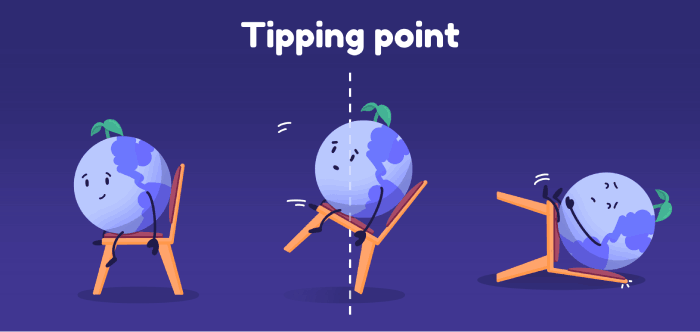
@prince_luikun People often use a chair metaphor. Lean back a little and the system returns to normal when you stop applying force. Lean back too far, and the system "tips" into a new state. An AMOC collapse is a potential result of going past this invisible tipping point.
@prince_luikun Good question! I agree. It's confusing how they are often meshed. A tipping point is just the point of no return. Picture tripping off a cliff. Once you've gone over the edge, there's nothing you can do, but there is still time (in this case decades) before you hit the ground.
What remains clear is that an AMOC collapse is an existential threat, but as of now we cannot yet predict the mechanisms and timing of a collapse with any certainty. It's an imperfect look at the future, and perhaps for the layman, an unsatisfying one.
@WinansC_A@NewYorker Hi Carol-Ann. I read the case study! Is there an email where I can send input? I can send you the original maps, georeferenced overlay, and point to some USGS material I relied on.
On the 10th anniversary of Sandy, I wrote about barrier islands and the history of NY’s coastlines. It’s a tale of lost islands, forgotten hurricanes, and an endlessly transforming coast. Honored to share it with the @NewYorker https://t.co/YQtKeBXuqT