Are you not entertained? 🤯
Ilia Malinin scored 200.03 points to secure the team event gold at the #WinterOlympics!
📺 @nbc & @peacock
https://t.co/V8lwsh3YKY
@NBCOlympics@kksheld I watched in a restaurant and didn’t hear the music. Her costume was distracting for me. It took away from the beauty and elegance of the skate instead of enhancing it.
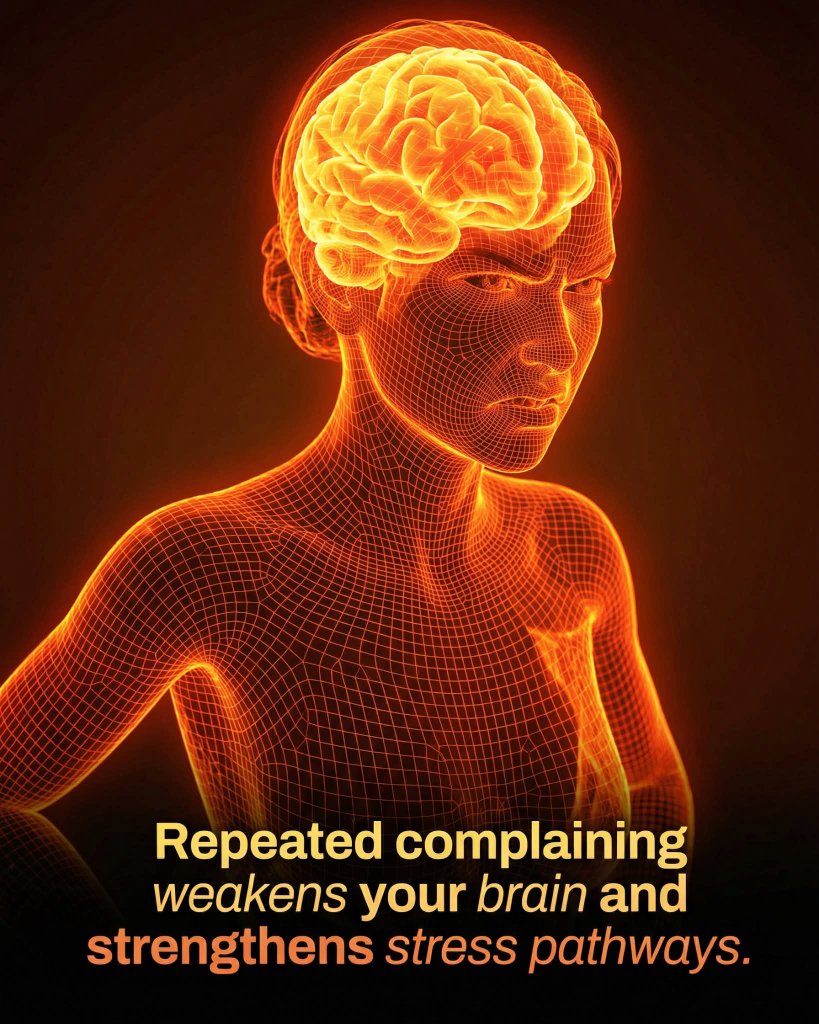
🚨 STOP COMPLAINING — IT’S LITERALLY TRAINING YOUR BRAIN TO BE NEGATIVE 🧠⚠️
Ever notice how some people seem stressed all the time, even over small things? Science says it’s not just their personality — it’s their brain.
Research shows that repeated complaining actually rewires your brain. Every time you complain, your brain activates stress and threat-detection circuits. Do it again and again, and those circuits get stronger. This process is called neuroplasticity — your brain becomes better at whatever you practice most.
So if you constantly talk about problems, frustrations, and annoyances, your brain learns to search for negativity. What starts as a bad day slowly turns into a habit of negative thinking. Over time, the brain treats the world as a dangerous place, even when nothing is wrong.
This is why chronic complainers often feel tense, irritated, or overwhelmed by small issues. Their stress level stays high because their brain is stuck in “alert mode.” Even minor problems feel big, because the brain has been trained to react that way.
The powerful part? This can be reversed. Stanford researchers explain that once you understand how your brain works, you can retrain it. Shifting how you speak — focusing on solutions, gratitude, or learning — builds new, healthier pathways. Your brain can be trained for calm, resilience, and clarity just as easily as it was trained for stress.
What you repeat, your brain remembers.
So choose your words carefully — you’re shaping your mind every day.
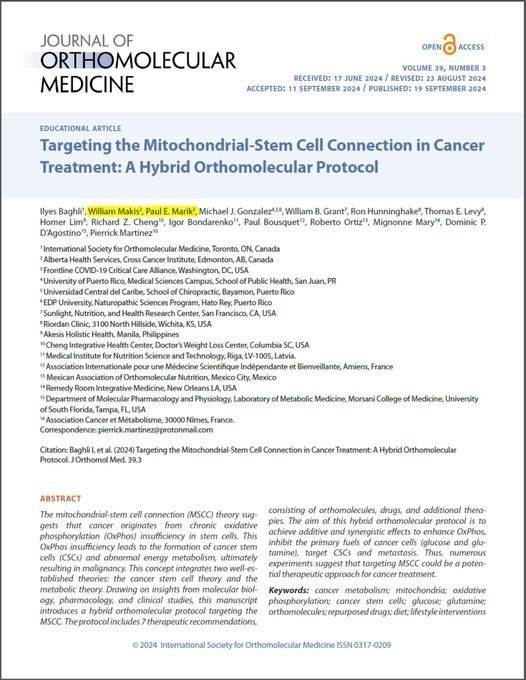
🚨🚨El PRIMER protocolo del mundo revisado por pares que utiliza antiparasitarios como ivermectina, mebendazol y fenbendazol para el cáncer ha sido publicado...
Esto podría cambiar el futuro de la oncología para siempre..
Estos medicamentos desempeñan un papel fundamental en el tratamiento del cáncer...
Miles de pacientes con cáncer ya han utilizado alta dosis de #ivermectina, #mebendazol y #fenbendazol con resultados notables...
La teoría de la conexión mitocondrial-célula madre (CMCM) sugiere que el cáncer se origina por una insuficiencia crónica de fosforilación oxidativa (OxPhos) en las células madre. Esta insuficiencia de OxPhos conduce a la formación de células madre cancerosas (CSC) y a un metabolismo energético anormal, lo que finalmente resulta en malignidad. Este concepto integra dos teorías consolidadas: la teoría de las células madre cancerosas y la teoría metabólica. Basándose en conocimientos de biología molecular, farmacología y estudios clínicos, este manuscrito presenta un protocolo ortomolecular híbrido dirigido a la CMCM. El protocolo incluye siete recomendaciones terapéuticas, que consisten en ortomoleculas, fármacos y terapias adicionales. El objetivo de este protocolo ortomolecular híbrido es lograr efectos aditivos y sinérgicos para potenciar la OxPhos, inhibir los principales combustibles de las células cancerosas (glucosa y glutamina), y dirigirse a las CSC y la metástasis. Por lo tanto, numerosos experimentos sugieren que dirigirse a la CMCM podría ser un posible enfoque terapéutico para el tratamiento del cáncer...
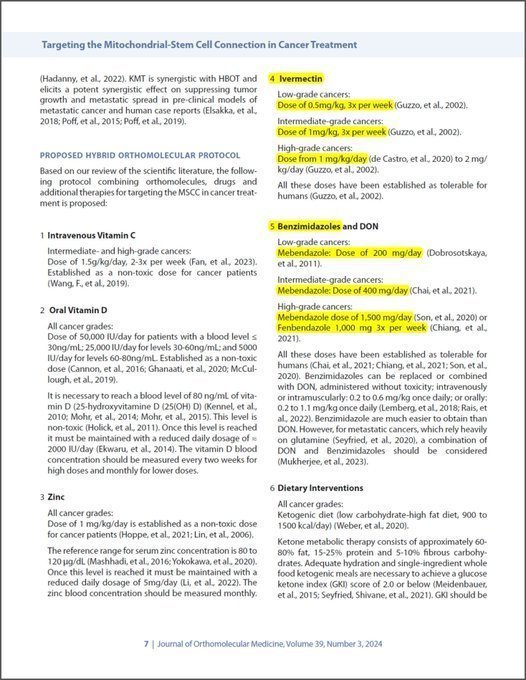
🚨PROTOCOLO ORTOMOLECULAR HÍBRIDO PROPUESTO
1. Ivermectina
* Cánceres de bajo grado: Dosis de 0.5 mg/kg, 3 veces por semana (Guzzo, et al., 2002).
* Cánceres de grado intermedio: Dosis de 1 mg/kg, 3 veces por semana (Guzzo, et al., 2002).
* Cánceres de alto grado: Dosis de 1 mg/kg/día (de Castro, et al., 2020) hasta 2 mg/kg/día (Guzzo, et al., 2002).
Todas estas dosis se han establecido como tolerables para humanos (Guzzo, et al., 2002).
2. Vitamina C Intravenosa
* Cánceres de grado intermedio y alto: Dosis de 1.5 g/kg/día, 2-3 veces por semana (Fan, et al., 2023). Establecida como una dosis no tóxica para pacientes con cáncer (Wang, F., et al., 2019).
3. Vitamina D Oral
* Todos los grados de cáncer: Dosis de 50,000 UI/día para pacientes con un nivel en sangre ≤ 30 ng/mL; 25,000 UI/día para niveles entre 30-60 ng/mL; y 5000 UI/día para niveles de 60-80 ng/mL.
Se ha establecido que esta es una dosis no tóxica (Cannon, et al., 2016; Ghanaati, et al., 2020; McCullough, et al., 2019).
* Es necesario alcanzar un nivel en sangre de 80 ng/mL de vitamina D (25-hidroxivitamina D (25(OH) D)) (Kennel, et al., 2010; Mohr, et al., 2014; Mohr, et al., 2015).
Este nivel no es tóxico (Holick, et al., 2011). Una vez alcanzado, debe mantenerse con una dosis diaria reducida de 2000 UI/día (Ekwaru, et al., 2014).
La concentración de vitamina D en sangre debe medirse cada dos semanas para dosis altas y mensualmente para dosis más bajas.
Consulta siempre con tu médico...
https://t.co/rYPaZusuJ4
🚨 Here is the full 42 minutes of my crew and I exposing Minnesota fraud, this might be my most important work yet. We uncovered over $110,000,000 in ONE day. Like it and share it around like wildfire! Its time to hold these corrupt politicians and fraudsters accountable
We ALL work way too hard and pay too much in taxes for this to be happening, the fraud must be stopped.
@Riley_Gaines_@AggieVolleyball Congratulations Texas A & M from a true Husker fan. The writing was on the wall with the reverse sweep. Your team showed that get it done attitude that is a mark of true champions. #TexasAM
@PaulGoldEagle I have been taking frequency tuned nutrition for over a year. People look at me like I’m crazy when I talk about this. I love that eyes are being opened to frequencies and the importance of being in sync with them. What an amazing creator we have. Everything has frequencies
I used to love my wife because she earned it.
When she was kind, I was kind.
When she respected me, I respected her.
When she didn't—I didn't.
Marriage was a transaction.
A balance sheet.
I gave what I got.
Nothing more.
Then one Sunday our pastor said something I couldn't shake.
"The way you treat your wife is the way you treat the Lord."
I thought he was being poetic.
He wasn't.
That night I looked at my wife.
Really looked.
She was exhausted.
The kids had been brutal.
The house was chaos.
And I was keeping score.
Waiting for her to earn my kindness.
That's when it hit me:
I wasn't loving a woman.
I was worshiping myself.
Every act of service I withheld was worship I stole from God.
Every cold shoulder was an altar to my ego.
Every "she started it" was a prayer to my own righteousness.
Marriage isn't a contract between two people.
It's an offering to the One who made them.
I started loving her differently.
Not because she deserved it.
Because He does.
I served her when she didn't thank me.
I pursued her when she pulled away.
I led when I didn't feel like leading.
Not for applause.
For an audience of One.
She noticed.
Not right away.
But one night she said:
"You're different. What happened?"
I told her the truth.
"I stopped loving you to get something back."
"I started loving you to give something up."
She didn't understand at first.
Now she does.
When you love your spouse as an act of worship
Everything shifts.
The scoreboard disappears.
The transaction ends.
And marriage becomes what it was always supposed to be.
A daily death to self.
A living sacrifice.
An act of worship disguised as a Wednesday night doing dishes.
Your spouse isn't your enemy.
They're your offering.
Treat them like one.