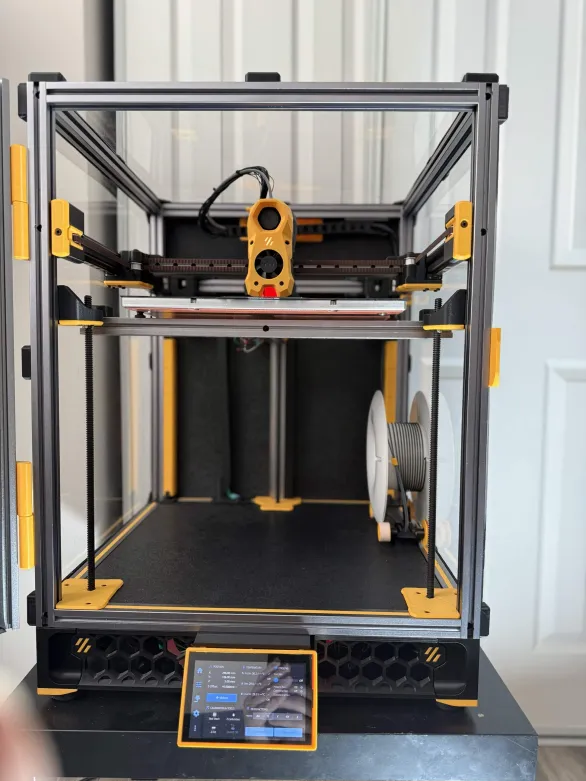
Trident R2 had been released!
With a reworked XY and Z motion system, CAD, STLs, panel DXFs and manual are on VORON Github. https://t.co/taV816rzVn
Thanks to everyone involved in the design, build, testing, and documentation for this update!
Change highlights below!
In what universe is it acceptable for the media or anyone affiliated with the media to donate to a political party? The same party they're meant to hold accountable and expose?
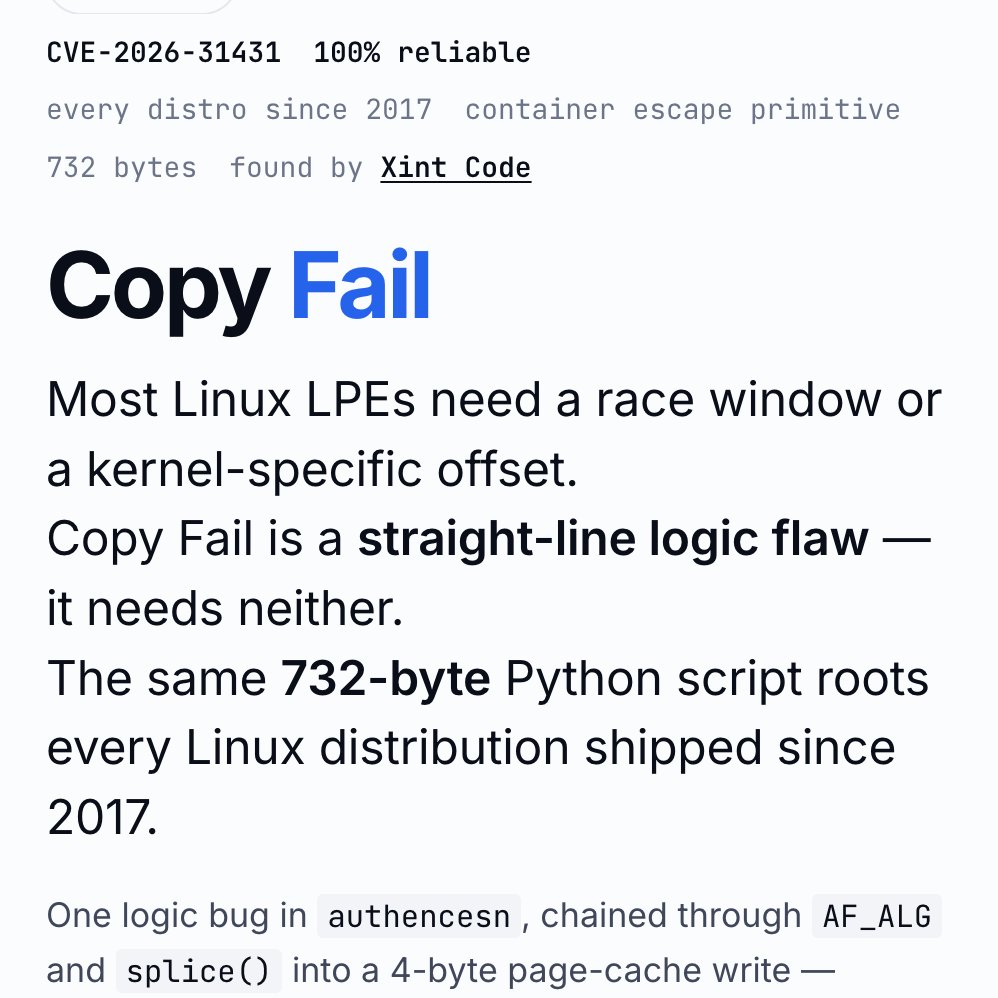
‼️🚨 BREAKING: An AI found a Linux kernel zero-day that roots every distribution since 2017. The exploit fits in 732 bytes of Python. Patch your kernel ASAP.
The vulnerability is CVE-2026-31431, nicknamed "Copy Fail," disclosed today by Theori. It has been sitting quietly in the Linux kernel for nine years.
Most Linux privilege-escalation bugs are picky. They need a precise timing window (a "race"), or specific kernel addresses leaked from somewhere, or careful tuning per distribution. Copy Fail needs none of that. It is a straight-line logic mistake that works on the first try, every time, on every mainstream Linux box.
The attacker just needs a normal user account on the machine. From there, the script asks the kernel to do some encryption work, abuses how that work is wired up, and ends up writing 4 bytes into a memory area called the "page cache" (Linux's high-speed copy of files in RAM). Those 4 bytes can be aimed at any program the system trusts, like /usr/bin/su, the shortcut to becoming root.
Result: the next time anyone runs that program, it lets the attacker in as root.
What should worry most: the corruption never touches the file on disk. It only exists in Linux's in-memory copy of that file. If you imaged the hard drive afterwards, the on-disk file would match the official package hash exactly. Reboot the machine, or just put it under memory pressure (any normal system load that needs the RAM), and the cached copy reloads fresh from disk.
Containers do not help either. The page cache is shared across the whole host, so a process inside a container can use this bug to compromise the underlying server and reach into other tenants.
The original sin was a 2017 "in-place optimization" in a kernel crypto module called algif_aead. It was meant to make encryption slightly faster. The change broke a critical safety assumption, and nobody noticed for nine years. That bug then rode every kernel update from 2017 to today.
This vulnerability affects the following:
🔴 Shared servers (dev boxes, jump hosts, build servers): any user becomes root
🔴 Kubernetes and container clusters: one compromised pod escapes to the host
🔴 CI runners (GitHub Actions, GitLab, Jenkins): a malicious pull request becomes root on the runner
🔴 Cloud platforms running user code (notebooks, agent sandboxes, serverless functions): a tenant becomes host root
Timeline:
🔴 March 23, 2026: reported to the Linux kernel security team
🔴 April 1: patch committed to mainline (commit a664bf3d603d)
🔴 April 22: CVE assigned
🔴 April 29: public disclosure
Mitigation: update your kernel to a build that includes mainline commit a664bf3d603d. If you cannot patch immediately, turn off the vulnerable module:
echo "install algif_aead /bin/false" > /etc/modprobe.d/disable-algif.conf
rmmod algif_aead 2>/dev/null || true
For environments that run untrusted code (containers, sandboxes, CI runners), block access to the kernel's AF_ALG crypto interface entirely, even after patching. Almost nothing legitimate needs it, and blocking it shuts the door on this whole class of bug...
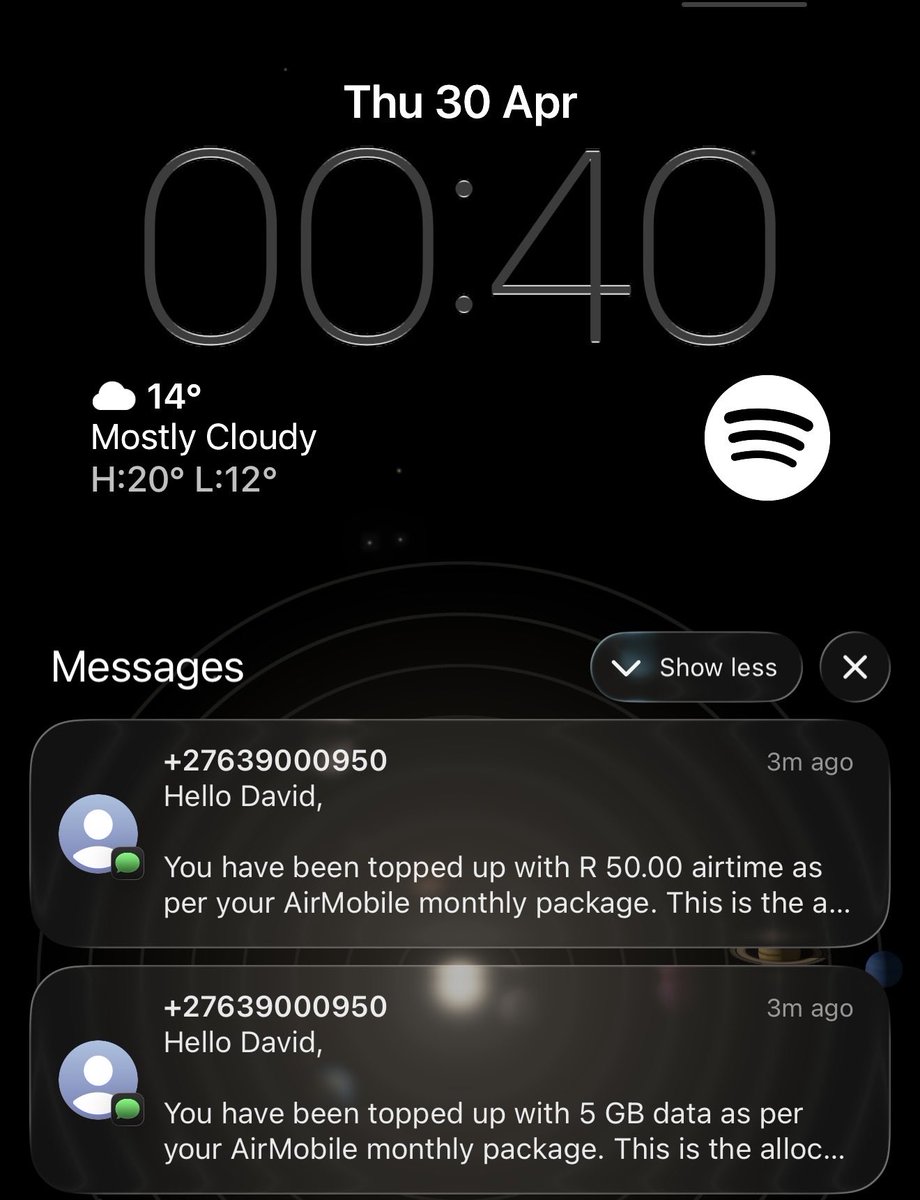
@airmobilesa how much do you hate your customers or did no one think sending messages at midnight wouldn’t wake anyone… disappointed how do i unsubscribe from these notices?
🇿🇦 A senior South African politician just got caught lying about Starlink to protect mobile network operators.
Parliamentary communications chair Khusela Diko claimed Starlink "doesn't move the needle" on school connectivity.
Here's what she left out: 16,000 schools still have no internet after 12 years, a missed deadline, and mobile operators billions over budget.
Starlink offered to connect 5,000 schools for free and was turned away.
A rural mobile tower costs around $61,000 and can serve just a single school.
The numbers don't lie. The politician did.
Source: MyBroadband
Show @afriforum some love today. It was AfriForum that laid the criminal charges against Julius Malema and it was AfriForum's private prosecution unit that had to threaten legal action to force the NPA to make a decision to prosecute.
@ErnstRoets All the politicians in South Africa who push their viciously racist laws should be sanctioned, barred from travel, declared criminals and have their international assets seized
@Discovery_SA An increase in insurance premium from 4621.22 to 5321.43 represents a 15.15% increase (an additional 700.21). This is the reason I moved away from discovery years ago it's going to happen again. Someone better fix it and call me.