In 2025, Frontier portfolio companies started building an additional 1.4M ton of annual carbon removal capacity.
Our annual letter looks back at some of the progress, the hurdles, and what’s top of mind for us for the year ahead.
https://t.co/WNlp5uesuK
Ocean alkalinity enhancement could remove gigatons of CO₂ from the atmosphere and ease acidification, but it has to be done with care. That means:
• Site-specific material testing
• Stage-gated deployment under strong regulatory oversight
• High-frequency ecosystem and MRV monitoring
• Stopping activities if thresholds are exceeded
Planetary removed the first certified ocean alkalinity tons; now they’re advancing operations at Tufts Cove in Nova Scotia with a $31M Frontier deal.
https://t.co/yN14GYP1Id
Quick state of play on Ocean Alkalinity Enhancement (OAE): where the science stands, what recent trials show, and why it warrants careful, scaled testing. 🧵
The companies in Frontier’s fifth round of prepurchases focus on two promising but underexplored approaches:
- Ocean alkalinity enhancement
- Surficial mineralization
https://t.co/J1MflUySyZ
Planetary just delivered the world's first verified carbon removal tons via ocean alkalinity enhancement (OAE).
We think OAE is hugely promising. Part of what's made it tricky is the measurement/verification piece. Planetary's delivery represents some big strides forward here: https://t.co/enJByAjXfh
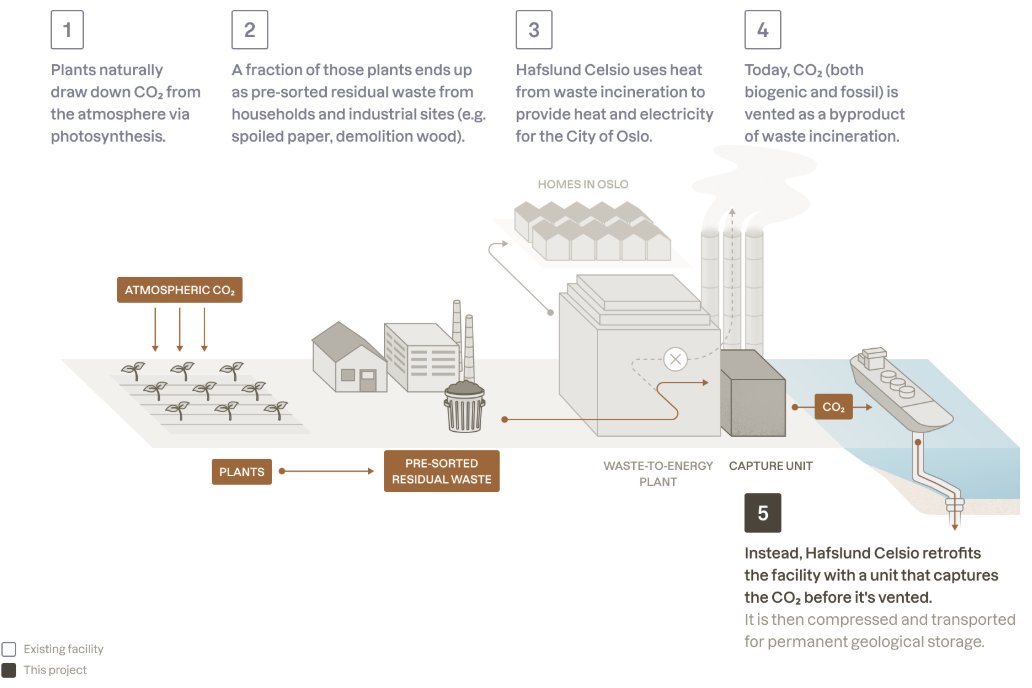
Hafslund Celsio is building the world's first carbon removal retrofit at a waste-to-energy facility, enabled by a $30M offtake with Frontier buyers. Writ large, this approach could remove 400 million tons of CO2 per year by 2050. https://t.co/5GNP9wUF1h
Frontier buyers have signed $33M in offtake agreements with Eion! 🪨🌿
Eion uses olivine, a fast-weathering rock that serves as a substitute for ag lime. This means high farmer adoption, more CO₂ removal per ton, and better data on weathering rates.
https://t.co/daoprhdXKm
Getting clean energy procurement right is a key requirement for making energy-intensive carbon removal approaches (like DAC) credible.
Today, Frontier has published a set of buyer principles for responsible clean energy procurement (link in following tweet).
Frontier has facilitated its first electrochemical DAC offtake with Phlair.
Phlair is on the path to deliver ultra low-cost DAC for a few reasons—one being their process being explicitly designed to work with cheap intermittent energy sources like solar.
https://t.co/ElCbH5NBTj
Frontier is accepting applications for our 2025 prepurchase track!
1. We’ll now accept applications on a rolling basis (vs batched).
2. We’re explicitly focused on companies that fill gaps in the field or in our portfolio.
Read more and apply: https://t.co/knWWFydSbb
This year we’re publishing our annual letter to Frontier buyers in case others are curious about recent progress at Frontier and carbon removal more broadly: https://t.co/7KVJO1y1eB
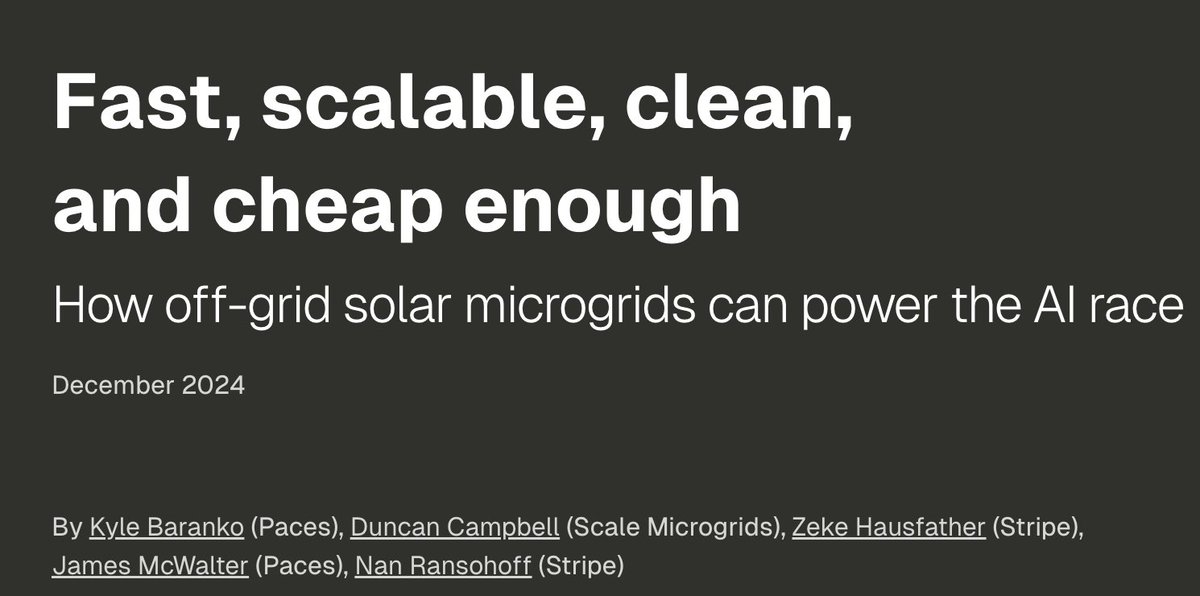
The rise of AI datacenters risks driving rapid emissions growth if not powered by clean energy. In a new report, we (Scale Microgrids, Paces, and Stripe) provide a detailed analysis of one promising solution: off-grid solar and storage. https://t.co/RXb02ZcIsr
Psyched to share something @stripe, @ScaleMicrogrids, and @paces_ai have been cooking for the past few months.
A massive wave of new energy demand has been unleashed by AI.
How will we power it?
We think gigantic off-grid solar microgrids offer a very compelling solution.
📣Frontier facilitated offtake agreements with CO280 and CREW, two companies integrating carbon removal into existing industrial processes!
Both companies offer a model for how startups can partner with large industrial players to scale carbon removal.
https://t.co/LwgF1lKiaW
🚀Huge day for innovation in carbon removal. The Carbon Dioxide Removal Investment Act, introduced by @SenatorBennet & @lisamurkowski, ensures *all* promising solutions can qualify for a $250 tax credit for each high-quality ton removed from the atmosphere & permanently stored.🚀
Sharing some quick math to suggest that is not completely crazy that the world could pay for all of the carbon removal needed to stabilize temperatures around 1.5C in the next ~100 years. Inevitable? Absolutely not. Possible? I think so, yes. https://t.co/4IO3QjDhBP
In a quiet patch of forest in Nova Scotia, a company is building a machine designed to help slow global warming by transforming Earth’s rivers and oceans into giant sponges that absorb carbon dioxide from the air. https://t.co/lIwHnvGeqL
Excited to announce Frontier's offtake agreement from CarbonRun today!
CarbonRun reverses river acidification by adding calcium carbonate, which captures CO2 and forms durable bicarbonate thats stored in the ocean: https://t.co/jwgopzX7IW
Maine CDR can be done safely and responsibly. Drawing from weeks of research and discussions with experts, we put together our principles for Maine CDR purchases.