We have just released a new C++Now 2026 Conference Video!
What is your Algorithmic Core? - Egor Suvorov - C++Now 2026
https://t.co/8b1mGdxfXX
#Coding#Cplusplus#Cpp#Programming
@tanujDE3180 Design B.
Don’t pipe 20GB through your API. Hit /files/upload-url, get a presigned URL, upload straight to S3. Multipart and resume or you’re cooked.
I have a lot of respect of turbopuffer's design decisions, but this one where they describe their task queue built atop s3 appears a bit silly to be honest. correct, yes, the right choice for their architecture, yes, but silly nevertheless
https://t.co/CveLOaJwxb
I think our whole industry overindexes on kernels; we should be more focused on end to end performance.
Most real world CUDA perf problems are likely launch/transfer latency & insufficient parallelism expaure. You miss that if you look at kernels in isolation.
Great article.
MIT's "The Mathematics in Toys and Games"
Explores the mathematical strategies behind popular games, toys, and puzzles.
Lecture Notes: https://t.co/RnclMR0bKC
I just finished reading Microsoft Research’s Garnet paper this weekend, and the architecture is actually far more interesting than the benchmark numbers.
Here is a small summary :
The team at Microsoft Research basically asked:
What if we rebuilt a Redis-compatible cache-store from the ground up?
The result is Garnet.
It keeps Redis’ RESP protocol, so existing Redis clients can talk to it.
But underneath, almost everything is redesigned: networking, storage, durability, transactions, and clustering.
Here’s what makes it interesting.
1. A very thin storage interface
Garnet supports a large Redis API, but the storage engine doesn’t need to understand hundreds of Redis commands.
Instead, Garnet maps them onto four basic operations:
→ Read
→ Upsert
→ Delete
→ Atomic read-modify-write
This narrow interface separates Redis command processing from storage concerns like concurrency, tiering, checkpointing, and recovery.
2. Tsavorite is the storage engine
Tsavorite is designed for thread scalability and tiered storage.
Garnet can work across:
→ Memory
→ SSD
→ Cloud storage
So the dataset doesn’t have to fit entirely in RAM.
3. Two storage paths
Garnet has a main store optimized for raw string operations and an object store for richer data types such as:
→ Hash
→ Set
→ List
→ Sorted Set
→ Geo
Both stores are tied together through a unified operation log, which supports durability, checkpointing, recovery, and replication.
4. The network path is redesigned too
Garnet uses a shared-memory network design.
Instead of receiving a request on one thread and then shuffling it across threads to the right storage worker, the network I/O completion thread can process the request and interact directly with storage.
That reduces thread switching and data movement.
It also has a pluggable network layer and supports TLS, with the architecture designed to support kernel-bypass networking.
5. It scales beyond one machine
Garnet has cluster mode with:
→ Sharding
→ Replication
→ Failover
→ Dynamic key migration
So you can scale both vertically across CPU cores and horizontally across nodes.
Put it together and the architecture looks roughly like:
Client
↓
RESP / Network
↓
Parsing + Command Processing
↓
Narrow Tsavorite API
↓
Main Store + Object Store
↓
Memory / SSD / Cloud Storage
↓
Operation Log + Checkpoints
↓
Replication / Shards
And the performance numbers are impressive:
Up to 100× higher throughput and 4× lower high-percentile latency in the paper’s comparisons.
But that isn’t even the most interesting part.
Garnet isn’t simply trying to make Redis faster.
It rethinks the entire cache-store stack around modern CPUs, memory, NVMe, networking, larger-than-memory datasets, durability, and horizontal scaling.
That’s what makes this paper worth reading. Checkout few resources :
Paper: https://t.co/khTRzuJ6sy
GitHub: https://t.co/Iwzyu4sHuw
Docs: https://t.co/cg38AsanWw
Tsavorite docs: https://t.co/NseNGCo3Jc
Microsoft Research: https://t.co/zB9Q3IhnCE
Why foundations are important, and plays a significant role - so don't skip those CS courses at uni.
The OS concepts, memory hierarchy, how branch prediction works, memory alignment pitfalls, core affinity, false sharing - these are just the tip of the iceberg.
https://t.co/T8CjzQj1gL
Storage choices for ECS workloads have always involved tradeoffs between EBS, EFS, and S3. The new S3 File System mounts close a gap that has quietly frustrated teams for years, letting applications use normal file paths while the data lives in S3.
The article discusses where S3 File Systems actually fit, comparing them against EBS and EFS. The setup steps cover bucket config, mount targets, IAM roles, and a full task definition example using filebrowser to make the workflow easy to follow. Thanks to Sreedhar Reddy Madithati for putting this together.
https://t.co/0Dfk5AIJlR
#ECS #S3Files #AWS #EFS #EBS
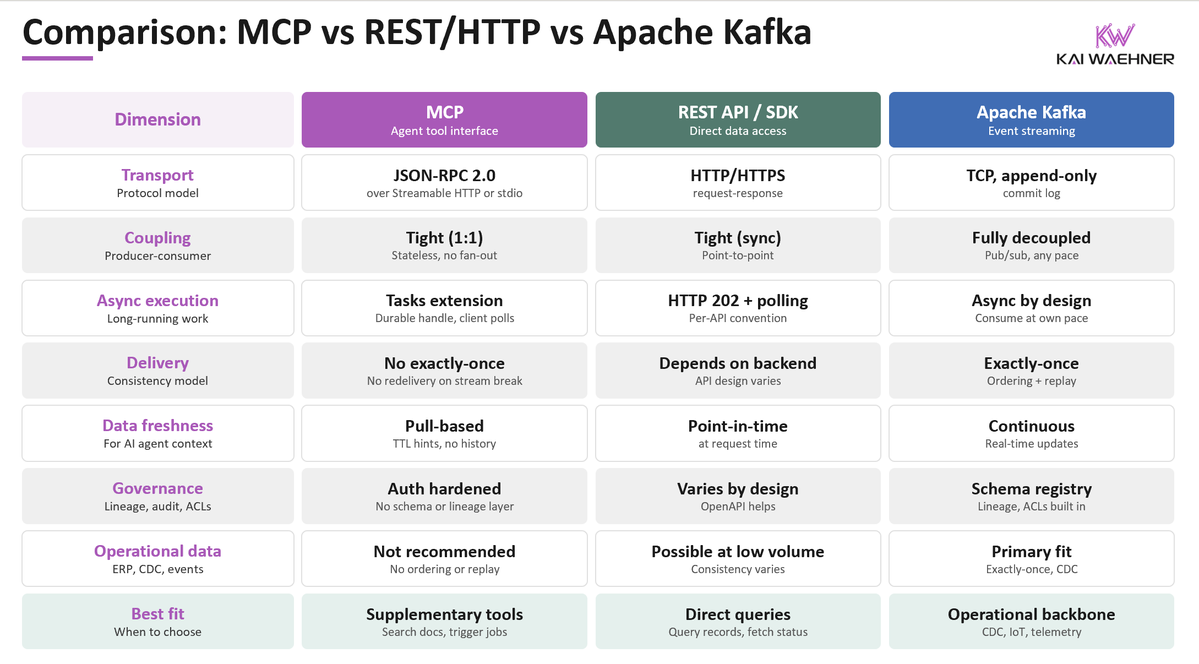
Can we just use #MCP for everything? No.
It is a tool interface: look up a doc, open a ticket, start a job.
Operational data is another problem. Payment flows, SAP CDC, factory telemetry need ordering and replay. #ApacheKafka covers that.
The #AgenticAI hype skips this.
Architecting the Next Generation of Asynchronous, Distributed GPUs for the AI Era
https://t.co/sUuNSXrTJS
Accel-Sim 2.0 — Validated GPU Simulation with full Hopper support
https://t.co/exsK0qzVI9
Twitter now charges $0.20 per tweet if I include a URL in the message. So the @pvldb paper bot no longer includes links to papers. You can follow it in other ways:
‣ Bluesky: https://t.co/zsyqo1tlgE
‣ Mastodon: https://t.co/kppohFuJbA
‣ RSS: https://t.co/YOX5o7vdiW