In The Firm, a 1993 legal thriller with Tom Cruise, there’s a great example of a storytelling technique called Chekhov’s Gun.
Named after Anton Chekhov, who advised in letters to young playwrights that “One must never place a loaded rifle on the stage if it isn't going to go off. It's wrong to make promises you don't mean to keep."
The term explains that every element in a story must be necessary, and if it’s not, it should be eliminated from the scene entirely.
Three times throughout the movie, while Tom Cruise’s character is making his way into his office, there is a cotton truck blocking an alleyway.
For some odd reason, you hear the voices of the security guard and the truck driver going at it louder than you hear other extras on the street.
A reference is also made by the security guard that he’s tired of having this conversation with the driver every day, hinting to the viewer that the truck blocking the alley is a regular occurrence.
By the movie's end, the cotton truck does not have any importance. But true to the essence of Chekhov’s gun, it’s there for a reason.
When Tom Cruise eventually has to make a daring escape from the law firm’s building, he uses the cotton truck to catch his fall after jumping from a third-story window.
If that truck wasn’t ever there before in the movie, it would be an occurrence of deus ex machina, or what happens when a plot is resolved in an implausible way.
But knowing the cotton truck was there in both Acts 1 and 2 of the movie, the viewer doesn’t feel like they’re being cheated, and the question every viewer is asking – “Why is the cotton truck parked there every day and why do we hear them yell so much about it,” – is finally resolved.
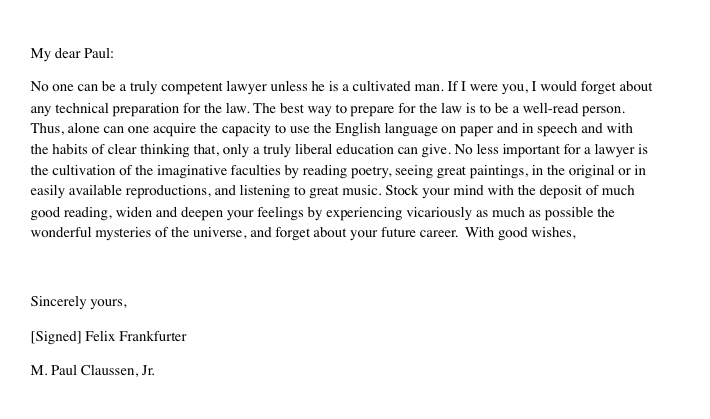
Felix Frankfurter's advice to a young person interested in the law:
“Stock your mind with the deposit of much good reading. Widen and deepen your feelings by experiencing vicariously as much as possible the wonderful mysteries of the universe. . .”
This is Timothy Eaton. He built Canada's first retail empire.
But if you didn't know that, there's a reason: it crumbled because the company was guided by the erroneous belief that yesterday's success guarantees tomorrow's survival.
The great thing about studying history is that we can learn from people like Eaton, to see what they did that made them famous, and then try to avoid what made them fall.
That's exactly what we're trying in our new series on the podcast, Outliers.
In this first episode of the podcast, you'll be introduced to Timothy Eaton and learn what happens when someone chases spectacles instead of building great systems.
Listen and learn at the link below.
@erikmbaker 100% yes. I thought, "wow something major is happening on Episode 3 and not Episode 8 where we'll have to wait another three years to see how this plays out."
my theory: idk if its recency bias or what, but since "planes being bad" is in the news, every little thing is now being made 10x more obvious than it was before. accidents happen, minor things abort takeoffs on planes all of the time, but because "it's in" it seems like it's happening more but we're all just being made more aware of it.
First, Scorsese and DiCaprio team up in a narrative non-fiction thriller from David Grann.
Now, they team up in a narrative non-fiction thriller from Erik Larson.
History and book nerds going crazy right now!
Leonardo DiCaprio will star in the ‘DEVIL IN THE WHITE CITY’ movie with Martin Scorsese set to direct for 20th Century
The story follows a serial killer who murdered dozens of people while the city of Chicago was busy with hosting the World’s Columbian Exposition of 1893.
(Source: Deadline)
@startingfromnix building your own SSG is great, but time consuming.
if you want something simple, clean, and easy to write, I recommend Pika! It's an awesome platform. It's relatively new, but the creators are dedicated to making it future-proof. https://t.co/dmmJXGFMS1
@_MLFootball People getting mad at Mahomes for this, but dude just playing the game. If refs call it, it's on them/the league, not Mahomes for taking advantage when he gets the chance. (They didn't even call this.)
I think one reason it's hard to make new friends when you're older is because you have the ability to ignore people who you just don't want to be with very much.
The slightest weird comment, the annoying laugh, the crazy takes, etc. all give you a reason to just keep living life: you can drive, you have a house, you're free.
when you're in middle school and even college, you don't have that freedom. so people who have a few things off about them, but are generally good people, you're kinda forced to hang around with. over time you realize those things are all not that big of a deal.
when you're older, you write people off (I do this for sure) before it gets to that point.
Wesly Huff on Joe Rogan's show exposing Jordan Peterson's moralism & wrong views about Christ just being a moral example.
Rogan asks Huff "How do you define Jesus being against moralism?" And Huff explains the true meaning of the law was to show us our sin & need for a Savior
On Blackstone's famous line: "it is better than ten guilty persons escape, than that one innocent suffer."
Apparently the story is told of a Chinese law professor who heard that line from a British lawyer. The Chinese professor thought for a second and asked, "Better for whom?"
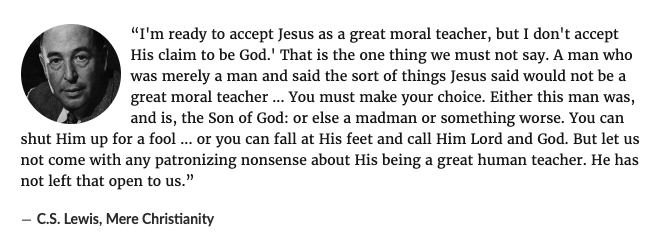
I started my reading today for crim law. I loved this quote from a juror in a criminal trial on proof beyond a reasonable doubt.
"We [the jury] discovered that . . . there seemed to be no limit to the power of the state over us, once we fell into its hands."
During a private funeral ceremony for the late President Carter attended by Carter Center staff, Chip Carter, the president's son, recounts how his father learned Latin to tutor him over Christmas break after he failed a midterm in 8th grade. https://t.co/nT5YOZYdi1




![dltnio's tweet photo. I started my reading today for crim law. I loved this quote from a juror in a criminal trial on proof beyond a reasonable doubt.
"We [the jury] discovered that . . . there seemed to be no limit to the power of the state over us, once we fell into its hands." https://t.co/eKh4byfYY9](https://pbs.twimg.com/media/GgtgtT1aUAAskjU.jpg)



