The liquid float of $ETH is quietly evaporating.
Since mid-2025, an abnormal volume of Ethereum has been systematically swept off the market and locked directly into staking.
While short-term price action chops, the supply is being aggressively absorbed into vaults.
$BTC Spot Cumulative Volume Delta just hit an absolute historical low.
We are watching the total capitulation of spot holders. This is the most aggressive on-chain selling pressure ever recorded.
Historically, it's the exact mechanical setup for a structural bottom.
The latest COT report shows non-commercial $BTC futures traders flipping to a Net Long position.
Historically, this specific structural shift marks an absolute macro bottom.
The mathematical definition of a structural bottom.
The Short-Term $BTC Sharpe Ratio just plunged to -38.38 – a level of extreme negative deviation only seen in 2015, 2019, and 2022.
This price action is mechanical clearing.
We are watching the industrial-scale bankruptcy of the tourists. The big players are starving the small ones to monopolize the supply later.
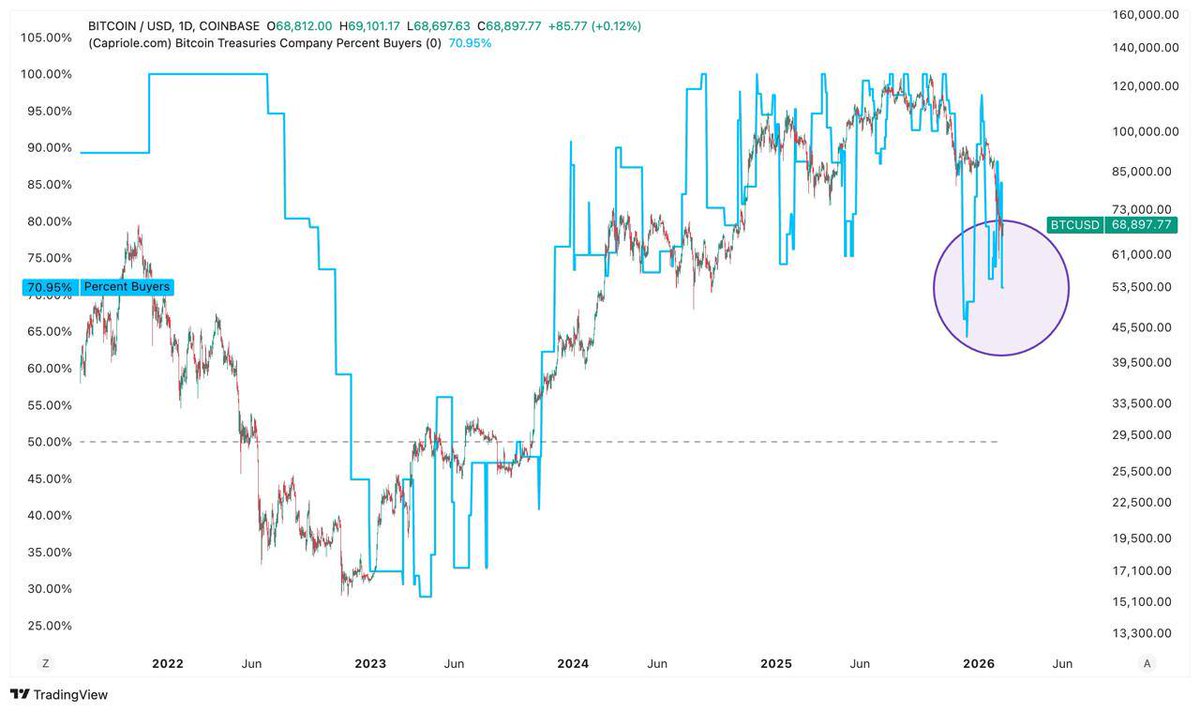
The "MicroStrategy Copycat" trade has officially imploded.
For months, the playbook was simple: Announce a $BTC treasury → Stock pumps → Raise cheap capital → Buy more $BTC . A perfect reflexive flywheel.
But the mechanism broke.
Now, the flywheel is spinning in reverse:
• Stocks are trading below the NAV of their Bitcoin holdings.
• Capital raising is dead.
• Weak companies are becoming forced sellers to service debt.
While the market panics over the correction, the on-chain reality is entirely different.
We are witnessing a massive absorption event. Since the drop began, large entities (1k-100k $BTC) have swept 40,000 $BTC off the market.
Coins are simply transferring from weak hands to high-conviction vaults.
In a negative scenario, one metric becomes the absolute baseline: Realized Price.
Simply put, this is the average cost basis of every Bitcoin on the network.
History gives us two clear signals of statistical anomalies:
– $BTC in 2022: Trading below $22k was a deviation below the market's average entry.
– $ETH in April 2025: When it dipped below its realized price of $1,950, it proved to be the cycle's best asymmetric entry just months later.
I am not saying price must revisit these levels. Data requires preparation, not prediction.
Right now, the Realized Price for Bitcoin sits at ~$55,500.
The most effective edge right now is a mental shift: operate as if the bull run is never coming.
This acts as a strict filter for your decision-making. If you strip away the expectation of a rising tide, you are forced to look for:
1. Idiosyncratic triggers.
2. Internal ability to reprice in a sideways market.
Everything looks like a gem when liquidity is overflowing. The real question is – who performs when the inflows stop?
Focus on assets that don't need a market frenzy to expand. If the mania returns, treat it as a bonus to your multiplier, not the base case.
Short-term $BTC holder capitulation has hit levels not seen since March 2020.
This deep red flush represents a complete washout of "tourist" capital – historically, a reliable signal for a local bottom.
Stablecoin supply has been stuck at the $310 billion mark since October. While this may look like market stagnation on the surface, the underlying mechanics suggest it’s just a temporary reallocation.
The main competitor for liquidity right now is the US Treasury. High Treasury yields create a massive opportunity cost – capital is staying off-chain to capture risk-free returns rather than sitting idle in stablecoins.
Regulatory clarity is the other bottleneck. Investors are frozen between the US GENIUS Act and the EU’s MiCA framework. Big capital is hesitant to deploy at scale until the rules of the game are defined.
The liquidity hasn't left the ecosystem – it is simply parked in traditional instruments, waiting for the regulatory fog to clear.
The gap between Fintech and DeFi is finally closing.
I’ve been looking at @glider__, which combines the slick UX of Robinhood with actual ownership of on-chain assets.
In TradFi, you pay fees for ETFs while brokers lend your shares and keep the profit. Glider flips this structure allowing you to build your own index (like S&P 500) without fees.
• Real Ownership: You own the underlying assets, capturing dividends and yield from lending them out – revenue that usually goes to the broker.
• Tax Efficiency: The protocol automates tax-loss harvesting, selling losers to offset your gains.
They use Chain Abstraction, so there’s no bridging, no gas tokens, and no network selection. It feels like a standard banking app, but settlement happens on-chain.
Right now, there are no fees. In the future, they plan to monetize via Payment for Order Flow (like Robinhood). But here is the difference: due to blockchain efficiency, they can rebate part of that profit back to the user. You could effectively get paid to trade.
The protocol is currently running a points program to incentivize early adopters. It’s a chance to test the infrastructure and position yourself before the crowd arrives.
Get access here: https://t.co/zjXSgUjIQ6
The Blueprint For Finding 100x Gems
Most market participants mistake gambling for investing. Real investing is about finding a Diamond – a rare asset class defined by the following strict criteria:
• Valuation: Market cap under 20M. This is the baseline for a 10-30x multiple.
• Cap Table: Backed by Tier-1 entities (Coinbase) – not a crowded party of secondary funds looking for an exit.
• Tokenomics: Real value accrual. This means revenue share, buybacks, or constant burn. Zero inflation.
• Structure: No cliffs. Focus on fully unlocked supplies where the sell pressure is already absorbed.
These setups are incredibly rare – you might find only 1-3 per year. The strategy is mechanical: identify the anomaly, capture the expansion, and rotate profits back into the conservative portfolio. Rinse and repeat.
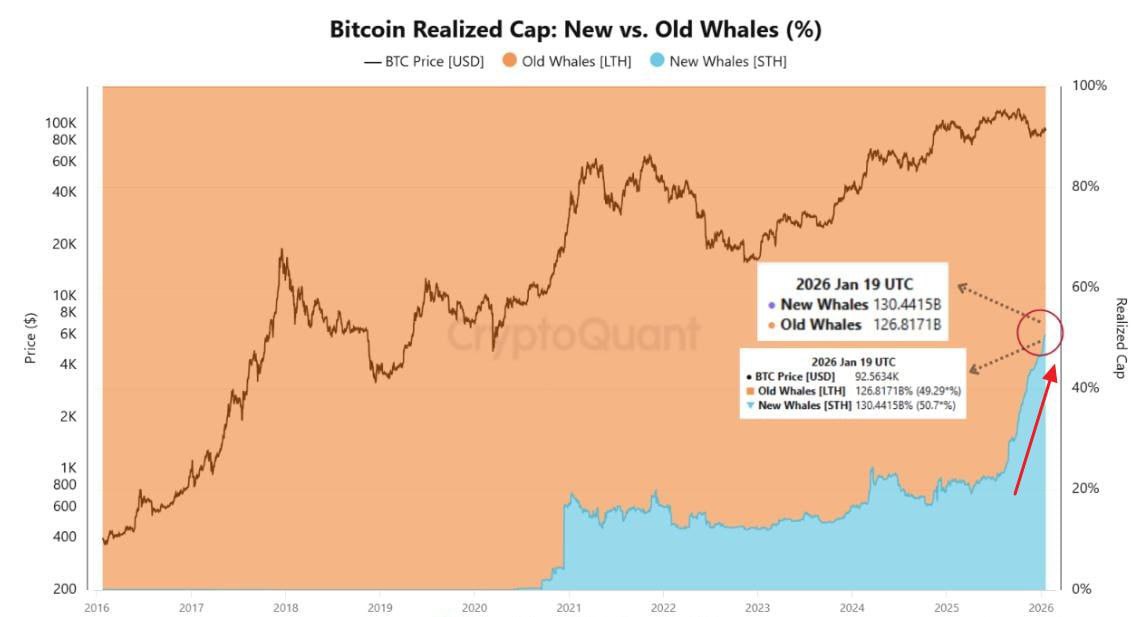
Since mid-2025, on-chain metrics have signaled a record influx of new whales entering $BTC. The dynamic is clear: vintage wallets are selling to lock in profits, but that supply is being immediately absorbed by new whales.
This structure suggests we are witnessing a massive redistribution of Bitcoin rather than a systemic exit. The coins are simply changing hands from early cycle winners to new capital. The current bearish sentiment serves as the perfect liquidity environment for this transfer.
The gap between "Bitcoin is a scam" and "We are so back" is usually just a few 10% green candles. While the crowd panics over the dip, the order books are being quietly filled.
The number of Bitcoin wallets holding 100+ $BTC just hit a new all-time high. While there has been massive distribution over the last two years, the coins aren't flowing where people think.
This is not a retail accumulation story. In the last year, "shrimps" (<1 BTC) added a negligible 2,363 BTC total. Compare that to the "sharks" (100–1000 BTC) who absorbed 654,723 BTC. That is a 300x difference. We are watching supply move into $9M+ positions, not small accounts.
We are seeing a massive transfer of wealth, but the price action suggests we are still bound by historical cycles rather than a supercycle paradigm shift. The October high hit exactly at the 35-month mark typical of previous tops, and price remains stuck below the 50-week moving average.