Customers don't buy managed services. They buy confidence that their partner owns the outcome.
That's why this isn't an outsourcing strategy. It's a business model, and it changes almost everything upstream of the invoice.
The definition is straightforward: a recurring relationship where the provider assumes ongoing responsibility for specific business or technology outcomes, with defined services, measurable performance levels, and predictable recurring fees.
Four things make the model work:
• Trust - built through transparency, consistency, and delivering on commitments
• Expertise - deep enough to solve the problems the customer can't
• Proactive action - finding problems before the customer does
• Ownership - the outcome belongs to the provider, not the ticket queue
Each of those demands a specific sales process, support structure, engagement model, and culture. The culture piece is the one most providers underestimate.
#ManagedServices #RecurringRevenue #CFO #EnterpriseValue #CrookedFenceBooks
How many people are on the CFO’s team?
I’ve been asked that question more than once.
My answer?
Everyone.
Maybe not on the org chart. But over a CFO career, you find yourself involved in almost every corner of the business.
Finance. Operations. Sales. HR. Technology. Legal. Customers. Strategy.
That’s part of what makes being a CFO interesting — and occasionally exhausting.
My latest Executive Story: Everyone.
One Topic. One Story. One Minute.
#CFO #Leadership #Finance #ExecutiveLeadership
Why did the forecast change?
That question gets asked in almost every management or Board meeting.
And “we updated the forecast” isn't much of an answer.
I’ve always used a Change Log to capture the assumptions and business drivers that changed—and, more importantly, the financial impact of each change.
Bookings went up.
A project slipped.
Churn increased.
Hiring changed.
Each one has an impact on revenue, EBITDA, cash, or margin.
A good Change Log turns a forecast from a spreadsheet into a management tool.
If you can’t explain the change, you can’t own the forecast.
Part of my Forecasting Series and the Forecast Says Rain Executive Story.
#CFO #Forecasting #FPandA #Finance #Leadership
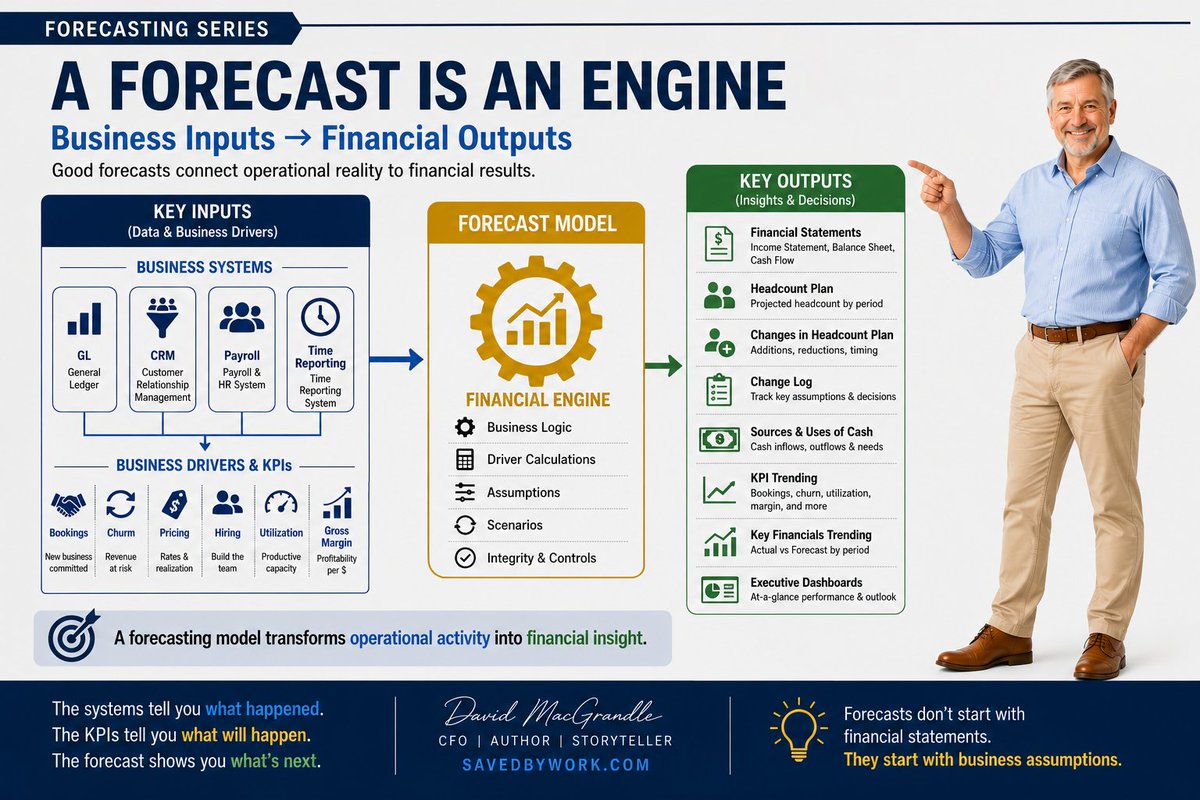
A forecast doesn’t start with the financial statements.
It starts with the business.
Bookings. Churn. Pricing. Hiring. Utilization. Gross margin.
Those operating assumptions feed the financial engine, and eventually become the income statement, balance sheet, cash flow forecast, headcount plan and KPIs management uses to make decisions.
Good forecasting models are the engine:
Business inputs go in.
Financial insight comes out.
#CFO #Forecasting #Finance #FinancialPlanning #Leadership
The Weather Forecast was wrong!
The Weather Forecast was wrong!
But was it a bad forecast?
Business forecasts get treated like predictions far too often. Then, when actual results are different, we ask why the forecast was “wrong.”
I think that misses the point.
A forecast is built on assumptions. When the assumptions change, the forecast should change, and sometimes our decisions should change with it.
Great forecasts don’t predict the future. They prepare leaders for it.
Another Executive Story — One Topic. One Story. One Minute.
#CFO #Forecasting #Leadership #Finance #Weather #WeatherForecast
It’s tough being a CFO.
Not because accounting is tough.
Because the job stopped being just about accounting a long time ago.
Today’s CFO gets pulled into operations, strategy, technology, people, customers, risk, and sometimes just about everything else in the business.
And I think that’s exactly where a CFO can create the most value.
My latest Executive Story is about the changing role of the CFO.
One Topic. One Story. One Minute.
#CFO #Leadership #Finance #ExecutiveLeadership