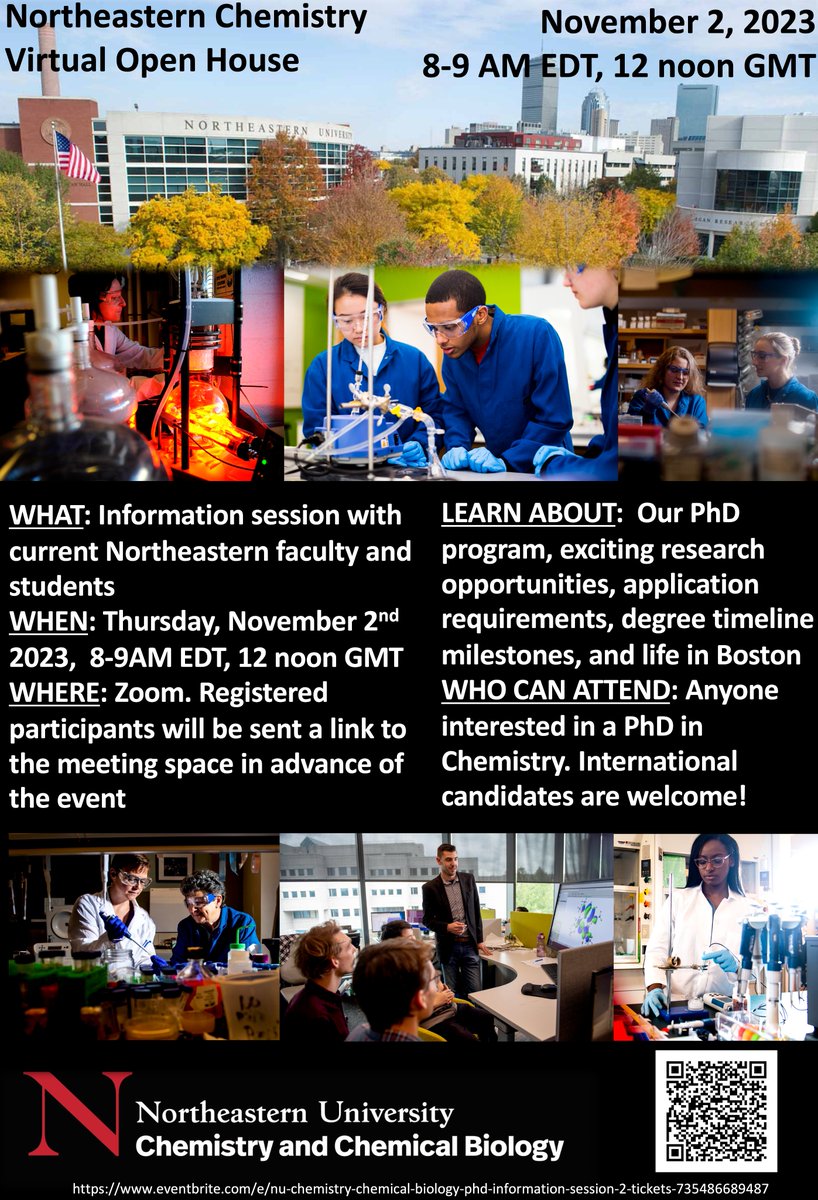
Interested in a Ph.D. in Chemistry? Join @StevenLopez_neu, Director of Graduate Studies from CCB Northeastern University to learn about the program, including requirements, research areas, and co-op opportunities. Oct 8: https://t.co/N8qrpoLIvn Oct 16: https://t.co/GoRDnY0KwV
Join us for an epic session in room FAB 008 on the LAST day of #MACRO2024. It's your final chance to soak up amazing insights in RAFT, ROP, ROMP and avoid post-conference FOMO.
I am chairing the morning session and will be the last speaker of the afternoon one. @Macro2024
We highly encourage our community members to nominate groundbreaking colleagues for C&EN Trailblazers! All nominations will be submitted by April 30th #LatinXChem
Dear Prospective #PhD students,
If you missed @NU_Chemistry's 1st fall open house, join us on Nov. 2 and bring questions! Register at https://t.co/KU8kHNetHI
@NU_Chemistry 2nd virtual open-house on November 2 at 8-9 am EDT (noon GMT). Register at https://t.co/KU8kHNf1xg to attend and get an application fee waiver! Co-hosted by @ChakraSrirupa and myself! #PhD#compchem
We will have another open house on Thursday Nov. 2, 2023 at 8-9 am Eastern Time. This timeframe may be friendlier for those of you in Europe/Africa/Asia. Please stay tuned for more information!
Today, I officially start my tenure-track position at @NU_Chemistry. Really happy with the INVEST program, which allowed me to have a smooth transition from postdoc to faculty. I highly recommend these strategies to embark incoming professor into their new role. @Northeastern
TMW, Friday Jun 15th, we will have a great @POLY_ACS sustainability symposium starting at 8:00 am in room CSC 433. Come to see the amazing work from Professors Rong Yang (Cornell), Jeremiah Johnson (MIT) and grad students Ziyan Yu (Brown), Danielle Fitzgerard (BU)
#NERM2023.
Really excited to be part of #NERM. We will have an amazing symposium on Friday about Polymer Sustainability, more details to follow.
Anybody interested in connecting, feel free to reach out.
Rejection of your paper or grant has NO relevance to the opinion of #research community. It is nothing but the opinion of one person.
Several examples:
1. The first paper on graphene was rejected from Nature because “it did not constitute a sufficient scientific advance”. Later, it was awarded a Nobel prize.
2. The first manuscript showing the microbiome-brain connection was published after 7 submissions that took 3 years. Today, this field has exploded. I expect it will get a Nobel prize in the future.
3. Theodore Maiman tried to publish a paper describing the first operating laser in Physical Review Letters and… got a rejection!
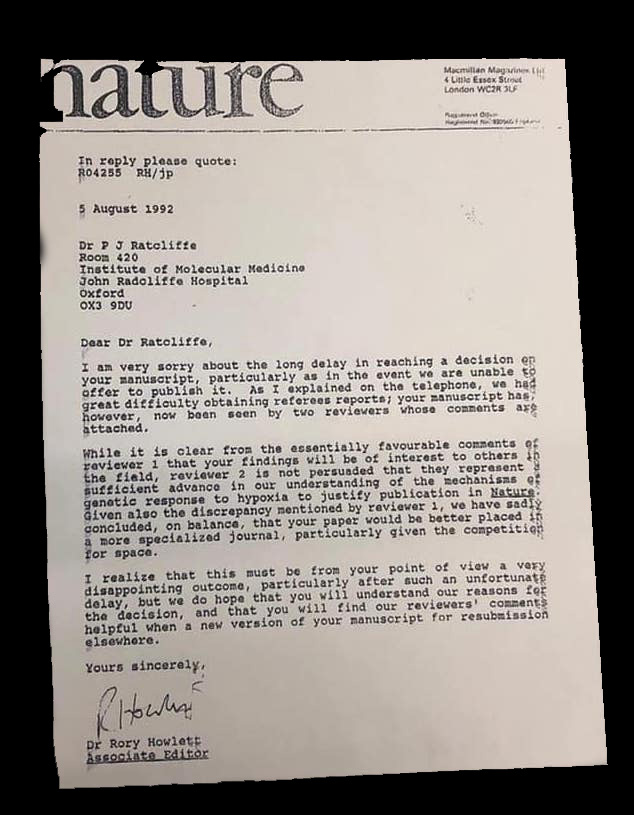
4. Peter Ratcliffe, who worked on cells’ response to changes in oxygen levels, got his key paper rejected from Nature (see photo). Later, he was awarded a Nobel Prize for this work.
And there are many other examples…
.
And yet I see so many young scientists stressing about rejections. For some reason, they seem to genuinely expect that the editors should know which study is truly worth it.
As a result, many rejections are met with surprise and disbelief:
“How could they reject it? They publish so much trash, and yet they think our detailed 3-year-long study is not interesting to the community! WHY?”
.
Well, the reality is:
- Most editors have very little time to delve into your study. They can easily FAIL to recognize the potential impact of your study. Proper communication in the cover letter and clear writing style can help (although only to a limited degree).
- Many reviewers have little idea about the science in your paper. But they can have a big ego. So, if they have a bad day or were rejected recently, it’s easy for them to find 1000 technical reasons to reject your paper as well.
- Most scientists genuinely don’t know if your discovery can make any impact. If we could predict the course of science, we would be living very differently!
My message is simple:
Forget about objectivity. Academia is a very subjective world. Fight for objectivity but don’t take it for granted.
A great study will be found, cited and recognized. Disregard of where it’s published.
A bad study requires a high-impact journal to be found and cited. But the long-time recognition might be a problem.
High-IF journals are simply billboards. Their rejections do NOT represent the opinion of a scientific community.
You can get rejected but don’t reject yourself!
Believe in your results.
#AcademicTwitter #AcademicChatter
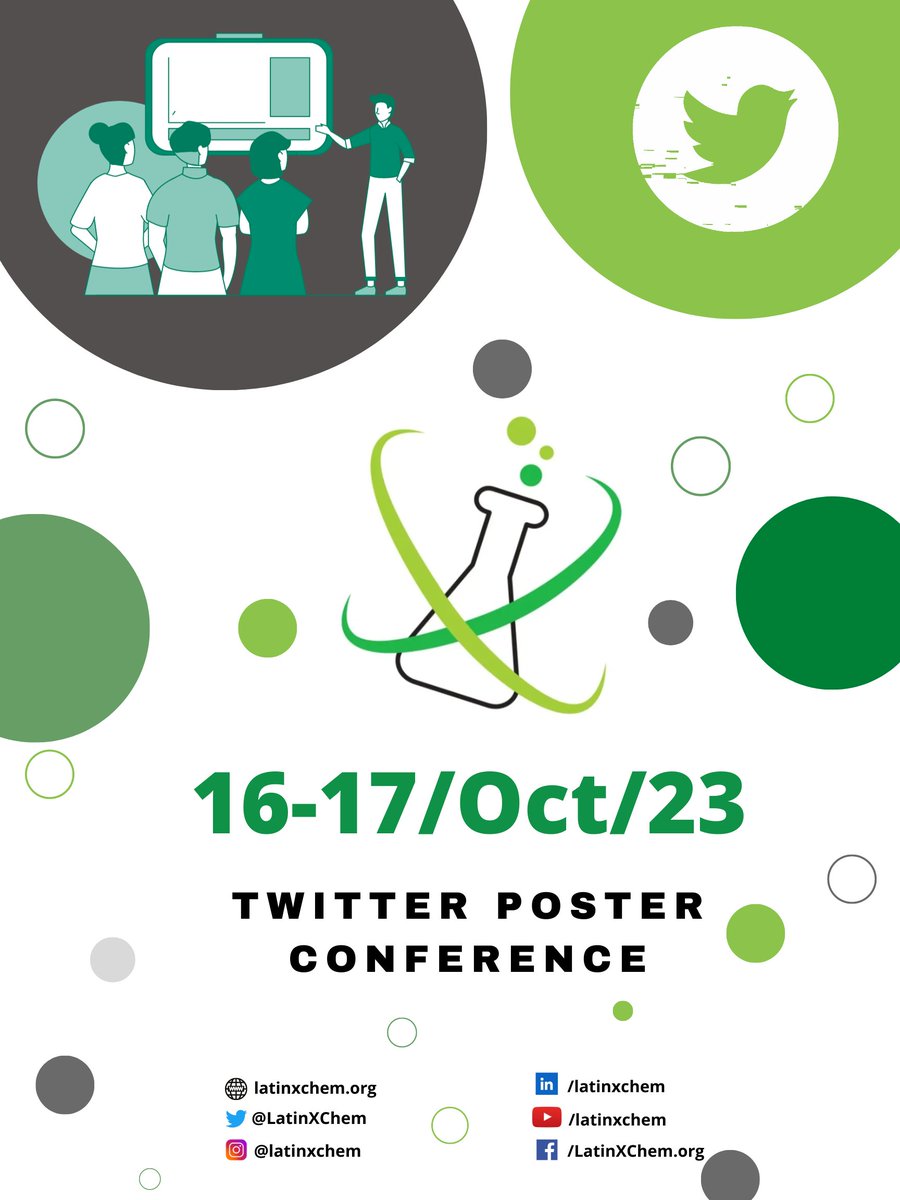
Save the date for our upcoming fourth edition of #LatinXChem on Oct 16 and 17, 2023! Get ready to showcase your posters and help us spread the word. We're excited to see you there! #LatinXChem23
Happy to share my first collaboration with Professor Cesar Sierra and his brilliant student Lissette Ariza from @QuimicaUN. Looking forward to continue working with researchers in Latinoamerica @LatinXChem
https://t.co/dvyTcNloy4