SpaceX had its IPO yesterday
And @Tessera_PE gave us early exposure to it months ago through T-SpaceX (+137%)
Now the next one is here: "T-OpenAI"
I just got accepted into Tier 1, and I've got 5 spots to give away to my community
Why I'm bullish:
Pre-IPO access to OpenAI, the most important AI company in the world
Tessera already proved the model with T-SpaceX (IPO'ing today) and T-Kalshi (2x)
Retail has never had a way into names like this before launch
To enter:
→ like + RT this post
→ follow me
→ comment which pre-IPO you want to see next on Tessera
Picking 5 winners before June 24
If winning was guaranteed &certain, you'd go 10x harder at it.
Paradoxically, if you went 10x harder, the win would almost be a guarantee, on a long enough time horizon, for any goal.
It's easy to mentally recognize this, but it ideally should be felt in the body as a fact.
in some of the groups im in. I've noticed a really common theme lately where people just hold onto a bad trade wayyyy too long. they just can't let it go. they can't accept the loss, so the loss grows
they commit to a position based on what they have already lost. Instead of focusing on forward looking expected value. their decisions are based on the past losses vs future opportunities. which is basically just the sunk cost fallacy
Rationally. You are suppose to allocate capital to the best risk adjusted places regardless of where prices currently sit. the market doesn't know or care what we paid for something.
one has been in eth since last year. he has known he can get better returns since then, but has been frozen. there is obviously a financial cost to it, but there is an emotional cost as well, and then the opportunity cost. all 3 can be very expensive.
a lot of that is also just a result of thesis drift where the original thesis gets invalidated and then a new thesis arrives on why the trade should continue
if you think there is a better opportunity elsewhere, and have something to support it then i think its better to make the jump. its a big reason why i mainly switched to stocks over a year ago. you could see the bubble brewing.
its part of a mental framework we all have to work on, and constantly improve on.
Some thoughts on crypto market-structure and where we go from here.
1. Crypto produces six times more in terms of revenue, for each venture dollar deployed this year, compared to '22. The problem is, that revenue is concentrated in a handful of players. Which is why venture in crypto has struggled.
It used to be a consensus, early stage market. Now the players making money are the ones deploying into power law players in the late stage.
2. If you remove stablecoin issuance (can't back it now), hyperliquid (doesnt need VC), polymarket (gambling??) - the investible opportunity subset are quite few.
If you take L2s , you have a situation where transaction throughput and valuation have no correlation. There are protocols with 10k tps, trading at sub 100mil mcap, because nobody uses them.
3. The market - at this point, splits into networks, protocols and platforms. I see Privy (yes the wallet guys) as a network. I see Tradexyz as a platform. And I see solana/ethereum as a protocol.
Semantics aside, here's what I mean. Privy wins with each marginal application that embeds it. They are network agnostic. They actually own the user with more stickiness than any protocol. At some point, Privy became the standard - like Google single sign on pages did.
Tradexyz is a platform, because it is the default layer built atop Hyperliquid for trading interface. They can upsell other products there. They can integrate other markets if they choose to. Currently that can look like RFQs/ block-trades and enabling cross-market arbitrage with tradfi avenues. It is a platform, because it has the optionality to do it and therefore has the highest LTV per user.
Solana and Ethereum are in this situation where they are likely to scale TPS, but the case for network fee rising is not strong. The next marginal user in the web, cares about fee going from $1 to $5 and no they are not coming for meme coins. For networks to have value, the applications built atop it need to be sticky. Right now the only place a developer rushes to is Hyperliquid given liquidity moats. It may change, but Solana was there 18-24 months back.
Protocols in crypto have a single product and that is liquidity. All else, is hogwash. You can't simultaneously hold the truth that crypto is about capital markets and not acknowledge that liquidity is the product.
4. There are new money networks that are valuable. Chainlink, LayerZero, Ondo - come to mind. These interact with traditional layers and are protocol independent. These businesses grow regardless of which protocol is evolving.
The mental model I've been using is that of Visa/Swift. Neither of those networks are token governed. Neither of them are open or customisable to the needs of a developer.
Yes, all these products are vulnerable to hacks, but I think as we see a new class of tokenised assets moving hands more often, mostly owing to agents - these networks will be crucial infrastructure. They grow more powerful with each protocol they embed into so you may see a world where a developer is no longer thinking of deploying on Solana or Base, but simply using these money networks. That is interesting.
5. I think, when an ecosystem trends to concentrating in late stage players there are two things that happen. One is the cost of media goes exponentially higher because anyone surviving has incentives to go where the money is. That makes it harder for smaller players to reach end-users. I see this on the daily now.
The second, is the capital that used to go from VC -> startup -> employee , often used to be the first entrant to new capital primitives. If there is employment displacement (which has happened) in crypto, we will see newer capital primitives struggling to find users.
So you have this situation where culture is defined by late-stage corpo-bros, and startups struggle to find early users. Which is equal parts an opportunity and crisis.
6. I say opportunity, because this is where I expect the bulk of future VC returns and wealth generation to happen. Crypto has reached a point of maturity where talking about the underlying protocol, extent of decentralisation, wallet security and all that nonsense is actually going to make you look stupid. The end user doesnt care. They care about what the product does.
The users within crypto don't care either. Which means, founders are incentivised to expand TAM and position products without the techno jargon and look at what makes money harder. Earlier you could be ethereum or solana or hyperliquid aligned and have a shot at survival. The market has wisened up and nobody cares. That is equal parts scary and an opportunity.
This is also where founders that have zero experience in crypto or the ability to forget all they studied the past few years will win. Fwiw - go study lightspark or altitudes' comms. They do this quite well.
7. In the past three months, we've seen clear dispersion of a few players from Bitcoin. Hyperliquid. Near. VVV. I will also go ahead and presume Virtuals may see a similar fit in the next few months.
My understanding is that crypto money rails are valuable, but to build it is not a function of issuing tokens, faking community with bots and talking techno jargon. You need these thigns to work. You need them to be useful. Most founders get lost in the first half and forget the end user. Tokens will continue to be valuable, so long as founders can communicate what it does, back it with action and commit to it explicitly.
8. I remain long crypto. I am also long crypto venture. The idea that tokens are down does not discount the opportunity subsets that exist in the long-tail of financial applications that are yet to be built. I think being bearish is an extension of a lack of imagination. And while you can run an incredible hedge fund book running things by the facts, venture has always been a dreamer's playground. Maybe i choose to dream. maybe that's stupid - or maybe its just gut instincts from seeing this story play out a few times in past cycle.
every single KOL and 'respected' crypto person coming out to say crypto is dead, AI is the future and capitulating on the space as a whole...
guess what
it always happens
every bear market we wash out previous holders and believers and cryptocelebbros, some hang around, and we start anew
don't outsource your thinking or conviction to them.
'but this time it's different'
no it's not, FUD seems real in the moment, it's only in hindsight you see that it was obviously not that important
The only real difference is, this bear market has had a significant stocks bullmarket in the background causing FOMO and outrage
crypto will be back, Bitcoin will hit significant new ATHs, a new batch of tokens will dominate, many strong projects will 10x off their bear lows, the space will renew
lower your time preference,
good things come to those who wait
🦪 Pearl Research (PRL): The “Bitcoin of AI Compute” - Comprehensive overview & latest updates (as of May 28, 2026)
@prlnet, also known as the Pearl Network (ticker: $PRL), is a Layer 1 blockchain forked from Bitcoin. Instead of traditional SHA-256 Proof-of-Work, it uses Proof-of-Useful-Work (PoUW) based on matrix multiplication (MatMul) - the core operation behind all major AI workloads, including training, inference, and fine-tuning.
The core idea: GPUs perform real, useful AI computations while simultaneously mining blocks and securing the network. This turns compute power into actual currency, eliminating the energy waste associated with Bitcoin mining.
The project is developed by Pearl Research Labs, backed by strong mathematical foundations from researchers including Omri Weinstein (ex-NVIDIA, ex-VAST Data, Hebrew University). The whitepaper and open-source code are publicly available on GitHub (pearl-research-labs/pearl). Mainnet launched on April 27, 2026, with an average block time of ~194 seconds and a stable difficulty adjustment algorithm (WTEMA).
✦ Core Technology & How it works
Pearl retains Bitcoin’s UTXO model, P2P network, and economic principles but replaces PoW with cuPOW (custom proof-of-work via MatMul). Miners run AI inference or training through a vLLM plugin with an integrated MatMul kernel to produce blocks. The overhead is only 0.5–10% compared to normal compute, giving miners a near “2-for-1” benefit: they serve real AI queries while earning PRL and securing the chain.
- Mathematics: Built on the paper “Proofs of Useful Work from Arbitrary Matrix Multiplication” (arXiv 2504.09971). It uses standard naive MatMul O(n³) - fully compatible with current NVIDIA/AMD GPUs. Future upgrades to approximate formats (BF16, FP8) are planned after thorough testing.
- Security: zkSNARKs (Plonky2), post-quantum signatures (XMSS), and BLAKE3 commitments. ASIC-resistant by design, as specialized hardware would lose its AI utility value.
- Value Proposition: Solves Bitcoin’s energy waste problem while addressing AI compute centralization (dominated by OpenAI, Anthropic, etc.). PRL aims to become the native “unit of account” for AI compute, similar to how USDC functions in DeFi.
Omri Weinstein has confirmed that the design is not strictly dependent on naive MatMul; the protocol can adapt to future Fast Matrix Multiplication advances without compromising security.
✦ Tokenomics & Economics
- Total Supply: 2.1 billion PRL (Bitcoin-style but fixed cap).
- Launch Fairness: No premine, no team tokens, no public sale or VC discounts.
- Emission Schedule: Smooth daily polynomial decay (~1/t²), avoiding Bitcoin-style halving shocks. Roughly 50% of supply emitted in the first 4 years, then tapering off.
- Price Floor: Directly tied to real AI compute costs (GPU + electricity). If PRL trades below production cost, miners exit and difficulty drops - creating natural equilibrium. Early May 2026 production cost was estimated at ~$0.30–$0.51 per PRL.
✦ Current Status (Updated May 28, 2026)
- Mainnet & Hashrate: Live with initial hashrate around 3.56 EH/s (≈0.4% of Bitcoin’s). Supports only enterprise GPUs like H100/H200 (no consumer gaming cards).
- Trading & Price Action: Primarily OTC with limited CEX/DEX liquidity so far. Price surged from ~$0.30 to $0.70–$1.20+ within weeks. Current FDV sits at approximately $2.4–2.5 billion (based on 2.1B total supply). Many early miners are realizing strong daily profits.
✦ Onchain activity
On-chain activity for Pearl Research ($PRL) shows strong silent institutional accumulation, with wallet 0xFf09 (allegedly backed by a16z-affiliated 0xb5E) steadily buying over $1.5M worth of PRL via OTC platforms. This positions Pearl as the stealth liquid play in blockchain-enabled AI computation, backed by a broad list of top VCs following @prlnet ~ including a16z crypto, Dragonfly, VanEck, USV, and Delphi. Today, $PRL has pumped to $1.45, signaling early smart-money conviction in its PoUW model without public hype.
✦ Mining Community Sentiment:
- Miners are calling this the “8th wonder” ~ true compound interest in action.
- Early participants secured cheap GPU rentals, flipped 3–5x profits, and reinvested to scale up.
- Small miners in groups are pocketing tens of USD daily, while larger operators are earning $100–200+ per day.
- The community is “eating full” as long as the price holds. Don't fomo to rent GPU now.
➜ Pearl-certified Llama 3.3 70B models offer higher throughput than Meta’s original, and a fiat-powered GPU cloud platform allows users to run AI workloads while mining simultaneously.
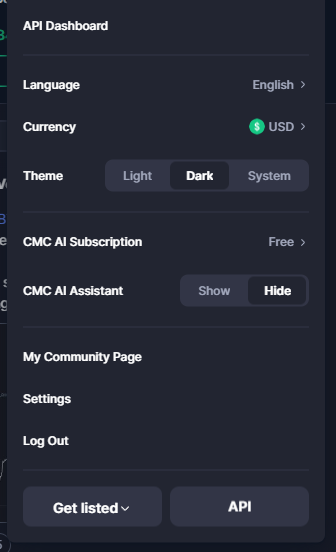
Am I the only one missing saving the selected settings in cookies?
Priority fee for @kamino
Enabling and positioning the graph for @Titan_Exchange
And @CoinMarketCap. Why do you change the currency and language based on the IP address? I chose USD/US and it should be final
some confused folks think I left SOL because I talk about not one but *two* coins now
reminder: we run the no 1. validator, no 1. trading infra, no 1. dev platform, RPCs, & soon the no. 1 privacy protocol - on Solana
the *only* Solana exclusive leading provider
pls. trillions.