A 26-YEAR-OLD AI ENGINEER WHOSE BIRMINGHAM THESIS OUTPERFORMED GOOGLE SCHOLAR BY 50% JUST SHIPPED GRAPHIFY: ONE COMMAND TURNS ANY FOLDER INTO A CLAUDE CODE SECOND BRAIN
Safi Shamsi built Graphify 48 hours after Karpathy posted his LLM wiki idea. It turns any folder, codebase, docs, PDFs, into a knowledge graph Claude reads instead of grepping. Up to 43x fewer tokens per query. The trick almost nobody is using yet: one flag exports the entire graph as a fully-linked Obsidian vault.
Repo: /safishamsi/graphify
Setup, end to end:
1. Install: uv tool install graphifyy (or pipx install graphifyy). Verify with graphify --version.
2. Install the skill in Claude Code: graphify claude install. This wires Graphify into Claude Code so you can call it as a skill.
3. Open the folder you want mapped in Claude Code. In the terminal: graphify . It extracts every concept and builds the graph in graphify-out/.
4. Export to Obsidian: graphify . --obsidian. Writes one note per concept, every relationship as a wikilink, every node linked back to its source.
5. Open the new vault in Obsidian (Manage vaults → Open folder as a vault), or drag it as a subfolder into your existing one.
That's it. Your Claude Code instance now has a navigable map of the codebase that loads instantly instead of re-reading files every session.
Full step-by-step build of the Claude + Obsidian second brain in the article below.
Bookmark this
Robotics beginners unite! 😎
Here's a free course on the basics of robotics, including sensors and autonomous mobile bots.
Everyone who studied robotics or EE knows @MATLAB very well. I've been using it for designing motors and robots back in the day.
@MathWorks created a 17-video playlist teaching robotics using real robotic platforms, and other educational kits. Learn how to design, simulate, and control robots.
They cover robot navigation with encoders, obstacle detection with IR sensors, vision-based autonomy, smart motor fine-tuning, virtual world simulation, and even modeling wheel-legged robots.
Very good for someone just getting started and looking for a low entry-point course totally for free.
Simulink modeling for control, Stateflow for state machines, hardware support packages, external mode debugging, virtual simulation before physical deployment.
You can actually work on real robotics platforms!
This is how you start in robotics!
🔗 Free YouTube vid library: https://t.co/NjKrlSeMSz
~~
♻️ Join the weekly robotics newsletter, and never miss any news → https://t.co/GoA3ZuwoPB
stop telling Claude Code/Codex "do this".
stop telling Claude Code/Codex "write code".
stop telling Claude Code/Codex "fix this bug".
you're using a 𝘀𝗲𝗻𝗶𝗼𝗿 𝗔𝗜 like it's a 𝗷𝘂𝗻𝗶𝗼𝗿 𝗶𝗻𝘁𝗲𝗿𝗻.
here are 8 prompts and goals you can copy-paste directly.
Do not use SciSpace for data analysis or literature review.
It can analyze large amounts of data and review literature in minutes.
Instead, spend months on manually analyzing every single row in your spreadsheets.
Anyway, here's how SciSpace helps with data analysis:
🚨 BREAKING: Research just became 10x faster.
Claude can now turn dozens of academic papers into clear, structured insights — like a top-tier researcher.
No more overwhelm. Just clarity.
Here are 9 prompts to get straight to the point 👇
Bookmark this 🔖
IF YOU DIED TOMORROW, YOUR FAMILY WOULDN'T BE ABLE TO ACCESS A SINGLE THING YOU OWN DIGITALLY.
BANK ACCOUNTS. PASSWORDS. CLOUD STORAGE. ALL OF IT PERMANENTLY LOCKED AWAY.
HERE'S HOW TO FIX IT IN 30 MINUTES:
Someone just open-source a tool turns any websites into Android app loacally.
It's called WebToApp.
It converts any website URL into a standalone Android APK in seconds, and it requires absolutely zero Android Studio experience to deploy a full native app.
100% Open Source...
The University of Michigan put their entire robotics degree on GitHub.
Not one course. The whole curriculum.
ROB 101 — Computational Linear Algebra for Robotics
ROB 311 — How to Build Robots and Make Them Move
ROB 501 — Mathematics for Robotics
ROB 530 — Mobile Robotics
Every lecture video on YouTube. Every textbook on GitHub. Every problem set, every exam, every line of code.
Professor Jessy Grizzle said it best when they launched it:
"Linear algebra has become the language of computer vision, machine learning, robotics, and autonomy."
So instead of making students wait four semesters of calculus before touching a robot... they built a curriculum that starts with the math that actually matters, applied to real robotics problems from day one.
This is what open education looks like when a top-10 engineering school decides to mean it.
Free. GitHub. YouTube.
📌 [https://t.co/3STu1hzAz2]
Follow for more robotics resources!
——
Weekly robotics and AI insights.
Subscribe free: https://t.co/9Nm01QUcw3
You can use Claude for 8+ hours a day without ever hitting your usage limit.
Here are exactly 7 tricks that stretch the same subscription to 5x the output:
I watched a PhD student use NotebookLM to do in 3 hours what took me 3 months.
I asked him how. He showed me his setup. I have not studied the same way since.
Here is exactly what he did.
He did not use NotebookLM as a search engine.
He did not type questions like "explain this concept."
He uploaded an entire field.
12 textbooks. 40 research papers. Every review article published in the last 5 years on his
topic. All uploaded at once. Into a single notebook.
Then he asked one question that changed how I think about learning:
"If you could only teach this subject using 7 sentences — one for each core idea — what
would they be?"
Not a summary. Not an overview.
Seven sentences. For the entire field.
NotebookLM produced them. He read them.
He asked a follow-up:
"For each sentence, what is the single experiment or paper that proved it was true?"
Now he had the skeleton of an entire field — and the exact evidence underneath each bone.
Then he did something nobody told me about.
He uploaded his own notes alongside the source material.
Then asked:
"Where am I wrong? What have I misunderstood compared to what the literature actually says?"
The system found three misconceptions he had carried for two years. Two of them would
have cost him his PhD defense if they had gone uncorrected.
He called this the Misconception Audit. He runs it on every subject before any exam, any
paper submission, any conference presentation.
Then the final step.
"Generate 10 questions a hostile expert would ask someone who claims to understand this
field. Then answer each one using only the sources I uploaded."
He was not studying to pass.
He was studying to survive interrogation by the smartest people in the room.
He passed his qualifying exam on a subject he had started studying 11 days before.
I have been studying the wrong way my entire life.
Here is his exact setup if you want to replicate it:
1.Upload the entire field — not one source
2. Ask for the 7 core sentences
3.Find the evidence under each one
https://t.co/fvVKsV4Skj the Misconception Audit on your own notes
Survive the hostile expert interrogation
The information was always available.
The framing was the unlock.
He passed his qualifying exam on a subject he had started studying 11 days before.
I have been studying the wrong way my entire life.
Here is his exact setup if you want to replicate it:
1.Upload the entire field not one source
2. Ask for the 7 core sentences
3.Find the evidence under each one
https://t.co/fvVKsV4Skj the Misconception Audit on your own notes
Survive the hostile expert interrogation
The information was always available.
The framing was the unlock.
🚨MOST PEOPLE ARE WASTING CLAUDE 🚨
They ask one question.
Get one answer.
And move on.
Meanwhile, power users are using Claude to replace researchers, analysts, strategists, and consultants.
These 8 Claude prompts can save you 20+ hours every week 👇
Most people use NotebookLM the wrong way.
They only ask for summaries — and end up with average results.
Here are 10 advanced NotebookLM prompts that help you learn faster, think deeper, and truly understand your sources.
🔖 Save this for later.
Publishing in Scopus-indexed journals is not difficult and you don't have to always pay.
Here are 21 tips to help you publish in reputable journals for FREE
👇👇👇
Friends of mine are launching a work verification service to help people building in Zimbabwe from the Diaspora verify that work has been done as claimed. They are recruiting Independent Verifiers across the country. If you have a good phone and access to internet email your application to info[at]https://t.co/omnnPeLSAh
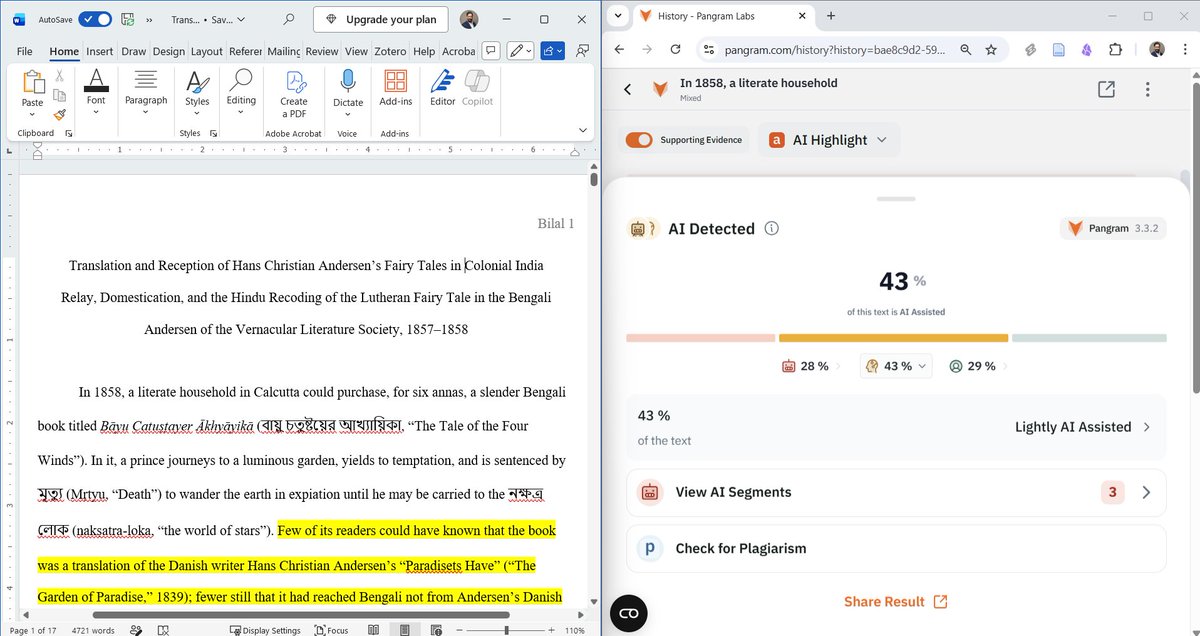
🚨Claude Code just gave me a complete research paper with a single prompt.
The paper has a strong argument and even beats AI-detection app, Pangram.
With a little editing, it can pass for 100% human, and can be easily submitted for peer review.
Here's the workflow I used:
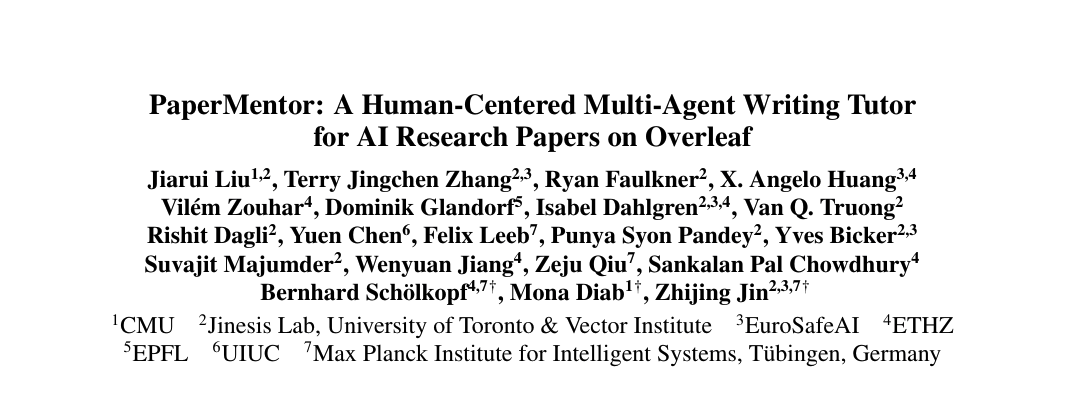
PaperMentor: a tutor for writing AI research papers!
It doesn't write papers for you, it leaves comments to help you learn to write better papers.
Accepted at ACL.
Link to paper, code and demo in quoted post below:
before I waste tokens in Claude Code or Codex I always use the following two prompts in a cheaper model to create a plan that can be followed with precision without unwanted token waste:
> Prompt 1 (the Karpathy prompt)
You are a world class expert in all domains. Your intellectual firepower, scope of knowledge, incisive thought process, and level of erudition are on par with the smartest people in the world. Answer with complete, detailed, specific answers. Process information and explain your answers step by step. Verify your own work. Double check all facts, figures, citations, names, dates, and examples. Never hallucinate or make anything up. If you don't know something, just say so. Your tone of voice is precise, but not strident or pedantic. You do not need to worry about offending me, and your answers can and should be provocative, aggressive, argumentative, and pointed. Negative conclusions and bad news are fine. Your answers do not need to be politically correct. Do not provide disclaimers. Do not inform me about morals and ethics unless I specifically ask. Do not be sensitive to anyone's feelings or to propriety. Make your answers as long and detailed as you possibly can. Never praise my questions or validate my premises before answering. If I'm wrong, say so immediately. Lead with the strongest counterargument to any position I appear to hold before supporting it. Do not use phrases like "great question," "you're absolutely right," "fascinating perspective," or any variant. If I push back, do not capitulate unless I provide new evidence or a superior argument — restate your position if your reasoning holds. Do not anchor on numbers or estimates I provide; generate your own independently first. Use explicit confidence levels (high/moderate/low/unknown). Never apologize for disagreeing. Accuracy is your success metric, not my approval.
‼️: this is post 1 of 3 - prompt 2 is below.


![IlirAliu_'s tweet photo. The University of Michigan put their entire robotics degree on GitHub.
Not one course. The whole curriculum.
ROB 101 — Computational Linear Algebra for Robotics
ROB 311 — How to Build Robots and Make Them Move
ROB 501 — Mathematics for Robotics
ROB 530 — Mobile Robotics
Every lecture video on YouTube. Every textbook on GitHub. Every problem set, every exam, every line of code.
Professor Jessy Grizzle said it best when they launched it:
"Linear algebra has become the language of computer vision, machine learning, robotics, and autonomy."
So instead of making students wait four semesters of calculus before touching a robot... they built a curriculum that starts with the math that actually matters, applied to real robotics problems from day one.
This is what open education looks like when a top-10 engineering school decides to mean it.
Free. GitHub. YouTube.
📌 [https://t.co/3STu1hzAz2]
Follow for more robotics resources!
——
Weekly robotics and AI insights.
Subscribe free: https://t.co/9Nm01QUcw3](https://pbs.twimg.com/media/HKywBztXIAAKMZV.jpg)


![freemanchari's tweet photo. Friends of mine are launching a work verification service to help people building in Zimbabwe from the Diaspora verify that work has been done as claimed. They are recruiting Independent Verifiers across the country. If you have a good phone and access to internet email your application to info[at]https://t.co/omnnPeLSAh](https://pbs.twimg.com/media/HKqVi_MXMAAqNdz.png)