Strategic S&T Policy Leader | Ex-White House OSTP Assistant Director (Both Parties) | Creator of Center for Data-Driven Policy | GAO Polaris Council Member
Submitted my response to the @WHOSTP47 RFI on "Accelerating the American Scientific Enterprise."
Drawing from 25+ years in federal S&T policy, including White House roles and public-private innovation research, my recommendations rest on three key principles:
1) Target public-private interventions to specific tech lifecycle stages for maximum acceleration.
2) Sustain curiosity-driven basic research while fixing underserved mid-stage innovation gaps.
3) Orchestrate existing tools/authorities toward shared national objectives.
These ideas help deliver the vision in the 2025 NSS, President’s March letter, America’s AI Action Plan, and Genesis Mission EO: U.S. innovation moving at the speed of national necessity.
https://t.co/nkG9YNciN4
China's 5 year Plan list of emerging technologies:
-quantum
-biomanufacturing
-hydrogen and nuclear fusion power
-brain-computer interfaces
-embodied artificial intelligence,
-6G mobile communications.
#FEDID starts tomorrow at 8:30AM with exciting programming, networking opportunities, and exhibits. etc. The agenda is available on the website at https://t.co/dg85pjnpQh
#FEDID is less than one week away! Don’t miss the top government identity event in North America. It's not too late to register—secure your spot today: https://t.co/sHc5plo4iO
Register to attend #FedID 25, taking place September 23-24, in Chantilly, VA. FedID is where identity pros forge partnerships, spark breakthroughs, and set the course for secure, trusted identity. Designed for maximum interaction and impact, this is North America’s must-attend identity forum. Visit the website to register today. https://t.co/LErlJCeIyq
Numerous individuals from federal agencies, the private sector, and academia gathered this week to exchange insights and build collaborations to advance critical and emerging technologies in the national interest. I was honored to kick off 2025 TechNet Emergence with remarks on today’s unique S&T situation, the international competition with China, and how we can leverage America’s strengths to succeed.
https://t.co/F2AI41oFZ2
Unlock your voice at #FEDID 2025 by joining the Poster Sessions. Showcase your ideas, connect with leaders in identity innovation, and help shape the future by submitting your poster proposal today.
Act now! Slots are limited.
https://t.co/vzg2viFzyl
Do you know someone that has had an incredible impact on the federal identity management community? Nominations are now open for the 2025 FedID awards: https://t.co/eD6MFwJhJl
Not familiar with FedID? It’s the U.S. government’s annual identity conference, uniting government, industry, and academia to advance cutting-edge identity, biometric, and credentialing technologies & federal applications. The FedID Awards celebrate the biggest innovators in this space.
Nominate a standout individual or team in one of these categories:
• Best Technical Advancement: Game-changing tech or discoveries in identity capabilities (past 18 months).
• Best Operational Success: Impactful tech, practices, or policy changes driving measurable results (past 18 months).
• Best Educational Effort: Exceptional training or education for the federal identity community or public (past 18 months).
• FedID Service and Leadership: Outstanding guidance or leadership in the field (past 18 months).
• Career Achievement and Recognition: Sustained excellence in federal identity over 15+ years.
Be sure to nominate deserving candidates by August 1st!
Registration is now open for #FedID 25 taking place September 23-24, in Chantilly, VA. FedID is where identity pros forge partnerships, spark breakthroughs, and set the course for secure, trusted identity. Designed for maximum interaction and impact, this is North America’s must-attend identity forum. Visit the website to register today. https://t.co/LErlJCeaIS
Now available: a (lightly polished) text version of my remarks at last month's @NDIAToday webinar, 'Navigating Uncertainty: Simulation as a Tool for Policy Innovation'. https://t.co/9XgXiVq0yN
Poster session slots at FedID, the federal government’s annual identity conference, are now available!
A key focus for the interagency 2025 FedID Planning Committee is to meet federal manager’s needs to hear from the identity community on capabilities, opportunities, and issues. One aspect of supporting this objective is an extensive ‘poster session’ on each day to support bidirectional and 1:1 strategic conversations amongst community members. Read more and apply today at https://t.co/PaCJkQDc77. And don’t take too long as poster slots are first-come, first-served (provided they’re on topic!).
(Housing reservations and sponsorship opportunities for FedID are also open!)
Join me on Thursday for an @NDIAToday webinar that will explore the enhanced use of modeling in federal policymaking. I’ll be providing a policy ‘user’ perspective on an interactive panel with modeling & simulation SMEs.
https://t.co/XqtLv5EXnZ
As new political appointees begin to assume office on Inauguration Day, I thought it’d be valuable to share insights from my own experiences and observations across multiple administrations, from both political parties, regarding common mistakes in crafting and/or promoting policies. This isn't meant to criticize but to offer reflective guidance to help new appointees navigate their roles more thoughtfully and effectively.
In federal policymaking:
1. Creating the ‘first ever’ policy doesn’t automatically mean that it’s wise
2. Largest doesn’t equal best, or even that it’s good or appropriate
3. Maximizing short-term benefits can often undermine long-term sustainability
4. Trying to do too much at once can dilute focus and effectiveness; prioritizing key issues is crucial
5. Not everything you fear is an existential threat (most everything is not)
6. Not everything you hold dear is critical, or potentially even true
7. You’re probably not truly uniquely qualified, nor facing a unique situation
8. Effectively leading your staff enables you to accomplish orders of magnitude more than working solo
9. Policies often fail because decision-makers didn't adequately listen to those they affect or the experts in the field
10. Consensus doesn’t always mean correctness
11. If you destroy relationships to push a policy through, it probably won’t be implemented
12. Having 1 or 2 votes from the other party doesn’t really make something “bipartisan”
13. There are numerous biases and they’re omnipresent, and are usually overlooked due to the attention given to a predominant bias
14. Communications can sometimes have a greater impact than the quality of the policy
15. It’s very difficult to have too much transparency & accountability, but very easy to have too little
What other observations would you add from your policy experiences?
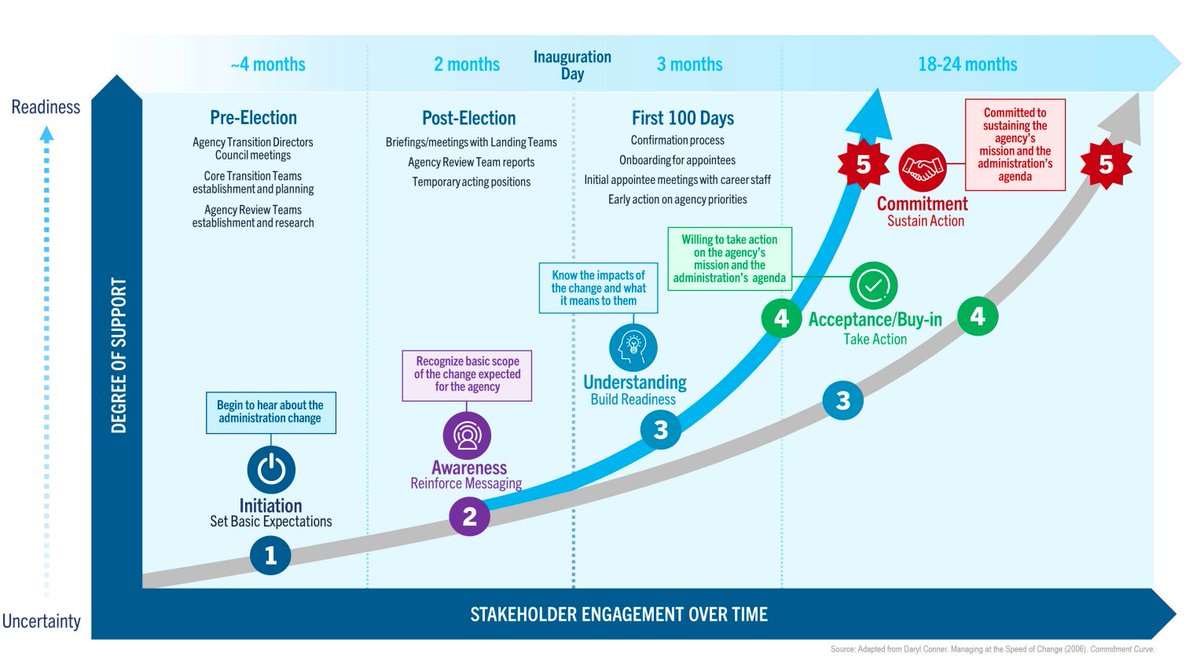
My presidential transition series continues with vital guidance for federal managers. This piece offers timeless strategies for easing career staff through the uncertainties of the critical period surrounding Inauguration Day, ensuring continuity and setting the stage for success in any new administration. Dive in for insights on how to handle pre- and post-inauguration challenges effectively: https://t.co/ipa4OQwhNT.
#PresidentialTransition #ChangeManagement #Leadership