$SLNH | Texas Data Center Policy: Why a Prolonged Moratorium May Be Politically and Economically Difficult
The incoming Texas administration may introduce significant changes to data center regulation. But stronger community protections do not necessarily require a prolonged construction freeze.
In fact, when we examine the economic importance of data centers to Texas construction workers, infrastructure investment, and organized labor, a more nuanced picture emerges.
There are several reasons why a balanced regulatory framework may be more practical than an open-ended moratorium.
1. Ryan Pollock's Appointment Is More Significant Than It May Appear
Ryan Pollock, president of the Texas State Building & Construction Trades Council, was appointed co-chair of Governor-elect Gina Hinojosa's transition team.
This is not a minor advisory position. Pollock is part of the transition's senior leadership.
His appointment sends a clear political message: organized construction labor has a seat at the table.
But such appointments also create expectations.
If the incoming administration implements policies that substantially disrupt construction employment, Pollock could face pressure from the unions he represents to demonstrate that his involvement produces meaningful results.
And that pressure would not necessarily stop with Pollock.
By placing a prominent construction labor representative in transition leadership, the incoming administration has publicly emphasized the importance of organized labor.
A policy that significantly damages future construction employment could therefore create political difficulties for the administration itself.
2. Data Centers Are Becoming an Increasingly Important Part of Texas Construction
According to the Federal Reserve Bank of Dallas, data center construction contracts in Texas reached approximately $10.8 billion in 2025, representing about 5.7% of total construction contract value.
Industry forecasts indicated substantial additional growth in 2026 and 2027, significantly outpacing many traditional construction sectors.
This distinction matters.
The entire Texas construction industry is not expanding at the same rate.
Some traditional segments have experienced relatively weak conditions, while data centers have become an increasingly important source of new projects and demand for skilled labor.
The relevant question is not simply what percentage of construction activity data centers represent today, but how much of the industry's future growth depends on them.
That percentage may be considerably higher.
3. The Real Economic Footprint Extends Far Beyond Data Center Buildings
When discussing data center construction, we should not limit our analysis to the buildings themselves.
A large AI data center can require substantial investment in:
Electrical substations and transmission infrastructure
Natural gas generation and pipeline connections
Wind, solar, and battery storage facilities
Cooling and water infrastructure
Fiber connectivity
Roads, site preparation, and heavy civil construction
These projects generate work for electricians, pipefitters, operating engineers, ironworkers, laborers, welders, and numerous other skilled trades.
Many of these professions are represented by unions within Pollock's organization.
The IBEW, one of the most important unions involved in electrical infrastructure, has publicly opposed blanket data center moratoriums at the national leadership level.
This is therefore not an issue affecting only technology companies or a relatively small group of specialized construction workers.
The economic exposure extends across much of the construction and energy infrastructure ecosystem.
4. The Infrastructure Multiplier Also Works in Reverse
This may be the most overlooked consequence of a prolonged moratorium.
Consider a utility planning a major substation expansion primarily to accommodate several new data centers.
If those data centers are delayed indefinitely, what happens to the substation project?
There is a strong economic incentive to postpone the investment.
The same reasoning applies to dedicated transmission upgrades, power generation, gas pipelines, and other infrastructure projects whose timing depends on anticipated data center demand.
Utilities generally do not accelerate major capital expenditures when the demand supporting those investments becomes uncertain.
Some projects would continue regardless, particularly infrastructure required for grid reliability or existing customers.
But investments driven primarily by future data center demand could be delayed.
That creates a potential chain reaction:
Data center delays → Lower near-term electricity demand growth → Deferred infrastructure investment → Fewer construction contracts → Reduced demand for skilled workers.
And for construction workers, a project postponed by 12–18 months can be economically damaging even if it is never permanently canceled.
5. ERCOT's Demand Pipeline Illustrates the Scale
Data centers accounted for an overwhelming share of the capacity requested by large-load customers in ERCOT's March 2026 interconnection pipeline.
This does not mean every proposed project will be built, or that all planned electricity infrastructure depends on data centers.
But it demonstrates how important the sector has become to projected electricity demand growth.
The implications for construction employment extend well beyond the data center sites themselves.
If data centers are responsible for a substantial portion of future electricity demand growth, they may also be responsible for a substantial portion of the construction work required to support that growth.
This is why looking only at direct data center construction spending understates the industry's potential importance to organized labor.
6. Organized Labor Has a Direct Interest in the Outcome
Pollock's organization represents a broad coalition of construction trades.
The potential effects of a prolonged moratorium would not be limited to electricians.
Pipefitters, heavy equipment operators, ironworkers, laborers, and other trades could also experience reduced demand if projects and supporting infrastructure investments are postponed.
The political implications are important.
Pollock was not appointed merely as an outside representative invited to occasional discussions. He was appointed to help lead the transition.
That gives organized labor a visible position within the incoming administration's leadership structure.
If construction employment suffers because of a prolonged regulatory freeze, unions may expect their representative to explain what he accomplished.
But the governor-elect also has to consider the interests of the workers whose political support and participation she has publicly emphasized.
A prolonged moratorium could therefore create political tensions not only with developers and utilities, but also within the administration's own labor constituency.
7. Balanced Regulation Is Not the Enemy of Data Center Development
This is an essential distinction.
Communities have legitimate concerns about electricity prices, water consumption, noise, environmental impacts, and the strain large developments may place on local infrastructure.
Those concerns deserve meaningful answers.
Data center developers should be expected to contribute fairly to the infrastructure they require and to provide tangible benefits to surrounding communities.
Stronger requirements concerning electricity, water, noise, environmental protection, and community benefits are not inherently anti-development.
In fact, a clear and balanced regulatory framework could strengthen the industry's long-term prospects by increasing public acceptance, reducing local opposition, and creating greater regulatory certainty.
The objective should not be unrestricted development.
It should be responsible development that benefits communities, workers, and investors.
And there is an important difference between implementing such standards and imposing an indefinite halt on construction.
8. A Workable Compromise Could Address Both Community and Labor Concerns
The incoming administration could pursue meaningful regulatory reform through:
Clearer electricity and water requirements
Stronger noise and environmental standards
Fair infrastructure cost-sharing arrangements
Community benefit agreements
Transparent and predictable permitting procedures
Transitional provisions for projects already under development
Such an approach could deliver meaningful changes without unnecessarily disrupting the entire investment ecosystem.
It could also address two objectives that might otherwise come into conflict: protecting local communities and preserving skilled construction employment.
That does not mean the administration will necessarily choose this approach.
But a prolonged, open-ended moratorium is not the only way to deliver stronger community protections.
9. Why This Matters for Soluna's Kati 2 and Dorothy 3
For $SLNH investors, the distinction between regulatory reform and a prolonged development freeze is particularly important.
Kati 2 and Dorothy 3 are not merely conceptual projects.
Both have progressed through development activities, infrastructure planning, and construction-related work, although important commercial, financing, and regulatory milestones remain outstanding.
A regulatory framework that distinguishes between speculative proposals and projects already advancing through development could be especially relevant.
There is no guarantee that either project would receive exemptions or favorable transitional treatment.
Nor can we rule out additional permitting requirements, costs, or delays.
However, a significant delay should not be treated as an inevitable consequence of stronger regulation.
The outcome will depend on the specific rules adopted, the timing of implementation, and how existing projects are treated.
10. The Political Reality Changes After an Election
Campaign commitments are made in a political environment.
Governing requires translating those commitments into policies with real economic consequences.
An open-ended moratorium affecting a rapidly expanding industry could influence far more than the companies developing data centers.
It could affect utilities, energy developers, construction contractors, local governments, and workers across multiple skilled trades.
That does not invalidate the case for stronger regulation.
But it means the costs of different policy choices deserve serious consideration.
The appointment of Pollock to transition leadership is particularly relevant in this context.
Organized labor has been given a prominent role in the incoming administration, while data centers and their supporting infrastructure represent an increasingly important source of future construction activity.
Those two facts create an important political consideration when evaluating the consequences of a prolonged freeze.
My Takeaway
I expect Texas data center regulation to evolve toward stronger community protections, clearer infrastructure responsibilities, and greater scrutiny of environmental and local impacts.
I do not see balanced regulation as inherently negative for the industry.
Quite the opposite: well-designed rules could help establish a more sustainable foundation for long-term growth.
But I also believe the economic and political consequences of a prolonged, open-ended moratorium are being underestimated.
Data centers are not isolated technology projects. They are increasingly connected to a much broader ecosystem of electricity generation, transmission, gas infrastructure, construction employment, and local investment.
Organized construction labor has a substantial interest in keeping that ecosystem moving.
And with Ryan Pollock serving as transition co-chair, those interests have a visible place in the incoming administration.
My central conclusion is not that regulatory changes will be avoided. It is that meaningful regulatory reform and continued data center development are entirely compatible.
A significant construction freeze remains a possibility, but it should not be assumed to be inevitable.
For $SLNH, $APLD, and other companies developing AI infrastructure in Texas, that distinction matters enormously.
Stronger community protections and continued infrastructure investment do not have to be competing objectives.
$SLNH $APLD #Texas #DataCenters #AIInfrastructure #Energy #Construction #OrganizedLabor
$SLNH | Kati 2 — Two Months of Satellite Evidence Show Meaningful Construction Progress
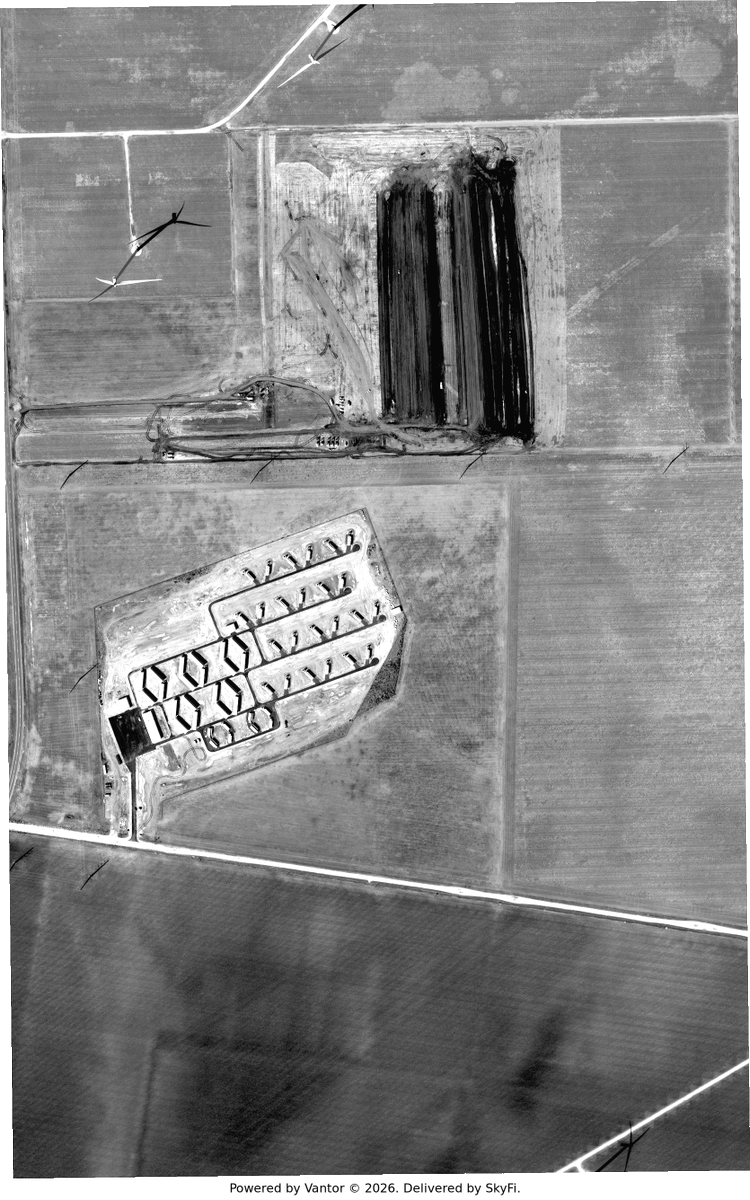
📸 Latest satellite image: November 20, 2026
I've been tracking Soluna's Kati 2 AI data center in Willacy County, Texas, through commercial satellite imagery since September 19.
After roughly two months of observations, one conclusion is becoming increasingly clear:
Kati 2 is not simply sitting idle while Soluna waits for a binding tenant agreement. Substantial site preparation is taking place.
What the images show:
Significant clearing, grading, and preparation of the central construction pad.
Increasingly uniform and clearly defined work areas.
Continued development of access roads and surrounding infrastructure.
Multiple pieces of heavy construction equipment, with approximately 17 machines identified in one earlier image.
Visible progress between October 23 and November 20.
The latest comparison covers just 28 calendar days — approximately 20 potential working days. Rainfall in the Raymondville area may have further reduced effective working time.
The broader two-month progression is what matters most.
We are seeing sustained, visible development across multiple satellite observations, not isolated activity or equipment simply parked on the property.
Why this matters
Soluna's current Kati 2 delivery target is Q2 2028.
By advancing earthworks before securing a binding lease, Soluna is completing work that would otherwise need to begin after the contract is signed.
This could shorten the remaining construction timeline and help preserve the targeted delivery date.
It also demonstrates a willingness to commit capital to actual site development while commercial negotiations continue.
What we have NOT seen yet
There is still no clearly identifiable large-scale foundation construction or vertical building activity.
The imagery cannot confirm that tenant negotiations are complete, financing is secured, or the delivery schedule is guaranteed.
My assessment
The pace and scale of visible progress over approximately two months suggest a genuine, active site-development program.
This does not look like a developer merely performing symbolic work while waiting for a tenant.
However, earthworks involve a much smaller financial commitment than structural foundations and vertical construction.
The next major milestone will be the transition to foundations.
That would represent a substantially greater engineering and financial commitment, especially if it happens before a binding tenant agreement is announced.
Bottom line:
The identity of the new prospective 118MW IT tenant remains the most important unanswered commercial question.
But the satellite evidence supports a meaningful conclusion:
Soluna is making tangible progress on Kati 2 while negotiations continue. The project is moving forward on the ground, not just in investor presentations.
Satellite observations: September–November 2026. Latest image acquired November 20, 2026. Analysis based on visible site changes, not contractor progress reports.
#SLNH #Soluna #Kati2 #AIInfrastructure #DataCenters
$SLNH | Kati 2: A New Regional Framework for AI Data Centers in South Texas — Risk or Opportunity?
I reviewed the 121-page October 28, 2026 board meeting packet of the Lower Rio Grande Valley Development Council (LRGVDC). Pages 33–41 contain an eight-page draft Community Benefit Agreement (CBA) framework that could become relevant to Soluna's Kati 2 project in Willacy County, Texas.
There are several important findings worth discussing.
1. Who created this framework?
The document was prepared by Rio Grande Valley community members and the RGV Broadband Coalition, led by the nonprofit Connect Humanity.
It was developed through workshops involving community organizations, economic development officials, and representatives of local governments.
On October 28, the framework was placed on the agenda of the LRGVDC Board of Directors for formal consideration.
Importantly, the council's president is Aurelio "Keeter" Guerra, the County Judge of Willacy County — the same county where Kati 2 is being developed.
This creates a meaningful institutional connection between the regional initiative and the local government involved in Kati 2's tax abatement process.
However, the meeting packet alone does not establish how Guerra voted or whether Willacy County intends to adopt the proposed terms.
2. Is the framework legally binding?
No — not by itself.
The document is a proposed template for negotiations between local governments and AI data center developers.
It is not a new law, an environmental permit requirement, or an executed agreement with Soluna.
Even formal adoption by the regional council would not automatically impose these conditions on Kati 2.
A separate agreement would be required to create contractual obligations.
The document also explicitly allows negotiators to customize its provisions to reflect local priorities.
3. The proposed financial commitments
One provision suggests:
$5 million upon signing a Community Benefit Agreement.
2% of annual revenue contributed to a community endowment.
Both figures appear in brackets, indicating proposed negotiating terms rather than finalized requirements.
The endowment would support workforce training, digital infrastructure, education, telehealth, and other community initiatives.
For Kati 2, the distinction between these two payments matters.
A one-time contribution could potentially be incorporated into the project's development budget and reflected in lease economics, particularly if negotiated before the final tenant agreement.
The recurring revenue contribution could be more significant.
The draft does not clearly define whose revenue would be used — the developer, the project company, or the data center operator.
For a project structured through a development JV and a long-term tenant lease, that distinction is critical.
4. Natural gas generation: Temporary generators vs. permanent Behind-the-Meter power
Section I.A.2 is explicitly titled "Temporary Nature of Onsite Generation."
It describes a scenario in which a data center contracts with a third party to install and operate onsite gas generators until the local utility can provide the requested electrical capacity.
Under that scenario, the draft proposes removing those generators once utility service becomes available.
This is fundamentally different from a permanent Behind-the-Meter (BTM) power generation project.
Temporary gas generators are deployed as a bridge solution while waiting for grid infrastructure.
Permanent BTM generation is designed from the outset to remain part of the facility's long-term power architecture.
Gas turbines in such a configuration may provide continuous or supplemental electricity, operate alongside renewable generation, and potentially reduce dependence on grid-supplied power.
That distinction is particularly relevant to Kati 2.
Soluna has been exploring gas turbine capacity as part of a broader energy strategy combining wind resources with additional power generation.
If those turbines are developed as permanent BTM infrastructure rather than temporary bridge generation, the rationale behind the draft's generator-removal provision may not apply.
The document does not explicitly prohibit permanent gas turbines or require all data centers to obtain their electricity exclusively from the grid.
Nor does it expressly exempt permanent BTM facilities.
The wording would therefore need to be clarified in any project-specific agreement.
My interpretation is that this provision primarily targets temporary gas generation installed while waiting for utility service, rather than permanent, purpose-built BTM power plants.
Environmental requirements concerning emissions, noise, and water consumption would remain relevant regardless of whether generation is temporary or permanent.
5. Renewable energy could benefit Soluna
The framework explicitly supports responsible renewable energy development, although the relevant provision remains unfinished.
Soluna's model combines renewable energy resources with data center infrastructure, potentially reducing reliance on conventional grid-supplied electricity.
If Soluna can demonstrate that its power architecture reduces pressure on the regional grid while maintaining reliable operations, it may be able to address some of the framework's central concerns.
That would not guarantee preferential treatment, but it could strengthen the company's negotiating position.
6. Water consumption and cooling
The framework calls for closed-loop cooling systems and responsible water management.
Kati 2's planned direct-to-chip liquid cooling architecture could be well positioned to address these requirements.
However, the document also proposes financial support for regional water infrastructure, meaning that efficient cooling alone might not satisfy every requested commitment.
7. Fiber infrastructure and local economic benefits
Another provision proposes installing additional conduit alongside the fiber routes serving a data center, allowing surrounding communities to benefit from expanded broadband infrastructure.
For Kati 2, this could represent an additional development expense.
However, incorporating additional conduit during initial fiber construction may be considerably more efficient than installing it later.
The framework also proposes local hiring, workforce training, apprenticeships, and procurement from regional businesses.
These are areas where a large-scale development could potentially offer meaningful benefits to the surrounding community.
8. Environmental studies and construction timing
The draft proposes a wildlife impact study delivered at least six months before construction.
If such a provision were imposed on an already progressing project without modification, it could create scheduling complications.
But there is currently no evidence that this requirement applies to Kati 2.
The framework is a negotiating template, not an automatically applicable construction restriction.
9. What does this mean for Kati 2's tax abatement negotiations?
The document advises local negotiators to examine the tax incentives being offered to developers and determine whether additional community commitments should accompany those incentives.
It also specifically recommends identifying the data center's owners and tenants.
That is particularly relevant to Kati 2, given its JV structure involving Soluna and Metrobloks and the ongoing process of securing a tenant.
The economic responsibilities of the developer, project owner, and eventual operator may differ considerably.
My Assessment: A Framework for Moving Forward, Not Necessarily an Obstacle
I believe the broader significance of this document may be positive for Kati 2.
Rather than signaling an intention to prevent AI data center development, the establishment of a formal Community Benefit Agreement framework suggests that regional officials are defining the conditions under which such projects can proceed.
That is an important distinction.
The discussion may increasingly be shifting from whether data centers should be built to what commitments developers should make in exchange for local support and incentives.
This is particularly relevant because the president of the LRGVDC is also the County Judge of Willacy County.
Although the framework is not automatically binding, it would be unrealistic to assume that a document considered by a regional council led by the county's own judge will have no influence on local negotiations.
Its political and practical significance may be considerably greater than its immediate legal effect.
Additional costs should also be viewed in the context of overall project economics.
The precise dollar amounts proposed in the draft are less important than the broader principle.
Community benefit requirements, infrastructure contributions, environmental commitments, and other local obligations are additional costs that developers must incorporate into the economics of building and operating data centers.
Where these requirements are known before final agreements are signed, they can be incorporated into development budgets, financing structures, and lease negotiations.
Some of those costs may ultimately be borne by tenants through lease pricing or other contractual arrangements, although the exact allocation will depend on negotiations.
For multibillion-dollar AI infrastructure developments, reasonable community contributions are unlikely, by themselves, to be the decisive factor in whether a project proceeds.
If similar frameworks become common across Texas, these obligations may increasingly become a standard component of data center development costs rather than a unique disadvantage for Kati 2.
The specific terms will vary by jurisdiction, and it has not been established that other Texas regions are adopting this particular template. Nevertheless, the broader economic logic is straightforward: developers and tenants will need to price local community commitments into their projects.
There is also an important political benefit.
A negotiated CBA gives local officials a way to demonstrate that their communities receive tangible benefits from hosting large AI infrastructure projects.
That may make it easier to justify development approvals and tax incentives while addressing residents' concerns.
For Soluna, a negotiated framework could therefore provide greater clarity about the commitments required to advance Kati 2.
Its renewable energy integration, potential permanent BTM generation, planned closed-loop cooling, and infrastructure development may also offer useful arguments in those negotiations.
None of this guarantees approval or eliminates execution risk.
However, I would not automatically interpret the emergence of a regional CBA framework as a negative development.
Bottom Line
The October 28 LRGVDC document may represent a meaningful step toward establishing a practical framework for AI data center development in the Rio Grande Valley.
Its importance is not the specific proposed payment amounts, but the creation of a structured process through which developers and local governments can negotiate the economic, environmental, and community terms of development.
For Kati 2, that could ultimately be more constructive than continued regulatory uncertainty.
The next question is not whether the draft creates additional potential costs — it clearly does.
The more important question is whether it helps establish a negotiated path toward local support, tax abatements, and eventual project execution.
Source: LRGVDC Board of Directors Meeting Packet, October 28, 2026, pp. 33–42.
$SLNH #Soluna #Kati2 #AIInfrastructure #DataCenters #Texas
$SLNH | What Texas’ incoming administration is likely to do about data centers
I expect Texas Governor-elect Gina Hinojosa to pursue a pause on new state permits, followed by tougher conditions for projects to move forward. On November 19, after winning the election, she reaffirmed that she wants the pause to last until lawmakers pass protections for Texans. She also clarified that a project already under construction could be affected if its next phase still needs state approval. That makes permitting delays a real risk. Benzinga
What would it take for a project to move forward? Hinojosa has been clearest on three points: protect water supplies, shield households from higher electricity bills, and give host communities real leverage over whether a project is built and on what terms. She has also backed union hiring and ending state tax subsidies for data centers. One important question is still open: two bills already filed in Texas take opposite approaches to sales-tax exemptions that projects have already received. Both Kati 2 and Dorothy 3A hold those certifications. https://t.co/EcvL1gQRhL
Why I think an open-ended freeze will be harder to sustain: Hinojosa chose Ryan Pollock, head of the Texas Building Trades Council, as one of two co-chairs of her transition team. Months before the election, he wrote about data center construction: “we want this work. We want Texans doing it.” His published position favors enforceable hiring and wage commitments, water-efficient cooling, renewable power and projects that pay for the infrastructure they need. Hinojosa publicly linked his appointment to her commitment to good jobs. https://t.co/E7ec6jwRBv
The pressure can start before a single layoff. At the Stargate project in Abilene, Crusoe reported more than 8,000 workers on site daily at peak construction, with about half the workforce from Texas. A contractor waiting on a permit can put the next round of hiring on hold while crews are still working today. My expectation is that organized labor will press for clear deadlines and a way for advanced projects to keep hiring once they meet the new conditions. Hinojosa has yet to announce such a provision. https://t.co/vo9YlF4fxg
What that means for Soluna: Both Texas campuses are designed to use closed-loop cooling and sit alongside existing wind farms. Dorothy 3A already shows what local negotiating power can look like: Briscoe County approved a Phase 1 property-tax agreement with residential noise limits and independent monitoring. At Kati 2, Soluna has held its Willacy County open house. The more consequential questions are what the county can enforce, how much power the campus will draw from the grid when wind output is low, and who pays for the added infrastructure. Soluna
My read is that Texas is likely to become more selective about which data centers it approves. That creates near-term risk for the whole industry, especially for projects still waiting on permits. It also gives developers a reason to compete on water use, grid costs, Texas jobs and enforceable local benefits. Soluna has a credible starting position on several of those measures. The first real test for $SLNH will be whether the new rules let Kati 2 keep to a timetable a tenant can sign up to.
$SLNH | Dorothy 3A: the Microsoft connection looks strong. The delivery schedule and lease economics still need explaining.
ChronoScale’s November 18 SEC presentation identifies Silverton, Texas, as the location for its 49.5 MW Microsoft deployment. The Texas Comptroller lists ChronoScale as Dorothy 3A’s occupant, while Soluna describes a planned 50 MW critical IT facility—approximately 75 MW gross—with Applied Digital.
The evidence strongly points to Dorothy 3A, although ChronoScale does not explicitly name Dorothy in its presentation. https://t.co/0HK20ZLdXt
Several important questions remain.
1. The delivery schedule is extremely tight.
ChronoScale signed its Microsoft agreement on August 6, 2026. Its presentation schedules:
• February 28, 2027: 12,600 GPUs / 24.3 MW IT
• March 31, 2027: 13,104 GPUs / 25.2 MW IT
That totals 25,704 GPUs and 49.5 MW IT, approximately seven to eight months after signing. These are ChronoScale’s planned deliveries; Soluna has not announced a corresponding rent commencement date. https://t.co/5UQM4xY0B0
Soluna says construction started in October, leaving roughly four to six months of site construction before those deliveries. Earlier design, procurement and off-site manufacturing could help, but we need evidence showing how this schedule is achievable.
For context, Applied Digital describes standardized construction cycles of approximately 12–18 months for larger 100–150 MW facilities. Dorothy’s smaller, phased deployment has different requirements, but its schedule still appears exceptionally aggressive. https://t.co/cZFZYvpnBk
2. How much of the building actually exists?
Soluna’s progress chart indicates initial vertical construction at Dorothy. The building image on its Dorothy slide is explicitly illustrative.
We have not independently verified a completed shell or the current state of electrical, cooling and commissioning work. That leaves a critical gap in assessing delivery readiness. https://t.co/cZFZYvpnBk
3. The JV closing and definitive lease remain outstanding.
Soluna and Applied signed a binding subscription agreement on October 20, but closing and the definitive ChronoScale lease remain unfinished in the disclosures reviewed.
Applied is already funding development and long-lead equipment before closing. Nevertheless, if the site transaction fails, we have no basis to assume another facility could meet the same Microsoft schedule. https://t.co/sBRiUncjin
4. The lease terms will determine the project’s financing and Soluna’s economics.
Microsoft’s disclosed GPU services agreement runs for approximately three years. The Dorothy 3A lease must establish its own duration, rent, delivery obligations and payment guarantees. Those terms have not yet been disclosed.
We need to know whether ChronoScale’s rental obligations will carry an Applied Digital guarantee, prepaid rent or other security. Microsoft’s involvement alone should not be treated as a guarantee of the JV’s rental income. https://t.co/sBRiUncjin
ChronoScale’s presentation allocates approximately $200 million of equity funding to the Microsoft GPU contract and describes Silverton fit-out work. It also anticipates additional financing for remaining capital expenditure. This does not establish that all funding for the GPUs and facility is committed.
Soluna’s planned 49% interest is in the landlord JV. Its returns will depend on the lease, project expenses, financing and distribution terms. That interest does not represent 49% of ChronoScale’s Microsoft GPU revenue.
5. Delivery extensions are not a blanket escape clause.
ChronoScale discloses possible extensions, excluded delays and force majeure provisions. The precise qualifying events, extension periods and approval mechanism have not been disclosed in the material reviewed.
Its filings also describe daily delay credits and Microsoft termination/refund rights under specified circumstances. Financing or construction difficulties should not be assumed to qualify for a penalty-free extension. https://t.co/sBRiUncjin
6. Microsoft delay credits are ChronoScale’s obligations.
No direct Soluna guarantee of those credits has been disclosed. Any delivery liability of the landlord JV would need to arise under its own agreements, whose final terms remain unknown.
Soluna does have a separate disclosed exposure if the JV transaction terminates: reimbursement of 80% of specified Applied-funded development costs, capped at $45 million, plus applicable interest. That obligation relates to transaction termination, rather than automatically arising from a late Microsoft delivery. https://t.co/sBRiUncjin
7. Expansion remains potential.
The disclosed Microsoft deployment is approximately 50 MW. I have not found a publicly disclosed capacity expansion option beyond that initial deployment. Dorothy’s broader campus potential should therefore remain separate from confirmed Microsoft demand. https://t.co/sBRiUncjin
The Microsoft connection materially strengthens Dorothy 3A’s commercial case. The next proof points are the completed JV closing, signed lease with credible credit support, committed financing and a construction-to-service schedule supported by actual site progress.
Until those are clearer, a full quarter of project rental income in Q2 2027 remains a conditional scenario.
$SLNH | Kati 2 has a new prospective tenant. Why did the first one get exclusivity?
On the Q3 earnings call, Ryan Carver said Soluna chose not to renew the previous prospective tenant’s exclusivity because management did not expect it to meet the credit requirements for a lease of this size. Soluna marketed the site again and signed a non-binding LOI with a different prospective tenant for 118 MW of critical IT capacity. Management expects the new tenant to meet its credit requirements. Slide 12 still lists a signed lease as a target with no committed date.
Soluna had to enforce its credit standards. The project’s financing depends on the strength of the lease and the ability of the tenant or its guarantor to pay. My question for Soluna and Metrobloks is what gave them enough confidence to grant exclusivity in the first place? A short period to secure a specific guarantee can make sense. If the credit gap was apparent early and exclusivity lasted months without progress toward closing it, that would be a mistake. Management hasn’t disclosed when it identified the issue or how long exclusivity lasted.
My takeaway: I think many of us, myself included, started with the outcome we wanted: Microsoft as the end customer, or at least a tenant with the financial strength to support a deal of this size. We gave the Microsoft hires and other posts more weight than they deserved because they fit that hope. I was wrong to treat those clues as strong evidence about who was behind the original deal. The new LOI shows another party is interested. The milestone that matters is a binding lease that can support project financing.
$SLNH | Kati 2: What We Learned From the Willacy County Community Meeting
Soluna's recent community presentation provides some interesting new details about Kati 2, its planned 166 MW first phase, infrastructure readiness, construction preparations, and expected operational timeline.
I've reviewed the available presentation slides alongside the information discussed at the meeting. Here are my main takeaways.
1. Phase 1: 166 MW, with initial service targeted for Q2 2028
The presentation explicitly states:
"Phase 1 initial service is targeted for the second quarter of 2028."
This is an important clarification compared with the previously discussed late-2027 construction completion target.
It does not necessarily indicate a construction delay. Building completion, commissioning, and initial customer service are different milestones.
However, the Q2 2028 target is conditional on development milestones and county approvals.
Future phases remain TBD and are expected to develop over several years.
2. ERCOT and AEP: No new high-voltage grid upgrades needed
One of the most significant statements in the presentation:
"ERCOT and AEP found Kati 2 needs no new high-voltage grid upgrades."
If applicable to the full first phase, this could remove a major potential infrastructure obstacle.
Soluna also states that Kati 2 can reduce electricity consumption during periods of high grid demand.
Importantly, this does not establish that all interconnection arrangements or power commitments are finalized.
3. Natural gas generation is planned for future phases
The presentation describes five coordinated power components:
• Wind energy from Las Majadas
• Grid coordination through ERCOT and AEP
• UPS systems
• On-site natural gas generation in future phases
• Diesel backup generators
The explicit reference to future phases suggests that on-site natural gas generation is not currently presented as a prerequisite for initial Phase 1 service.
This is particularly interesting given earlier discussions about potential dedicated gas infrastructure.
4. Construction preparations are advancing
Soluna states:
"Soluna is finalizing its construction team."
The presentation also identifies construction traffic management, on-site worker parking, equipment staging, dust control, stormwater protection, and defined construction hours.
Previously disclosed engineering and site-development activity provides additional context.
Since Soluna previously indicated that a general contractor had been selected, the statement may refer to finalizing the broader construction organization and subcontractors rather than selecting the primary contractor.
However, the presentation does not identify the contractor or confirm a final construction contract.
5. Engineering and site planning
Soluna states that geotechnical, wetlands, and flood-risk studies were completed ahead of construction.
The presentation includes a Phase 1 site layout identifying the data center, office area, access gates, and supporting facilities.
The design also addresses Gulf Coast weather conditions, including extreme heat, hurricane-force winds, heavy rain, and corrosion exposure.
These details support the impression of a project with substantial engineering work already completed.
6. Estimated Phase 1 taxable value: $3.8 billion
The presentation estimates Kati 2 Phase 1 will represent approximately $3.8 billion in taxable value in 2028.
For comparison, Willacy County's entire certified tax base in 2025 was approximately $1.2 billion.
This is potentially transformative for the county's tax base.
However, taxable value should not be confused with construction cost, project equity value, or Soluna's economic ownership.
The presentation also indicates that the proposed tax abatement would not apply during construction and that school taxes would not be abated.
County approvals remain outstanding.
7. Community concerns and local opposition
The meeting focused heavily on issues relevant to nearby residents, particularly water consumption, noise, traffic, and environmental impacts.
A related local Facebook discussion attracted approximately 86 comments, although two particularly active participants accounted for more than 50 of them.
This suggests that the raw comment count may exaggerate the breadth of opposition.
Nevertheless, online comments are not a reliable measure of overall community sentiment, and the project still faces a formal county approval process.
8. What remains unanswered?
Despite the engineering detail, the available presentation materials do not establish:
• A signed hyperscale customer or final tenant
• Financial close or committed construction financing
• The identity of the general contractor
• A final construction authorization
• A binding date for full Phase 1 delivery
These are the critical commercial milestones investors still need to see.
My assessment
The presentation strengthens the case that Kati 2 is progressing beyond preliminary conceptual planning.
The combination of detailed site engineering, completed studies, a defined 166 MW initial phase, a stated grid-upgrade assessment, and an operational target suggests meaningful project-development maturity.
But engineering readiness and commercial readiness are not the same thing.
The biggest remaining questions are financing, customer commitments, final agreements, and the path from site preparation to full-scale construction.
With Soluna's earnings report and investor presentation approaching, I will be watching for measurable progress on those milestones.
Bottom line: Kati 2 looks increasingly tangible as an engineering project. The next step is demonstrating that the commercial and financial structure is equally advanced.
$SLNH #Soluna #Kati2 #AIInfrastructure #DataCenters
Texas certified $SLNH’s Project Kati II for its large data center sales and use tax exemption, effective October 27, 2026.
That puts the exemption in place for eligible purchases such as electrical and cooling equipment. The program requires at least $500M in qualifying investment within five years, 40 qualifying jobs, and a commitment to contract for at least 20 MW of transmission capacity. Those are eligibility commitments. Actual spending and financing remain unconfirmed by this record.
The field I’m watching is Occupant. Texas currently lists Soluna MB Kati 2 OPCO, LLC as owner, operator, and occupant. The occupant registration is LD902571-OC1.
There’s a precedent worth watching. In the same registry, the EDC Fort Worth entry originally listed the developer as occupant and was later updated to name Oracle America Cloud Services. If a third-party occupant appears on the Kati II entry, we’ll have a legal entity to investigate.
Update on Michal Stark, Soluna’s new VP of Planning:
Her LinkedIn profile has been corrected. Microsoft is no longer listed as a current employer alongside Soluna.
Some investors interpreted the overlapping roles as evidence of simultaneous employment and cooperation between the companies. The correction supports the simpler explanation: the profile update was initially incomplete.
Her hiring and Microsoft experience remain significant. But the overlapping listings should no longer be treated as a clue about the customer’s identity or a commercial relationship between the companies.
It’s important to update our interpretation when the evidence changes. $SLNH
Michal Stark's LinkedIn now lists her as VP Planning at $SLNH — while her Microsoft role still says "Present."
So, is Michal Stark's LinkedIn profile simply not fully updated yet… or have we just discovered the ultimate proof of an $SLNH–Microsoft partnership? 👀😂
Just kidding, of course. Probably just a LinkedIn update.
But the Microsoft talent pipeline into Soluna is getting pretty impressive. 😉
$SLNH | Dorothy 3 — What We Know, What Satellite Imagery Shows, and What Remains Unconfirmed
I've been tracking Soluna's Dorothy 3 project through company disclosures, Texas regulatory records, and Sentinel-2 satellite imagery.
Here's where things stand.
1. The project and its power infrastructure
In April 2026, Soluna completed its approximately $53M acquisition of the 150 MW Briscoe Wind Farm, strengthening its control over the renewable energy infrastructure supporting the Dorothy campus.
On May 7, Soluna disclosed an initial 50 MW load interconnection study for Dorothy 3 involving Golden Spread and Oncor.
The broader Dorothy 3 development has been discussed as a potential 300+ MW campus, although that capacity is not yet secured or operational.
2. The ChronoScale connection
An August 2026 agreement involving ChronoScale and Microsoft, followed by ChronoScale's appearance in Texas records associated with Dorothy 3A, creates an interesting connection worth investigating.
However, the regulatory records alone do not establish that Microsoft is Soluna's direct tenant, that a binding Dorothy 3 lease has been signed, or that construction has begun.
3. What the satellite images show — and why the bright areas matter
The attached comparison uses Sentinel-2 imagery from September 11, October 8, and October 23, 2026.
All three images cover the same geographic area, including the coordinate associated with the STX-01 / TCEQ authorization, marked by the yellow circle.
Several areas appear unusually bright, almost as if illuminated.
Importantly, the existing Dorothy 1–2 facilities also appear intensely bright in satellite imagery.
This is a valuable reference point. We know those facilities already exist, yet their rooftops and surrounding surfaces produce the same kind of bright appearance.
The likely explanation is strong sunlight reflection from light-colored or reflective surfaces, combined with image rendering and Sentinel-2's relatively coarse 10-meter resolution.
However, this comparison has an important limitation:
The fact that Dorothy 1–2 appear bright does NOT prove that the additional bright area near STX-01 is an existing building.
Nor does it prove that construction is absent.
It demonstrates something more specific: brightness alone cannot reliably distinguish existing infrastructure, exposed ground, reflective materials, or new construction.
The bright area visible near the permit coordinate may reflect surface conditions rather than physical development. At present, there is insufficient evidence to classify it as a newly constructed structure.
Any apparent changes between September and October must also be interpreted cautiously because of differences in sunlight, surface conditions, and image processing.
4. What remains unknown
We still lack independent confirmation of:
A finalized Dorothy 3 tenant agreement.
The precise boundaries of the proposed first construction phase.
Mobilization of a general contractor or substantial earthworks.
A confirmed construction schedule for the initial 50 MW.
My assessment
The regulatory and commercial developments surrounding Dorothy 3 are meaningful, particularly the 50 MW interconnection process and the ChronoScale connection.
But commercial progress and physical construction are two different things.
The satellite imagery does not currently establish that major construction has begun — and the bright areas should not be presented as evidence that it has.
Equally, the imagery is not detailed enough to rule out preliminary site preparation.
The next step is obtaining 30–50 cm commercial satellite imagery of the STX-01 area to look for actual ground disturbance, access roads, equipment, or foundations.
Dorothy 3 remains a potentially significant development, but its physical progress still requires independent verification.
Image: Sentinel-2 L2A, September 11 / October 8 / October 23, 2026. Source: Copernicus via Microsoft Planetary Computer. Yellow circle marks a reported permit coordinate, not a surveyed project boundary
$SLNH | Kati 2 satellite update — October 28
Comparing the October 28 image with October 23 suggests continued earthworks over roughly three standard working days:
• The central/eastern pad appears more uniform, with changes in surface patterns consistent with further spreading and grading.
• Equipment positions have changed, with a cluster visible along the southern edge.
• A defined horizontal strip is visible along the northern boundary. It was not clearly apparent in the October 15 image and could relate to excavation or drainage. Its purpose remains unconfirmed, and the October 23 image does not fully cover this area.
The overall work footprint appears broadly unchanged, with activity concentrated within the previously disturbed area.
We still appear to be at the general site-preparation stage. No clear foundations or building-specific installations are identifiable in the visible areas, and the images cannot establish earthwork volumes or percentage completion.
Crucially, this work does not provide a reliable basis for judging progress in tenant lease negotiations.
As construction becomes more specific and visibly matches the planned building and infrastructure, satellite imagery should become a stronger proxy for execution progress.
$SLNH | Kati 2: RDH Identified in Official Site-Preparation Records
TCEQ, Texas’s environmental regulator, lists RDH Site and Concrete LLC as the operator under the construction stormwater authorization for “MFE-A-KATI 2 DATA CENTER DEVELOPMENT.”
The project is classified under “Site Preparation Contractors.”
Key details:
• Coverage began: September 15, 2026
• Reported disturbed area: 50 acres
• Authorization status: ACTIVE as checked October 26
• Site number: RN112529060
• Authorization: TXR1513ZL
RDH is a South Texas contractor specializing in excavation, grading, drainage, underground utilities and concrete.
These records establish a direct, project-specific link between RDH and Kati 2’s site preparation, identifying the contractor associated with the stormwater authorization, the reported work area and the coverage start date.
Source:
https://t.co/2MxiKGn03P
$SLNH Kati 2: Oct 23 satellite imagery shows further earthworks vs Oct 15, with roughly 17 vehicles and equipment units visible. Meaningful site preparation underway; no clear foundations yet.
@SolunaHoldings@jbelizaireCEO
@perspez@jbelizaireCEO@perspez@jbelizaireCEO I broadly agree. But with $SLNH falling so sharply, shareholders expect more than “Nothing fundamental has changed. We keep pushin’.” We’re not asking for confidential details—just a concrete update on progress, milestones and whether timelines still hold.
@jbelizaireCEO@SolunaHoldings Most of us believe in Soluna’s potential. But with $SLNH around $0.65 and a major share authorization vote ahead, we expected more than “Patience. Stay tuned.” A concrete progress update would mean much more.
$SLNH Sept 19 vs. Oct 13 satellite images show further grading at the presumed Kati 2 site, north of Kati 1. Changes in ground layout and visible equipment support ongoing site preparation. Heavy cloud cover limits conclusions about the rest of the site.