$SLNH $MSFT A few days ago, I teased some of the Microsoft connections I’d been digging into around Soluna’s Project Kati 2. The response showed that quite a few of you wanted to see the full research.
I’ve also been fairly quiet on X lately, and this is a big reason why. This took a lot more time and focus than I originally expected.
FOLLOWING THE POWER: The Case for Microsoft at Soluna’s Project Kati 2 --> Full 12-part investigation:
https://t.co/6DrxeXms7h
I originally thought I could turn all of this into one detailed X post. That stopped making sense once the research kept expanding.
I ended up going through Microsoft Research, EDF, Masdar, Las Majadas, Project Tumbleweed, Fairwater, Ryan Carver, Siemens, Kati 2’s evolution from an 83 MW second phase into a 350+ MW AI campus, and the anonymous tenant now negotiating around its first 100 MW phase.
This has been weeks of digging through filings, research papers, company materials, historical agreements, infrastructure developments and personnel connections. I’ve built it piece by piece, and in the end I decided I’d rather share the full work than squeeze it into a few conclusions on X and strip away the context that makes the thesis interesting.
There was simply too much that would have been left out, so I put everything together as one long-form Substack instead.
12 parts. Weeks of research. One thesis: why so many independent trails around Project Kati 2 keep converging on Microsoft.
Enjoy the deep dive.
$SLNH $MSFT
Guys, I have some really big evidence pointing to a Microsoft–Soluna connection.
I’ve gone much deeper with the research, and I’m honestly surprised by what I found. There’s far too much to fit into an X post, so I’m going to put together a much more detailed deep dive somewhere I can lay out all the findings, sources, and connections properly.
Stay tuned.
$slnh | My birthday is November 15.
@jbelizaireCEO scheduled @SolunaHoldings earnings call for November 16.
Now, I'm not saying the entire management team should organize a massive hyperscaler announcement just to make one shareholder happy...
But it would be pretty rude not to. 😂
No pressure, John.
📅 Nov 16 | 5 PM ET / 23:00 CET
🔗 https://t.co/aR8hFFctfR
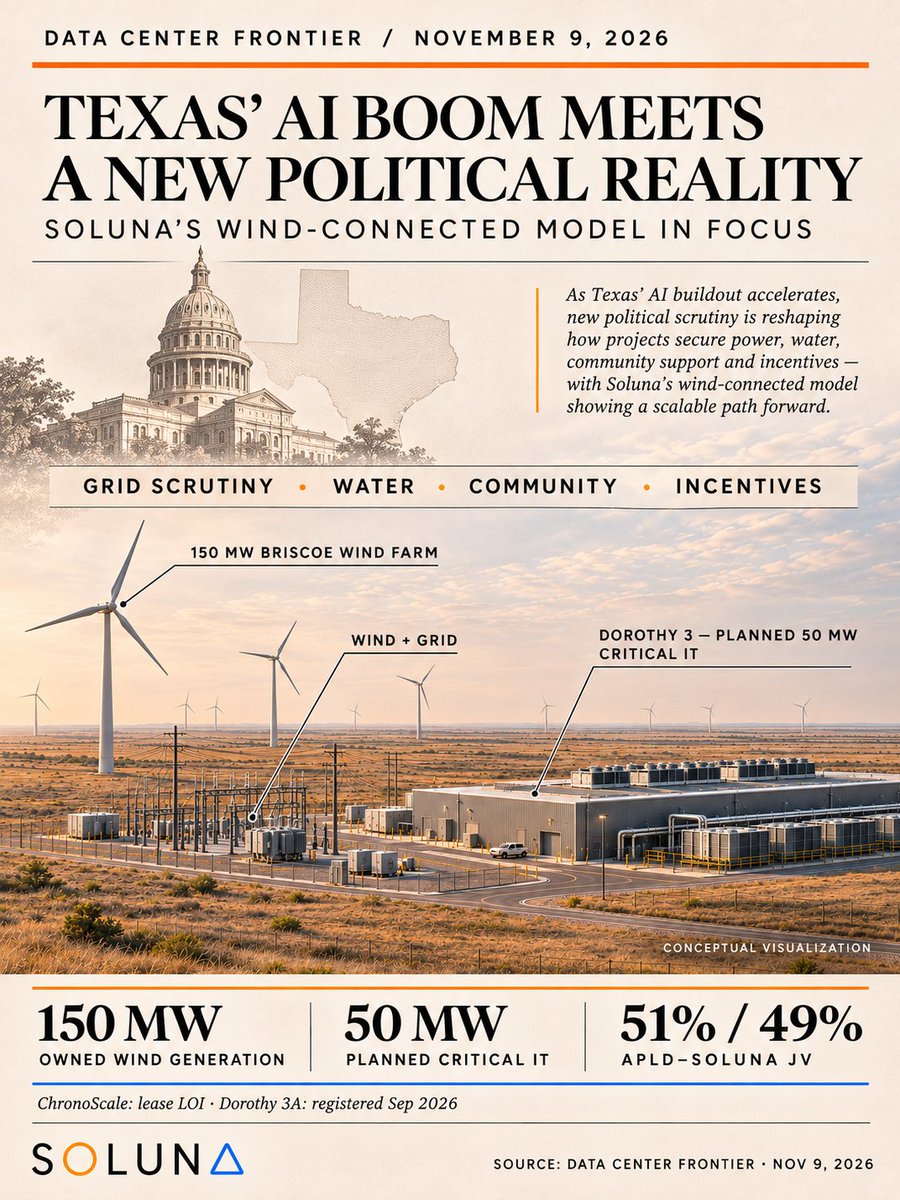
$SLNH | In its November 9 Land & Expand report, Data Center Frontier examines how Texas’ changing political landscape is reshaping the development of AI infrastructure.
Alongside major industry players such as Riot Platforms, Hut 8 and Fermi, the publication features Soluna Holdings and its partnership with Applied Digital.
What makes the coverage particularly interesting is the emphasis on Soluna’s approach to securing electricity for AI infrastructure through existing renewable energy assets and hybrid power arrangements.
Following Gina Hinojosa’s election as governor, Texas faces the prospect of stricter requirements concerning electricity consumption, water resources, environmental protection, public incentives and community involvement.
Developers are coming under greater scrutiny over how their projects will be powered, their impact on surrounding communities and their ability to deliver the capacity they announce.
Soluna has spent years building its business around many of these considerations.
Its strategy starts with access to energy, developing computing infrastructure alongside existing power-generation assets and creating additional demand where electricity is produced.
Data Center Frontier specifically highlights Project Dorothy 3 in Briscoe County, where Soluna is advancing a planned 50 MW critical IT facility in partnership with Applied Digital.
The development brings together several important elements:
- 150 MW Briscoe Wind Farm: An operating renewable energy asset acquired by Soluna in April 2026.
- 50 MW critical IT: The planned first phase of Dorothy 3, combining wind-generated electricity with grid power.
- Applied Digital: An experienced AI infrastructure developer expected to hold 51% of the joint venture, with Soluna retaining 49%.
- ChronoScale: A publicly traded accelerated-computing company that has signed a nonbinding letter of intent for a triple-net lease.
- Established local presence: Soluna already operates in Briscoe County, owns land and has extensive experience developing computing facilities alongside renewable generation.
Another noteworthy detail, not mentioned in the article, is that Project Dorothy 3A was registered in the Texas Comptroller's qualifying data center program on September 8, 2026, with STX-01 LLC listed as owner/operator and ChronoScale as occupant.
Data Center Frontier identifies Dorothy 3 as an example of the industry's growing interest in hybrid power strategies.
The timing is significant.
Texas continues to attract enormous AI infrastructure investments, while electricity availability, grid readiness and regulatory requirements are becoming central to determining which projects can move forward.
Soluna has been assembling the necessary foundations through renewable energy acquisitions, land development, existing operations and partnerships with established infrastructure companies.
The Applied Digital partnership represents another major step in bringing that strategy into the high-density AI computing market.
When announcing the partnership in October, Soluna CEO @jbelizaireCEO stated:
«“We have said for a long time that the constraint in AI is energy access, not chips.”»
The latest developments across Texas reinforce that argument.
As policymakers place greater emphasis on responsible energy consumption, infrastructure readiness and local accountability, projects built around existing power resources could gain a considerable competitive advantage.
Soluna enters this changing environment with an operating 150 MW wind farm, an established presence in Briscoe County and a major AI infrastructure partnership advancing at Dorothy 3.
The company spent years developing its strategy around an energy constraint that the AI industry is now confronting at scale.
The industry's priorities are catching up with Soluna's long-standing strategy.
Source: "Data Center Frontier — November 9, 2026" (https://t.co/R57P5iZJM9)
" @SolunaHoldings and @APLDdigital Digital Pursue Wind-Connected AI Infrastructure
Another approach to securing electricity is emerging in the Texas Panhandle. On October 21, Soluna Holdings and Applied Digital announced an agreement to form a joint venture for a proposed 50 MW critical IT facility at Soluna's Project Dorothy 3 site near Silverton in Briscoe County.
The development would be co-located with the 150 MW Briscoe Wind Farm, with its initial phase drawing electricity from both wind generation and the grid. Under the proposed ownership structure, Applied Digital would hold 51% of the venture and Soluna 49%, following closing. ChronoScale, a publicly traded accelerated-computing company majority-owned by Applied Digital, has signed a nonbinding letter of intent to lease the planned facility."
$SLNH @SolunaHoldings
https://t.co/jP0O84bykv
We'll be interviewing the CEO of $SLNH on Tuesday, November 17 at 2:30pm EST.
Reserve Your Spot: https://t.co/xfBugBXO65
Disruptor Investing: https://t.co/4Hddmr6IfZ
Membership: https://t.co/tQfZ0Fa4lT
Disclosures: https://t.co/rg3Y7CogWu
Soluna’s Q3 2026 earnings call is on Monday, November 16 at 5:00 PM ET.
Register for the webcast or dial in for live Q&A: https://t.co/GdrGC7fuky
$SLNH
$SLNH | November 12: Soluna’s Kati 2 Community Open House Comes as Willacy County Shapes Its AI Data Center Future
On Thursday, November 12, Soluna Holdings will host a community open house in Raymondville, Texas, to present Project Kati 2 and discuss its implications for Willacy County.
Soluna is preparing a major AI infrastructure development in a county where the company has already established relationships with local officials, just as regional leaders are introducing a new framework for negotiating community benefits from large-scale data centers.
On August 6, 2025, the Willacy County Commissioners Court unanimously approved a tax abatement agreement with Soluna KK1 ComputeCo, LLC, associated with Project Kati 1.
Commissioner Ernie Garcia introduced the motion, Commissioner Mario Tijerina seconded it, and County Judge Aurelio “Keter” Guerra voted in favor.
That approval concerned Kati 1, not the planned Kati 2 AI facility. Nevertheless, it established an important precedent for cooperation between Soluna and the county.
Guerra has also publicly welcomed Soluna’s investment, emphasizing the economic value such developments can bring to a rural county with a relatively small budget.
On November 3, the Rio Grande Valley Business Journal reported that the Lower Rio Grande Valley Development Council had approved a regional Community Benefit Agreement framework in late October.
Developed with significant involvement from Connect Humanity and more than 50 participating organizations, the framework addresses:
• Water conservation and responsible cooling
• Electricity infrastructure and grid costs
• Local employment and workforce development
• Broadband and fiber expansion
• Environmental protections
• Economic contributions to surrounding communities
The framework provides a negotiating template rather than automatically imposing these requirements on every project.
Interestingly, the article specifically highlights Soluna’s operations in Willacy County.
Unlike conventional data centers that must secure entirely new energy supplies, Soluna’s model is built around existing renewable generation.
The article describes how the company utilizes power from nearby wind farms, including electricity that has faced negative wholesale pricing during periods of excess generation.
It also reports that Soluna does not purchase municipal water service from East Rio Hondo Water Supply Corporation.
These distinctions matter as communities increasingly scrutinize the electricity and water requirements of proposed AI facilities.
Developed through Soluna’s joint venture with Metrobloks, Kati 2 is designed for more than 100 MW of critical IT capacity in its initial phase.
An October 7 Texas state filing describes a proposed 471,884-square-foot AI data center with approximately 112 MW of critical IT load and an estimated construction cost of $471.8 million.
The longer-term campus roadmap exceeds 300 MW of critical IT capacity.
At the November 12 open house, residents will be able to discuss water use, cooling, electricity, noise, construction, traffic, emergency preparedness and local tax revenue directly with the project team.
Ben Carranza, Soluna’s Director of Community Engagement, is listed as the event contact.
Commissioner Ernie Garcia has also shared the invitation publicly, while clarifying that this is not a county-sponsored event.
$SLNH That's very much in line with what I've been thinking, Hugh. What's particularly interesting is that Soluna's recruitment of Microsoft talent was already underway before the broader buyout announcement. Carver, Robinson and Stark bring complementary expertise in development, construction and planning. It looks like Soluna is assembling a serious team capable of delivering multiple hyperscale AI campuses. And your point makes sense. Microsoft could secure long-term, renewable-powered capacity through an independent developer like Soluna without having to manage every aspect of site development itself. It's still my own hypothesis, but the bigger picture is becoming increasingly interesting.
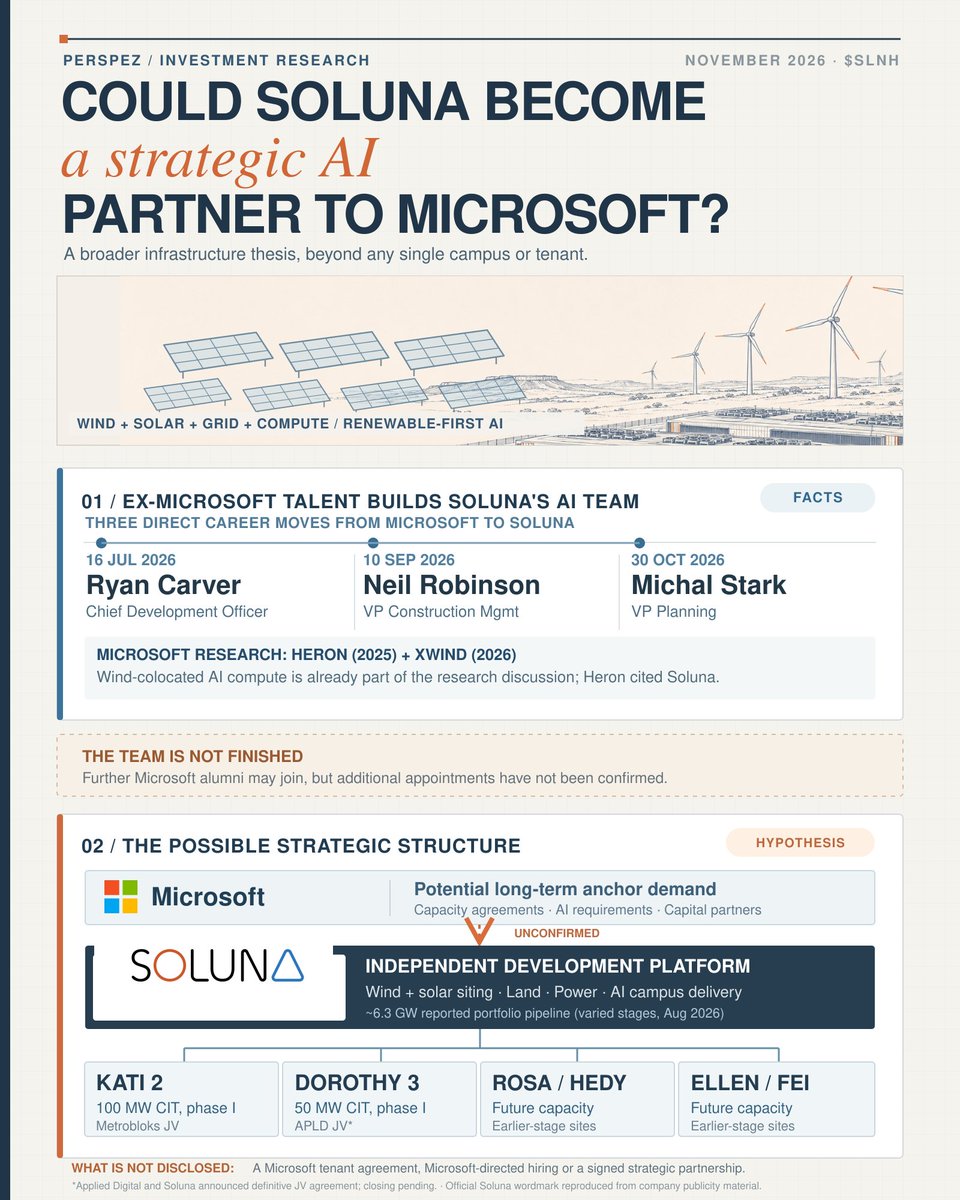
1/2 $SLNH | COULD SOLUNA BECOME A STRATEGIC AI INFRASTRUCTURE PARTNER TO MICROSOFT?
Three Microsoft data-center veterans joined Soluna in 106 days. All took senior roles. And the team is still being built.
- July 16: Ryan Carver became Chief Development Officer after leading AI construction and site development at Microsoft, including work on Fairwater.
- September 10: Neil Robinson joined as VP of Construction Management, coming from Microsoft's AI construction organization.
- October 30: Michal Stark joined as VP of Planning, bringing years of experience managing complex Microsoft data-center programs.
Development. Construction. Planning.
For a company the size of Soluna, that is a notable concentration of experience in a remarkably short period.
Carver is assembling a trusted team; Soluna has said as much. More former Microsoft colleagues could follow, although no further appointments are confirmed.
But consider the wider context.
Soluna is developing an AI infrastructure platform around energy already available at renewable generation sites.
Kati 2 is planned around an initial 100 MW of critical IT capacity, with a path toward 350 MW. Dorothy 3 has a 50 MW first phase planned with Applied Digital, alongside a substantially larger campus opportunity.
Rosa, Hedy, Ellen and Fei extend the development pipeline beyond those two flagship projects.
The model brings computing infrastructure directly to renewable generation, combining access to wind or solar power with grid connections and supplementary generation or storage where necessary.
Microsoft is already familiar with this approach.
Its researchers cited Soluna in the 2025 Heron paper, which explored routing AI inference workloads to modular data centers at wind farms.
That research evolved into XWind in 2026, examining how AI workloads could be distributed across renewable-energy sites.
These papers do not establish a commercial relationship. They do, however, demonstrate that researchers within Microsoft were examining the same infrastructure architecture Soluna has been developing.
There is also an important commercial precedent.
Microsoft has already entered into a 20-year power agreement involving Chevron for dedicated, behind-the-meter generation supporting its Pecos AI data-center campus in Texas.
Separately, Microsoft and Qcells are exploring ways to develop additional energy capacity alongside AI infrastructure.
Both arrangements illustrate how Microsoft can use independent energy companies to support its data-center expansion.
Meanwhile, Microsoft's latest SEC filing disclosed $364.6 billion in future lease commitments, primarily for data centers, that had not yet commenced as of September 30.
The company may be reassessing certain third-party GPU rental agreements, but long-term investment in physical data-center infrastructure continues.
This brings us to a broader question: Could Soluna become an independent, multi-site infrastructure development partner for Microsoft?
Consider a potential arrangement:
- Soluna develops renewable-linked AI campuses and secures the underlying energy infrastructure.
- Project-level investors and development partners provide construction capital.
- Microsoft, or companies serving its cloud ecosystem, commit to long-term capacity agreements.
- Soluna remains an independent company, outside Microsoft's corporate structure.
- A leadership team experienced in Microsoft's infrastructure requirements oversees development and execution.
Such a relationship would not require Microsoft to acquire Soluna.
And it raises another possibility.
Could Microsoft itself be aware of, supportive of, or even encouraging the movement of experienced infrastructure executives into Soluna?
That is speculative but the sequence deserves examination.
r
$slnh | Texas Is Rewriting the Rules for Data Centers. Soluna Has a Head Start.
I've written about this before, and I believe Soluna ($SLNH) is better prepared for Texas' changing political landscape than many investors realize.
Gina Hinojosa's victory has brought renewed attention to data-center regulation. But the pressure to reform the industry began well before the election.
Republican Governor Greg Abbott had already ordered ERCOT and water-resource audits, followed by restrictions on new environmental permits. At the federal level, the Trump administration introduced its Ratepayer Protection Pledge in March.
Now the incoming Democratic administration wants to go further.
What exactly are Democrats demanding?
Hinojosa has called for a moratorium on new data-center approvals until lawmakers introduce stronger protections for Texas residents.
Her proposals include:
- Data-center operators covering their own electricity infrastructure, including grid connections, transmission upgrades and additional generation capacity.
- Preventing households from paying higher electricity or water bills because of new developments.
- Protecting local water resources and requiring greater transparency over consumption.
- Giving local communities greater authority over proposed projects.
- Requiring skilled, licensed union workers.
- Eliminating generous tax incentives for data-center operators.
These are proposals rather than enacted legislation. Nevertheless, several of the underlying principles are already reflected in Soluna's development strategy.
1. Soluna secures power before building the data center
Most importantly, Soluna has spent years securing access to renewable generation instead of relying entirely on future grid capacity.
Project Kati is located beside the Las Majadas wind farm in Willacy County.
At Project Dorothy in Briscoe County, Soluna went a step further by acquiring the 150 MW Briscoe Wind Farm for $53 million in April 2026.
Owning the generation asset gives the company greater control over energy supply and costs, while retaining the ability to sell excess electricity into ERCOT.
During the October announcement of the Applied Digital partnership, CEO @jbelizaireCEO explained the strategy:
“We built Soluna to bring load to the generation, so the power would be ready when the demand arrived.”
That approach existed long before the current political debate over data centers.
2. Soluna's existing operations already contribute to grid flexibility
Soluna states that it finances its own interconnection infrastructure and avoids major transmission upgrades that would otherwise affect ratepayers.
Its existing Bitcoin hosting operations can reduce electricity consumption during periods of grid stress.
The company also generates revenue from providing ancillary services to the electricity market.
For AI infrastructure, where continuous power availability is essential, Soluna is developing a different architecture.
At Kati 2, renewable generation is combined with ERCOT connectivity, battery storage and additional backup power.
Its joint venture with Metrobloks is developing an initial 100+ MW critical IT facility, with the potential for a substantially larger AI campus.
3. Soluna is working with Siemens on AI-related grid stability
Another aspect worth highlighting is Project Grace.
Soluna has partnered with Siemens PTI on technical modeling involving the electrical behavior of AI data centers.
The work examines voltage ride-through, sub-synchronous oscillations and rapid fluctuations in AI computing demand.
These are precisely the types of technical issues grid operators need to understand as increasingly powerful AI facilities connect to electricity networks.
Soluna has allocated the 2 MW Project Grace validation effort to Dorothy 3.
The company is therefore working on the integration challenges associated with AI infrastructure alongside the development of its future campuses.
$SLNH | I Bought More Soluna Today. My Conviction Has Only Grown.
I previously shared that I had increased my position in Soluna. Today, I added even more shares at $0.5168.
The share price keeps falling, but when I look at the company itself, I see a business that is fundamentally stronger than it was a year ago.
We are witnessing the transformation of a relatively small renewable-powered Bitcoin infrastructure company into a potential player in the AI data center market.
Of course, there are still milestones ahead, particularly final tenant agreements and project execution. But my original investment thesis hasn't weakened. If anything, the progress over the past year has strengthened it considerably.
I understand why people are nervous. Watching a stock fall day after day is never pleasant, particularly when the entire AI infrastructure sector is under pressure.
But I invest based on where I believe a business is heading, not where its share price happens to be trading today.
When the market offers me a lower price for a company whose underlying business continues to improve, I see an opportunity.
As Warren Buffett famously put it: “Be fearful when others are greedy, and greedy when others are fearful.”
Easy words to repeat. Much harder to put into practice.
Today, I chose to act on that principle.
I'm continuing to accumulate $SLNH, and my long-term conviction remains firmly intact.
1/2 $SLNH | COULD SOLUNA BECOME A STRATEGIC AI INFRASTRUCTURE PARTNER TO MICROSOFT?
Three Microsoft data-center veterans joined Soluna in 106 days. All took senior roles. And the team is still being built.
- July 16: Ryan Carver became Chief Development Officer after leading AI construction and site development at Microsoft, including work on Fairwater.
- September 10: Neil Robinson joined as VP of Construction Management, coming from Microsoft's AI construction organization.
- October 30: Michal Stark joined as VP of Planning, bringing years of experience managing complex Microsoft data-center programs.
Development. Construction. Planning.
For a company the size of Soluna, that is a notable concentration of experience in a remarkably short period.
Carver is assembling a trusted team; Soluna has said as much. More former Microsoft colleagues could follow, although no further appointments are confirmed.
But consider the wider context.
Soluna is developing an AI infrastructure platform around energy already available at renewable generation sites.
Kati 2 is planned around an initial 100 MW of critical IT capacity, with a path toward 350 MW. Dorothy 3 has a 50 MW first phase planned with Applied Digital, alongside a substantially larger campus opportunity.
Rosa, Hedy, Ellen and Fei extend the development pipeline beyond those two flagship projects.
The model brings computing infrastructure directly to renewable generation, combining access to wind or solar power with grid connections and supplementary generation or storage where necessary.
Microsoft is already familiar with this approach.
Its researchers cited Soluna in the 2025 Heron paper, which explored routing AI inference workloads to modular data centers at wind farms.
That research evolved into XWind in 2026, examining how AI workloads could be distributed across renewable-energy sites.
These papers do not establish a commercial relationship. They do, however, demonstrate that researchers within Microsoft were examining the same infrastructure architecture Soluna has been developing.
There is also an important commercial precedent.
Microsoft has already entered into a 20-year power agreement involving Chevron for dedicated, behind-the-meter generation supporting its Pecos AI data-center campus in Texas.
Separately, Microsoft and Qcells are exploring ways to develop additional energy capacity alongside AI infrastructure.
Both arrangements illustrate how Microsoft can use independent energy companies to support its data-center expansion.
Meanwhile, Microsoft's latest SEC filing disclosed $364.6 billion in future lease commitments, primarily for data centers, that had not yet commenced as of September 30.
The company may be reassessing certain third-party GPU rental agreements, but long-term investment in physical data-center infrastructure continues.
This brings us to a broader question: Could Soluna become an independent, multi-site infrastructure development partner for Microsoft?
Consider a potential arrangement:
- Soluna develops renewable-linked AI campuses and secures the underlying energy infrastructure.
- Project-level investors and development partners provide construction capital.
- Microsoft, or companies serving its cloud ecosystem, commit to long-term capacity agreements.
- Soluna remains an independent company, outside Microsoft's corporate structure.
- A leadership team experienced in Microsoft's infrastructure requirements oversees development and execution.
Such a relationship would not require Microsoft to acquire Soluna.
And it raises another possibility.
Could Microsoft itself be aware of, supportive of, or even encouraging the movement of experienced infrastructure executives into Soluna?
That is speculative but the sequence deserves examination.
r
4. Soluna already has a substantial position within ERCOT
In September, Soluna completed the 83 MW Kati 1 facility, increasing companywide operating capacity to approximately 206 MW.
ERCOT also conditionally classified:
- 166 MW at Project Kati as Base Load.
- 100 MW at Project Dorothy as Base Load.
Together, that represents 266 MW of conditionally classified interconnection capacity.
The classification remains subject to verification and should not be confused with approval of every future expansion.
Nevertheless, Soluna has existing electrical infrastructure and previously studied interconnections at both campuses.
That is particularly valuable in a state dealing with an enormous queue of proposed large electricity loads.
5. Dorothy 3 illustrates the strategy especially well
Consider what Soluna has already assembled in Briscoe County:
- Ownership of the 150 MW Briscoe Wind Farm.
- Approximately 98 MW of energized capacity at Dorothy 1 and 2.
- 397 acres acquired for Dorothy 3.
- A planned AI campus with potential capacity of up to 300 MW.
- An additional 50 MW interconnection request under study.
In October, Soluna signed an agreement with Applied Digital to establish a joint venture for the first 50 MW of critical IT capacity.
Applied Digital is expected to own 51%, with Soluna retaining 49%.
Soluna contributes land and power-related assets, while Applied Digital contributes capital to support development.
ChronoScale has also signed a non-binding letter of intent to lease the planned facility.
The project has advanced to local administrative proceedings, including Briscoe County's scheduled consideration of a tax-abatement application on November 9.
Importantly, Soluna had already established a community-relations task force to engage residents ahead of construction.
That local engagement is relevant to Hinojosa's emphasis on giving communities a greater voice in data-center development.
6. Water consumption and community benefits
Water is becoming one of the most contentious issues surrounding large AI campuses in Texas.
Soluna's existing modular Bitcoin facilities use air cooling without consuming water for equipment cooling.
For Kati 2, Metrobloks is developing direct-to-chip liquid cooling and promotes closed-loop systems designed to minimize ongoing water consmumption.
Soluna has also described its commitment to local employment at Kati, including approximately 75 construction jobs, more than 18 permanent positions and workforce training opportunities.
The detailed requirements of the incoming administration are still to be established, but several of its stated priorities have clear parallels with Soluna's existing operations and development approach.
My perspective
Soluna shares have been under considerable pressure alongside the broader AI infrastructure sector. Investors are also waiting for the definitive Kati 2 tenant agreement.
Neither changes the fact that Soluna has spent years developing an infrastructure model built around renewable generation, existing power access and flexible computing.
And Dorothy 3 adds something especially significant: ownership of the generation asset itself, supported by an agreement with an experienced AI infrastructure developer.
As Texas moves toward stricter requirements for electricity, water and public infrastructure costs, developers will increasingly need to demonstrate how their projects can meet those standards.
Soluna can point to operating facilities, wind generation it owns, existing ERCOT infrastructure, and technical development work with Siemens.
That is why I believe the changing political environment could ultimately strengthen Soluna's position relative to developers still trying to secure the electricity their projects require.
$slnh | Texas Is Rewriting the Rules for Data Centers. Soluna Has a Head Start.
I've written about this before, and I believe Soluna ($SLNH) is better prepared for Texas' changing political landscape than many investors realize.
Gina Hinojosa's victory has brought renewed attention to data-center regulation. But the pressure to reform the industry began well before the election.
Republican Governor Greg Abbott had already ordered ERCOT and water-resource audits, followed by restrictions on new environmental permits. At the federal level, the Trump administration introduced its Ratepayer Protection Pledge in March.
Now the incoming Democratic administration wants to go further.
What exactly are Democrats demanding?
Hinojosa has called for a moratorium on new data-center approvals until lawmakers introduce stronger protections for Texas residents.
Her proposals include:
- Data-center operators covering their own electricity infrastructure, including grid connections, transmission upgrades and additional generation capacity.
- Preventing households from paying higher electricity or water bills because of new developments.
- Protecting local water resources and requiring greater transparency over consumption.
- Giving local communities greater authority over proposed projects.
- Requiring skilled, licensed union workers.
- Eliminating generous tax incentives for data-center operators.
These are proposals rather than enacted legislation. Nevertheless, several of the underlying principles are already reflected in Soluna's development strategy.
1. Soluna secures power before building the data center
Most importantly, Soluna has spent years securing access to renewable generation instead of relying entirely on future grid capacity.
Project Kati is located beside the Las Majadas wind farm in Willacy County.
At Project Dorothy in Briscoe County, Soluna went a step further by acquiring the 150 MW Briscoe Wind Farm for $53 million in April 2026.
Owning the generation asset gives the company greater control over energy supply and costs, while retaining the ability to sell excess electricity into ERCOT.
During the October announcement of the Applied Digital partnership, CEO @jbelizaireCEO explained the strategy:
“We built Soluna to bring load to the generation, so the power would be ready when the demand arrived.”
That approach existed long before the current political debate over data centers.
2. Soluna's existing operations already contribute to grid flexibility
Soluna states that it finances its own interconnection infrastructure and avoids major transmission upgrades that would otherwise affect ratepayers.
Its existing Bitcoin hosting operations can reduce electricity consumption during periods of grid stress.
The company also generates revenue from providing ancillary services to the electricity market.
For AI infrastructure, where continuous power availability is essential, Soluna is developing a different architecture.
At Kati 2, renewable generation is combined with ERCOT connectivity, battery storage and additional backup power.
Its joint venture with Metrobloks is developing an initial 100+ MW critical IT facility, with the potential for a substantially larger AI campus.
3. Soluna is working with Siemens on AI-related grid stability
Another aspect worth highlighting is Project Grace.
Soluna has partnered with Siemens PTI on technical modeling involving the electrical behavior of AI data centers.
The work examines voltage ride-through, sub-synchronous oscillations and rapid fluctuations in AI computing demand.
These are precisely the types of technical issues grid operators need to understand as increasingly powerful AI facilities connect to electricity networks.
Soluna has allocated the 2 MW Project Grace validation effort to Dorothy 3.
The company is therefore working on the integration challenges associated with AI infrastructure alongside the development of its future campuses.
"We have said for a long time that the constraint in AI is energy access, not chips," Soluna CEO John Belizaire said in a press release. "We built Soluna to bring load to the generation, so the power would be ready when the demand arrived."
A Hybrid Power Model May Be the Most Practical Path
If policymakers decide to pursue Trump’s idea, they will likely need to translate it into a more flexible and workable policy. The AI Data Center Energy Performance Framework accounts for that kind of flexibility, avoiding a rigid preference for either bring-your-own-power or grid power. Its guidance on grid-interactive design, onsite energy, and thermal efficiency addresses the role of onsite and offsite renewables, as well as intelligent energy storage, in reducing strain on the grid.
“There’s no single answer, as the right onsite generation strategy will inevitably depend on each facility’s load, site, and regulatory landscape,” Hughes said.
___
Many believe @SolunaHoldings is on the right track with where the future is going. I agree. You'll see. $SLNH
https://t.co/BdLMlEEuT9
@cazenove_uk@power_analys1s@disruptorinvest@perspez
2/2 $SLNH
That is particularly relevant following October’s agreement with Applied Digital to develop an initial 50 MW critical IT AI facility at Dorothy 3, supported by Soluna’s Briscoe Wind assets.
Meanwhile, Kati 2 is being developed with Metrobloks toward an initial 100 MW of critical IT capacity.
The Siemens work addresses the electrical side of this challenge. Technologies such as NVIDIA DSX Flex illustrate how the computing side is evolving in parallel.
Why this matters for Soluna
Gupta’s presentation touches on four areas that are increasingly inseparable in modern AI infrastructure: reliable power, efficient cooling, flexible computing and responsible integration with local communities.
For Soluna, these are directly relevant to the company’s development strategy.
The combination of renewable generation, grid connectivity, firm power, advanced electrical controls and experienced AI infrastructure partners is taking shape across Kati 2 and Dorothy 3.
What began as a business built around monetizing curtailed renewable energy is developing into a broader AI infrastructure platform.
The interesting part is that Soluna has been working at the intersection of energy and computing for years. The requirements of the next generation of AI data centers are increasingly moving toward that same intersection.
1/2
$SLNH | Beyond Megawatts: Soluna’s Pulkit Gupta on the Next Evolution of AI Infrastructure.
https://t.co/Yqyq13l0jw
The rapid expansion of AI infrastructure is forcing a rethink of how data centers are powered, cooled and operated.
In a recent presentation to the Clean Energy Leadership Institute’s 2026 Fellows, Pulkit Gupta, AI Product Manager at Soluna Holdings, examined the technical and environmental challenges emerging as AI facilities grow larger and more power-intensive.
His observations are particularly interesting given Soluna’s ongoing transition from renewable-powered Bitcoin infrastructure toward large-scale AI data centers.
The changing economics of power
Gupta began with electricity, arguably the most important constraint facing AI infrastructure development.
Traditional grid connections and transmission expansion are struggling to match the pace of demand. Developers are consequently turning toward behind-the-meter generation, bringing power directly to their campuses.
Natural gas has become an important component of these installations because AI operators require extremely high availability.
Yet Gupta highlighted another developing approach.
Crusoe and Redwood Materials have demonstrated 99.2% operational availability from a solar-plus-repurposed-battery microgrid in Nevada. Their broader cloud service achieves 99.9% uptime with grid backup.
Soluna is pursuing the same renewable-first principle using wind generation.
The commercial opportunity lies in combining renewable electricity with firm backup power and the ability to adjust computing demand when conditions change.
At Kati 2, this is reflected in the planned combination of wind generation, ERCOT grid access, on-site gas generation and battery storage.
Cooling: the overlooked trade-off
Gupta also addressed a misconception surrounding liquid-cooled AI infrastructure.
A closed-loop system does not necessarily mean zero water consumption.
Water usage depends on how the facility ultimately rejects heat. Evaporative systems, adiabatic cooling and dry cooling each involve different trade-offs between electricity and water consumption.
For high-density AI campuses, the relationship between PUE and WUE will increasingly influence design decisions, operating costs and environmental performance.
When AI computing becomes flexible
Perhaps the most consequential part of Gupta’s presentation concerned the relationship between computing workloads and electricity availability.
He referenced NVIDIA DSX Flex and Emerald AI, which are developing technologies that allow AI facilities to respond dynamically to grid conditions.
Flexible workloads, including certain training and batch-processing tasks, can be adjusted while priority inference services remain protected.
This introduces an important shift: rather than relying exclusively on additional generation capacity, AI operators can increasingly coordinate computing demand with available power.
For renewable-powered infrastructure, that capability could become particularly valuable.
A connection worth examining: Soluna and Siemens
This brings us to Soluna’s collaboration with Siemens, announced in January 2026.
Through Project Grace, the companies began developing a 2 MW technical pilot intended to address the rapid fluctuations in electricity demand created by GPU-intensive AI workloads.
The work includes Siemens electrical infrastructure, SICAM SCADA controls and high-fidelity PSS/E and PSCAD simulations focused on power quality, voltage ride-through and grid stability.
Siemens has even featured Soluna on its own AI infrastructure website under the case study Taming GPU Power Swings.
An important development followed in August.
Soluna disclosed that Project Grace and the Siemens collaboration would transition into the planning for Dorothy 3.