The hardest problem in crypto isn’t writing data to chain - it’s reading it properly. That’s the read-layer problem nobody talks about. Shinzo fixes it.
The separation between indexers and hosts is intentional.
Indexers focus on validation and data production.
Hosts focus on serving data and scaling consumer demand.
As usage grows, the network can add more hosts without increasing indexer requirements, keeping validation lean while scaling access.
Read more: https://t.co/liYcBFtYSR
hosts are the least-talked-about role in shinzo. they're also the most accessible entry point for infrastructure operators who don't run nodes.
Hosts sit between indexers and applications. They receive signed primitive data over P2P, verify signatures, run Lens transforms, build attestation records and serve view documents to subscribers.
Think of them as the network's serving layer -> turning validated data into something applications can consume.
Something we've been building toward is getting close.
The Rainfall Coherence System (RCS) — a platform that turns probabilistic agentic AI into governed, deployable, ownable applications.
The model may phrase differently.
The CApp decides consistently.
Early access for builders coming mid-June. More soon.
https://t.co/Sm15h67052
The AI industry has gone through two phases:
Phase 1 — Capability. Make the model smarter.
Phase 2 — Context. Give it more to work with.
Phase 3 is starting now: Economics.
Can it run reliably, predictably, and cheaply enough to be worth deploying at scale?
Most current architectures weren't built for phase 3.
Retweet if you think the economics of AI deployment are more important than raw capability right now 👇
1/ every document in defradb is stored as a MerkleCRDT. that's a combination of two things: a Merkle DAG and a CRDT. understanding why you need both is the key to understanding shinzo's data model.
A highly available indexer can still serve incorrect state.
These are different properties: availability, consistency and verifiability. Most infrastructure discussions only optimize the first one.
Blockchain systems require all three.
Latency is not correctness.
A 3ms response is meaningless if:
- it reflects stale state
- misses a reorg
- drops events silently
In blockchain systems, correctness > speed.
Yet indexers optimize the opposite.
A blockchain without a verifiable read layer is incomplete.
Shinzo’s goal:
make reads as trustless as writes.
Not faster APIs.
Not better dashboards.
But cryptographically anchored data access.
If it can’t be proven, it shouldn’t be indexed.
The trust problem with centralised indexers isn't just about provider behaviour, it's architectural. Blockchain data is designed for verification. Every transaction is signed. Every block is hashed. State roots enable Merkle proofs.
The entire architecture exists so you can verify without trusting.
Indexers take that verifiable data, remove the verification and store it in conventional databases that have no mechanism for cryptographic proof of integrity. These systems weren't built for trustless environments. They assume a trusted operator. We don't accept "they seem trustworthy" as a security model for consensus.
The read layer deserves the same standard.
when you query a hosted blockchain indexer, here's what you're actually trusting:
- their servers stayed up
- their database didn't get corrupted
- their decoding logic is correct
- their api didn't silently change behavior
- nobody with db access ran a query they shouldn't have
you can verify none of these. you pay for the data anyway.
shinzo changes the trust model to: "how many independent operators agreed on this?" that's a question you can actually answer.
AI Is Entering Its Execution Phase. Reliability Is the New Intelligence.
For three years the AI conversation has been about capability. Bigger models. Broader skills. Higher benchmarks. Each new release moved the conversation forward in the only dimension the market knew how to measure: how smart the system was on a given day, on a curated task, in a controlled room.
That phase is closing. The next one is already underway, and it is being measured on a different axis entirely.
Our co-founder @mstrehlow put it this way: "AI is entering its execution phase — value is now defined by reliability, not intelligence. The next generation of infrastructure will be built on coherence: systems that carry intent, enforce constraints, and keep humans in control. That's what turns AI outputs into outcomes you can trust."
The shift is structural, and three signals make it clear.
First, the production gap. 97% of enterprises now run AI agents in some form. Only 12% have any centralised governance over them. The remaining 85% are deploying autonomous systems they cannot fully observe, cannot fully steer, and cannot coherently roll back. The capability is there. The reliability is not.
Second, the regulatory clock. The EU AI Act enters full enforcement on 2 August 2026. The Council and Parliament's Omnibus amendments earlier this month sharpened the obligations — traceability, governance, sovereignty over data and behaviour — rather than relaxing them. Boards are being asked to demonstrate not what their AI knows, but what its behaviour can be held to.
Third, the protocol moment. Multi-agent standards are landing — MCP, A2A, the agentic web's connective tissue. Agents will increasingly talk to each other, transact with each other, and act on each other's behalf. Connectivity is being solved at the protocol layer. Coherence is not.
These three forces converge on the same conclusion: the next generation of AI infrastructure has to do three things the current one cannot.
It has to carry intent across time, sessions, and tools. Not re-derive it. Not approximate it. Hold it — across every state transition the system goes through, against every change to model, prompt, or downstream dependency. This is what longitudinal memory does.
It has to enforce constraints — at design time and at runtime. Not log the violation after the fact. Not surface it on a dashboard for a human to chase. Mediate behaviour at the moment the agent acts, and enforce the boundaries that were defined before the agent ever ran. This is the difference between observability and a control surface.
It has to keep humans in control — by structural design, not by configuration option. Sovereignty over data and over behavioural intelligence has to be the default of the stack, not a checkbox bolted on for a regulated industry. Privacy is not a feature. Trust is not a setting. They are the foundation, or they are not there.
This is what Rainfall has been building for over a decade. Intent that survives the system's evolution. Constraints that bind behaviour in real time. Settlement that produces verifiable, auditable proof that the system did what it was supposed to do.
Coherence is not a brand. It is the engineering discipline of the execution phase. The teams that win the next decade of AI will be the ones who treated reliability as the product — not the dashboard after it ships.
#AICoherence #AgenticAI #AIGovernance #SelfSovereignAI
decentralization in web3 is almost always about writes.
who controls what gets written to the chain. who can be censored. who can front-run.
reads get a pass. every serious dapp trusts a centralized indexer and just doesn't talk about it.
shinzo thinks that's the wrong trade.
Data quality is the floor, not the ceiling. Recent 2026 Agentic AI reports are consistent, with 42% of enterprises citing data access and quality as a primary blocker. Clean, governed data is essential - grounding knowledge, reducing hallucinations, and building baseline trust.
But here's what the surveys understate: even with pristine data, behavior still drifts.
One well-trained agent makes a contextually reasonable deviation. That output becomes input for the next. Across retries, handoffs, or long-running tasks, small behavioural shifts compound into outcomes no-one designed.
Data governance secures what the model knows.
Behavioural governance secures what the system does - consistently, over time, under change.
There are ~1 million active Ethereum validators right now.
Every single one re-executes every block, independently, and arrives at the same state. That's not redundancy, that's a distributed verification network that the entire indexing industry should be built on top of, but isn't.
Shinzo fixes that. If you're one of those million validators, devnet is open. Your node is already doing the work → https://t.co/jKY9QaW7Yg
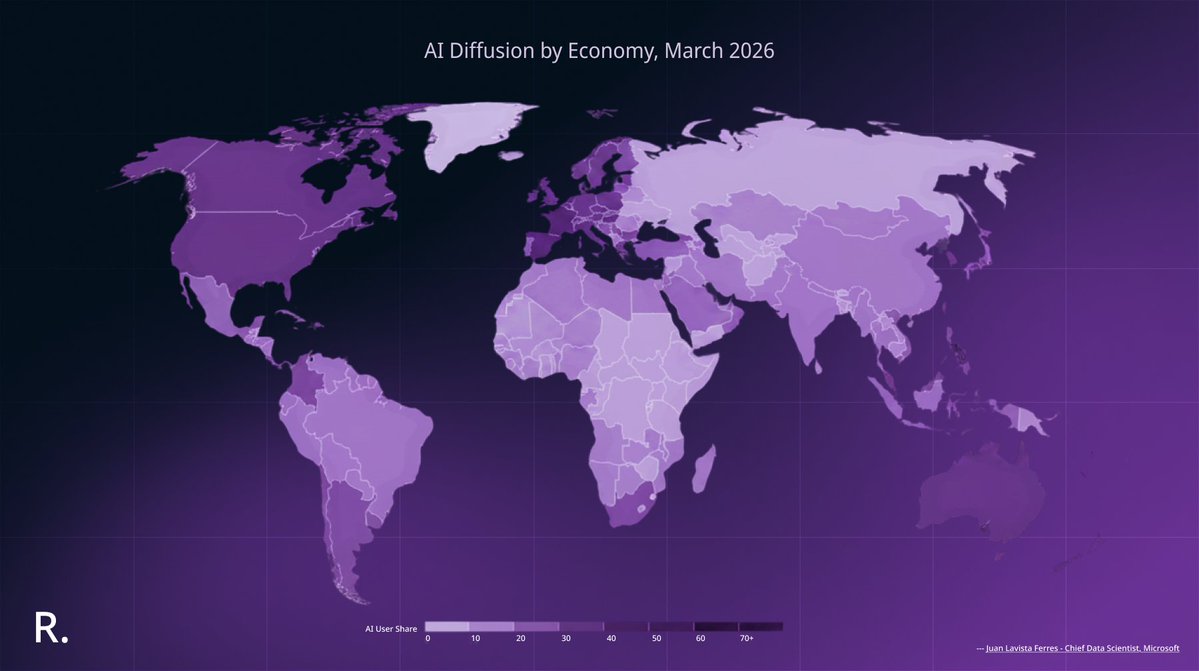
17.8% global AI adoption. +78% surge in AI-coded output.
As multi-agent systems scale, so does drift. Rainfall's preemptive modulation catches problems before they happen — not in the postmortem.
The AI Coherence Stack.