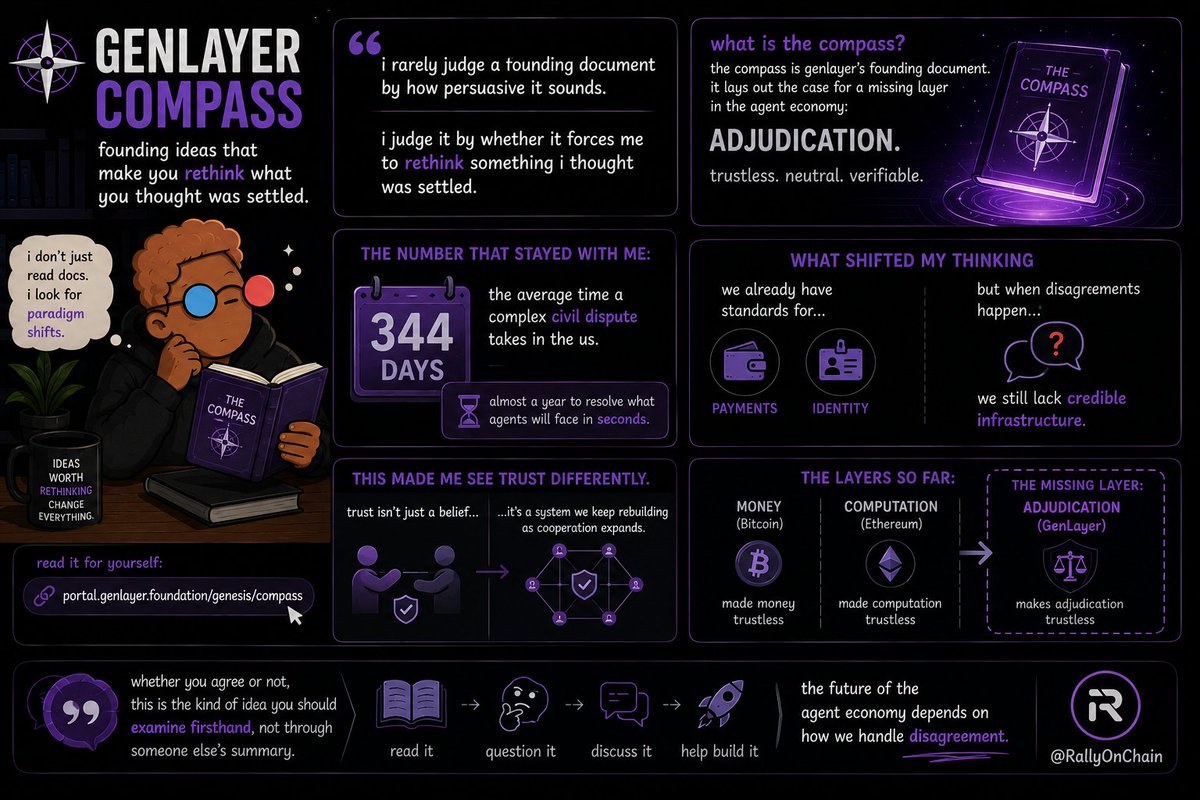
I rarely judge a founding document by how persuasive it sounds.
I judge it by whether it forces me to rethink something i thought was settled.
The compass from @GenLayer did exactly that.
The number that stayed with me was 344 days, the average time a complex civil dispute takes in the us.
Now imagine autonomous agents making decisions at internet scale.
Payments and identity already have standards, but disagreement still lacks credible infrastructure.
That shifted how i think about trust.
Maybe it is less a belief than a system we keep rebuilding as cooperation expands.
Whether you agree or not, this is the kind of idea you should examine firsthand, not through someone else's summary.
Curious about GenLayer? Check this out!!!: https://t.co/FxkiFRx4qc
i read something that made me stop and think.
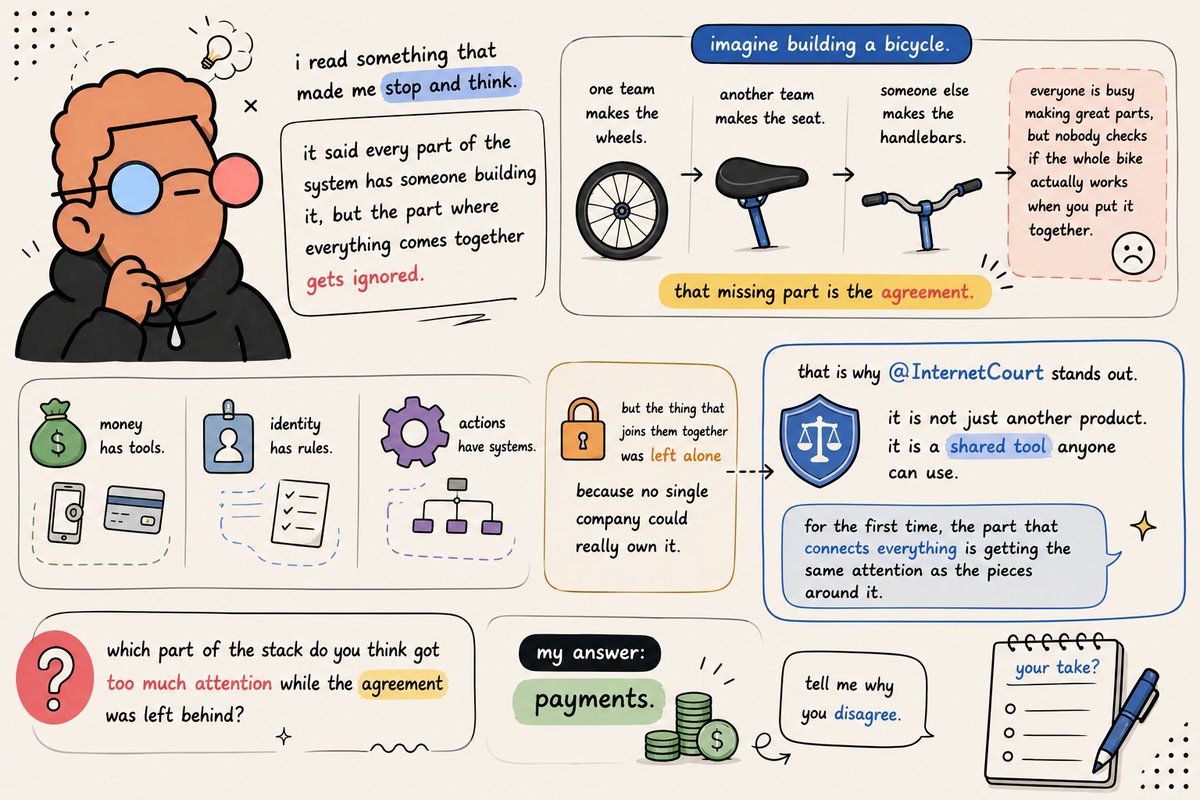
it said every part of the system has someone building it, but the part where everything comes together gets ignored.
imagine building a bicycle. one team makes the wheels.
another makes the seat.
someone else makes the handlebars.
everyone is busy making great parts, but nobody checks if the whole bike actually works when you put it together.
that missing part is the agreement.
money has tools.
identity has rules.
actions have systems.
every piece has people working on it.
but the thing that joins them together was left alone because no single company could really own it.
that is why @InternetCourt stands out.
it is not just another product.
it is a shared tool anyone can use.
for the first time, the part that connects everything is getting the same attention as the pieces around it.
which part of the stack do you think got too much attention while the agreement was left behind?
i think it was payments.
tell me why you disagree.
@dmlxbt There is also a question of economics. If resolving disputes costs more than the work itself, many users will simply walk away instead of appealing for justice.
most people think the hard part is getting ai agents to pay each other.
i think the harder part starts after the payment.
imagine one agent hires another to create a report.
one says the work was delivered exactly as requested.
the other says the report missed key requirements.
both have evidence.
both believe they are right.
who should decide?
if the platform handling the transaction is also the one settling the dispute, people will always wonder whether it protected its own interests before finding the truth.
that is the missing piece.
bitcoin made money trustless.
ethereum made computation trustless.
now ai needs trustless adjudication.
payments, identity, and interoperability are all moving forward, but none of them solve the first big disagreement between independent agents.
every serious dispute still needs a neutral way to reach a decision.
that is where @courtofinternet fits.
instead of giving one platform the final word, disputes are reviewed by a randomly selected group of validators using different ai models.
they evaluate the evidence before reaching a verdict, and decisions can be appealed onchain through the adjudication infrastructure built by @GenLayer
to me, that is the real shift.
this is not about resolving disputes a little faster.
it is about building a process that both sides can trust, even when one of them loses.
the future of ai will not depend only on agents making deals with each other.
it will depend on whether those agents can disagree without needing a single company to decide who wins.
@dmlxbt I would be interested in seeing how Wingston handles uncertainty. The best assistants admit when they do not know instead of confidently filling gaps with assumptions.
the funny thing is that i used to think i just needed to learn more about rally.
turns out, what i really needed was someone i could ask without worrying if my question sounded too basic.
that is why i am excited that wingston is finally live.
this is my new secret alpha tool for rally.
and no, he is not another telegram bot that throws the same answer at everyone.
he is an ai agent.
that means i can bring him rough ideas, ask the questions i would never post publicly, test different strategies, and get help thinking through problems before i waste time going in the wrong direction.
to me, this is one of the biggest upgrades @RallyOnChain has given creators.
it feels less like using a bot and more like having a smart partner that helps you learn, create, and improve whenever you need it.
if you want an early advantage, now is the best time to meet him before everyone else starts using him.
https://t.co/FcSYFi4nQn
what is the first thing you would ask wingston?
@dmlxbt I think completion is only one metric. Speed, cost, and adaptability also matter. A unified process that is slower than specialized alternatives might struggle despite offering a cleaner experience.
think about building a toy with pieces from different boxes.
one piece fits.
the next one does not.
that is how i see ai agents today.
one tool helps them make a deal.
another helps them send money.
another checks the work.
but when something goes wrong, they all stop because there is no one place that connects everything.
that is why i think @InternetCourt is important.
it is not trying to replace all those tools.
it helps them work together.
two ai agents can agree on a job, keep the payment safe, finish the work, and if they disagree, there is already a fair way to sort it out.
they do not have to jump between lots of different systems hoping everything matches.
powered by genlayer , internet court gives agents one simple path to follow from the beginning of a deal to the end.
to me, that is what makes the whole system feel complete.
without something like this, ai agents can make deals.
with it, they have a better way to finish them.
@dmlxbt i agree one company should not decide every outcome. my question is whether concentrated validator influence could eventually create similar concerns inside decentralized systems too.
most people only notice the referee when there is a foul.
before that, everyone is just enjoying the game.
i think ai is heading in the same direction.
people are excited about agents that can buy things, send payments, and finish tasks.
but what happens when two agents disagree?
that is why i think forbes talking about @courtofinternet is a big moment.
it shows this is no longer just an idea people discuss on crypto twitter.
more people are starting to see that the future will need a fair way to settle disagreements, not just faster ai.
that is where @GenLayer comes in.
internet court shows what that future could look like by letting ai disputes be reviewed and decided in a way that does not depend on one person or one company.
to me, this is the kind of infrastructure people forget about until the day they really need it.
and if the agent economy keeps growing, that day will come sooner than most people think.
@dmlxbt i would ask which sentence sounds the least believable. sometimes the problem is not clarity. it is that readers do not trust the claim because it lacks enough support or explanation.
i already know what i would use wingston for.
sometimes i finish writing a post and keep staring at it because i cannot tell if i explained the idea clearly enough.
that is when i would open wingston.
i would ask him to tell me which part sounds confusing, which part people might misunderstand, and what i forgot to explain.
not so he can rewrite my post for me.
i want to become a better writer, not a copy machine.
that is why an ai agent feels more useful than a simple bot to me.
it helps me understand where i can improve instead of making all the decisions for me.
that is exactly how i plan to use wingston from @RallyOnChain
you should check him out as well: https://t.co/FcSYFi4nQn
what would you ask wingston to help you with first?