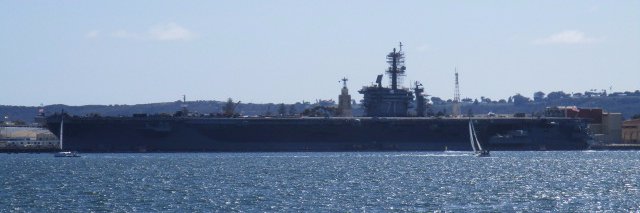
Thankful for our shipmates. ⚓
For the friends who become family and the Sailors standing watch around the world: thank you. Wherever you’re spending Thanksgiving, we’re grateful to serve alongside you.
Happy Thanksgiving!
24 November 1963. Jackie, widow of JFK, visited her husband’s flag-draped coffin with her daughter, Caroline, while JFK was lying in state in the Capitol Rotunda in Washington DC. In a deeply poignant moment, Jackie and Caroline kissed the coffin.
An American legend has taken his final rest. John Kinsel Sr., one of the last original Navajo Code Talkers who used their language to outwit the Japanese in World War II, has died at 107.
Happy birthday to the legendary Jamie Lee Curtis, Control in Star Trek: Section 31. Whether or not you liked the movie, you can still be happy that Curtis (who costarred with Michelle Yeoh in Everything Everywhere All at Once) is now part of the Star Trek family.
#StarTrek
Wishing a very happy birthday to Oded Fehr, who played Admiral Charles Vance, commander in chief of Starfleet, on Star Trek: Discovery and Star Trek: Starfleet Academy.
#StarTrek
Frank Wright was only 16 when America entered World War II. Too young to enlist in the Marine Corps, he used his older brother’s birthdate and stuffed bananas into his clothes to make the weight. On January 21, 1942, he became a Marine anyway.
He joined the Marine Raiders and fought through the Pacific’s hardest campaigns: Guadalcanal, New Georgia, Guam, and Iwo Jima.
On Guam, a Japanese soldier drove a bayonet into his stomach during close combat. Wright fell on top of the attacker. A corpsman treated the wound and told him to keep going if he could still walk. He did.
Months later, on March 3, 1945, during the Battle of Iwo Jima, machine-gun fire tore through his upper body while he was advancing uphill. The rounds damaged his collarbone, punctured his lung, and exited through his arm. This time the wounds were too severe. He was medically evacuated.
He survived both injuries.
After recovering, he returned to duty and finished his service as a drill instructor. When he was honorably discharged in January 1946, he left as a corporal with two Purple Hearts. He never received the sergeant’s stripes he had hoped to earn during the war.
He went on to earn a business degree, raise a family, and stay connected to the Marine community for the rest of his life. The scars from Guam and Iwo Jima remained with him.
Nearly 80 years later, as he approached his 100th birthday, the Marine Corps prepared something extraordinary. Commandant General Eric M. Smith recommended him for an honorary promotion to sergeant.
On August 31, 2025, in Stockton, California, Frank Wright stood in a World War II-era Marine uniform. His two sons pinned the sergeant’s chevrons onto his collar.
He even joked about whether the new rank came with decades of back pay.
When he spoke about what the Marine Corps meant to him, he said:
“I am a Marine. Not was. Am.”
The promotion was honorary. It couldn’t erase the wounds he carried from Guam and Iwo Jima or bring back the Marines who never came home. But it recognized a teenager who had been willing to risk everything for the uniform before he was even legally old enough to wear it.
Frank Wright left World War II as a corporal. He carried the scars of two of the Pacific’s bloodiest battles for the rest of his life. And when his sons finally pinned those sergeant’s stripes, they honored something that had never depended on rank.
He survived a bayonet to the stomach, machine-gun fire through his chest, and some of the most dangerous fighting of the war. Nearly 80 years later, the Marine Corps gave him the title.
He never stopped being a Marine.
Semper Fi, Sergeant Frank Wright.
Patrick Stewart "stood up and gave a speech to the crew" on his last day filming #AvengersDoomsday, which is now his final movie after his death.
“It was clear that he was struggling with his health, and he worked so hard to deliver a performance and a presence — for us as directors, for his other actors, for the crew,” co-director Anthony Russo tells Entertainment Weekly. “You could see it wasn’t just the effort of a regular actor showing up and delivering that kind of presence and performance and experience for others, collaboration. It was someone who was really being challenged in a very deep way on a health level, showing up and doing that. For him to have muscled through and delivered the performance that he did in that movie, and the experience that he delivered for all of us as collaborators, it made it intensely emotional.”
Marvel Studios boss Kevin Feige confirms a tribute to Stewart is being planned for the movie: We’re long done filming that movie, and he did an amazing job for us. We’re looking now at how we can put something together that honors and respects our friend.”
https://t.co/gV1VaCuHnb
In 1942, Japan had the best destroyers in the world. By the end of that year it was using them to deliver groceries.
And while delivering groceries, they still beat the US Navy.
It started in the 1920s. Japan assumed it would someday fight a bigger American fleet, so it planned to wear that fleet down first with night torpedo attacks. It needed destroyers built for exactly that.
In 1928 it got the Fubuki class. When they came out, they were the most powerful destroyers on earth. They were bigger, faster and longer-ranged than anything else in their class, with firepower close to some light cruisers. Almost every Japanese destroyer that followed was built on that pattern.
Then came the weapon. The Type 93 torpedo, which the Americans later called the Long Lance, ran on pure oxygen. It left almost no wake, carried a huge warhead, and could hit targets far beyond what Allied torpedoes could reach. On top of that, Japanese crews drilled for night combat for years while the US Navy mostly didn't.
Then came Guadalcanal.
In August 1942 the Marines took the airfield and named it Henderson Field. Once American planes were flying from it, any Japanese ship near the island in daylight was in serious danger. Slow transports couldn't get through.
So Japan turned to the only ships fast enough to make it. Destroyers would leave the Shortland Islands in the afternoon, race down the Slot after dark, unload soldiers and supplies at Guadalcanal, and be back out of range before sunrise.
The Japanese called it Rat Transportation. The Americans called it the Tokyo Express.
Eventually they didn't even bother docking. They packed food and medicine into steel drums, lashed them together, and rolled them over the side for the troops ashore to haul in. On one night in December 1942, 1,500 drums went into the water and only about 300 were recovered.
Here's the part people miss.
On November 30, 1942, Rear Admiral Raizo Tanaka took eight destroyers down the Slot. Six were loaded with supply drums, and to save weight they had left their spare torpedoes behind.
Waiting for them were five US cruisers and their destroyers, with radar and surprise on their side. The Americans saw Tanaka coming and opened fire first, sinking one of his destroyers.
The muzzle flashes gave away exactly where the American cruisers were.
Tanaka's ships fired their torpedoes into the dark. Within minutes the heavy cruiser Northampton was sinking, and Minneapolis, New Orleans and Pensacola were all badly damaged. New Orleans lost her whole bow.
More than 390 Americans died. Japan lost one destroyer.
It was a supply convoy beating a cruiser force that had been sent specifically to stop it.
But winning nights like that didn't save them. The runs never brought in enough food for the men on Guadalcanal. Every run put destroyers within reach of aircraft, PT boats and damage, and Japan couldn't replace ships the way American shipyards could. By early 1943 the losses were bad enough that the Japanese navy told the army it was shutting the runs down.
The tactical reversal came in 1943. American destroyer captains got radar, stopped tying themselves to the cruisers, and started making their own night torpedo attacks. At Vella Gulf that August, US destroyers sank three Japanese destroyers without losing a ship. At Cape St. George in November, Arleigh Burke's squadron did it again.
Japan built the best destroyers in the world for one decisive battle. It ended up spending them on supply runs, one night at a time.
Happy birthday to Denise Crosby, Tasha Yar in the first season of Star Trek: The Next Generation, "Yesterday's Enterprise," and the series finale, "All Good Things..." She also played her own descendant, Sela.
#StarTrek
The Japanese commander on Tarawa reportedly said a million men couldn't take the island in a hundred years.
The Marines did it in 76 hours.
Betio, the main island, is about two miles long and never more than about 800 yards wide. The Japanese had spent a year turning it into a fortress: concrete bunkers, coconut-log pillboxes, coastal guns, and nearly 5,000 defenders.
On November 20, 1943, the tide didn't come in the way the planners expected.
The landing craft hit the coral reef hundreds of yards out and stuck there. Thousands of Marines climbed out and waded toward the beach, chest-deep, rifles over their heads, under machine-gun fire the whole way.
By the end of day one, the Marines held a thin strip of sand and a seawall. Some officers thought they might be thrown back into the sea.
They weren't. The commander who made that boast, Admiral Shibasaki, was dead before the first night was over.
The fighting went bunker to bunker. On the night of November 22, the remaining defenders launched a final counterattack. By the afternoon of November 23, Betio was declared secure.
More than 1,000 Americans were killed and over 2,000 wounded. Of the roughly 4,700 defenders, only 17 Japanese soldiers were taken alive.
Back home, people were stunned. FDR personally approved releasing footage that showed dead Marines on the beach. The documentary "With the Marines at Tarawa" won an Oscar.
The lessons from those 76 hours changed every Pacific landing that came after it.