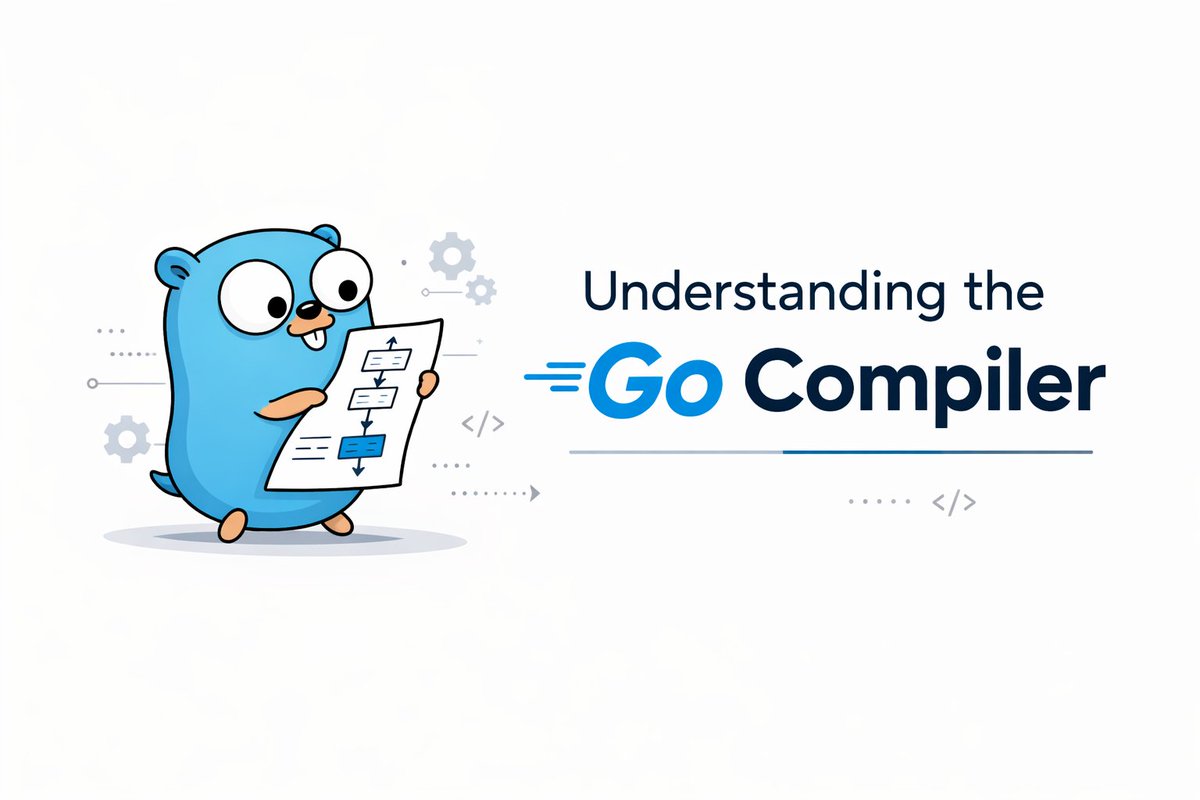
🐹 Go: Understanding the Go Compiler
Walks step-by-step through every major phase:
• Scanner
• Parser
• Type Checker
• IR
• SSA
• Machine code
• Linker
Readable, practical, and finally makes the compiler feel less like a black box.
https://t.co/YY2iJgELvi
#go#golang
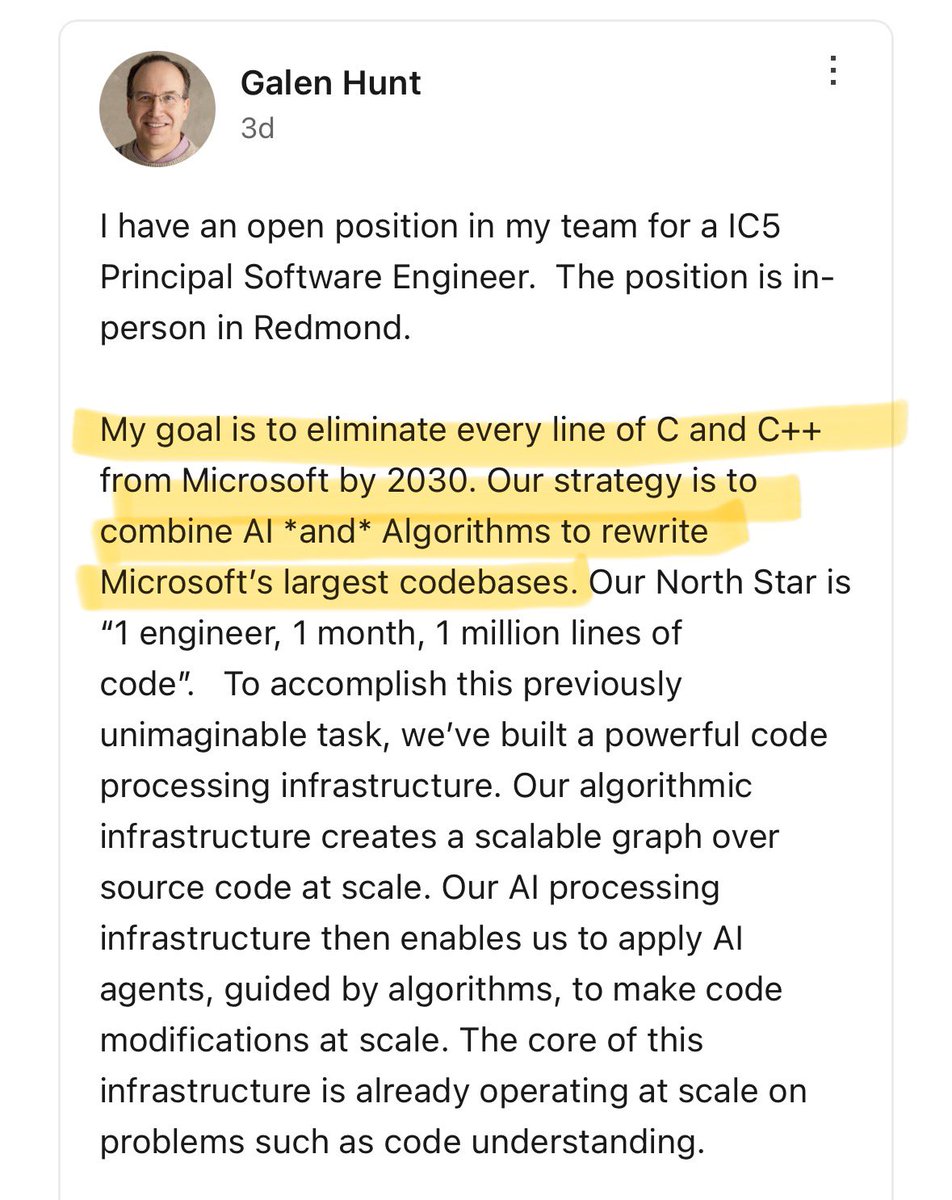
Microsoft has set a goal to “eliminate every line of C and C++ from Microsoft by 2030.”
What are they going to try to replace that C & C++ code with?
You guessed it. Rust.
And they’re going to use AI to do the “Rust re-write” at an insane speed.
“Our strategy is to combine AI *and* Algorithms to rewrite Microsoft’s largest codebases. Our North Star is “1 engineer, 1 month, 1 million lines of code”.
You read that right.
One million lines of code, per engineer, per month.
Pure insanity. This kind of decision making is common among those with a deeply held, delusional faith in the Cult of Rust.
Take battle tested code, and re-write it (without a clear benefit to the end user) at a recklessly rapid rate. Then force others to adopt that rewritten code before it is ready or properly tested.
All while holding a delusional belief that your new Rust code is superior in all ways, and is inherently bug free thanks to the divine nature of Rust.
We learned this from a post by Galen Hunt, Distinguished Engineer at Microsoft Research.
https://t.co/UQFk76ncXf
Last quarter I rolled out Microsoft Copilot to 4,000 employees.
$30 per seat per month.
$1.4 million annually.
I called it "digital transformation."
The board loved that phrase.
They approved it in eleven minutes.
No one asked what it would actually do.
Including me.
I told everyone it would "10x productivity."
That's not a real number.
But it sounds like one.
HR asked how we'd measure the 10x.
I said we'd "leverage analytics dashboards."
They stopped asking.
Three months later I checked the usage reports.
47 people had opened it.
12 had used it more than once.
One of them was me.
I used it to summarize an email I could have read in 30 seconds.
It took 45 seconds.
Plus the time it took to fix the hallucinations.
But I called it a "pilot success."
Success means the pilot didn't visibly fail.
The CFO asked about ROI.
I showed him a graph.
The graph went up and to the right.
It measured "AI enablement."
I made that metric up.
He nodded approvingly.
We're "AI-enabled" now.
I don't know what that means.
But it's in our investor deck.
A senior developer asked why we didn't use Claude or ChatGPT.
I said we needed "enterprise-grade security."
He asked what that meant.
I said "compliance."
He asked which compliance.
I said "all of them."
He looked skeptical.
I scheduled him for a "career development conversation."
He stopped asking questions.
Microsoft sent a case study team.
They wanted to feature us as a success story.
I told them we "saved 40,000 hours."
I calculated that number by multiplying employees by a number I made up.
They didn't verify it.
They never do.
Now we're on Microsoft's website.
"Global enterprise achieves 40,000 hours of productivity gains with Copilot."
The CEO shared it on LinkedIn.
He got 3,000 likes.
He's never used Copilot.
None of the executives have.
We have an exemption.
"Strategic focus requires minimal digital distraction."
I wrote that policy.
The licenses renew next month.
I'm requesting an expansion.
5,000 more seats.
We haven't used the first 4,000.
But this time we'll "drive adoption."
Adoption means mandatory training.
Training means a 45-minute webinar no one watches.
But completion will be tracked.
Completion is a metric.
Metrics go in dashboards.
Dashboards go in board presentations.
Board presentations get me promoted.
I'll be SVP by Q3.
I still don't know what Copilot does.
But I know what it's for.
It's for showing we're "investing in AI."
Investment means spending.
Spending means commitment.
Commitment means we're serious about the future.
The future is whatever I say it is.
As long as the graph goes up and to the right.
🔍 New article!
This time I'm digging into the type checker — the phase that decides whether your program actually makes sense 🧠
👉 https://t.co/S49Ttqu39G
A step-by-step look at initialization, declarations, function bodies, and more.
#GoLang#Compilers#Internals
Hi folks, it's survey time! We'd love to learn more about how you use Go and what could be improved. Share your feedback via our annual developer survey at https://t.co/m1qYvseF1K. It should take 10 - 20 minutes to complete, and will be open through September 30. Thank you! #golang
I've updated the list of Go features by version.
Now, each feature has ➀ a link to the documentation, ➁ a link to the proposal, and ➂ a link to the commits.
It's fascinating to see how Go has changed over the years.
https://t.co/2pDCfT8Vw1
@Santander_Ar solo quería recordarles lo INUTILES e INCOMPETENTES que son. Ya no tengo cuenta con ustedes pero me reclaman una deuda de TC. El resumen que llega por mail esta roto, no tengo acceso al homebanking, llamo por teléfono y me piden una clave que ya no tengo... 🤬
If you are a Go noobie and want to become better at both programming and Go i highly reccomend this playlist.
Incredibly well thought-out course.
https://t.co/KG3sPLSKyV
Graceful shutdown in Go is really nuanced and requires care to avoid corruption and poor user experience. This is the only guide you need to master it: https://t.co/ZsR66O4hmB