Finally brothers and sisters, whatever is true, whatever is honorable, whatever is just, whatever is pure, whatever is lovely, whatever is commendable — if there is any moral excellence and if there is anything praiseworthy — dwell on these things.
Philippians 4:8 CSB
If you reduce reading to the utility it provides, you will eventually find other things to do. If you read because you love the adventure of taking up temporary residence in the mind and heart of another human being, you’ll never stop. https://t.co/wKyIOcTfpY
Want to win a FREE premium leather ESV? My friends at @crossway have partnered with https://t.co/mWQizt9bTW to give away this stunning ESV Veritas ($350 value) from their redesigned Bible line.
To enter: Follow @JoshuaBarzon, like + repost, & tag someone below.
Ends on 5/15.
Several years ago, I found myself becoming quite the outspoken, cynical critic of many aspects of the SBC, happy to chime in on any and every debate, and locking arms with fellow individuals and groups who shared my frustration, willingness to air grievances and passion to...
Leon Morris on the Gospels and History.
"Many of the objections to the Gospel narratives at base amount to this, that the Gospels speak to happenings like the incarnation and miracles which we do not see at other periods of history and which historians accordingly cannot take seriously. But this is precisely the point of the Gospels. They do not purport to tell us the kind of thing that takes place from time to time in the history of men, but of something that happened once for all.”
- Leon Morris, Studies in the Fourth Gospel, 98-99.
So apparently I’m embroiled in some sort of controversy. Let me set a few things strait:
1. I don’t know Sam Allberry personally. We've met in-person a total of once — back in January while I was in Nashville when I did the Shawn Ryan Podcast, where I ran into and took a picture with Sam. When I saw the news initially about his removal from leadership I took that picture down. I had already started to see people commenting that by keeping it up I was implicating myself in his sin. I do not think they were correct. But ironically, said comments were then replaced with ones telling me that by taking it down… I was hiding something and implicating myself in his sin. Damned if you do, damned if you don’t.
2. I believe the language in the current public statements to be potentially unhelpfully vague. From my (brief though not uninformed) understanding of the details of the situation, what Sam did that disqualified him from leadership was not due to sexual or even a romantic impropriety, but what could best be described as a sinful emotional attachment. This is not to justify it or say that it wasn't disqualifying (I think it probably was). But the lack of clarity has left room for those who desire to gossip, defame, and sinfully speculate online to run wild — which they have.
3. I am genuinely saddened with the internet’s desire to tear down and jump to harsh judgements regarding another Christian’s failing. When someone falls into sin, those who are spiritually mature should work toward their restoration, approaching them with a spirit of gentleness (Gal. 6:1-2). The motivation for restoration carries spiritual weight. Bringing someone back who has wandered from truth saves their soul from death and covers a multitude of sins (James 5:19–20). This isn’t merely about correcting behaviour, it’s about spiritual rescue. The desire to gossip and breed quarrels, which is so obviously warned against in scripture (Proverbs 17:19; 26:17; 2 Timothy 2:14, 23-24; Titus 3:9-11; James 4:1-2) is, to say the least, lamentable and disappointing to see.
4. Sam Allberry is being labelled as “Side B,” this is genuinely confusing to me. To quote Sam in his own words: “Same sex attraction is not a good thing. It is... a consequence of the fall. ...This kind of attraction is not something God designed for us, and it contradicts his design” (Is God Anti Gay, 63). Sam has expressed in multiple places throughout his written work and public talks that he holds to the biblical position of marriage, that homosexual relationships are sinful, and that identifying as a “gay Christian” is incompatible with scripture. To be clear, I don't agree with Sam on all the nuances of how he discusses the issue. But I can only conclude that this attempt to make him into an LBGT advocate comes from either shear ignorance of his public work or some sort of internet-level frothing of the mouth to jump on whoever “we don’t like this week.”
But exhort one another every day, as long as it is called “today,” that none of you may be hardened by the deceitfulness of sin. - Heb 3:13.
"If I told you there was one free thing you could do every Sunday that would make your kids happier, healthier, smarter, and closer to you, you'd think I was selling something."
Take your kids to church regularly. I don't care if you believe. The data is so lopsided that skipping it is the parenting equivalent of refusing vegetables because you don't like the taste.
Grades. Religious teens get As at almost twice the rate of nonreligious teens. In a class of 100, that's 24 A-students instead of 14. Church gives a kid the same academic boost as being born rich instead of poor.
College. Working-class religious kids earn bachelor's degrees at double the rate of their nonreligious peers. Middle-class kids do it at 1.5x the rate. For families without a trust fund, this is one of the most powerful forms of upward mobility social scientists have measured.
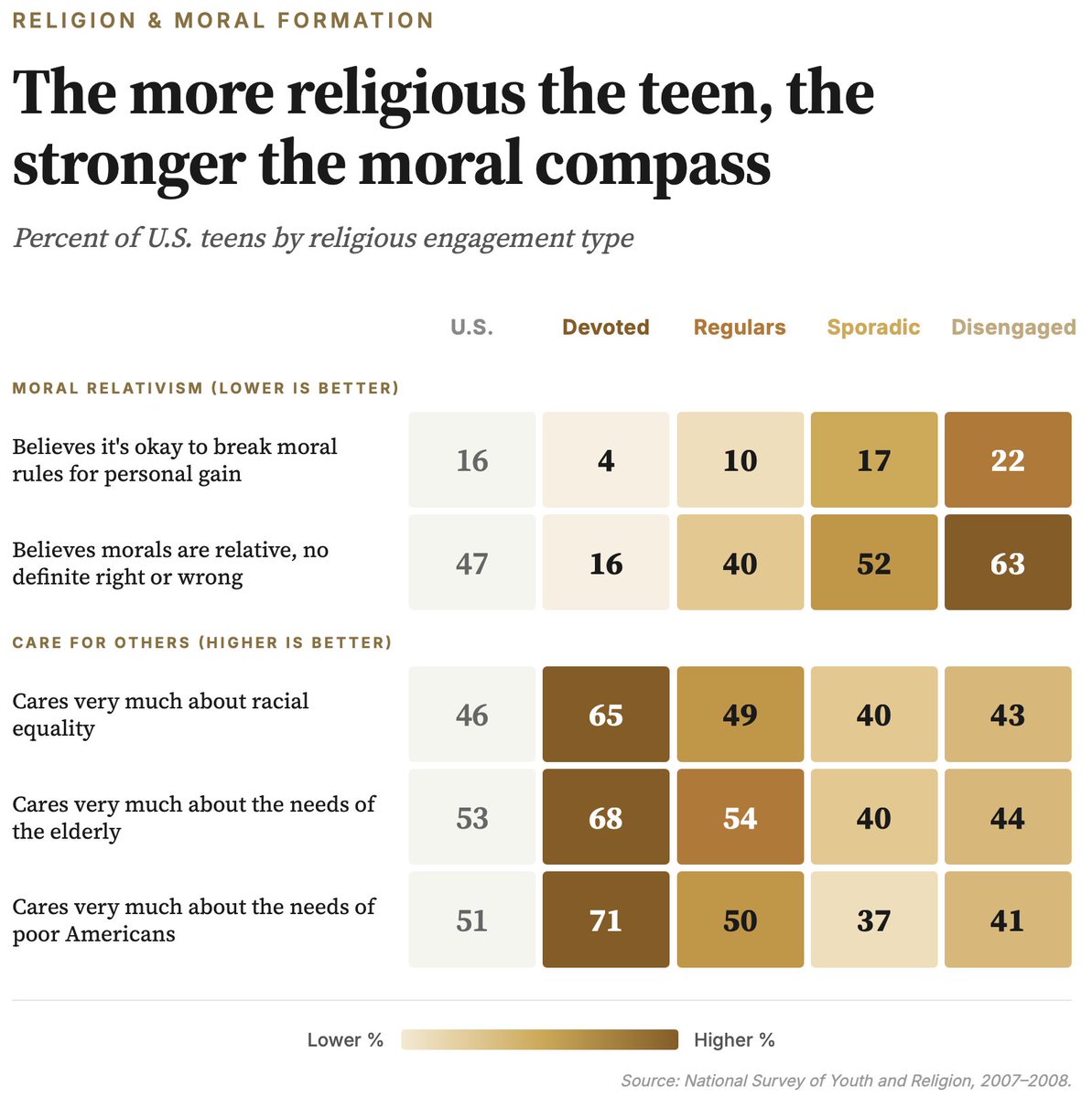
Character. Religious teens are far less likely to lie, cheat, or do things they hope their parents never find out about. They're more likely to care about racial equality, the elderly, and the poor. They reject the idea that morality is whatever works for you in the moment. That kind of kid doesn't happen by accident. It's built.
Closeness. 60% of parents of religious teens say they feel "extremely close" to their kid, compared to 50% of nonreligious parents. The kids report the same thing back. They get along better with their parents, talk about hard stuff, and actually want to spend time with their family.
Despair. Religious teens are dramatically less likely to be depressed, anxious, lonely, or feel that life is meaningless. 90% of devoted religious teens never binge drink, compared to 41% of the disengaged. Economists named the modern epidemic "deaths of despair." Regular church attendance is one of the strongest known buffers against it. Parents are spending fortunes trying to solve teen mental health. The most evidence-backed intervention is free.
Purpose. Religious young adults report higher purpose, gratitude, life satisfaction, and resilience. These are the exact traits every parent says they want their kid to have.
Here's why it works. Affluent families already surround their kids with networks of stable, accomplished adults through neighborhoods, schools, and parents' colleagues. Working and middle-class families usually don't. A congregation is often the last institution in American life that puts your kid in weekly contact with dozens of stable, employed, sober adults who know their name. It used to be called "a village." Now it barely exists outside of churches.
"But I don't believe." Your kid doesn't need your theology. They need you to show up.
"But church is boring." So is sitting through a kindergarten music recital. Parenting is the deliberate choice to be bored on purpose for someone you love.
There's a church within 15 minutes of nearly every American home. You don't need money, connections, or credentials to walk in. Nothing else in this country will surround your kid with engaged adults, teach them moral seriousness, and give them a stable weekly rhythm at zero cost.
You already drive them to practices that produce far less. The free thing on Sunday produces more, on more dimensions, than almost anything else you do as a parent.
You don't have to believe anything. You just have to take them.
Actually, the premise is that slowly and over time several subtle errors crept in and then snowballed into severe errors by the middle ages and needed to be reformed.
Now you might think they are wrong, but that is their actual claim.
And isn't it possible that "evangelical elites" don't exist not because evangelicals lack ambition but because they have a strong amibition for callings that the world regards as foolish: translating the Bible, fostering kids, being a rural pastor, etc?
Worth considering. 6/6
Below are the ages of several godly men when they completed their race on this earth:
• Charles Spurgeon - 57
• Jim Elliot - 28
• John Knox - 58
• William Tyndale - 42
• Robert Murray M’Cheyne - 29
• Samuel Rutherford - 60
• Jonathan Edwards - 54
• Dietrich Bonhoeffer - 39
• John Owen - 59
• David Brainerd - 29
• John Wycliffe - 54
With many of us men in our 30s, 40s, 50s, and beyond, it's sobering to consider how many men at this point in life had already finished their course with joy.
May the Lord teach us to number our days (Psalm 90:12), and help us truly grasp how short life is.
May we faithfully serve our Savior with whatever days He has given us.
20 But our citizenship is in heaven, and from it we await a Savior, the Lord Jesus Christ,
21 who will transform our lowly body to be like his glorious body, by the power that enables him even to subject all things to himself.
Philippians 3:20-21 ESV
In his excellent book, The Rise and Triumph of the Modern Self, historian Carl Trueman argues that the dominant worldview of the contemporary secular West is what he calls “expressive individualism.” This is the idea that “each of us finds our meaning by giving expression to our own feelings and desires” (46).
The Enlightenment philosopher Rene Descartes is famous for the dictum, “I think, therefore I am.” Expressive individualism is captured by the motto: “I feel, therefore I am.” Or perhaps, “I am what I feel I am.”
“And,” the reasoning goes, “in order for me to be my authentic self, I must give unfettered expression to those feelings. And because I am my feelings, any contradiction of my psychological beliefs about myself—any failure to affirm and validate those feelings—is a hateful threat to my very self. It is violence against my personhood.”
That is western culture over the last 15 years, especially as promoted by the political left. It’s why “speech” is called “violence.” It’s why words are spoken of as being “weaponized.” Everything is a weapon if I am under attack when my feelings aren’t affirmed.
Any lack of wholehearted affirmation and even celebration of my feelings—and certainly the notion that my feelings ought to change in order to be brought in line with objective reality—is virtually the same as wanting me to die.
It’s not difficult to see the implication: I have to kill you before you “kill” me. There is a straight line between the deification of one’s own feelings to the political assassinations (and attempts) that we are now seeing more of.
But the answer is to this is: you are not your feelings. You are what God your Creator says you are: a creature, made in His image, male or female as He has designed you, created to glorify and honor Him. And yet you have fallen into sin and corruption through disobedience to God’s law, and that disobedience earns you the just penalty of eternal punishment for your sins in hell.
But the Father has sent His Son into the world, (1) to live the perfect life of obedience you and I have failed to live, and (2) to die the substitutionary death that you and I were required to die (but couldn’t survive), bearing the penalty of divine wrath that sin deserves, and (3) to rise from the grave in victory over sin and death.
And He promises that if you will turn from your sin and trust Christ alone for your righteousness before God, your sins will be forgiven. If you repudiate yourself and find your identity in Jesus, He will replace the sinking sands of your feelings with the solid rock of truth. And He will be to you all the satisfaction and fulfillment that you could ever wish.
Expressive individualism is willing to take the lives of others in pursuit of self-actualization. The Gospel is: Jesus was willing to surrender His life in pursuit of others’ salvation. We live consistently with that Gospel when we lay down our lives to pursue others’ freedom.
A nation can only survive on one of those worldviews. The answer to our country’s brokenness is the Gospel of Jesus Christ alone.
David Powlison (1949–2019) once inverted Psalm 23 to portray what life feels like and looks like whenever God vanishes from sight. He called it AntiPsalm 23.
——
I’m on my own.
No one looks out for me or protects me.
I experience a continual sense of need. Nothing’s quite right.
I’m always restless. I’m easily frustrated and often disappointed.
It’s a jungle—I feel overwhelmed. It’s a desert—I’m thirsty.
My soul feels broken, twisted, and stuck. I can’t fix myself.
I stumble down some dark paths.
Still, I insist: I want to do what I want, when I want, how I want.
But life’s confusing. Why don’t things ever really work out?
I’m haunted by emptiness and futility—shadows of death.
I fear the big hurt and final loss.
Death is waiting for me at the end of every road,
but I’d rather not think about that.
I spend my life protecting myself. Bad things can happen.
I find no lasting comfort.
I’m alone . . . facing everything that could hurt me.
Are my friends really friends?
Other people use me for their own ends.
I can’t really trust anyone. No one has my back.
No one is really for me—except me.
And I’m so much all about ME, sometimes it’s sickening.
I belong to no one except myself.
My cup is never quite full enough. I’m left empty.
Disappointment follows me all the days of my life.
Will I just be obliterated into nothingness?
Will I be alone forever, homeless, free-falling into void?
Sartre said, “Hell is other people.”
I have to add, “Hell is also myself.”
It’s a living death,
and then I die.