I count my blessings every single day.
This one makes the list. George getting his laptop back affects (positively) every former shareholder of @MetaMaterialTec.
We are luckier than we know.
God is on our side; I know it to be true.
🙏😎💛🦋⚖️
Thank you George for being the man of integrity and determination that you are.
$MMTLP Kudos to @cvpayne for giving Next Bridge Hydrocarbons CEO Greg McCabe a platform to voice the frustrations that investors have had to live with since the unjust @FINRA trading halt of December 2022.
We are not going away.
Full Interview: Next Bridge CEO Greg McCabe on Making Money with Charles Payne FOX Business. Biden’s Regulators broke the Rules! The time has come for Answers, No More Stalling
MMTLP/DJT
Between 8000-10,000 Veterans Have Been Financially Impacted
@SECPaulSAtkins@POTUS
Hey. I think the MMTLP army should get a fraud whistleblower payment. Remember all those whistleblower reports we sent to James Comer’s oversight committee a couple years back during the Biden administration?
#MMTLP
"And pound it, and pound it, and pound it, and pound it.."
We are not an outlier but we ARE the tip of the spear; a crime scene frozen in time.
We have all the evidence to warrant an audited sharecount of how many shares were sold to the investing public.
Is it 2x oversold? 10x? 20x? 100x!!?
At least start with the domestic count that would subject FINRA member firms per FINRA Rule 4140; "at any time".
Mark your calendars:
@CVPayne x @NBHydrocarbons
Monday October 26th, 2026 at 2PM EST
on @FoxBusiness
You won't want to miss this!!
$MMTLP Next Bridge Hydrocarbons issue a Form 8K and we look at the proposal of 15M shares for $10M.
We also have an update from the company about an appearance on the Charles Payne show.
https://t.co/wERcQ5NAcE
Next Bridge Hydrocarbons CEO Greg McCabe to appear on “Making Money w/ Charles Payne” on the Fox Business Network. We are pleased to announce Chairman and CEO Greg McCabe will be live, in-studio with Fox Business host Charles Payne for an interview this Monday, October 26, 2026.
MMTLP still has a settlement issue @SECPaulSAtkins and you are tightly holding this stinking box of sh!t (trying to hide it when we all know what is inside) like a guilty kid with his hand in the cookie jar.
Show the real share count & fix your crooked program @SECGOV.
⏰THE MMAT 100-SHARE QUESTION🔥:
Inside an Attempt to Acquire Bankruptcy Standing in the Meta Materials Case.
An unusual seven-page stock transfer package, an urgent solicitation, and a shareholder willing to go on the record raise questions about WHO was attempting to acquire INFLUENCE in a multimillion/billion-dollar bankruptcy proceeding....and HOW.
A curious proposition:
On May 10, 2026, an MMAT shareholder says he received an unusual proposal from none other than...
Danielle Spears.... who, based on the attached docs, was allegedly acting on behalf of... you guessed it... Scott Traudt 🤣😂
The objective, according to Spear's message and the attachment (see below) was not conventional investment:
“I found a way for you to sell me 100 of your shares so I can have automatic standing in the bankruptcy. Please let me know if you are willing. I'll pay you above market value just to have them”
The proposed quantity was modest: just 100 shares in Meta Materials Inc., but the stated objective is anything but ordinary.
The shares were being sought, according to the message, to obtain standing in federal bankruptcy proceedings.
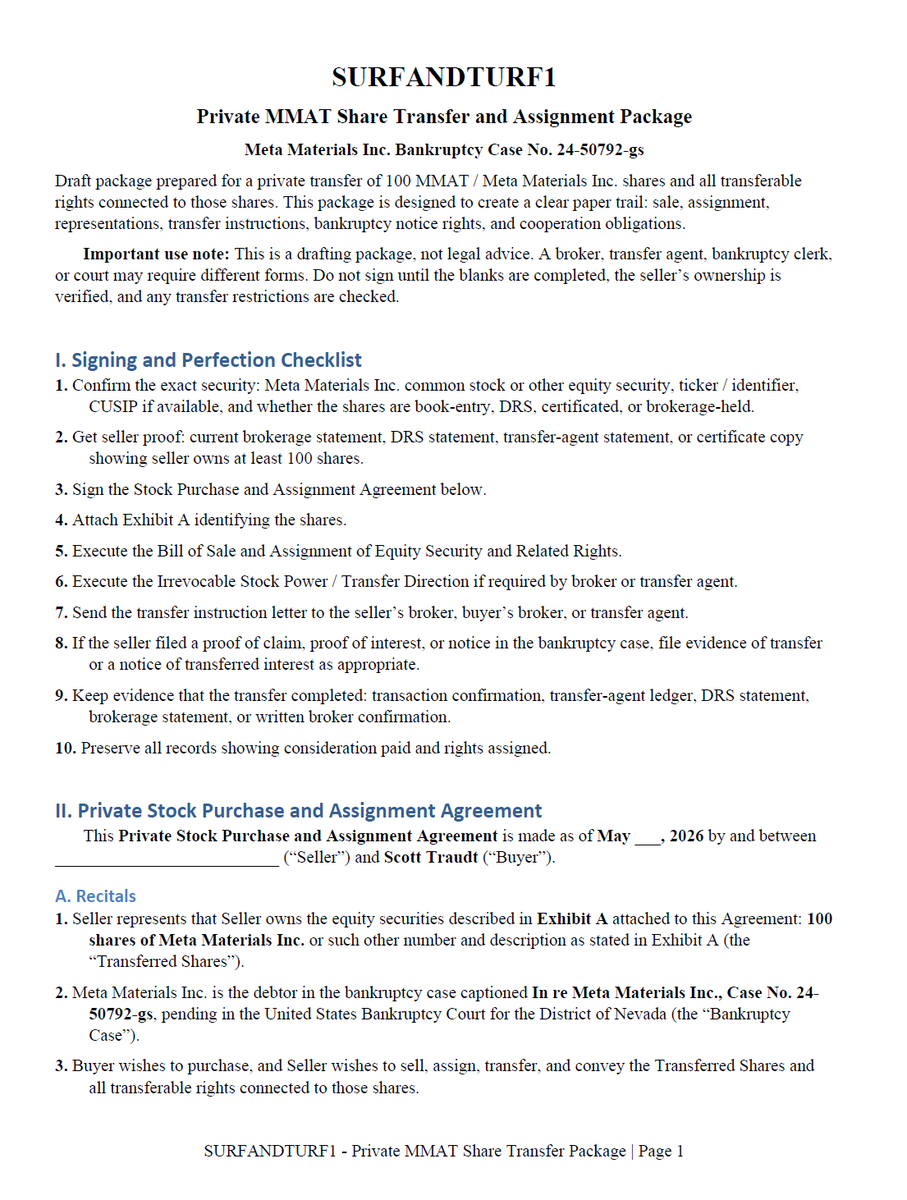
Spears also supplied our shareholder directly with a seven-page document titled:
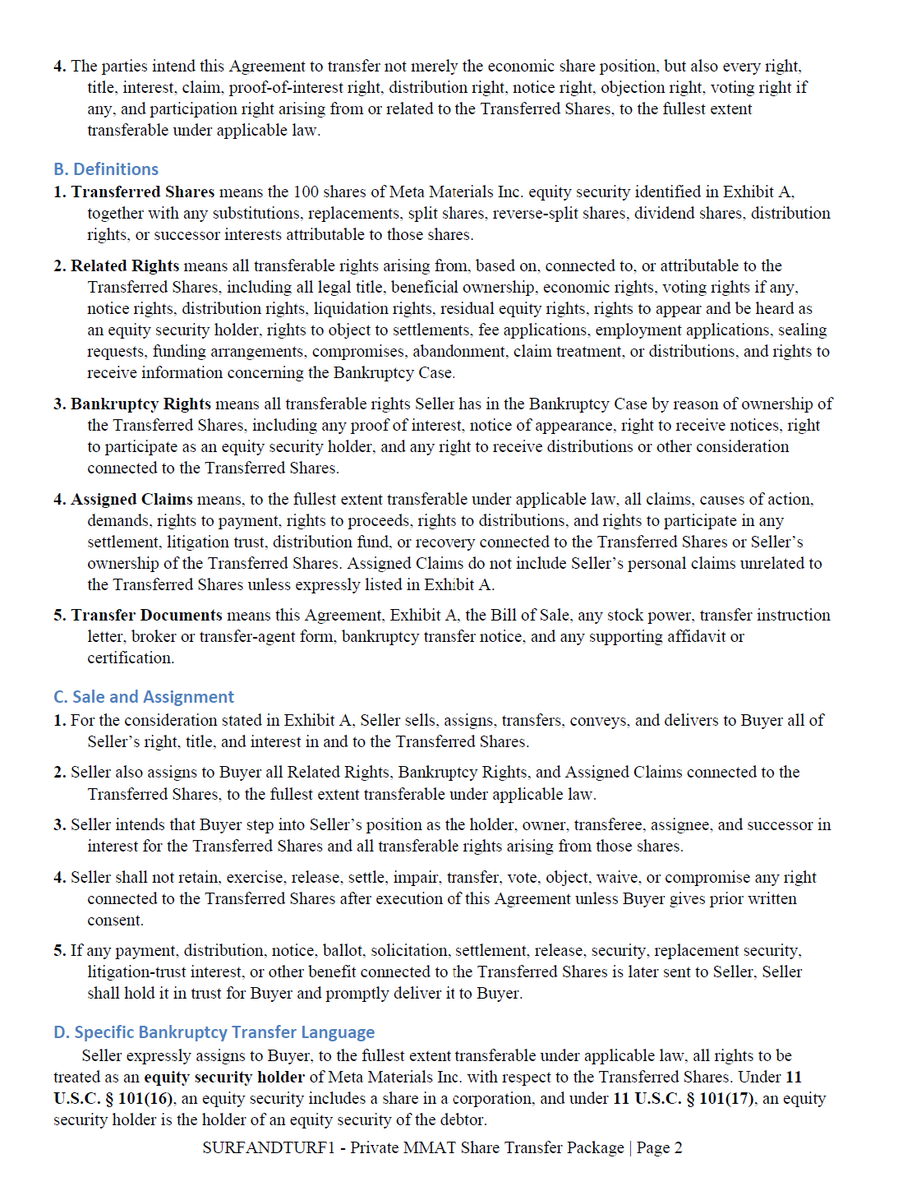
"SURFANDTURF1 — Private MMAT Share Transfer and Assignment Package".
SOURCE for the full PDF: https://t.co/8Qqz0rYMaS
Unlike the message referring to shares being sold to Spears, however, the document identifies a different purchaser: Mr Traudt.
Q: Who was actually supposed to buy the shares, Spears, Traudt or someone behind the scenes who is acting through them, and what is the relationship between them?
The document shows this is more than a simple stock purchase... see for yourselves.
The SURFANDTURF1 package is dated for execution in May 2026 and identifies the buyer as Scott Traudt.
Its structure is unusually expansive for a transaction involving 100 shares.
The proposed agreement seeks not only the securities themselves but also a collection of TRANSFERABLE RIGHTS associated with the MMAT's bankruptcy proceedings.
These include rights to receive notices, participate in proceedings, object to settlements, challenge fee applications, address funding arrangements, and pursue certain claims or distributions.
The agreement attempts to transfer these rights to the fullest extent permitted by applicable law.
Separate exhibits provide a bill of sale, stock-transfer instructions, a proposed notice for filing with the bankruptcy court, a seller certification, and a buyer's reservation of rights.
The package even addresses how the buyer might respond if the trustee CHALLENGES the acquisition as an attempt to manufacture standing.
On page seven, the author (Traudt? Spears? a 3rd person?) supplies suggested arguments for responding to precisely that objection.
The document is not simply concerned with whether 100 shares can move from one account to another.
It is concerned with what the buyer might subsequently be able to do in court.
An urgent Wednesday deadline:
Additional messages by Spears reinforce the apparent emphasis on bankruptcy participation.
“I need shares immediately” one message states.
Another adds: “We need to get it done this week, filed by Wednesday if possible”
These messages were exchanged on May 10 and so the Wednesday referenced would have been May 13, 2026.
Why that date mattered will be interesting to discusss since the deadline corresponded to a specific hearing, planned objection and anticipated filings in the bankruptcy case.
The messages indicate urgency. They also suggest that obtaining and documenting the shares was viewed as a prerequisite to some anticipated bankruptcy activity.
The precise nature of that activity remains an important unanswered question.
The metadata connection:
A forensic examination of the supplied PDF identified an embedded creation date of May 10, 2026.
Its creator and producer metadata identify PDFium, a PDF generation engine commonly associated with Chromium-based applications.
The document contains no named human author.
The creation date is significant because it corresponds to the date of the solicitation reported by the MMAT Shareholder.
The combination of the recorded creation date, the intended buyer's name, and the MMAT Shareholders' account of receiving the document directly from Spears supplies a testable chain of evidence.
The regulatory question: Was someone acting as an unregistered broker?
The communications raise a separate securities-law question.
Section 3(a)(4)(A) of the Securities Exchange Act of 1934 defines a broker, broadly, as a person engaged in the business of effecting securities transactions for the account of others.
Section 15(a) generally requires qualifying brokers to register, unless an applicable exemption or exception applies.
Was Spears tricked into a potential Section 15(a) violation by Traudt, or was she a willing participant, and was she compensated for her "work"?
The distinction is important.
A private individual buying shares for their own account is not necessarily acting as a securities broker.
An unpaid individual helping arrange a single transaction is also not automatically required to register.
But repeated solicitation of shareholders (our MMAT Shareholder was one of at least three others), negotiation of purchases, participation in completing transactions, or acting as an intermediary for another purchaser can become HIGHLY relevant to the broker-registration analysis, and a whistleblower report.
Here, the proposed purchaser named in the written agreement is Scott Traudt, while the solicitation described by the MMAT Shareholder was allegedly communicated by Spears.
That creates legitimate questions:
1. Was Spears soliciting shares for Traudt or for herself?
2. Who prepared and approved the acquisition package?
3. Were other shareholders approached using the same document? (I know of at least 3).
4. Were any purchases completed? (We already now know that Traudt has acquired shares from Auxier)
5. Did Spears receive compensation, reimbursement, a prospective benefit, or any other consideration?
6. Did anyone involved hold the registration required for the activities actually undertaken?
These questions do not establish an unregistered-broker violation... yet.
They identify matters that could be examined by the @SECGov and local securities regulators if corroborating evidence establishes activity within their jurisdiction.
A broader contradiction:
The timing of these disclosures is notable.
In recent public posts, Traudt has sharply criticised the Meta Materials Chapter 7 trustee, questioned proposed litigation-claim transactions, and accused several individuals associated with the $MMAT and $MMTLP controversies of improper conduct.
In one post concerning today's October 13 bankruptcy hearing, Traudt characterised the trustee's proposal as an effort to "give Greg McCabe another $45 million".
He also publicly described his intention to object and advance alternative proposals.
The contrast is worth examining...
Traudt has demanded scrutiny of others' motives and financial arrangements.
At the same time, a document naming him as purchaser expressly seeks to acquire bankruptcy-related participation rights through a proposed 100-share transfer.
Did he know of the shareholder solicitations?
Did he authorise them?
What procedural advantage, if any, was intended?
SIDENOTE: i had no idea that bankruptcy standing can simply be... purchased⁉️⁉️⁉
The mere existence of an executed private agreement does not automatically entitle the buyer to EVERY right claimed within it.
There are differences between OWNING an equity security, being A RECOGNISED HOLDER, asserting a transferable LEGAL CLAIM, and demonstrating STANDING to seek particular relief.
Furthermore, a seller cannot transfer rights they do not own, including claims that may belong to the bankruptcy estate itself.
That distinction is particularly relevant to "SURFANDTURF1".
The package attempts to assign a broad array of claims and procedural rights, but its own language repeatedly acknowledges that transfers are limited by applicable law.
A bankruptcy court would therefore need to evaluate the actual completed transaction and the legal basis for any specific standing or participation asserted.
THE WITNESS:
Our MMAT Shareholder indicated that he is willing to provide an on-the-record account of the solicitation and document transmission and i have connected him to the trustee along with the evidence.
That is important.
An authenticated original conversation and a sworn declaration could establish what was said, who sent the proposed acquisition package, when it was transmitted, and whether additional representations were made.
Such evidence could assist the Chapter 7 trustee in determining whether further inquiry is warranted.
It could also support a referral through the SEC's established reporting channels, should the facts raise a credible concern about an applicable securities-law violation or even a deferral to the DOJ if there is more nefarious coordination happening behind the scenes with the "real" sponsors.
The materials reviewed for this report do not establish that regulators have opened an investigation or that any party has been found to have violated securities law.
The questions that now demand answers
The existence of SURFANDTURF1 is UNDISPUTED as a matter of the supplied document's contents.
The PDF names Scott Traudt.
It proposes the acquisition of 100 MMAT shares.
It seeks associated bankruptcy participation and objection rights.
It contains a ready-made court notice.
And it anticipates the possibility that someone will challenge the transaction as MANUFACTURED standing.
Our Shareholder's reported account adds a second dimension: direct delivery of the package by Spears and communications explicitly discussing acquiring shares for bankruptcy standing.
Together, these materials justify a very close examination of the acquisition arrangements.
The central questions are no longer merely theoretical.
Who authorised the solicitation?
Who was the intended ultimate purchaser?
How many shareholders were contacted?
What transactions were actually completed?
And how were any acquired interests subsequently presented to the bankruptcy court?
I would take it a step further:
It would be great to know TODAY at the hearing, where did the $200k ($100k x2) that Traudt put forward as an offer for the two cases come from? His own money? Can he show us the bank transfer into the LLC?
These are questions the relevant parties can answer, and that the trustee or the regulators can assess against original evidence.
THE BOTTOM LINE:
FOLLOW THE SHARES. FOLLOW THE MONEY. FOLLOW THE MOTIVES.
One hundred shares. Seven pages of legal documentation. A proposed bankruptcy strategy. An urgent filing deadline. And a witness prepared to speak.
For a transaction involving an apparently negligible economic interest, that is a remarkable amount of machinery.
But perhaps we have been asking the wrong question.
Is this really about protecting MMAT shareholders? Or are these efforts creating additional disputes, delaying the administration of the estate, and consuming resources that could otherwise be directed towards pursuing those responsible for its losses?
In my opinion, repeated procedural battles and related legal activity may already have cost the bankruptcy estate more than $500,000 in professional time and expenses, putting the massive Billion-dollar+ stock manipulation case against Citadel, Virtu and Anson at jeopardy.
That is my estimate, not an independently audited amount attributable to any particular individual. The trustee's fee applications and billing records deserve examination to determine what these disputes have actually cost.
And if those costs are substantial, shareholders deserve to know whether they have affected the economics of the trustee's decision to sell the Authentix and 24M litigation claims.
The proposed transaction would provide the estate with $250,000, plus 20% of net recoveries after specified expenses, while transferring responsibility for future litigation costs to the purchaser.
Was that the best possible commercial outcome? Were alternatives available? And how much of the trustee's resources have been diverted into dealing with procedural disputes rather than prosecuting recoverable claims?
Those are serious questions.
Personally, I wish I had the capital to submit a competing bid for those litigation claims, pursue them commercially, and structure the recoveries to maximise the estate's benefit.
Because that should be the objective.
Recover value. Hold responsible parties accountable. Maximise distributions.
Not simply generate another round of expensive legal arguments.
And what about Greg McCabe?