After more than two years of research in archives across Europe:
The malicious plots and international intrigues surrounding the most strategically important invention you’ve never heard of
https://t.co/ZpiLxhUIvL
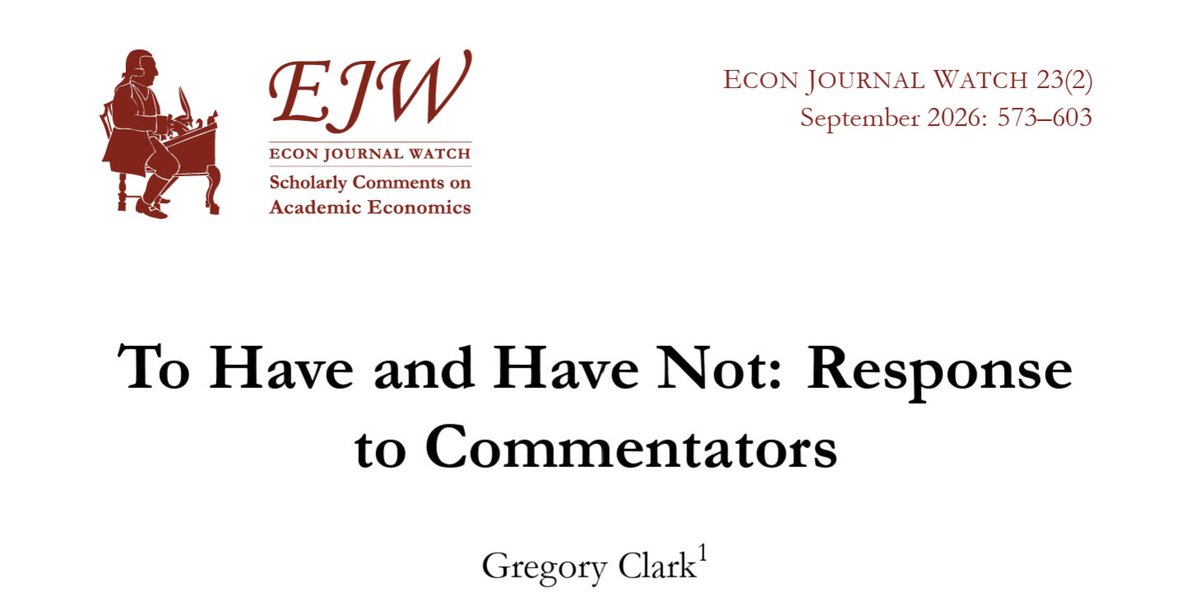
Greg Clark responds to critics of his 3rd Hemingway-allusion book:
"It is astonishing that the theorists of cultural transmission... cannot themselves produce any empirical tests that will demonstrate conclusively the importance of cultural transmission."
https://t.co/J1DOvGHlV6
Overreaching on Genes? https://t.co/MapRabmCX2
Rosalind Arden and Robert Plomin, John Benning, Noah Carl, Nikolai Eftedal, Joe Francis, Charles Murray, Jan Stuhler, and Greg Clark
Titles include:
Overreaching on Genes
Who’s Afraid of Gregory Clark?
Survival of the Richest
To Have and Have Not
To Know and Know Not
@andresilvatw In the long run,
Spain became poorer because of its empire than it would have been; see this joint work with @javiercharotti & @JPSantos_econ 👇🏼
https://t.co/xhyWD258J9
"At least Hitler built the Autobahn..." Can successful infrastructure projects boost support for a dictatorship? Nico Voigtländer and I wrote a paper looking at the German experience: "Highway to Hitler". Here is a link to the ungated version: https://t.co/BBgwQBcfmm
Hayek's insight was one of the most important in economics. Not only is the economic knowledge dispersed but the very actors do not know what knowledge they have, and whether that knowledge makes sense or not, until an action takes place. So aggregation of knowledge is simply impossible.
That does not make central planning "impossible" (as said below), but it makes central planning inefficient because it can never access all decentralized information--much of it, as I said, in nascent and yet not fully formed state.
Wars have no winners. The survivors, and their offspring, can bear their losses for decades.
A great work on the persistent effects of war on (the loss of) human capital and innovation.
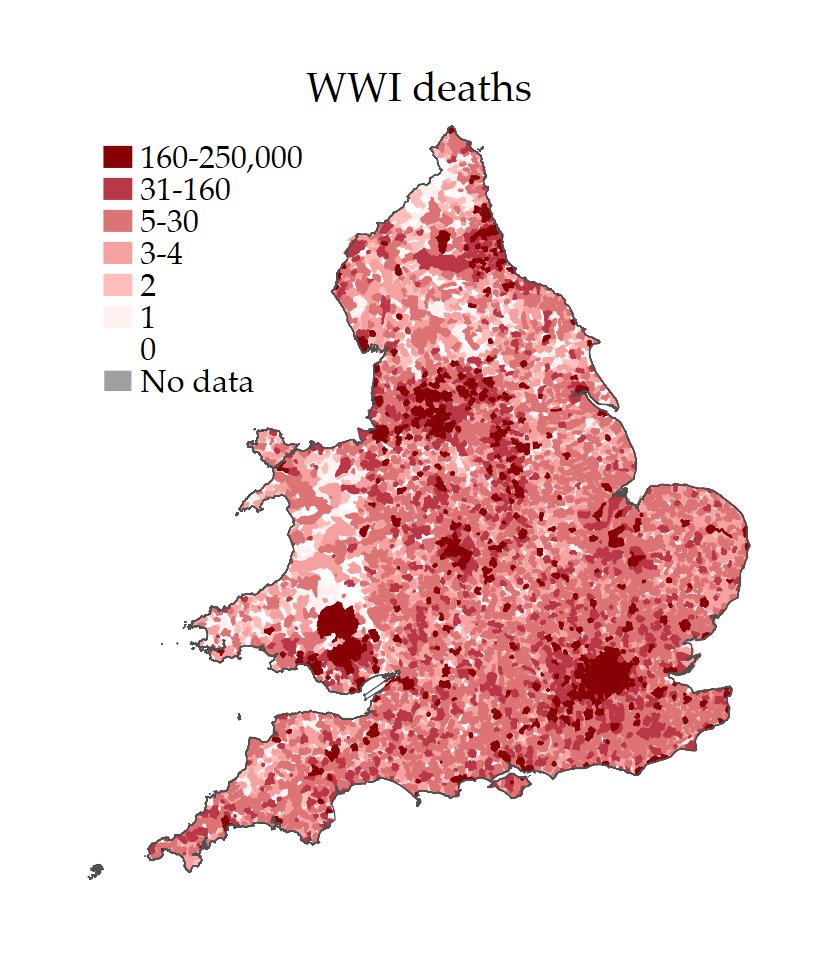
What are the effects of large human-capital shocks on innovation?
In a new paper, we study how WWI military deaths across British communities affected local invention over the next decades.
We find that places that lost more young men became persistently less innovative.
(🧵1/11)
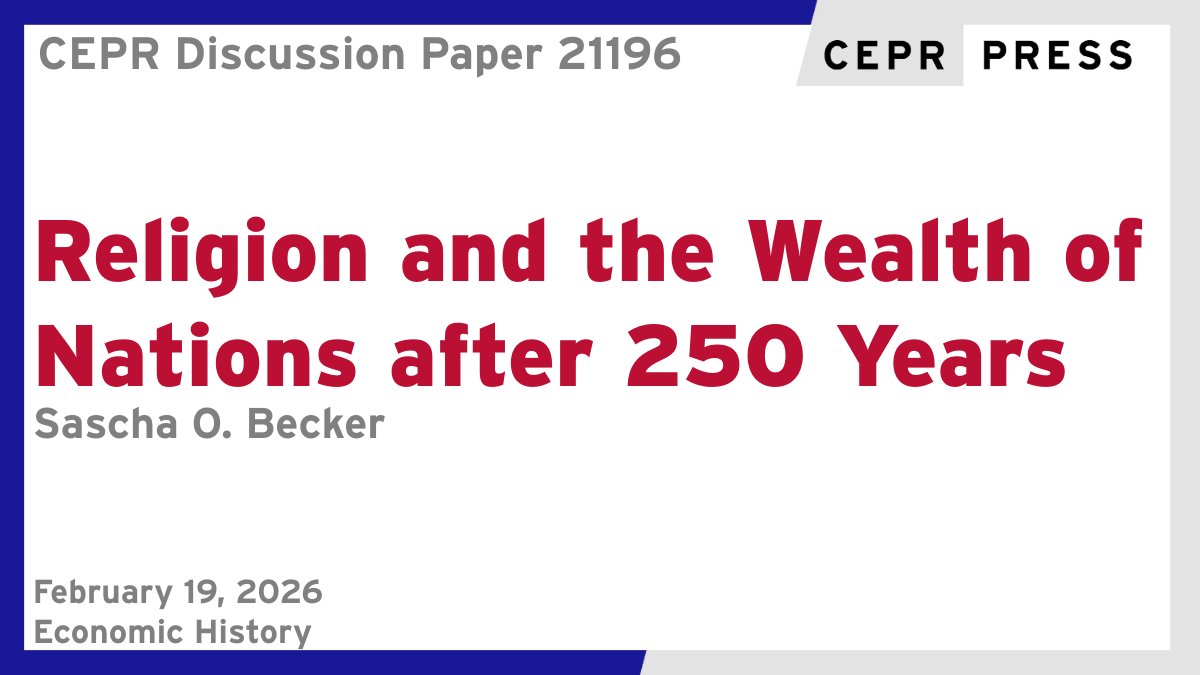
New CEPR Discussion Paper - DP21196
Religion and the Wealth of Nations after 250 Years
Sascha O. Becker @MonashWarwick
https://t.co/4E7Zc8UB9v
#CEPR_EH#EconTwitter
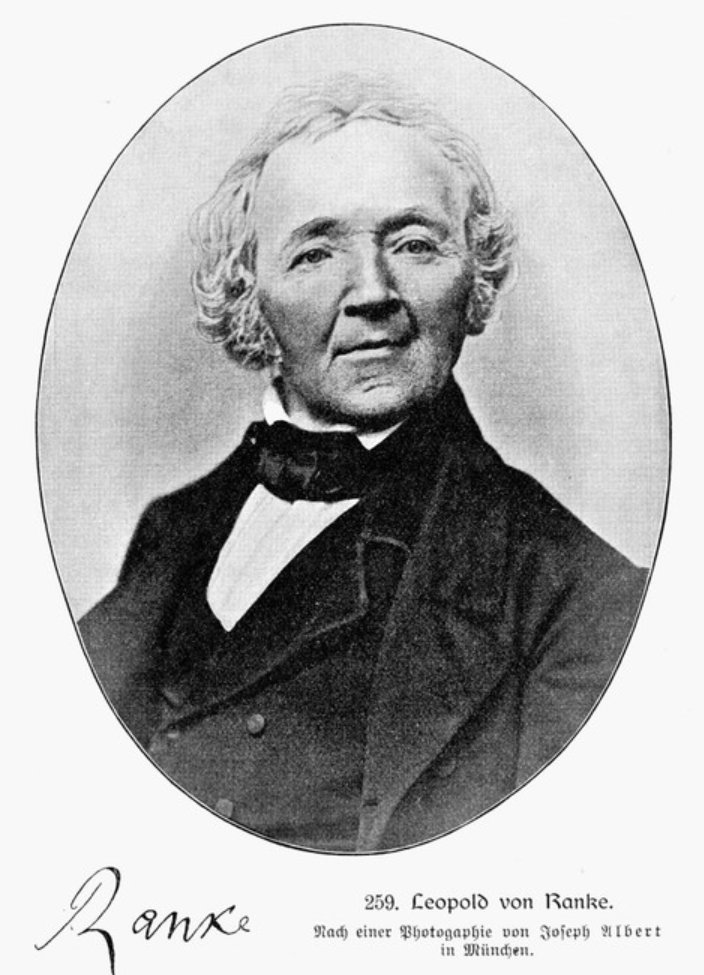
How did people in 1913 see the world? How did they think about the future? We trained LLMs exclusively on pre-1913 texts—no Wikipedia, no 20/20. The model literally doesn't know WWI happened. Announcing the Ranke-4B family of models. Coming soon: https://t.co/KOjbdLlH3S
Fourth edition of our workshop, with the great Sascha Becker as keynote. May 28-29, if you have a paper on institutions/culture/political econ and more with historical flavour please feel free to apply. Help us spread the word!
🚨 New Version 🚨
The new and extended version of our paper on dealing with spatial unit roots in regressions, now
*forthcoming at the Stata Journal* under a new title!
w/ Sascha Becker & @joachim_voth
Relevant to anyone who uses spatial data !
Link and more information in🧵
New paper alert:
Industrialization and the Return to Labor: Evidence from Prussia
joint with Ann-Kristin Becker, on the JM this year!
How did the IR affect unskilled workers’ wages?
Our answer: coal-driven industrialization raised unskilled wages and compressed inequality.
🚨 Your spatial regressions might be SPURIOUS! Forthcoming in Stata Journal: A guide to ready-to-use Stata commands to test & correct for strong spatial dependence 🗺️ w/ Sascha Becker + David Boll. Paper: https://t.co/umfgIFvsBq #EconTwitter#Stata
I’m very excited to see this year’s Nobel price winners.
I’ve been deeply engaged with the works of Joel Mokyr throughout my PhD and I can say that this is one of the most exciting Nobel prizes in econ for a long time. So here's a thread 🧵on Joel Mokyr’s work 🚨🚨