Why did Scotland punch so far above its weight in the age of industrialisation and enlightenment?
The usual answer is education.
But I argue that this puts the cart before the horse, and that it was almost entirely down to capital:
https://t.co/3essZXC7HC
@stephenfhwebb@andresilvatw@rcolvile Economically, yes. Politically though, it’s actually hard to see how they’d have avoided the temptation. Britain was perhaps lucky that the only way it could attract bullion was by having an export surplus - though even then it took them a long time to act on it!
@SolInvi24645112@PositivistWitch Next post will be on the Elizabethan developments, but essentially it all gets re-consolidated and reformed in 1563, so that it can be more flexible with inflation. But still in force. Main decline I think is c.1680-1720 due to legal decisions, but still some research to do there
@SolInvi24645112@PositivistWitch For the most part very much in effect up to the mid-17thC, but thereafter it begins to decline (partly due to deflation, and partly as legal decisions result in all sorts of loopholes). But there is evidence of some enforcement of wage caps still in the eighteenth century.
@DanNeidle@Politocrit1 Also politically most rewarding to do tax changes with concentrated benefits, eg the focus on overtime vs lowering income tax across the board
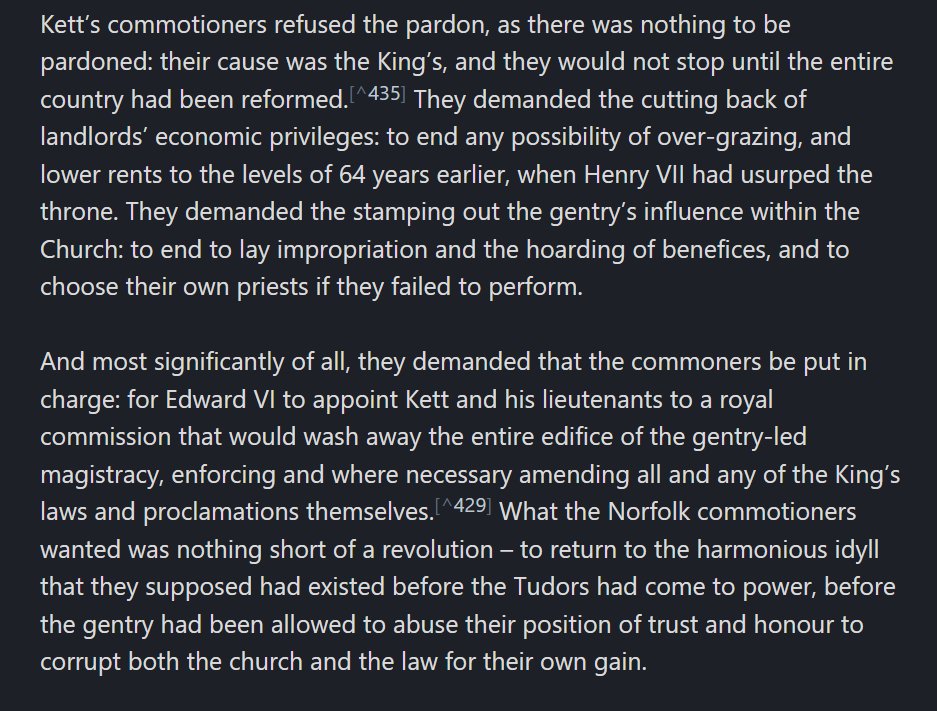
When in 1549 Lord Sheffield was hacked down by a butcher in Norwich, was this the third time in English history that a group of commoners had killed a peer of the realm? And was it the last?
(First being Archbishop of Canterbury in 1381 and second Lord Saye and Sele in 1450)
@hrcastor Indeed! As did all the rebels in 1549 - much like the other cases, they saw themselves as being on the King's side against a corrupt cabal of some gentry. Summary from my book draft:
@rmathematicus@AaronBastani I’m thinking more of things like the classic post box designs and railway stations, which they all had a hand in - public infrastructure can be beautiful!
So many of Britain's problems in a nutshell:
>1952 council block falling apart, sewage leaking into flats, loose cladding, dangerous wiring
>£48m bill to completely overhaul it and ensure it's habitable, so cheaper to demolish and rebuild
>council evacuates most social tenants and tries to buy up a majority of flats to be able to demolish
BUT
>resistant residents, backed by Living Rent activists, don't want to sell because asking price too low, and say council should never have let it get so bad
>they submit the building to Historic Environment Scotland to be listed
>HES unexpectedly say they're likely to list, which would make repairs even more expensive, and demolition potentially impossible
>council stops buying the remaining flats while they wait for a decision, in case they just have to sell what they can or write it off
>now residents will potentially be unable to sell at all
https://t.co/AXZV1QHv6p
@antonhowes@mongrelcelt The building has a lot of asbestos lining of the internal conduits carrying the soil pipes - quite apart from everything else the Council has not been able to find a contractor prepared to take on the task of removal of this due to the confined working space.
@mongrelcelt Maybe. This was the first of its kind in Scotland - hence the grounds for listing - so I expect it has all sorts of experimental weirdness too. And yes, could well have been plenty of potential mitigation that could have been done over the years.