#BTC Flywheel
-Create a biz
-Create a brokerage acc
-Buy Leaps , Sell CC
-Build Cash Position
-Leverage on brokers buying power
-Apply Personal Loan / RE w cash-back
-Apply SME /Term Loan
-Build Stronger Cash Flow
-Acquire Assets
> #BTC
> $MTPLF
> $IBIT / $IBIT Call
•1MDB
•Tabung Haji
•Felda
•KWAP (e-Fishery)
Malaysia, the land of endless bailouts!
Two key terms:
•impending bond (sukuk) repayments
•gov agencies with the highest deficit
💥 🤯
Terima kasih atas penjelasan yang begitu teliti.
Kita doa negara bersatu padu dan bersih, rakyat harmoni serta ekonomi maju. 🙏🏻
Jom baca!
https://t.co/Rpnfkm6RmA
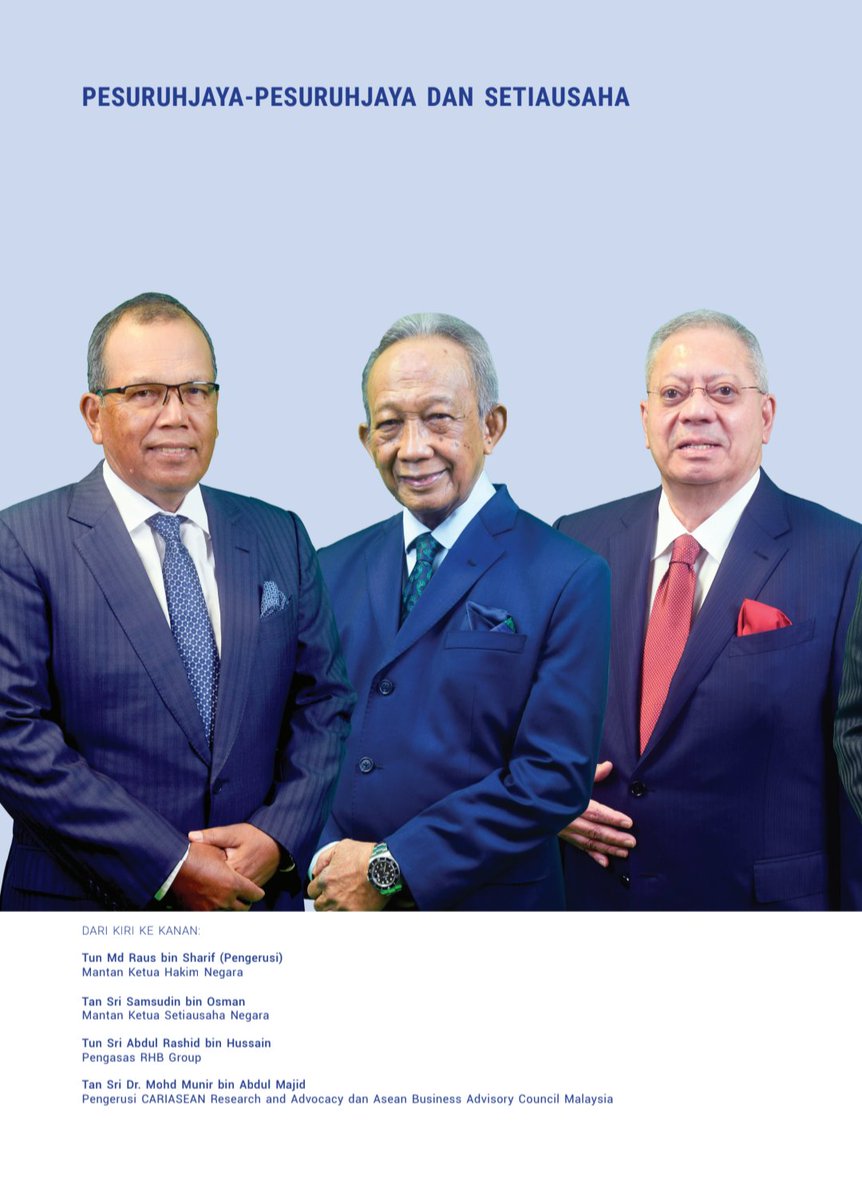
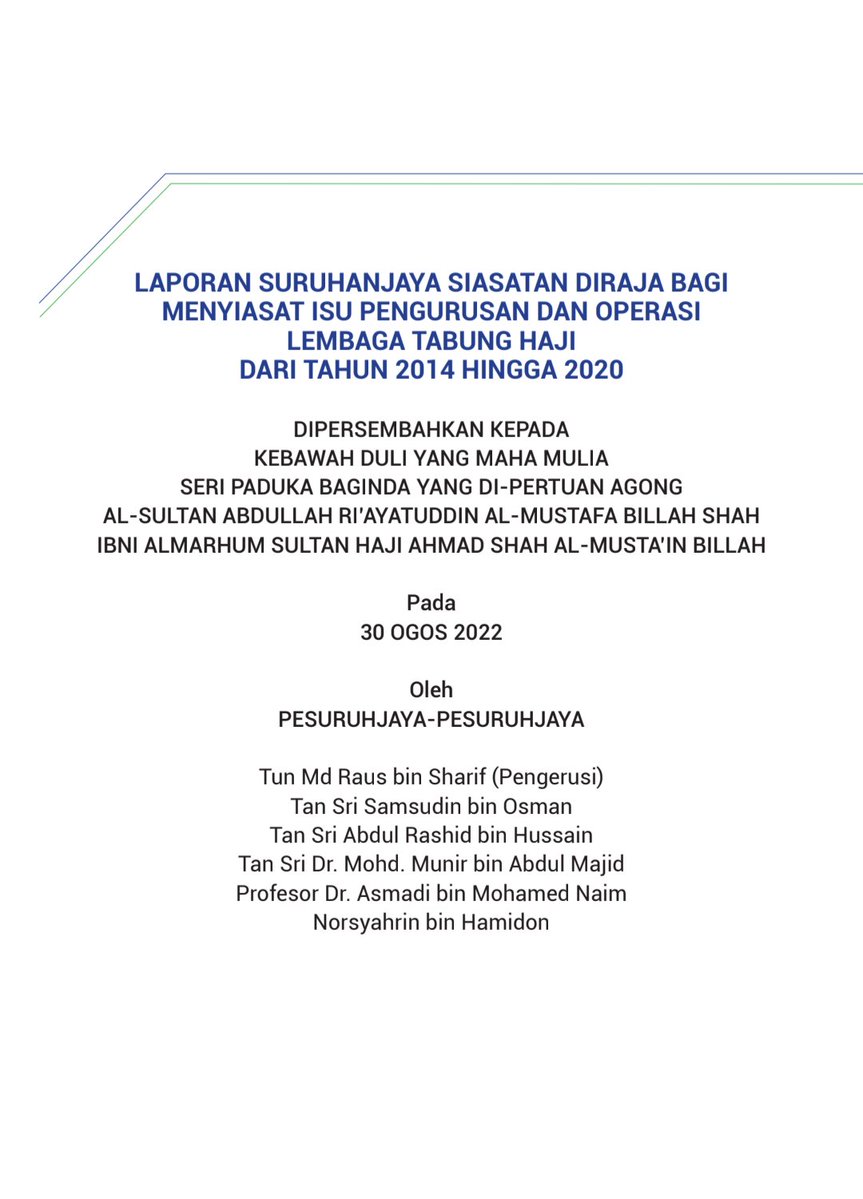
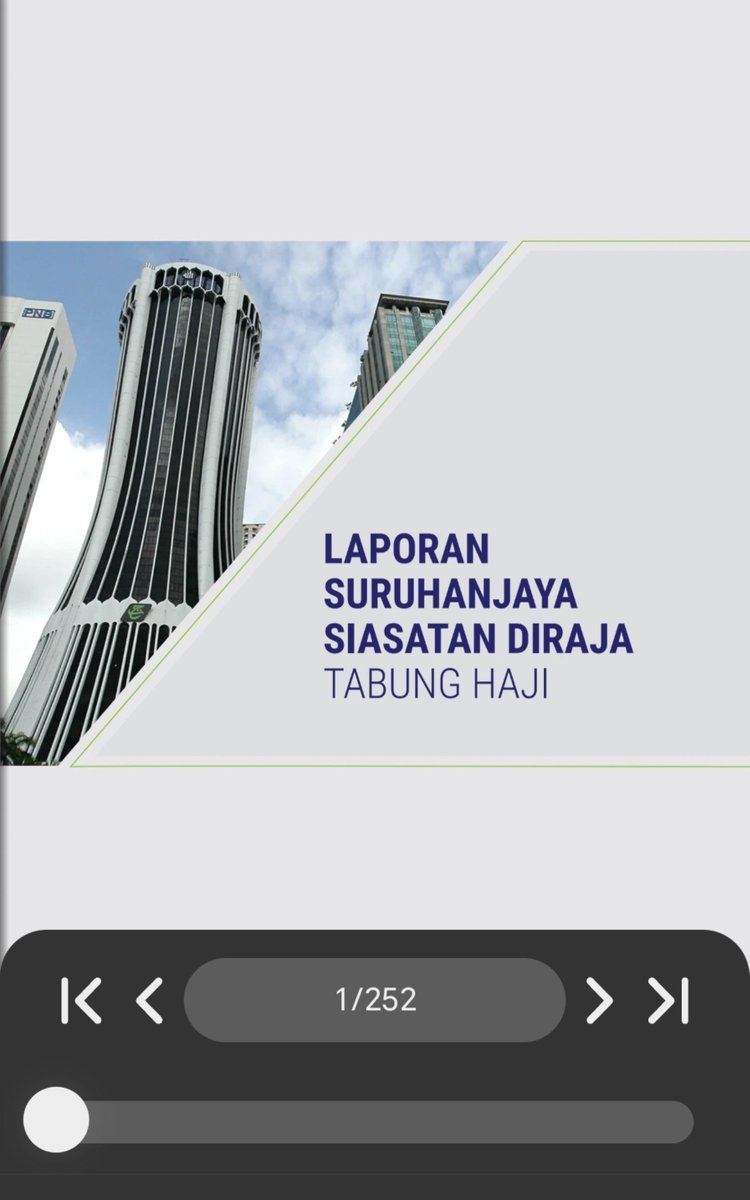
Takat baca suku dari 250 m/s, ini 8 point bahasa mudah memahami RCI Tabung Haji;
1) Dis 2015 - Gabenor BNM TS Zeti utus surat amaran kpd TH mengingatkan prestasi kewangan TH kini dalam masalah apabila asetnya lebih rendah dari tanggungan / liabiliti.
2) Pada hujung 2017 - Aset TH ada RM70.3 bilion, manakala liabiliti RM74.4 bilion.
3) Ikut Akta TH, kalau nak bagi hibah aset kena lagi tinggi dari liabiliti. Sinilah masalah timbul.
4) Tak bagi hibah, orang akan marah, imej gov akan buruk, apatah lagi awal 2018 akan diadakan pilihanraya.
5) Maka hibah telah dibayar menggunakan duit pendeposit orang nak pergi haji bukan guna duit aset. Konsepnya sama macam yg dibuat oleh Pak Man Telo.
6) Perakaunan Kreatif juga digunakan pembayaran hibah dan bonus kpd BOD serta supaya Laporan Kewangan TH yg akan didedahkan kpd umum nampak cantik atas kertas.
7) Suruhanjaya juga menegur kuasa Menteri terlalu luas hingga sewenangnya boleh melantik ahli politik yg masih aktif - Azeez Rahim (MP Baling); TS Badruddin Amiruldin (bekas MP Jerai / Pengerusi Tetap PAU); dll, walhal sepatutnya lantikan perlu ramai di kalangan pakar supaya dapat beri nasihat kpd Menteri dgn penuh kepakaran & syariah.
8) RM22.12 juta dikeluarkan dari Yayasan TH dgn cara yg menyalahi tatakelola Yayasan. Dibuat laporan polis pada 2018.
Jahanam..
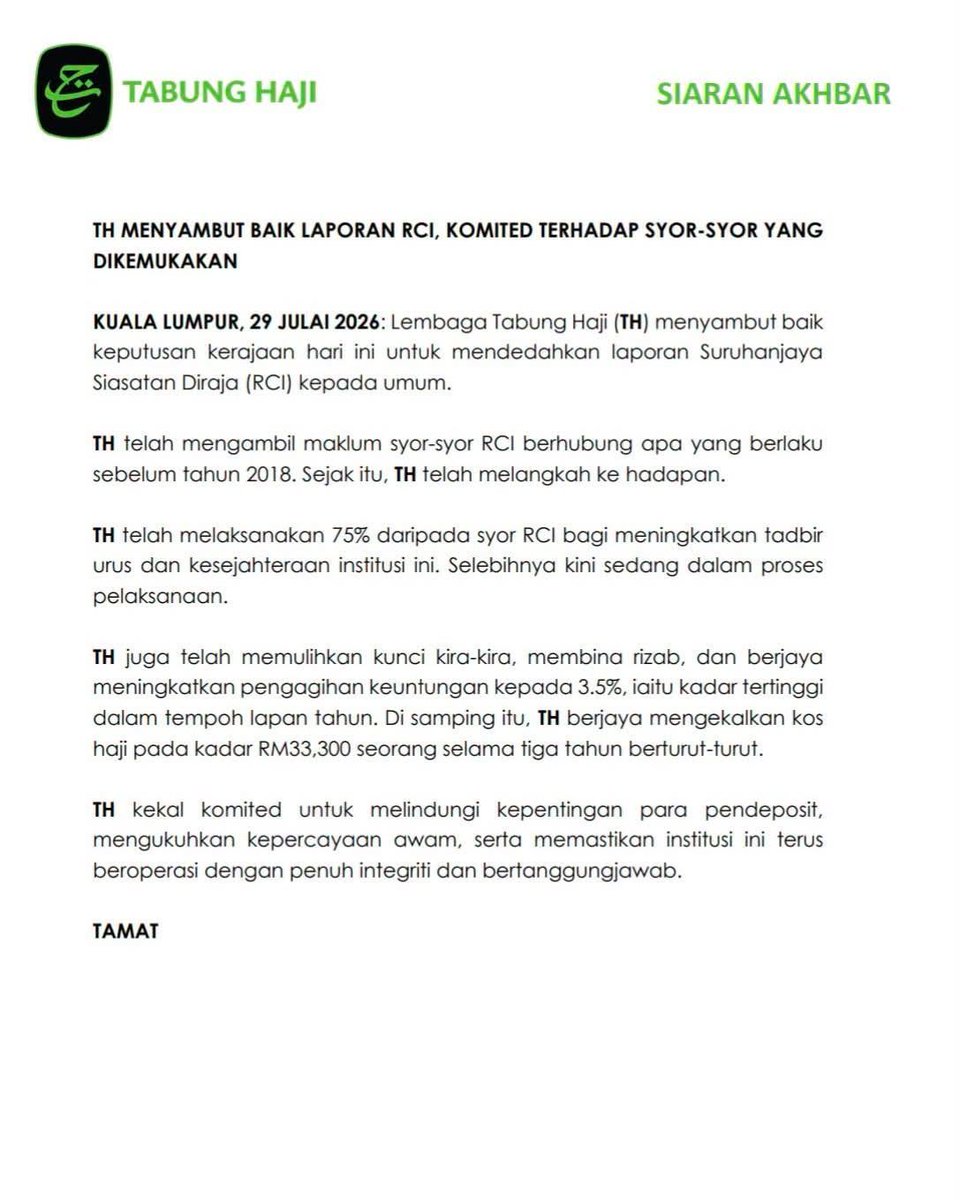
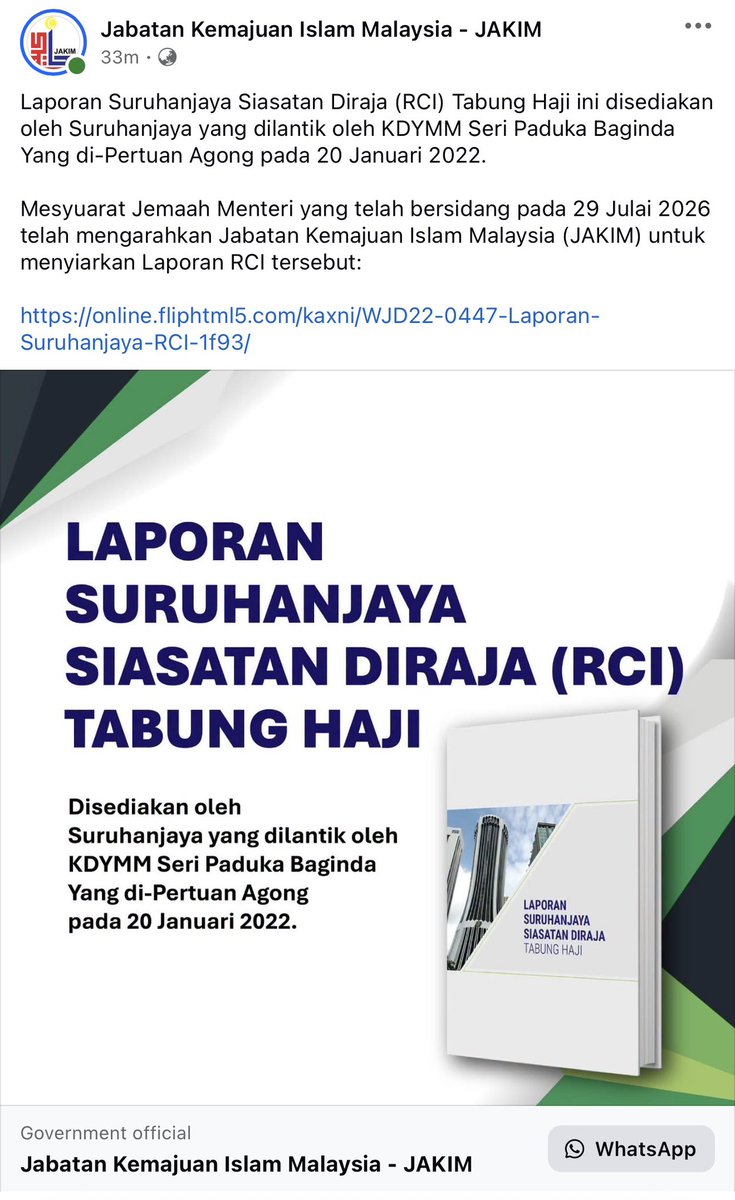
Lembaga Tabung Haji (TH) menyambut baik keputusan kerajaan untuk mendedahkan laporan RCI kepada umum, sambil menegaskan isu terdahulu telah ditangani dan penambahbaikan tadbir urus telah dilaksanakan.
TH memaklumkan 75% daripada cadangan RCI telah dijalankan, manakala baki cadangan dalam proses pelaksanaan.
Kronologi krisis kewangan dan Laporan RCI Lembaga TH
Krisis kewangan Lembaga Tabung Haji (TH) yang bermula dengan isu ketidakpadanan aset dan liabiliti membawa kepada pelaksanaan pelan pemulihan berskala besar, sebelum disusuli penubuhan Suruhanjaya Siasatan Diraja (RCI) bagi menyiasat isu-isu berbangkit bagi tempoh 2014 hingga 2020.
Selepas TH melalui proses penstabilan kewangan dan operasi, Jemaah Menteri hari ini bersetuju mengelaskan semula serta mendedahkan laporan RCI itu kepada umum, selain memutuskan siasatan lanjut oleh badan penguat kuasa diteruskan berdasarkan dapatan laporan berkenaan.
Artikel: https://t.co/l5oIrUk0ta
Anda boleh baca berita penuh di portal Sinar Harian di https://t.co/R2UYPBJuSb atau swipe up di IG story serta jangan lupa follow IG @sinarharian untuk berita terkini dalam dan luar negara.
#SinarHarian #SinarTerkini #TabungHaji #krisiskewangan
Antara 14 pelaburan bermasalah yg dibuat Tabung Haji, salah satunya ialah pada tahun 2014. Kita nak tanya Menteri Agama ketika itu - Jamil Khor Baharom kenapa TH melabur beratus juta ke dlm Deru Semangat S/B dan kemudian melakukan aktiviti pembalakan haram yg membuatkan TH rugi?
The Sukarelawan Leader 💛💙💛
I remember walking into @partibersamamy HQ prior to help out.
I was caught in disbelief when I saw @rafiziramli sweeping and cleaning just like the rest of us.
Hard to describe my feeling but “WOW”
My respect towards him only grows more over time.
After watching me partake in Johor elections.
Many have asked me “Have I stopped trading?”
Not quite tbh.
I’ve always diversified my trading timeline.
•Selling CSP/CC (Monthly Setup)
•Buying Iron Condor (Weekly Setup)
•Shorting Overextended Stocks (Daily)
Only daily ❌
BITCOIN-BACKED HOLDING COMPANY RAISES $40M TO CHALLENGE THE PRIVATE EQUITY MODEL
Private equity firms typically buy businesses, cut costs, and aim to sell them within 4-7 years. A new venture called ORANGE JUICE is pitching the opposite strategy: acquire profitable businesses, improve them, hold them permanently, and build a Bitcoin treasury along the way.
Founded by Ego Death Capital partners including Jeff Booth, Lyn Alden, and more, ORANGE JUICE has raised $40 million to launch a permanent capital holding company focused on acquiring US businesses generating $1 million to $10 million in annual cash flow.
Rather than preparing companies for resale, ORANGE JUICE says it will preserve each business’s identity, strengthen operations over the long term, and reinvest retained earnings into additional acquisitions and a growing Bitcoin treasury.
The company also plans to build an in-house AI operating team to help portfolio companies improve productivity while using leverage conservatively.
ORANGE JUICE intends to pursue a future public listing, not as an exit, but to gain access to capital markets and provide shareholders with liquidity.
Mexican billionaire Ricardo Salinas is participating as the anchor investor, calling the model a combination of “cash-flowing companies and a Bitcoin treasury.”
To speed up hyperbitcoinization, Bitcoiners in every country should come together and acquire profitable local businesses.
Imagine thousands of companies globally with Bitcoin as their treasury reserve asset. Doesn't need to be anything crazy but ordinary profitable businesses.
Plumbers, restaurants, manufacturers, logistics firms.
The second order effects compound quickly.
Companies holding Bitcoin have every incentive to accept Bitcoin as payment. Why convert to fiat only to buy back later? Suddenly Bitcoin starts functioning as a genuine medium of exchange in local economies through natural commercial incentive.
Then comes the unit of account.
Businesses holding and accepting Bitcoin will begin pricing in it. Suppliers get offered Bitcoin terms. Employees get offered Bitcoin salaries. Each business becomes a node of adoption in its community.
This is how monetary transitions actually happen. Not top down through governments but bottom up through commerce.
The beauty is that every acquisition is self-reinforcing.
Profitable businesses generate cash flow, cash flow buys more Bitcoin, Bitcoin appreciation strengthens the balance sheet, stronger companies acquire more businesses.
One can dream.
There's room in the market for a Bitcoin-backed operating conglomerate.
A real Berkshire-style capital allocator that is anchored by Bitcoin.
The model is simple:
1) Use Bitcoin on the balance sheet as permanent reserve capital. Build credibility and discipline around it.
2) Let that reserve anchor the equity.
3) Then use that equity to acquire boring, profitable, cash-flowing businesses in all-stock transactions.
Structure deals with:
-Earn-outs
-Performance conditions
-Vesting schedules
-Clawbacks
Essentially the acquisitions pay for themselves.
The subsidiary cashflow covers operating costs and allows for the accumulation of more Bitcoin.
Equity becomes acquisition currency.
Now you have three compounding engines:
-Bitcoin appreciation
-Operating earnings that allows for more Bitcoin stacking
-Capital allocation skill
This is why this model can justify a premium. Can be valued more traditionally instead of just a mNAV premium.
A Bitcoin-backed Berkshire.
If executed properly, it's one of the most powerful corporate structures imaginable and a viable alternative to Strategy's fixed income model.
Just sharing some ideas.
Lately, I’ve noticed a gap.
Be it business or politics.
We tend to normalize
•Food Price Hikes
•Political Party options
Rarely a demand dent as our society is unable to challenge food/politics.
Hence, a challenger (for market forces)
Be it
•social enterprise
•new party
PRESS STATEMENT
FOR IMMEDIATE RELEASE
9 July 2026
AUDITOR-GENERAL'S REPORT EXPOSES PAJ GOVERNANCE FAILURES: RM60 MILLION IN ARREARS, RM80 MILLION PAID WITHOUT APPROVAL
SIX REFORMS JOHOR STATE ASSEMBLY MUST DELIVER
1. I refer to the Auditor-General's Report (LKAN) 1/2026 on Perbadanan Pengangkutan Awam Johor Sdn. Bhd. (PAJ). The findings of this report deserve the serious attention of every Johorean, because they concern public money and a service that ordinary people depend on every single day.
2. PAJ, a company wholly owned by the Johor State Government through the State Secretary Incorporated (SSI), operates the Bas Muafakat Johor (BMJ) service used by millions of Johoreans.
3. The Auditor-General found that RM9.22 million was paid to operator companies without formal contracts, involving 41 BMJ routes. Paying RM9.22 million of public funds reflects basic failure of governance that leaves the people of Johor with no legal protection if things go wrong.
4. The Auditor-General further found that changes to routes, kilometres and trips were implemented without approval for periods of between 167 and 1,508 days (more than four years in some cases) involving payments of RM80.63 million. Eighty million ringgit was paid out for service changes that no one had approved, and no one noticed until the Auditor-General stepped in.
5. Most troubling of all, payments to bus operators were delayed by between 100 and 717 days, with arrears totalling RM60.10 million. An operator who is not paid for nearly two years cannot buy new buses, cannot maintain existing ones, and cannot pay drivers properly. It is no coincidence that the same audit found 12 of PAJ's 78 buses have exceeded five years of age, some as old as 12 years.
6. The audit also identified the root of the problem: after 13 years of operation, PAJ has still not achieved its founding objective of building a comprehensive public transport system for Johor. It has no Strategic Plan whatsoever. This is a company operating without direction and without discipline, using public money.
7. The BMJ service itself is a good product. The same audit confirms ridership grew by 1.08 million between 2021 and 2024, and passengers save RM1 to RM5 per trip compared to commercial fares. I do not attack the bus. I attack the management behind the bus because a good product wrapped in bad governance will eventually fail the very people it serves.
8. Here is a question worth asking: why has this report not become a campaign issue? Throughout this campaign, I have not heard either Barisan Nasional or Pakatan Harapan address these findings. The answer, I believe, is uncomfortable for both. For Barisan Nasional, this report is a verdict on governance at the state level: PAJ is wholly owned by the State Government that BN leads, and every failure documented in this report e.g. payments without contracts, two-year arrears, a company with no strategic plan, all of these happened under the state's watch as sole shareholder.
9. For Pakatan Harapan, the findings raise serious questions in the other direction. Bus operators and stage bus routes in Peninsular Malaysia are licensed and regulated by APAD, an agency under the Ministry of Transport which is a ministry held by Pakatan Harapan. The public deserves an explanation of how changes to routes, kilometres and trips could run unapproved for as long as 1,508 days under the nose of the federal regulator responsible for land public transport. When the state's failures embarrass one coalition and the regulator's blind spots embarrass the other, silence becomes a shared strategy. Only a party such as BERSAMA with no stake in either government is free to put this report before the people, and that is exactly what BERSAMA is doing today.
10. In this election, every party has promised more bus routes and better first-mile, last-mile connectivity. But bus route licensing is a federal matter under the Land Public Transport Act 2010. BN who promise more routes is promising what they cannot deliver. What BERSAMA promise is what the Johor State Legislative Assembly can actually do, and we set out six reforms below.
11. First, refer this audit to the Public Accounts Committee immediately, and establish a dedicated Select Committee on Public Transport. The DUN's existing PAC should examine LKAN 1/2026 with a fixed reporting deadline. But a PAC looks backward at money already spent. Johor needs a standing Select Committee on Public Transport that looks forward, with power to summon PAJ directors, SSI officers and operators, to scrutinise contracts before they fail, and to monitor the critical transition years ahead.
12. Second, impose payment discipline on PAJ through the instruments the State Government controls. The principle is simple: no contract, no payment. and operators must be paid within 30 days. As the sole shareholder through SSI, the State Government can write these conditions directly into its annual grant agreement with PAJ tomorrow. In the Assembly, if given the mandate, BERSAMA will use every tool available to a backbencher to force this including cut motions during the Committee of Supply to compel debate on the PAJ allocation and direct questions requiring the State Government to commit, on the record, that no payment will be made without an executed contract.
13. Third, legislate a Johor Public Transport Fund with multi-year funding commitments. The audit itself identified the year-to-year allocation cycle as the source of PAJ's financial instability as 89.2% of its operating income depends on annual state and local government allocations. A dedicated fund established by enactment, with statutory conditions on disbursement will end this cycle and makes proper planning possible.
14. Fourth, restructure PAJ from a company under SSI into a statutory body answerable to the DUN, with a statutory duty to prepare a five-year strategic plan and to table an annual report before the Assembly. A company answers only to its shareholder behind closed doors. A statutory body answers to the people's representatives in open session. If Johor Jaya gives me the mandate, I will work with the Government of the Day to bring this enactment forward, and if it will not act, I will table a Private Member's Bill myself.
15. Fifth, use the state's land-planning and local-government powers which belong fully to Johor to solve first-mile, last-mile connectivity properly. Transit-oriented development around the 32 planned E-ART stations and Bukit Chagar, walkways, safe and sheltered stops, feeder bus infrastructure through the local authorities: this is where the first-mile, last-mile problem is genuinely won or lost.
16. Sixth, guard the 2027–2030 transition with close oversight. The RTS Link is expected to begin operations in January 2027. The E-ART is only expected to complete around 2030. For at least three years, the entire burden of dispersing RTS passengers and serving Johor Bahru will fall on buses, to be administered through exactly the kind of contracting that this audit has just found to be broken. If we do not fix PAJ's governance now, Johor will squander a multi-billion ringgit investment at the moment it matters most.
17. These oversight mechanisms e.g. committees, questions etc only work if the Assembly actually sits. The Johor DUN must convene enough sitting days each year for real scrutiny to take place. Oversight that exists on paper but never convenes is not oversight.
18. An audit report like this should be the beginning of accountability. The people of Johor deserve representatives who treats it that way, regardless of which party forms the government. That is the work BERSAMA is asking for the mandate to do.
LAU YI LEONG
Candidate, N.42 Johor Jaya (BERSAMA)
9 July 2026