The "1 repository in your GitHub account might be affected by a security vulnerability" emails hit different these days (with the gains in automated cyber-offense)
@AlexKrusz "Alice in Wonderland" was the other book I downloaded, surprisingly spooky, esp. considering that I was listening to it alone while driving into Sequoia National Park at night on a very sketchy road lol
@AlexKrusz It's a great book! Once upon a time (before Spotify had paid audiobooks) I was going on a road trip and looked for free audiobooks on Spotify and this was one that came up. Great road trip vibe. https://t.co/G7xPoJkH9D
Having gone through Blue Dot's AGI Strategy coursework on the topic, I wanted to provide my own answer to the question: "Are We in an Intelligence Explosion?" I wrote up a post (link in next tweet), which aggregates the writings on AI-progress that I've found most compelling.
...and my latest is the one on foundation-model companies at the top of the thread. Still posting every week. The posts don't always make it to Twitter. Subscribing to the blog itself is the best way to follow along!
While I'm at it, allow me to fill in all of the latest activities on blog dot danielsosebee dot com. Many varied posts! Health, philosophy, etc. Take you pick!
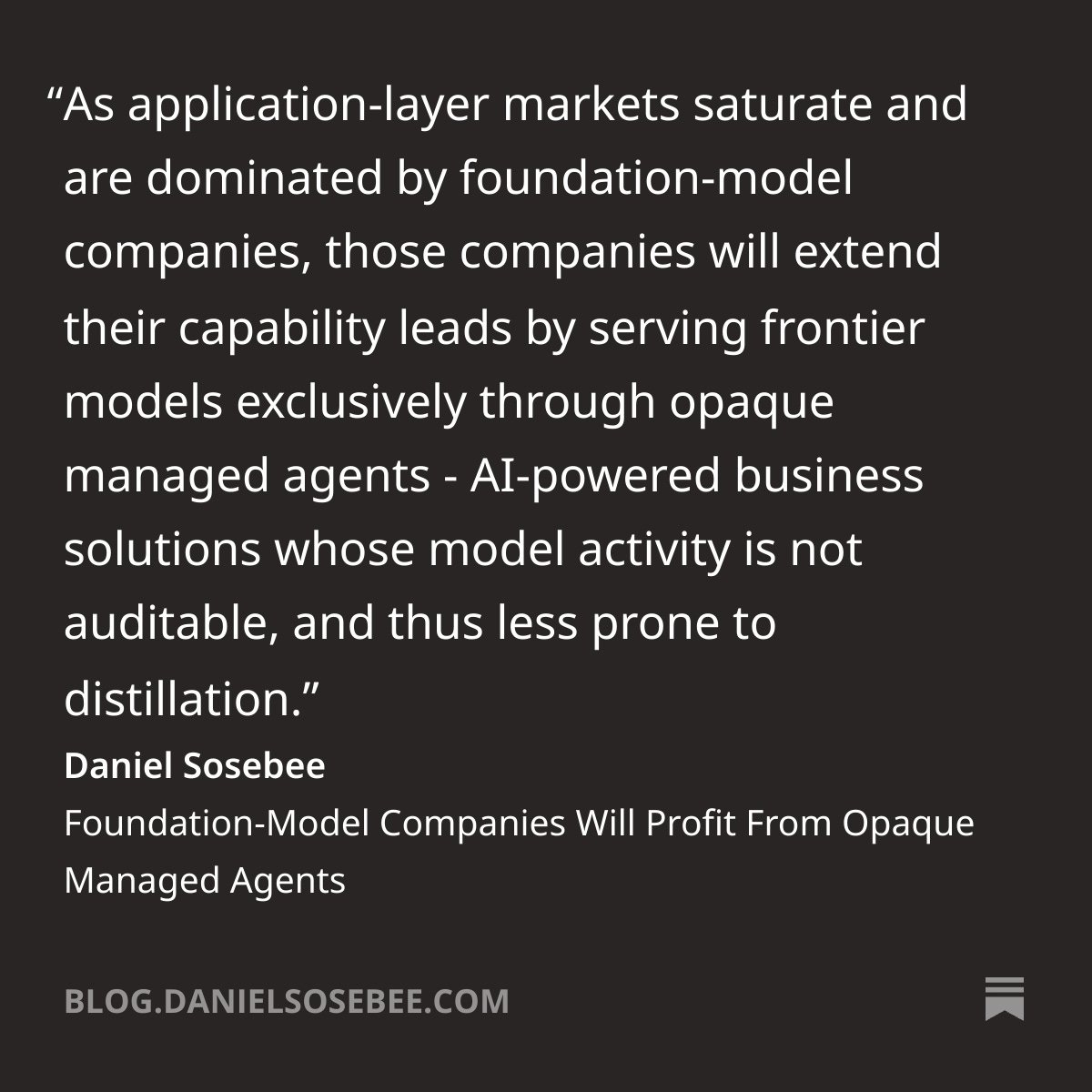
I submitted a blog post to Dwarkesh Patel's blog prize! I answered the question "What’s the most plausible story where foundation model companies actually start making money?" My response has some nuance, but the headline claim is "expect labs to focus their attention on opaque managed agents"...
I submitted a blog post to Dwarkesh Patel's blog prize! I answered the question "What’s the most plausible story where foundation model companies actually start making money?" My response has some nuance, but the headline claim is "expect labs to focus their attention on opaque managed agents"...
One of the tech categories I'd be most excited to work on is "intent servers" (/"value servers") - how are personal intentions best represented, and then made accessible in our digital lives?
I think ambient intents are going to be a big deal.
There are so many intentions we have that would make our lives better, but the cost of surfacing them to a market it too high, so they never become legible to the world.
You want a better job, you want to swap your couch, you would apartment-swap with someone in your web-of-trust, you would upgrade from a two-bedroom to a three-bedroom if there were some graceful way to find the person who wants to size down, and you would love to sublet you place in New York without posting on Instagram and making 95% of you friends read a logistical errand that has nothing to do with them.
Right now, the cost of expressing these intents is high. You have to remember the want, decide it is worth acting on, find the right channel, phrase it socially, tolerate the inbound, filter for trust, negotiate details, and then keep the whole thing alive in your head.
So most of the long tail dies.
Agents change this because they can keep the low-grade, half-formed wants running in the background. They know your calendar, your travel plans, your music, your reading, your friends, your constraints, and maybe your willingness to be interrupted.
You listen to a band on repeat on Spotify and your agent notices they are playing 20 minutes from where you will be in California next month. You highlight a book you love in Readwise and it tells you that your friend is reading it too, and you will both be at the same dinner next week. You mention wanting Berlin in June and it quietly checks whether any trusted people from there want to apartment swap in New York then.
The magic is lowering the cost of noticing, holding, matching, and negotiating these things. It will feel like a higher level of serendipity.
This will require a web-of-trust that has yet to be built because there is an important privacy aspect to this. The dystopian version is "AI companies capture your intentions and auction them to whoever wants to manipulate you." The useful version is user-owned intents, where your agent can prove enough to match or negotiate without dumping your private life into a marketplace.
Some of this already has been solved in cryptography: private set intersection for finding overlaps without revealing all non-matches, secure multiparty computation / homomorphic encryption for computing matches or scores over private inputs, zero-knowledge credentials for proving things like membership, attendance, reputation, or trust path without exposing everything underneath.
If this works, a lot of modern life gets more liquid. Idea sharing, couches, apartments, reading groups, dinner plans, travel overlaps, introductions, tiny labor exchanges, borrowing a camera, finding the one person at an event who cares about the same weird thing. All the stuff that currently relies on posting into the void and hoping the right person happens to see it.
The hard parts are real: consent, spam, weird incentives, agent loyalty, social context, and making sure this becomes a tool for people rather than a new ad exchange with better vibes.
But I increasingly think the big unlock is giving our unexpressed intentions a safe place to live, and giving our agents permission to help them find each other.
I know of @indexnetwork_ working on this. Anyone else?