The extreme RCP8.5 pathway that powered a decade of “settled science” apocalypse headlines, school curricula, and trillion-dollar green policy was quietly retired by the modelers themselves as implausible for the next IPCC cycle.
Trump spent years calling out the mismatch between the worst-case scare scenarios and real-world energy trends—cheaper renewables, actual emissions paths, and policy reality. The official scenario process has now caught up. The overreach cost real money and trust; the correction is overdue.
Medal of Honor Monday 🇺🇸🫡
Corporal Hiroshi H. “Hershey” Miyamura was an American hero whose extraordinary courage during the Korean War would earn him our nation's highest military decoration.
On April 24, 1951, near Taejon-ni, Korea, overwhelming enemy forces attacked his company's defensive positions. Rather than retreat to safety, Miyamura fought fiercely to protect his fellow soldiers.
He engaged enemy troops in hand-to-hand combat, helped evacuate wounded men, and repeatedly remained behind to cover his comrades' withdrawal. Even after being wounded, he continued fighting until he was finally overwhelmed and captured.
For more than 27 months, Miyamura endured the hardships of being a prisoner of war.
But what makes his story even more remarkable is that his Medal of Honor was kept classified while he remained in captivity. American officials feared his captors might retaliate if they learned of his extraordinary battlefield heroism.
Following his release in August 1953, President Dwight D. Eisenhower presented him with the Medal of Honor on October 27, 1953.
Miyamura passed away on November 29, 2022, at the age of 97.
His story is a powerful reminder that true heroism isn't measured by medals or recognition, but by the willingness to sacrifice everything for the lives of others.
Corporal Hiroshi H. Miyamura stood his ground so his brothers-in-arms could live.
May we never forget his courage, his sacrifice, or his unwavering devotion to duty.
Rest in peace, American hero. Your legacy will live on. 🇺🇸🫡❤️
This is GOLD
A woman who’s trying to virtue signal about being a Muslim and talks about life as a Muslim gets destroyed by a real Muslim who left Islam
This is why you need to be extremely careful with all the pro-Islam influencers who have popped up over the last few years, they are lying to you. They are completely changing what Islam is and in many cases telling you the exact opposite of the truth
We need more people like this real former Muslim to keep speaking up
I also included some footage of this woman’s social media accounts, she is not at all a Muslim
🚨 A PACKED ARENA.
Thousands of hands raised, all singing HALLELUJAH.
They keep telling you faith is dying in America. This doesn't look like it to me. https://t.co/iTmbZWk4jP
🚨🔔President Trump just stunned the world and brought the mastermind behind the Bengazi attack to American soil‼️
He is getting the justice that Hillary Clinton refused to get for our fallen heroes. Finally, we have a leader who delivers accountability.
This is what REAL leadership looks like . GOD BLESS 47.!🇺🇸👊🏻
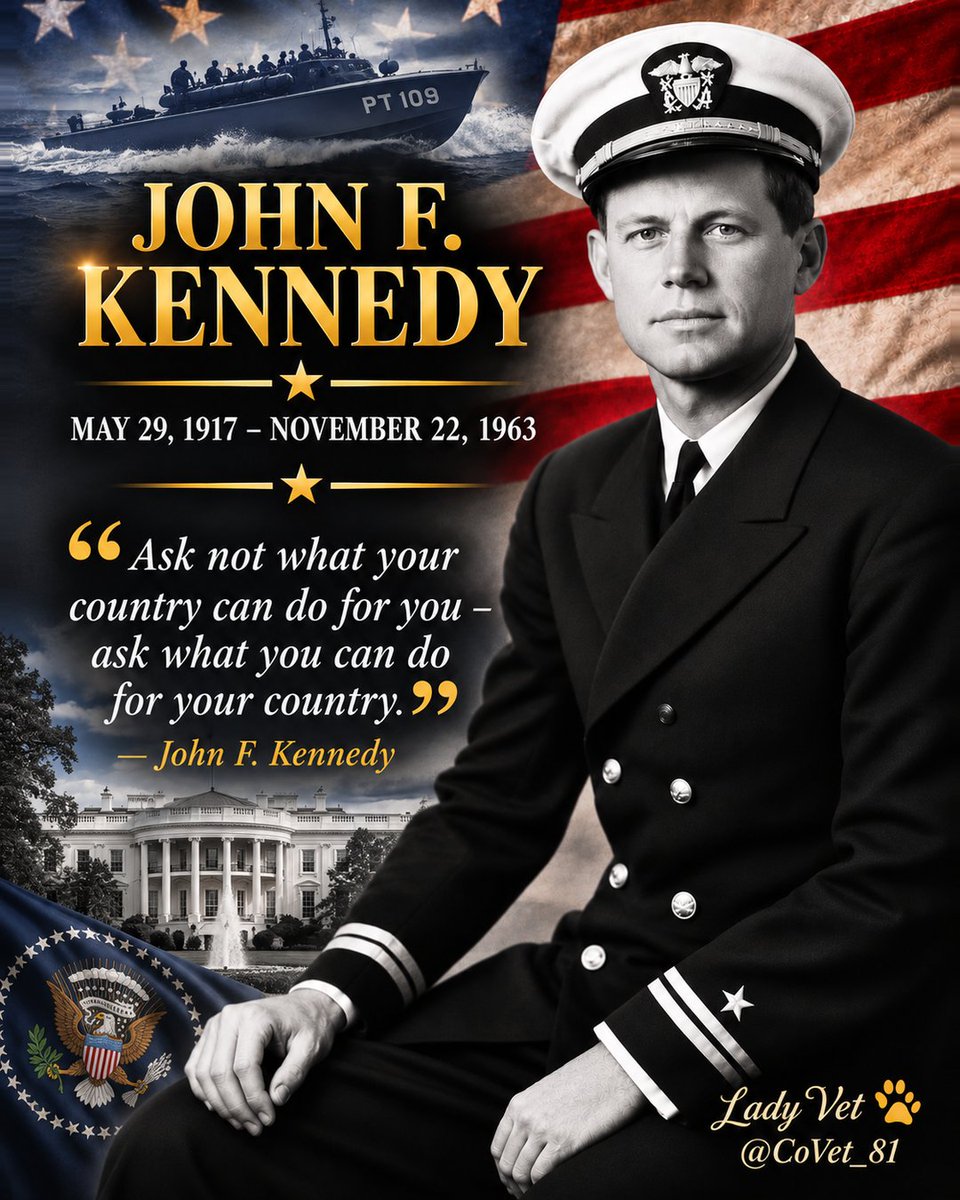
JOHN F. KENNEDY 🇺🇸
May 29, 1917 – November 22, 1963
From a young boy in Massachusetts to a Navy war veteran and the 35th President of the United States, John Fitzgerald Kennedy lived a life shaped by family, sacrifice, service, and history.
On May 29, 1917, John Fitzgerald Kennedy was born in Brookline, Massachusetts, to Joseph P. Kennedy Sr. and Rose Fitzgerald Kennedy. Known affectionately as “Jack,” he was the second of nine children in a prominent Irish-American Catholic family.
His father was a successful businessman who later served as U.S. Ambassador to Great Britain. His mother came from a politically influential Boston family. The Kennedy household was filled with competition, ambition, education, and an expectation that its children would accomplish something meaningful.
But Jack's childhood wasn't without hardship. Despite growing up surrounded by privilege, he battled serious illnesses, including a nearly fatal case of scarlet fever before his third birthday. Health problems would follow him throughout his life.
As a young man, Kennedy attended Harvard University, graduating in 1940. His interest in international affairs led him to write Why England Slept, a book examining Britain's lack of preparedness before World War II.
Then came the war that would change his life.
In 1941, Kennedy joined the United States Navy.
He eventually became commander of PT-109, a patrol torpedo boat operating in the dangerous waters of the South Pacific.
During the early morning hours of August 2, 1943, a Japanese destroyer struck PT-109, splitting the wooden vessel apart. Two American sailors were killed, and the surviving crewmen were stranded in enemy-controlled waters.
Kennedy, despite injuring his back, refused to abandon his men.
He helped lead the survivors through the water to a small island, towing a badly burned crewman by holding the strap of the man's life jacket between his teeth.
For days, the survivors struggled with hunger, exhaustion, and uncertainty. Kennedy continued searching for help, eventually making contact with local islanders who assisted in arranging their rescue.
All eleven survivors were rescued.
For his actions, Kennedy received the Navy and Marine Corps Medal and the Purple Heart.
But the war brought personal tragedy as well.
On August 12, 1944, his older brother, Joseph P. Kennedy Jr., a Navy aviator, was killed during a dangerous bombing mission over Europe.
Joe Jr. had long been considered the brother most likely to pursue the family's political ambitions. His death profoundly affected the Kennedy family and helped redirect Jack's future.
After leaving the Navy in 1945, Kennedy briefly worked as a journalist before entering politics.
In 1946, at just 29 years old, he was elected to the U.S. House of Representatives from Massachusetts. He served three terms before winning election to the United States Senate in 1952.
His personal life was changing, too.
On September 12, 1953, Kennedy married Jacqueline Lee Bouvier in Newport, Rhode Island. Their marriage would become one of the most recognizable in American presidential history.
Their daughter, Caroline, was born in 1957, followed by their son, John F. Kennedy Jr., in 1960. Their family also experienced the heartbreak of pregnancy loss and, later, the death of their infant son Patrick in 1963.
Kennedy was also an accomplished author. His book Profiles in Courage, examining acts of political bravery by American senators, won the Pulitzer Prize for Biography in 1957.
By 1960, Kennedy had set his sights on the presidency.
He faced Vice President Richard Nixon in a closely contested election that included the first nationally televised presidential debates. Kennedy's youth, communication skills, and message of national renewal became central features of his campaign.
On November 8, 1960, Americans elected John F. Kennedy as their next president.
At just 43 years old, he became the youngest person ever elected President of the United States and the nation's first Catholic president.
On January 20, 1961, standing before the United States Capitol, John Fitzgerald Kennedy took the oath of office as America's 35th president.
During his presidency, he established the Peace Corps, challenged America to land a man on the Moon, confronted the Cuban Missile Crisis, advocated civil rights legislation, and helped negotiate the Limited Nuclear Test Ban Treaty.
His administration faced serious challenges and controversies, including the failed Bay of Pigs invasion, Cold War tensions, and the struggle over racial equality.
Yet his call for Americans to serve something greater than themselves became one of the defining messages of his presidency.
“Ask not what your country can do for you—ask what you can do for your country.”
Those words, spoken during his inaugural address, continue to be remembered more than six decades later.
Before he was President Kennedy, he was Jack. A son, a brother, a husband, a father, a Navy officer, and a man whose experiences helped shape his path to the White House.
On this November 22, we remember not only the president America lost in 1963, but the remarkable journey that came before that tragic day.
May his service, sacrifice, and place in American history never be forgotten. 🇺🇸
In 1968, 20-year-old American soldier Gary Wetzel lost his left arm in Vietnam. Bleeding heavily and severely injured by an explosion, he still climbed back into his helicopter's gun position to protect his fellow soldiers. This act of bravery earned him the Medal of Honor. On January 8, 1968, Gary was a door gunner with the 173rd Assault Helicopter Company. When his helicopter landed, intense enemy fire erupted. Two rockets exploded near him, throwing him into a muddy rice paddy. His injuries were horrific: his left arm was barely attached, his right arm was torn, his chest ripped open, and blood flowed from his leg. Yet, he managed to get back up. An enemy automatic weapon was still firing, trapping some American soldiers. Despite shock and unbearable pain, Gary realized his machine gun was operational. He knew it had to be stopped to save more lives. Gary made his way back to the helicopter's gun well. He tucked his mangled left arm into his waistband and, using his severely injured right arm, took hold of the machine gun. He opened fire, continuing until the enemy position was eliminated. Only then did Gary turn his attention to the wounded around him. He tried to reach his aircraft commander but collapsed unconscious. When he awoke, he immediately thought of the men still out there. He dragged himself through the rice paddy, repeatedly losing consciousness, to reach his crew chief and the wounded commander. He helped move the commander to safety behind a dike before collapsing again. Rescue personnel found him barely alive the next morning. His condition was critical, and doctors amputated his left arm. During his recovery, soldiers he had helped protect visited him, showing him photos of their families. They told him, "Because of you, this is what I've got to go back to." These visits made Gary understand that his fight had saved not just soldiers, but families and futures. President Lyndon B. Johnson presented Gary Wetzel with the Medal of Honor on November 19, 1968. He also received the Purple Heart and Air Medal. After five months in hospitals, Gary returned home to South Milwaukee, Wisconsin. He adjusted to life with a prosthetic arm, becoming a heavy equipment operator, a job typically requiring two hands. He married Kathy, raised a family, and continued to advocate for others. Gary's commitment to helping others became particularly meaningful when he learned about Bella Zizzo, a four-year-old girl born without her left hand. Feeling a connection, he organized a charity ride with his motorcycle friends to raise money for Bella. The funds sent her to No Limits Camp and helped pay for a family vacation to Disney World. For Gary, this was another way to show that a physical difference doesn't prevent a full life. He views his Medal of Honor not just for himself, but as a responsibility to remember fallen soldiers and help those facing challenges. He once said, "I'm not Superman. I was just a guy doing his job." Gary Wetzel lost his arm, but his refusal to give up ensured other soldiers survived. He went into that rice paddy as a young soldier and emerged without an arm, yet with the profound knowledge that other men would go home because of his actions. He spent his life proving that even after great loss, one can still make a difference in the lives of others.
#MedalOfHonor #MilitaryHeroes #AmericanHistory
United States Army Specialist Justin William Michael Hebert was killed in action on August 1, 2003 when his vehicle was struck by a rocket propelled grenade in Kirkuk, Iraq. Justin was 20 years old and from Arlington, Washington. 319th Field Artillery, 173rd Airborne Brigade. Remember Justin.🇺🇸🎖️
They wrote it down, entered it into federal court, and still somehow expect us to pretend this is just “diversity.”
Brigitte Gabriel is holding in her hand the Muslim Brotherhood’s 100 year plan to infiltrate and destroy America from within written in May 22, 1991.
“This plan was presented as evidence in the Holy Land Foundation trial, the largest terrorism trial ever in the history of the United States where our government handed down 108 guilty verdicts for Muslim-Americans and Muslim-American foundations raising money to support terrorist organizations in the Middle East to the tune of millions.”
A paragraph from the plan:
“Understanding the role of the Muslim brother in North America. The process of settlement is a civilization Jihadist process with all the words mean. Brothers must understand that their work in America is a kind of brand Jihad in eliminating and destroying the Western civilization from within and sabotaging its miserable house by their hands and the hands of the believers, so that it is eliminated and Allah’s religion is made victorious over all other religions.”
What more does any American need to know?
Do not vote these people into public office.
Liberals vote their states into communist shitholes, flee to red states, then bring the same destructive voting with them. They blame the politician, never the policies. They never learn, they just spread like a virus.
Let’s make them learn. Share this video & stop the spread!
"For god's sake, stop complying. Start rebelling. They are out to get you if you do not resist."
German MEP, Christine Anderson: The so-called "pandemic" was a beta test—conducted by unelected globalists—to see how easy it would be to seize totalitarian control, under the pretext of a global "emergency."
"The goal, ultimately, is to transform our free and democratic societies into totalitarian societies. Their goal is to strip each and every one of us of our fundamental rights, of freedom, democracy, the rule of law. They want to get rid of all of this."
"In the entire history of mankind, there has never been a political elite concerned about the well being of regular people, and it isn't any different now."