🧵
Who owns Politics UK?
The “impartial” news brand with half a million followers on @X discloses one co-owner’s politics. Its other half belongs to a former Conservative MP’s holding company, but you won’t find that on its website.
On Sunday evening, Politics Global (@PolitlcsGlobal) told its followers that only three world leaders had amassed more views on @X this year than Rupert Lowe. The line came from the Financial Times, but the FT’s explanation, that Lowe’s reach owes a great deal to Elon Musk, was left to a reply.
The main post has been viewed more than 390,000 times, the reply about 17,500. For every view of the context, the claim had roughly twenty-two. The flattering half of a story was selected and packaged as news.
Politics Global is one of three accounts run by Politics News Group Limited, alongside Politics US (@PolitlcsUS) and the best known of them, Politics UK (@PolitlcsUK). Note the spelling of the handles: each has a lower-case L where the second i in “Politics” should be, so at a glance they read as “Politics”.
Politics UK describes itself as “the home of UK political news”, run by young people for young people. It says it has grown from 30,000 followers on X in early 2023 to more than 500,000, that it is a member of the Parliamentary Lobby, and that it is regulated by IMPRESS. Its X profile promises impartial coverage.
Its About page is unusually open about one of its owners. It names Bailey Nash-Gardner as co-owner of Politics News Group, which he founded in January 2023 under the name News Hub Group. “In the interests of transparency”, it says, he was elected as a Reform UK councillor for Marshalls and Rise Park in Havering in May 2026, and he also works for Andrew Rosindell, the Reform UK MP for Romford. It adds that he oversees commercial operations and has no editorial involvement in Politics UK.
What the page does not say is who owns the other half.
Companies House does. On 21 March 2025 the company issued 99 new shares, taking the total to 100. Its confirmation statement of 8 August 2025 lists two shareholders: Bailey-Jon Nash, as he is registered, with 50 shares, and Chamber UK Services Limited with the other 50.
Chamber UK Services is the company behind Chamber UK, a Westminster events and political media business whose chief executive is Ben Howlett, Conservative MP for Bath from 2015 to 2017. Howlett also runs Curia, which describes itself as a non-profit policy institute.
Calling itself the UK’s first “do tank”, Curia sells memberships and runs parliamentary roundtables and reports, some with commercial backing: a roundtable on NHS dentistry organised with mydentist and the Association of Dental Groups, and events sponsored by the pharmaceutical company Bayer and the life sciences firm Revvity.
In January 2026, Howlett incorporated a holding company, Belvedere Ash Limited, of which he owns 75% or more. Over the following months his interests moved into it.
On 3 March 2026 Belvedere Ash replaced Howlett himself as the controlling owner of Curia UK Limited, and replaced Chamber UK Services as part-owner of UKAI, an AI industry trade body. On 20 August 2026 it was registered as owning between 25% and 50% of Politics News Group and appointed a director. The company’s 2026 confirmation statement lists the same 50-50 split, Nash and Belvedere Ash.
So half of Politics UK is owned by a holding company controlled by a former Tory MP whose businesses sell access to political events, and the other half by a sitting Reform councillor who works for a Reform MP. Readers of the About page learn only about the second.
None of this was secret to anyone who followed @PeterKGeoghegan’s reporting. In December 2025, #DemocracyForSale and Led @ByDonkeys revealed an undercover investigation in which a reporter, posing as an adviser to a Chinese investor, signed a £5,000 contract with Howlett’s Chamber Group. Howlett went on to arrange meetings with more than ten Labour MPs. Chamber also charged the reporters £2,400 plus VAT to place two pro-China posts on the Politics UK X account.
The posts linked to long articles on Politics UK’s website attributed to Curia UK, not to the client who had paid for them. Both were taken down after the reporters asked for comment. Howlett told the undercover reporter he had bought his 50% stake for £100.
The lobbying regulator later closed an investigation into Chamber, finding that it had not broken lobbying law. Geoghegan argued at the time that this said more about the narrowness of Britain’s lobbying rules than about the conduct he had exposed.
Nearly a year on, Curia still has its own section on the Politics UK website. Labelled “Curia Policy”, it describes itself as updates from Curia, “a non-profit policy institute”.
On 8 October 2026 it published a report from the Conservative Party conference, bylined Ben Howlett, in which a shadow minister urged AI businesses to help shape Conservative policy. The piece links twice to UKAI. Its subscribe prompts ask readers to support Curia’s work. Nowhere does it tell readers that the author’s holding company owns half of the outlet publishing him.
The piece itself is measured, even mildly critical of the party it covers, but that is beside the point. Readers judging any piece of journalism are entitled to know whose interests stand behind it. For news media, that is the most basic disclosure there is. Herman and Chomsky made ownership the first of the “filters” in their propaganda model for a reason: who owns a news outlet shapes what it covers, often in ways no single article reveals.
On “non-profit”: Curia UK Limited is a private company limited by shares, now owned through Howlett’s holding company. That legal form does not, in itself, establish that it operates on a not-for-profit basis. The description is Curia’s own. When Democracy for Sale reported on it in December 2025, its most recent accounts had been filed as dormant.
There is a further discrepancy in the company’s own filings. A person or company holding more than 25% of a UK company’s shares or voting rights should normally appear on its public register of people with significant control.
Politics News Group’s August 2025 confirmation statement shows Chamber UK Services holding half its shares. Yet Chamber UK Services never appears on that register. Until 20 August 2026, the register recorded Nash as the only person with significant control; his entry was amended to a stake of between 25% and 50% on the same day Belvedere Ash was added.
For at least twelve months, then, two filings by the same company gave different pictures of who controlled it. The filings do not say why.
Nash-Gardner himself has spoken about this kind of thing. Interviewed by an undercover @BylineTimes reporter before the May elections, he condemned a councillor who had failed to declare a business interest, saying people in public life should “be open and transparent about the interests that you have”. It’s a good principle, and it applies to news brands too.
Nash-Gardner’s own X bio follows it, naming him as “Founder & Non-Editorial Director” of Politics News Group and linking all three accounts. Howlett has shared the accounts’ posts from his X profile too. His bio describes him as a former MP, a cat parent and a charity runner. It does not mention his stake in them.
Politics UK’s defenders will say that it discloses its partnerships, and it does name Chamber UK and Curia as partners. But a partnership is one thing and common ownership is another. A reader told that a news outlet works in partnership with a policy institute would reasonably assume two independent organisations.
What the record shows is that Curia and half of Politics UK sit under the same holding company, and that Politics UK publishes Curia’s material under Curia’s name, on at least one documented occasion for a commercial client.
Speaking to Democracy for Sale last year, Green Party leader @ZackPolanski said former MPs now “slip effortlessly between Conservative, Labour and Reform UK”. Politics UK is a neat illustration. A Reform councillor shares ownership of a brand that tells young people it brings them impartial news with a former Tory MP who was recorded saying he had helped with Labour fundraising.
Politics UK says it holds itself to account through complaints and its regulator. A reasonable first step would be a single sentence on its About page saying who owns the other half.
In the next tweet: two posts from Politics UK in one evening, and the context that went missing on the way to half a million followers.
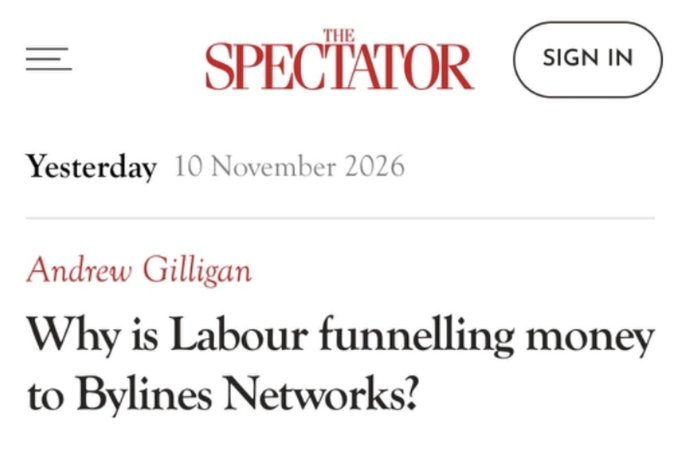
Interesting question.
As founder & director of Bylines Network, I can tell you.
Answer: Labour isn't.
The govt have set up a fund to support local news. This here is the panel of people who assess competitive bids --> https://t.co/kKoNHanJy5
So it was those industry figures who, as you can see, span a political range - and which collectively decided that two of our bids should win funding to support 1) citizen journalism training and 2) hyper local news organisations all over the UK.
If you'd like to know more about what we're actually doing with these grants to help local journalism everywhere in England and Wales, here's a piece I wrote on it --> https://t.co/mSKAp1i2gW
The article by Andrew Gilligan is a pretty sloppy hit job, in which he attacks Byline Times (separate legal entity) more than us. We've written a complaint to the @spectator, copying in IPSO, highlighting factual errors and misrepresentations.
Tight security as thousands gather for far-right Polish march.
Nazis from Spain, Hungary, Britain & elsewhere flock to this, of course.
@Searchlight_mag@AntiRacismDay https://t.co/KZiiwzzGg5
I've requested bodycam footage from
Kent Police after officers searched children's toys in front of my two-year-old.
Comments also suggested the raid was influenced by who the complainant was.
I want answers.
wow -- CNN broadcast footage of an Arlington guard yelling at a group with Pete Hegseth to "MAINTAIN SILENCE ... PAY RESPECT!" after someone in his entourage started laughing at the Tomb of the Unknown Soldier
On Tuesday, Joe Martin, Reform UK’s Member of the Senedd for Caerdydd Penarth, asked the Senedd for a statement on the “demographic replacement of white British people”.
The Presiding Officer barred him from speaking until he apologises.
Martin posted the clip to X the same day, where it has passed 100,000 views.
His “2063” is presented as fact. It comes from a single 2025 projection by Matt Goodwin, later himself a Reform candidate, which assumes every net migrant for the next hundred years comes from outside the EU.
Georgina Sturge, a former House of Commons Library statistician, tried to replicate it and couldn’t.
In the clip he says a nation is “a family which is capable of absorbing people of all races if done at a sensible rate, but not if it’s replaced altogether”. Read that last clause again. The thing to be protected is the majority status of one ethnic group.
His accompanying text says the same. What he calls “morally wrong” is the proportion of the population that is White British, and Britain becomes the “ancestral home” of an extended family, leaving millions of British citizens outside the “we” who “made the country”.
If racism means treating one ethnic group’s majority as a moral good and its loss as a moral wrong, then this is racism, in his own words.
The Senedd’s Presiding Officer has already ruled that his focus on race and ethnicity was “clearly discriminatory”.
White British people are set to be a minority in our own country by 2063.
This is morally wrong. We made the country the way it is, and if too many people from other countries move here, instead of assimilating to our way of life, they will bring with them theirs.
Numbers therefore matter. We can assimilate a small number of people from other cultures and countries over a long period of time. We cannot assimilate millions over the course of a generation.
Great Britain is not a collection of people who share the same passport, it is not a hotel, and we are not a charity. It is the ancestral home of the British people, who form an extended family, whom I love.
Trump: "Green Beret Ryan Hendrickson was leading his team through a Taliban-held village in Afghanistan at 3 in the morning when he was stepped on by enemy. I mean, he was the enemy, the enemy was all over. He made the mistake. A mistake that people understood when they were in the battles, jungles."
Increasingly desperate Nigel Farage is way beyond “ridiculous and outrageous”.
He doesn’t say why it happened.
On 10 November Martin asked for a government statement on the “demographic replacement of white British people”. Straight out of the far right playbook.
The Llywydd ruled this “unnecessarily provocative and deliberately offensive”.
Martin won’t be called to speak until he apologises, though he can still vote. The rule covers disorderly language. Martin is still free to discuss immigration.
It follows earlier warnings, and a formal reprimand in September after he called gender service doctors “butchers” and “liars”.
The sanction isn’t new either. In 2017 UKIP’s Gareth Bennett was barred from speaking until he apologised for comments about transgender people.
Martin can end the ban himself with one apology. Calling that persecution turns the rule-breaker into the victim.
It is ridiculous and outrageous that Reform’s duly elected Member of the Senedd, Joe Martin, has been banned from speaking in the Welsh Parliament.
Why is it only Reform that's targeted like this?
🧵
Who owns Politics UK?
The “impartial” news brand with half a million followers on @X discloses one co-owner’s politics. Its other half belongs to a former Conservative MP’s holding company, but you won’t find that on its website.
On Sunday evening, Politics Global (@PolitlcsGlobal) told its followers that only three world leaders had amassed more views on @X this year than Rupert Lowe. The line came from the Financial Times, but the FT’s explanation, that Lowe’s reach owes a great deal to Elon Musk, was left to a reply.
The main post has been viewed more than 390,000 times, the reply about 17,500. For every view of the context, the claim had roughly twenty-two. The flattering half of a story was selected and packaged as news.
Politics Global is one of three accounts run by Politics News Group Limited, alongside Politics US (@PolitlcsUS) and the best known of them, Politics UK (@PolitlcsUK). Note the spelling of the handles: each has a lower-case L where the second i in “Politics” should be, so at a glance they read as “Politics”.
Politics UK describes itself as “the home of UK political news”, run by young people for young people. It says it has grown from 30,000 followers on X in early 2023 to more than 500,000, that it is a member of the Parliamentary Lobby, and that it is regulated by IMPRESS. Its X profile promises impartial coverage.
Its About page is unusually open about one of its owners. It names Bailey Nash-Gardner as co-owner of Politics News Group, which he founded in January 2023 under the name News Hub Group. “In the interests of transparency”, it says, he was elected as a Reform UK councillor for Marshalls and Rise Park in Havering in May 2026, and he also works for Andrew Rosindell, the Reform UK MP for Romford. It adds that he oversees commercial operations and has no editorial involvement in Politics UK.
What the page does not say is who owns the other half.
Companies House does. On 21 March 2025 the company issued 99 new shares, taking the total to 100. Its confirmation statement of 8 August 2025 lists two shareholders: Bailey-Jon Nash, as he is registered, with 50 shares, and Chamber UK Services Limited with the other 50.
Chamber UK Services is the company behind Chamber UK, a Westminster events and political media business whose chief executive is Ben Howlett, Conservative MP for Bath from 2015 to 2017. Howlett also runs Curia, which describes itself as a non-profit policy institute.
Calling itself the UK’s first “do tank”, Curia sells memberships and runs parliamentary roundtables and reports, some with commercial backing: a roundtable on NHS dentistry organised with mydentist and the Association of Dental Groups, and events sponsored by the pharmaceutical company Bayer and the life sciences firm Revvity.
In January 2026, Howlett incorporated a holding company, Belvedere Ash Limited, of which he owns 75% or more. Over the following months his interests moved into it.
On 3 March 2026 Belvedere Ash replaced Howlett himself as the controlling owner of Curia UK Limited, and replaced Chamber UK Services as part-owner of UKAI, an AI industry trade body. On 20 August 2026 it was registered as owning between 25% and 50% of Politics News Group and appointed a director. The company’s 2026 confirmation statement lists the same 50-50 split, Nash and Belvedere Ash.
So half of Politics UK is owned by a holding company controlled by a former Tory MP whose businesses sell access to political events, and the other half by a sitting Reform councillor who works for a Reform MP. Readers of the About page learn only about the second.
None of this was secret to anyone who followed @PeterKGeoghegan’s reporting. In December 2025, #DemocracyForSale and Led @ByDonkeys revealed an undercover investigation in which a reporter, posing as an adviser to a Chinese investor, signed a £5,000 contract with Howlett’s Chamber Group. Howlett went on to arrange meetings with more than ten Labour MPs. Chamber also charged the reporters £2,400 plus VAT to place two pro-China posts on the Politics UK X account.
The posts linked to long articles on Politics UK’s website attributed to Curia UK, not to the client who had paid for them. Both were taken down after the reporters asked for comment. Howlett told the undercover reporter he had bought his 50% stake for £100.
The lobbying regulator later closed an investigation into Chamber, finding that it had not broken lobbying law. Geoghegan argued at the time that this said more about the narrowness of Britain’s lobbying rules than about the conduct he had exposed.
Nearly a year on, Curia still has its own section on the Politics UK website. Labelled “Curia Policy”, it describes itself as updates from Curia, “a non-profit policy institute”.
On 8 October 2026 it published a report from the Conservative Party conference, bylined Ben Howlett, in which a shadow minister urged AI businesses to help shape Conservative policy. The piece links twice to UKAI. Its subscribe prompts ask readers to support Curia’s work. Nowhere does it tell readers that the author’s holding company owns half of the outlet publishing him.
The piece itself is measured, even mildly critical of the party it covers, but that is beside the point. Readers judging any piece of journalism are entitled to know whose interests stand behind it. For news media, that is the most basic disclosure there is. Herman and Chomsky made ownership the first of the “filters” in their propaganda model for a reason: who owns a news outlet shapes what it covers, often in ways no single article reveals.
On “non-profit”: Curia UK Limited is a private company limited by shares, now owned through Howlett’s holding company. That legal form does not, in itself, establish that it operates on a not-for-profit basis. The description is Curia’s own. When Democracy for Sale reported on it in December 2025, its most recent accounts had been filed as dormant.
There is a further discrepancy in the company’s own filings. A person or company holding more than 25% of a UK company’s shares or voting rights should normally appear on its public register of people with significant control.
Politics News Group’s August 2025 confirmation statement shows Chamber UK Services holding half its shares. Yet Chamber UK Services never appears on that register. Until 20 August 2026, the register recorded Nash as the only person with significant control; his entry was amended to a stake of between 25% and 50% on the same day Belvedere Ash was added.
For at least twelve months, then, two filings by the same company gave different pictures of who controlled it. The filings do not say why.
Nash-Gardner himself has spoken about this kind of thing. Interviewed by an undercover @BylineTimes reporter before the May elections, he condemned a councillor who had failed to declare a business interest, saying people in public life should “be open and transparent about the interests that you have”. It’s a good principle, and it applies to news brands too.
Nash-Gardner’s own X bio follows it, naming him as “Founder & Non-Editorial Director” of Politics News Group and linking all three accounts. Howlett has shared the accounts’ posts from his X profile too. His bio describes him as a former MP, a cat parent and a charity runner. It does not mention his stake in them.
Politics UK’s defenders will say that it discloses its partnerships, and it does name Chamber UK and Curia as partners. But a partnership is one thing and common ownership is another. A reader told that a news outlet works in partnership with a policy institute would reasonably assume two independent organisations.
What the record shows is that Curia and half of Politics UK sit under the same holding company, and that Politics UK publishes Curia’s material under Curia’s name, on at least one documented occasion for a commercial client.
Speaking to Democracy for Sale last year, Green Party leader @ZackPolanski said former MPs now “slip effortlessly between Conservative, Labour and Reform UK”. Politics UK is a neat illustration. A Reform councillor shares ownership of a brand that tells young people it brings them impartial news with a former Tory MP who was recorded saying he had helped with Labour fundraising.
Politics UK says it holds itself to account through complaints and its regulator. A reasonable first step would be a single sentence on its About page saying who owns the other half.
In the next tweet: two posts from Politics UK in one evening, and the context that went missing on the way to half a million followers.
What does Politics UK leave out?
In the first tweet I looked at who owns Politics UK (@PolitlcsUK), the account that uses the 🚨 emoji whose @X profile invites followers to turn on notifications “for impartial coverage first”.
Half of the company behind it belongs to Bailey Nash-Gardner, a Reform UK councillor who, the company says, has no editorial involvement. The other half belongs to a holding company controlled by former Conservative MP Ben Howlett.
I now ask a different question: how faithfully does the account pass on what others say? Two posts from the evening of Friday 6 November make a useful test.
At 9:23pm on 6 November, Politics UK told its followers: “NEW: The Church of England has warned that the Government’s proposed ban on conversion therapy could ‘criminalise prayer’”. The post added that people could face up to five years in prison for attempting to change or suppress someone’s sexual orientation or gender identity. It has been viewed more than 700,000 times.
The words in quotation marks are not the Church’s.
What a Church spokesman actually told The Telegraph was that it is “important to ensure that any legislation does not unintentionally criminalise providing appropriate prayer and pastoral care to those who seek it”.
In the same statement, the Church recalled that its General Synod voted “overwhelmingly” in 2017 to call on the Government to ban conversion therapy relating to sexual orientation; the draft bill has since been widened to cover gender identity. It said prayer and pastoral care “should never be coercive”, and that preventing abuses of power and coercive practices should be the focus of any legislation.
In June, the Government’s announcement of the draft bill quoted the Bishop of Manchester, David Walker, for the Church of England, welcoming it as “a positive step”.
So the Church backs a ban in principle and wants the wording right. It plans to raise that in pre-legislative scrutiny, which is what that process is for. Take out “unintentionally”, “appropriate” and “to those who seek it”, and a request to get the drafting right reads as a warning against the ban itself.
The cut works in two directions.
The statement made several points, among them that prayer should “never be coercive” and that abuse and coercion should be “the focus of any legislation”; only one survived. And that one grew: a concern about prayer and pastoral care for people who ask for it became a warning about prayer itself.
The shortened version did not start with Politics UK. The Telegraph published its story at 8:20pm under the headline “Trans law risks criminalising prayer, warns Church”, and its opening line said the same.
“Unintentionally” survived only as far as the second paragraph. The headline also renamed the bill. The draft covers attempts to change sexual orientation as well as gender identity, but The Telegraph calls it a “trans law”, the label its campaign to scrap the bill uses.
Its standfirst called the Church’s statement “Anglican leaders’ criticism” and a “blow” to ministers, yet it was the mildest voice in the story. The Archbishop of Liverpool, speaking for the Catholic bishops of England and Wales, called for the bill to be abandoned; the Church of England, through an unnamed spokesman, asked for the drafting to be got right.
An hour later, Politics UK posted the same idea, now presented as the Church’s own words. Its post did mention sexual orientation as well as gender identity. It did not carry over “unintentionally”, though the word was there in The Telegraph’s second paragraph.
GB News did not run its version until 2:59am on 7 November. Its headline kept the word “unintentionally”, so that night GB News’s headline was more faithful to the Church’s statement than either The Telegraph’s headline or Politics UK’s post.
To be fair to Politics UK, it posted a second message in the same minute, as a reply to the first. It linked to The Telegraph’s story and added that the Government insists the bill is aimed at abusive practices, not ordinary religious expression, while Church leaders want the distinction made “crystal clear in the legislation itself”. That is a much fairer summary, but the two posts did not travel equally.
The reply has been viewed about 88,000 times; the first post, with the quotation marks and no link, about 716,000 times. For every view of the context, the claim had roughly eight.
The Telegraph is open about its position. It says it has launched a campaign to have the bill scrapped, and its news story links to the campaign’s other pieces: a 31 October report on falling support for the ban if parents could be prosecuted, and a 3 November comment piece by Baroness Falkner, the former chair of the Equality and Human Rights Commission, headlined “Labour’s conversion therapy ban is an assault on family life”.
Falkner’s piece draws on a report she co-wrote for Policy Exchange, an opaquely funded right-wing think tank: openDemocracy’s Who Funds You? project rates it E, the lowest grade for funding transparency. Her co-author on the report, published on 2 November, was Akua Reindorf KC, an employment and discrimination barrister who was an EHRC commissioner from 2022 to 2025.
The report’s two authors are, in other words, a former chair and a former commissioner of the equality regulator, though their former roles do not make the report the EHRC’s view.
Policy Exchange’s own page lists the coverage of its launch: The Times, five Telegraph pieces, the Daily Mail, the Express, The Spectator, GB News and LBC.
The news story itself states as fact that parents “risk arrest” for asking their child whether they really want to change gender, although the Government explicitly says it is not seeking to ban “explorative conversations and questioning about someone’s identity”.
Its poll graphic, which also appears in Falkner’s piece, was commissioned and funded by The Christian Institute, a conservative evangelical charity that is campaigning for the bill to be shelved. The article then quotes that organisation’s deputy director at length without connecting the two.
A newspaper running a campaign is nothing new. The problem comes when that campaign’s framing is passed on as neutral breaking news.
The first post also gave the penalty without the threshold that comes with it. In June this year the Government said “a high threshold for criminality has been included, so that only the acts that are abusive, seeking to change someone’s identity, and create real harm to the person, will be in scope”.
Under the draft bill itself, the abuse must cause “serious harm to the individual’s physical or mental health”, or “serious alarm or distress” with “a substantial adverse effect on their usual day-to-day activities”, a bar the Government says protects freedom of expression, including for religious leaders, and it states that it is “not seeking to criminalise expressing beliefs about LGBT+ identities”.
Critics say that threshold is too low and too vague: the Policy Exchange report argues that harm need not be intended and that ordinary parenting could be caught. But even that report accepts that conduct is only criminal under the bill if it is abusive and causes serious harm or serious alarm or distress. The threshold is real, and disputed. The reply’s mention of “abusive practices” goes some way towards it, for those who reached it. A reader who saw only the first post would not know it exists.
Put together, the sequence runs like this:
A newspaper campaigning against the bill turns a drafting concern into an alarming headline.
An account that promises impartial coverage shortens it further, puts it in quotation marks and attributes it to the Church, leaving the link and the Government’s side to a reply.
The post viewed more than 700,000 times then tells its readers that the Church of England has warned against a ban whose draft one of its own bishops welcomed in June.
No fact had to be invented. Three words came out, a pair of quotation marks went in, and the sender looked like a news service.
It was not the only post that evening to take this route.
Two hours earlier, at 7:05pm, Politics UK told its followers: “NEW: Small boats are now deploying from the Netherlands to avoid patrol boats in the English Channel”.
The post carried a map with an arrow running from the Dutch village of Cadzand to Dover, and has been viewed about 365,000 times. The source, again The Telegraph, again appeared only in a reply, which has been viewed about 32,000 times. For every view of the source, the claim had roughly eleven.
The Telegraph’s story, published at 3:06pm, rested on a single incident. On Saturday 31 October a dinghy carrying 38 people lost its outboard motor off the Dutch coast and was towed into Cadzand, the village at the start of Politics UK’s arrow. Dutch prosecutors later confirmed that it had launched from the Netherlands, without saying where.
The Dutch military police said at the time that they did not know where it was heading, and I have found no later statement that it was bound for Britain. On 6 November, the day of both posts, two Dutch MPs were still asking the minister in writing what was known about where it had set off from and where it was going.
The regional paper PZC reported that when first seen it was under power and heading west, towards the North Sea, and that those on board at first refused help from lifeboat crews. It never got anywhere near Britain.
The Netherlands Red Cross called it “unusual”, and the Dutch asylum and migration minister, Bart van den Brink, called it “highly disturbing”. He told RTL that a problem long “situated around Calais” had moved north towards Belgium, “but now for the first time in the Netherlands we see this occurring”.
The idea that gangs were finding “new launch locations and methods” came from Mike Tapp, the Labour MP for Dover and Deal. Tapp said the incident showed smugglers were adapting, though the Dutch investigation had not established where the boat was going.
Tapp also warned: “As launch disruptions grow, the criminal gangs will adapt and a part of that will be finding new launch locations and methods.” The Telegraph’s standfirst quoted the last six of those words without naming him, so an MP’s view read as the paper’s own finding.
Every outlet I checked carried those qualifications somewhere. The BBC and LBC attributed the framing to Tapp in their headlines.
The Telegraph and GB News put a firmer version in theirs, but both reported that crossings had fallen sharply this year: on provisional Home Office figures, around 22,000 people arrived by small boat between January and October, roughly 40% down on the same period last year. GB News told its readers this was believed to be the first such attempt from the Netherlands.
Politics UK’s post was the only version that carried none of these qualifications.
Set The Telegraph’s headline, “Migrants smuggled to UK on small boats from Netherlands to avoid patrols”, and its opening line, that “criminal gangs are smuggling migrants into the UK from the Netherlands”, against the record. Neither is hedged anywhere in the article.
Nobody was smuggled to the UK, there was one boat, and it was towed into a Dutch harbour.
Avoiding patrols was an MP’s reading of a boat whose destination nobody has confirmed. Of the headline’s multiple claims, the authorities have confirmed just one: a boat set off from the Netherlands.
Politics UK then went a step further, with boats that “are now deploying” and an arrow to Dover.
Politics UK’s method here matches the one it used on the Church statement. There, a request to get the drafting right was turned into an alarming warning that prayer would be criminalised, with quotation marks around words that were not the Church’s. Here, one stranded boat was inflated into an alarming new trend.
Both times, The Telegraph’s story had already dropped or distorted some of the context. Politics UK then left out what remained, and put the link to the story in a reply that drew a fraction of the views.
My first tweet opened with a smaller example of the same method: Politics Global’s post about Rupert Lowe, which kept the FT’s flattering ranking but left its explanation to a reply.
Three posts are not proof of a pattern, but they all point the same way. All three distorted the reporting they drew on: one made a politician on the right look more impressive than the FT’s own account allowed, and two made a Labour bill and a single stranded boat look more alarming than the facts supported.
Each left the context to a reply, and for every view of that reply the main post had between eight and twenty-two.
Together they go to the heart of what Politics UK asks its half a million followers to accept: that a red siren emoji and the word “NEW” mean impartial news, first.
On the evening of 6 November, it put words in quotation marks that the Church of England had not said, and told its followers that small boats “are now deploying from the Netherlands to avoid patrol boats in the English Channel”, with an arrow to Dover, on the strength of one stranded dinghy whose destination nobody had confirmed.
Its own About page promises that stories from other outlets are shared “with clear attribution to the journalist or outlet”. Neither initial post named The Telegraph.
Impartiality rests on accuracy, and on readers knowing who stands behind what they read.
Politics UK’s readers are told that a Reform UK councillor co-owns the company but has no editorial involvement. They are not told that the other half belongs to a holding company controlled by a former Conservative MP.
News consumers should always know exactly who is behind the headlines. Politics UK’s half a million followers don’t.
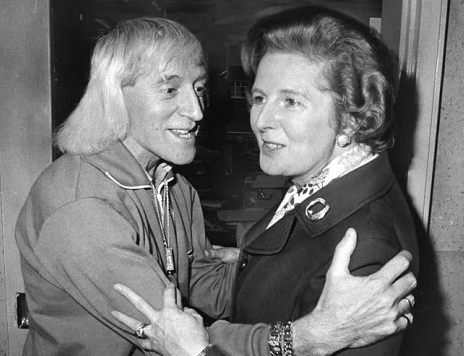
@carlyfarly69@Conservatives Precisely my point Carl: making political capital at #PMQs out of a recently convicted rapist who years ago spent time with an MP or party leader is, at best, cheap - regardless of who does it.
https://t.co/kNbdwybDfA
At #PMQs, Kemi Badenoch, leader of the @Conservatives, criticised Foreign Secretary Ed Miliband's judgement for "cosying up to Russell Brand" ELEVEN YEARS AGO.
How far back are we going?
At #PMQs, Kemi Badenoch, leader of the @Conservatives, criticised Foreign Secretary Ed Miliband's judgement for "cosying up to Russell Brand" ELEVEN YEARS AGO.
How far back are we going?
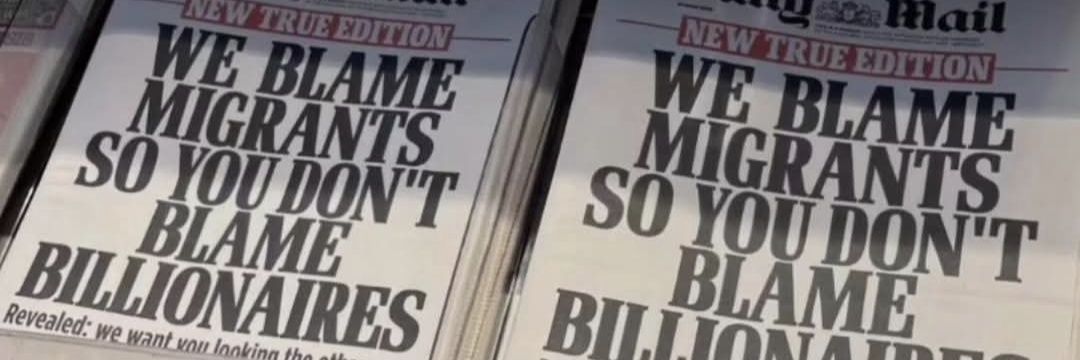
‘How do we protect freedom from capitalism?’
A pressing question you won’t see asked by any billionaire-funded UK or US ‘news’ outlets that constantly bang on about the erosion of our freedoms - can't think why! 🤑
Gil Duran has an answer...
https://t.co/YuFjsXufgy
In February 2025, Musk posted: “We spent the weekend feeding USAID into the wood chipper.” A Lancet study projected more than 14 million additional deaths by 2030 from the cuts, including about 4.5 million children under 5.
In 2023 he said Halli Thorleifsson, who has muscular dystrophy, “did no actual work, claimed as his excuse that he had a disability”.
He also told Joe Rogan “The fundamental weakness of Western civilization is empathy”.
A large-scale, covert paid advertising campaign that promoted anti-Muslim and anti-migrant narratives in Britain (and dozens of other countries) is real and well-documented. Production of much of its content has technical indicators pointing to Israel, but there is no direct evidence of Israeli government involvement.
What can be stated with high confidence:
The campaign existed and was substantial. Researchers Marc Owen Jones and Sohan Dsouza documented hundreds of millions of exposures (including ~154 million recorded for the UK) of content warning of a “Qatar-backed Islamic takeover” or “Islamisation of Europe,” using Great Replacement-style framing.
Meta’s own Q2 2024 Adversarial Threat Report independently confirmed a related earlier phase that spent roughly $1.2 million on ads and targeted the UK, France, and others.
Timing aligned with the 2024 UK election period and the run-up to the Southport riots. The content was explicitly Islamophobic and anti-migrant.
What the evidence supports with moderate-to-high confidence (the researchers’ own wording):
Video production metadata (Hebrew file/folder names, Sunday–Thursday workweek, Israeli timezone and daylight-saving shift) plus an Israeli fixed-line IP appearing in a linked Wikipedia editing session indicate the content was produced in Israel. Advertising was placed through proxies (Vietnam, Brazil, etc.).
The link is to production activity consistent with an Israel-based team (or Israeli-linked contractors), not proven state sponsorship.
In short: the anti-Muslim propaganda campaign targeting Britain was real, large, and its production has forensic traces pointing to Israel.
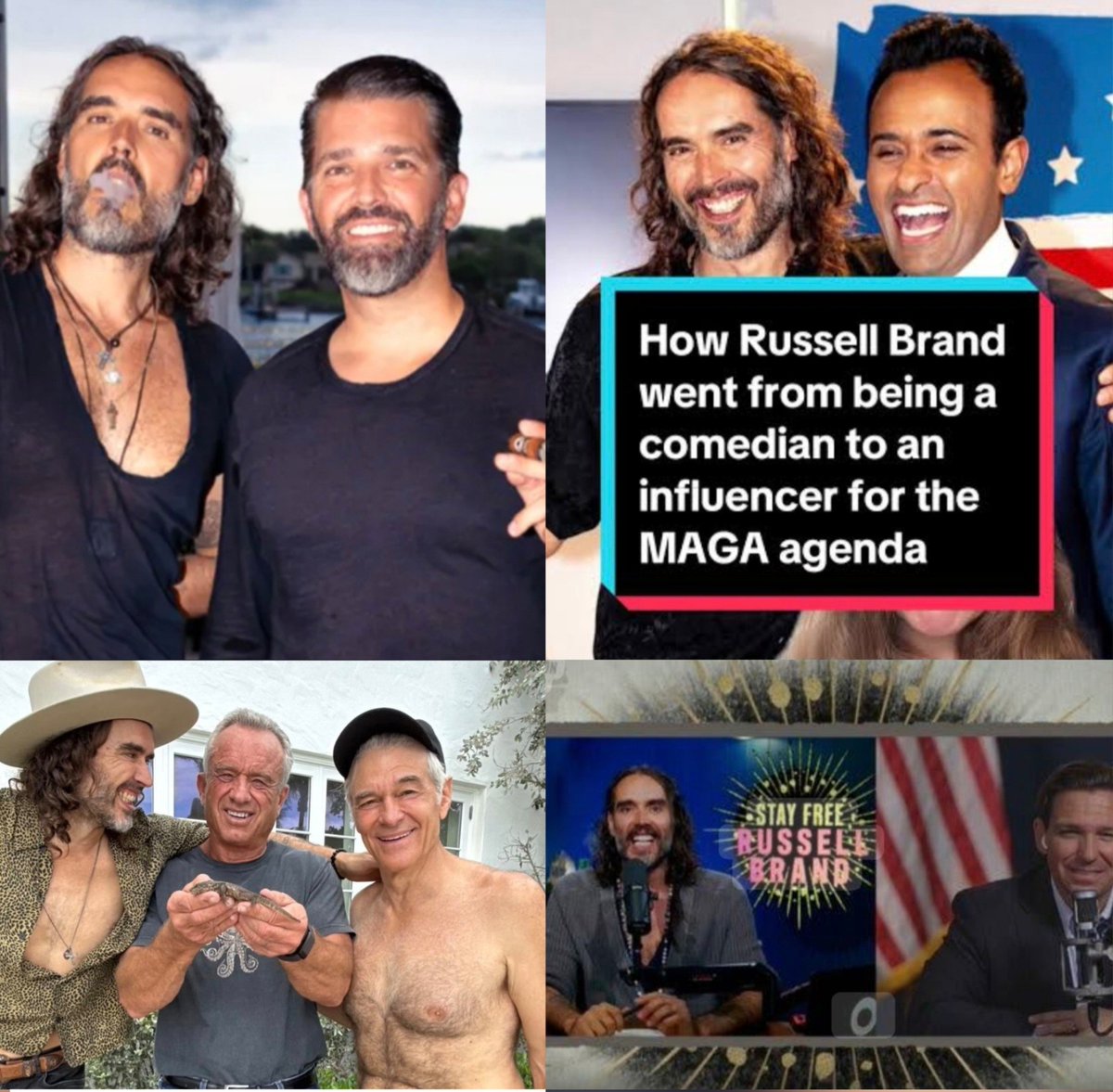
Don Jr is a stupid gullible ill-informed adolescent fucking dickhead, just like his dad.
A “Free Russell Brand” graphic from US lawyer Joseph McBride (@mcbridelawnyc) is circulating. It gets the numbers right and almost everything else wrong.
Yes, Brand was sentenced to 10 years and six months, for one rape and three sexual assaults against four women between 2004 and 2009.
No CCTV, no DNA, no police reports at the time? All true, and all normal in historic sexual offence cases. Many of the so-called ‘grooming gang’ prosecutions rested largely on victims’ testimony years after the event, and few of the idiots sharing this poster called those convictions a hit job.
English law doesn’t require physical evidence, and DNA proves little when the defence is consent.
Delayed reporting is common, and juries are told it doesn’t mean an account is false. One woman did complain at the time: the Channel 4 worker reported Brand in 2009, and Channel 4’s own review later confirmed it was never properly investigated.
“Selectively presented text messages”? Brand had a top KC, gave evidence himself, and explained the exchange to the jury. The graphic offers nothing to back the claim.
“Political hit job”? Utter bollocks. The jury acquitted him of two rapes and an attempted indecent assault. A jury doing a hit job doesn’t acquit on the most serious counts. The judge also rejected his lawyers’ argument that a fair trial was impossible.
If Don Jr, Brand, or anyone else thinks the trial was unfair, the Court of Appeal is the place to argue it, not a poster on social media or a stupid fucking video made while you're clearly off your tits.
What does Politics UK leave out?
In the first tweet I looked at who owns Politics UK (@PolitlcsUK), the account that uses the 🚨 emoji whose @X profile invites followers to turn on notifications “for impartial coverage first”.
Half of the company behind it belongs to Bailey Nash-Gardner, a Reform UK councillor who, the company says, has no editorial involvement. The other half belongs to a holding company controlled by former Conservative MP Ben Howlett.
I now ask a different question: how faithfully does the account pass on what others say? Two posts from the evening of Friday 6 November make a useful test.
At 9:23pm on 6 November, Politics UK told its followers: “NEW: The Church of England has warned that the Government’s proposed ban on conversion therapy could ‘criminalise prayer’”. The post added that people could face up to five years in prison for attempting to change or suppress someone’s sexual orientation or gender identity. It has been viewed more than 700,000 times.
The words in quotation marks are not the Church’s.
What a Church spokesman actually told The Telegraph was that it is “important to ensure that any legislation does not unintentionally criminalise providing appropriate prayer and pastoral care to those who seek it”.
In the same statement, the Church recalled that its General Synod voted “overwhelmingly” in 2017 to call on the Government to ban conversion therapy relating to sexual orientation; the draft bill has since been widened to cover gender identity. It said prayer and pastoral care “should never be coercive”, and that preventing abuses of power and coercive practices should be the focus of any legislation.
In June, the Government’s announcement of the draft bill quoted the Bishop of Manchester, David Walker, for the Church of England, welcoming it as “a positive step”.
So the Church backs a ban in principle and wants the wording right. It plans to raise that in pre-legislative scrutiny, which is what that process is for. Take out “unintentionally”, “appropriate” and “to those who seek it”, and a request to get the drafting right reads as a warning against the ban itself.
The cut works in two directions.
The statement made several points, among them that prayer should “never be coercive” and that abuse and coercion should be “the focus of any legislation”; only one survived. And that one grew: a concern about prayer and pastoral care for people who ask for it became a warning about prayer itself.
The shortened version did not start with Politics UK. The Telegraph published its story at 8:20pm under the headline “Trans law risks criminalising prayer, warns Church”, and its opening line said the same.
“Unintentionally” survived only as far as the second paragraph. The headline also renamed the bill. The draft covers attempts to change sexual orientation as well as gender identity, but The Telegraph calls it a “trans law”, the label its campaign to scrap the bill uses.
Its standfirst called the Church’s statement “Anglican leaders’ criticism” and a “blow” to ministers, yet it was the mildest voice in the story. The Archbishop of Liverpool, speaking for the Catholic bishops of England and Wales, called for the bill to be abandoned; the Church of England, through an unnamed spokesman, asked for the drafting to be got right.
An hour later, Politics UK posted the same idea, now presented as the Church’s own words. Its post did mention sexual orientation as well as gender identity. It did not carry over “unintentionally”, though the word was there in The Telegraph’s second paragraph.
GB News did not run its version until 2:59am on 7 November. Its headline kept the word “unintentionally”, so that night GB News’s headline was more faithful to the Church’s statement than either The Telegraph’s headline or Politics UK’s post.
To be fair to Politics UK, it posted a second message in the same minute, as a reply to the first. It linked to The Telegraph’s story and added that the Government insists the bill is aimed at abusive practices, not ordinary religious expression, while Church leaders want the distinction made “crystal clear in the legislation itself”. That is a much fairer summary, but the two posts did not travel equally.
The reply has been viewed about 88,000 times; the first post, with the quotation marks and no link, about 716,000 times. For every view of the context, the claim had roughly eight.
The Telegraph is open about its position. It says it has launched a campaign to have the bill scrapped, and its news story links to the campaign’s other pieces: a 31 October report on falling support for the ban if parents could be prosecuted, and a 3 November comment piece by Baroness Falkner, the former chair of the Equality and Human Rights Commission, headlined “Labour’s conversion therapy ban is an assault on family life”.
Falkner’s piece draws on a report she co-wrote for Policy Exchange, an opaquely funded right-wing think tank: openDemocracy’s Who Funds You? project rates it E, the lowest grade for funding transparency. Her co-author on the report, published on 2 November, was Akua Reindorf KC, an employment and discrimination barrister who was an EHRC commissioner from 2022 to 2025.
The report’s two authors are, in other words, a former chair and a former commissioner of the equality regulator, though their former roles do not make the report the EHRC’s view.
Policy Exchange’s own page lists the coverage of its launch: The Times, five Telegraph pieces, the Daily Mail, the Express, The Spectator, GB News and LBC.
The news story itself states as fact that parents “risk arrest” for asking their child whether they really want to change gender, although the Government explicitly says it is not seeking to ban “explorative conversations and questioning about someone’s identity”.
Its poll graphic, which also appears in Falkner’s piece, was commissioned and funded by The Christian Institute, a conservative evangelical charity that is campaigning for the bill to be shelved. The article then quotes that organisation’s deputy director at length without connecting the two.
A newspaper running a campaign is nothing new. The problem comes when that campaign’s framing is passed on as neutral breaking news.
The first post also gave the penalty without the threshold that comes with it. In June this year the Government said “a high threshold for criminality has been included, so that only the acts that are abusive, seeking to change someone’s identity, and create real harm to the person, will be in scope”.
Under the draft bill itself, the abuse must cause “serious harm to the individual’s physical or mental health”, or “serious alarm or distress” with “a substantial adverse effect on their usual day-to-day activities”, a bar the Government says protects freedom of expression, including for religious leaders, and it states that it is “not seeking to criminalise expressing beliefs about LGBT+ identities”.
Critics say that threshold is too low and too vague: the Policy Exchange report argues that harm need not be intended and that ordinary parenting could be caught. But even that report accepts that conduct is only criminal under the bill if it is abusive and causes serious harm or serious alarm or distress. The threshold is real, and disputed. The reply’s mention of “abusive practices” goes some way towards it, for those who reached it. A reader who saw only the first post would not know it exists.
Put together, the sequence runs like this:
A newspaper campaigning against the bill turns a drafting concern into an alarming headline.
An account that promises impartial coverage shortens it further, puts it in quotation marks and attributes it to the Church, leaving the link and the Government’s side to a reply.
The post viewed more than 700,000 times then tells its readers that the Church of England has warned against a ban whose draft one of its own bishops welcomed in June.
No fact had to be invented. Three words came out, a pair of quotation marks went in, and the sender looked like a news service.
It was not the only post that evening to take this route.
Two hours earlier, at 7:05pm, Politics UK told its followers: “NEW: Small boats are now deploying from the Netherlands to avoid patrol boats in the English Channel”.
The post carried a map with an arrow running from the Dutch village of Cadzand to Dover, and has been viewed about 365,000 times. The source, again The Telegraph, again appeared only in a reply, which has been viewed about 32,000 times. For every view of the source, the claim had roughly eleven.
The Telegraph’s story, published at 3:06pm, rested on a single incident. On Saturday 31 October a dinghy carrying 38 people lost its outboard motor off the Dutch coast and was towed into Cadzand, the village at the start of Politics UK’s arrow. Dutch prosecutors later confirmed that it had launched from the Netherlands, without saying where.
The Dutch military police said at the time that they did not know where it was heading, and I have found no later statement that it was bound for Britain. On 6 November, the day of both posts, two Dutch MPs were still asking the minister in writing what was known about where it had set off from and where it was going.
The regional paper PZC reported that when first seen it was under power and heading west, towards the North Sea, and that those on board at first refused help from lifeboat crews. It never got anywhere near Britain.
The Netherlands Red Cross called it “unusual”, and the Dutch asylum and migration minister, Bart van den Brink, called it “highly disturbing”. He told RTL that a problem long “situated around Calais” had moved north towards Belgium, “but now for the first time in the Netherlands we see this occurring”.
The idea that gangs were finding “new launch locations and methods” came from Mike Tapp, the Labour MP for Dover and Deal. Tapp said the incident showed smugglers were adapting, though the Dutch investigation had not established where the boat was going.
Tapp also warned: “As launch disruptions grow, the criminal gangs will adapt and a part of that will be finding new launch locations and methods.” The Telegraph’s standfirst quoted the last six of those words without naming him, so an MP’s view read as the paper’s own finding.
Every outlet I checked carried those qualifications somewhere. The BBC and LBC attributed the framing to Tapp in their headlines.
The Telegraph and GB News put a firmer version in theirs, but both reported that crossings had fallen sharply this year: on provisional Home Office figures, around 22,000 people arrived by small boat between January and October, roughly 40% down on the same period last year. GB News told its readers this was believed to be the first such attempt from the Netherlands.
Politics UK’s post was the only version that carried none of these qualifications.
Set The Telegraph’s headline, “Migrants smuggled to UK on small boats from Netherlands to avoid patrols”, and its opening line, that “criminal gangs are smuggling migrants into the UK from the Netherlands”, against the record. Neither is hedged anywhere in the article.
Nobody was smuggled to the UK, there was one boat, and it was towed into a Dutch harbour.
Avoiding patrols was an MP’s reading of a boat whose destination nobody has confirmed. Of the headline’s multiple claims, the authorities have confirmed just one: a boat set off from the Netherlands.
Politics UK then went a step further, with boats that “are now deploying” and an arrow to Dover.
Politics UK’s method here matches the one it used on the Church statement. There, a request to get the drafting right was turned into an alarming warning that prayer would be criminalised, with quotation marks around words that were not the Church’s. Here, one stranded boat was inflated into an alarming new trend.
Both times, The Telegraph’s story had already dropped or distorted some of the context. Politics UK then left out what remained, and put the link to the story in a reply that drew a fraction of the views.
My first tweet opened with a smaller example of the same method: Politics Global’s post about Rupert Lowe, which kept the FT’s flattering ranking but left its explanation to a reply.
Three posts are not proof of a pattern, but they all point the same way. All three distorted the reporting they drew on: one made a politician on the right look more impressive than the FT’s own account allowed, and two made a Labour bill and a single stranded boat look more alarming than the facts supported.
Each left the context to a reply, and for every view of that reply the main post had between eight and twenty-two.
Together they go to the heart of what Politics UK asks its half a million followers to accept: that a red siren emoji and the word “NEW” mean impartial news, first.
On the evening of 6 November, it put words in quotation marks that the Church of England had not said, and told its followers that small boats “are now deploying from the Netherlands to avoid patrol boats in the English Channel”, with an arrow to Dover, on the strength of one stranded dinghy whose destination nobody had confirmed.
Its own About page promises that stories from other outlets are shared “with clear attribution to the journalist or outlet”. Neither initial post named The Telegraph.
Impartiality rests on accuracy, and on readers knowing who stands behind what they read.
Politics UK’s readers are told that a Reform UK councillor co-owns the company but has no editorial involvement. They are not told that the other half belongs to a holding company controlled by a former Conservative MP.
News consumers should always know exactly who is behind the headlines. Politics UK’s half a million followers don’t.
🧵
Who owns Politics UK?
The “impartial” news brand with half a million followers on @X discloses one co-owner’s politics. Its other half belongs to a former Conservative MP’s holding company, but you won’t find that on its website.
On Sunday evening, Politics Global (@PolitlcsGlobal) told its followers that only three world leaders had amassed more views on @X this year than Rupert Lowe. The line came from the Financial Times, but the FT’s explanation, that Lowe’s reach owes a great deal to Elon Musk, was left to a reply.
The main post has been viewed more than 390,000 times, the reply about 17,500. For every view of the context, the claim had roughly twenty-two. The flattering half of a story was selected and packaged as news.
Politics Global is one of three accounts run by Politics News Group Limited, alongside Politics US (@PolitlcsUS) and the best known of them, Politics UK (@PolitlcsUK). Note the spelling of the handles: each has a lower-case L where the second i in “Politics” should be, so at a glance they read as “Politics”.
Politics UK describes itself as “the home of UK political news”, run by young people for young people. It says it has grown from 30,000 followers on X in early 2023 to more than 500,000, that it is a member of the Parliamentary Lobby, and that it is regulated by IMPRESS. Its X profile promises impartial coverage.
Its About page is unusually open about one of its owners. It names Bailey Nash-Gardner as co-owner of Politics News Group, which he founded in January 2023 under the name News Hub Group. “In the interests of transparency”, it says, he was elected as a Reform UK councillor for Marshalls and Rise Park in Havering in May 2026, and he also works for Andrew Rosindell, the Reform UK MP for Romford. It adds that he oversees commercial operations and has no editorial involvement in Politics UK.
What the page does not say is who owns the other half.
Companies House does. On 21 March 2025 the company issued 99 new shares, taking the total to 100. Its confirmation statement of 8 August 2025 lists two shareholders: Bailey-Jon Nash, as he is registered, with 50 shares, and Chamber UK Services Limited with the other 50.
Chamber UK Services is the company behind Chamber UK, a Westminster events and political media business whose chief executive is Ben Howlett, Conservative MP for Bath from 2015 to 2017. Howlett also runs Curia, which describes itself as a non-profit policy institute.
Calling itself the UK’s first “do tank”, Curia sells memberships and runs parliamentary roundtables and reports, some with commercial backing: a roundtable on NHS dentistry organised with mydentist and the Association of Dental Groups, and events sponsored by the pharmaceutical company Bayer and the life sciences firm Revvity.
In January 2026, Howlett incorporated a holding company, Belvedere Ash Limited, of which he owns 75% or more. Over the following months his interests moved into it.
On 3 March 2026 Belvedere Ash replaced Howlett himself as the controlling owner of Curia UK Limited, and replaced Chamber UK Services as part-owner of UKAI, an AI industry trade body. On 20 August 2026 it was registered as owning between 25% and 50% of Politics News Group and appointed a director. The company’s 2026 confirmation statement lists the same 50-50 split, Nash and Belvedere Ash.
So half of Politics UK is owned by a holding company controlled by a former Tory MP whose businesses sell access to political events, and the other half by a sitting Reform councillor who works for a Reform MP. Readers of the About page learn only about the second.
None of this was secret to anyone who followed @PeterKGeoghegan’s reporting. In December 2025, #DemocracyForSale and Led @ByDonkeys revealed an undercover investigation in which a reporter, posing as an adviser to a Chinese investor, signed a £5,000 contract with Howlett’s Chamber Group. Howlett went on to arrange meetings with more than ten Labour MPs. Chamber also charged the reporters £2,400 plus VAT to place two pro-China posts on the Politics UK X account.
The posts linked to long articles on Politics UK’s website attributed to Curia UK, not to the client who had paid for them. Both were taken down after the reporters asked for comment. Howlett told the undercover reporter he had bought his 50% stake for £100.
The lobbying regulator later closed an investigation into Chamber, finding that it had not broken lobbying law. Geoghegan argued at the time that this said more about the narrowness of Britain’s lobbying rules than about the conduct he had exposed.
Nearly a year on, Curia still has its own section on the Politics UK website. Labelled “Curia Policy”, it describes itself as updates from Curia, “a non-profit policy institute”.
On 8 October 2026 it published a report from the Conservative Party conference, bylined Ben Howlett, in which a shadow minister urged AI businesses to help shape Conservative policy. The piece links twice to UKAI. Its subscribe prompts ask readers to support Curia’s work. Nowhere does it tell readers that the author’s holding company owns half of the outlet publishing him.
The piece itself is measured, even mildly critical of the party it covers, but that is beside the point. Readers judging any piece of journalism are entitled to know whose interests stand behind it. For news media, that is the most basic disclosure there is. Herman and Chomsky made ownership the first of the “filters” in their propaganda model for a reason: who owns a news outlet shapes what it covers, often in ways no single article reveals.
On “non-profit”: Curia UK Limited is a private company limited by shares, now owned through Howlett’s holding company. That legal form does not, in itself, establish that it operates on a not-for-profit basis. The description is Curia’s own. When Democracy for Sale reported on it in December 2025, its most recent accounts had been filed as dormant.
There is a further discrepancy in the company’s own filings. A person or company holding more than 25% of a UK company’s shares or voting rights should normally appear on its public register of people with significant control.
Politics News Group’s August 2025 confirmation statement shows Chamber UK Services holding half its shares. Yet Chamber UK Services never appears on that register. Until 20 August 2026, the register recorded Nash as the only person with significant control; his entry was amended to a stake of between 25% and 50% on the same day Belvedere Ash was added.
For at least twelve months, then, two filings by the same company gave different pictures of who controlled it. The filings do not say why.
Nash-Gardner himself has spoken about this kind of thing. Interviewed by an undercover @BylineTimes reporter before the May elections, he condemned a councillor who had failed to declare a business interest, saying people in public life should “be open and transparent about the interests that you have”. It’s a good principle, and it applies to news brands too.
Nash-Gardner’s own X bio follows it, naming him as “Founder & Non-Editorial Director” of Politics News Group and linking all three accounts. Howlett has shared the accounts’ posts from his X profile too. His bio describes him as a former MP, a cat parent and a charity runner. It does not mention his stake in them.
Politics UK’s defenders will say that it discloses its partnerships, and it does name Chamber UK and Curia as partners. But a partnership is one thing and common ownership is another. A reader told that a news outlet works in partnership with a policy institute would reasonably assume two independent organisations.
What the record shows is that Curia and half of Politics UK sit under the same holding company, and that Politics UK publishes Curia’s material under Curia’s name, on at least one documented occasion for a commercial client.
Speaking to Democracy for Sale last year, Green Party leader @ZackPolanski said former MPs now “slip effortlessly between Conservative, Labour and Reform UK”. Politics UK is a neat illustration. A Reform councillor shares ownership of a brand that tells young people it brings them impartial news with a former Tory MP who was recorded saying he had helped with Labour fundraising.
Politics UK says it holds itself to account through complaints and its regulator. A reasonable first step would be a single sentence on its About page saying who owns the other half.
In the next tweet: two posts from Politics UK in one evening, and the context that went missing on the way to half a million followers.