#Vault
Sorry for the messy post. I guess I needed to get this off my chest.
I'm not even sure this post is necessary, but after spending the last couple of days debating whether to write it, here we are.
Everything is on-chain. Everything is public. Anyone can verify the numbers, and even ChatGPT can easily turn the data into charts and reports.
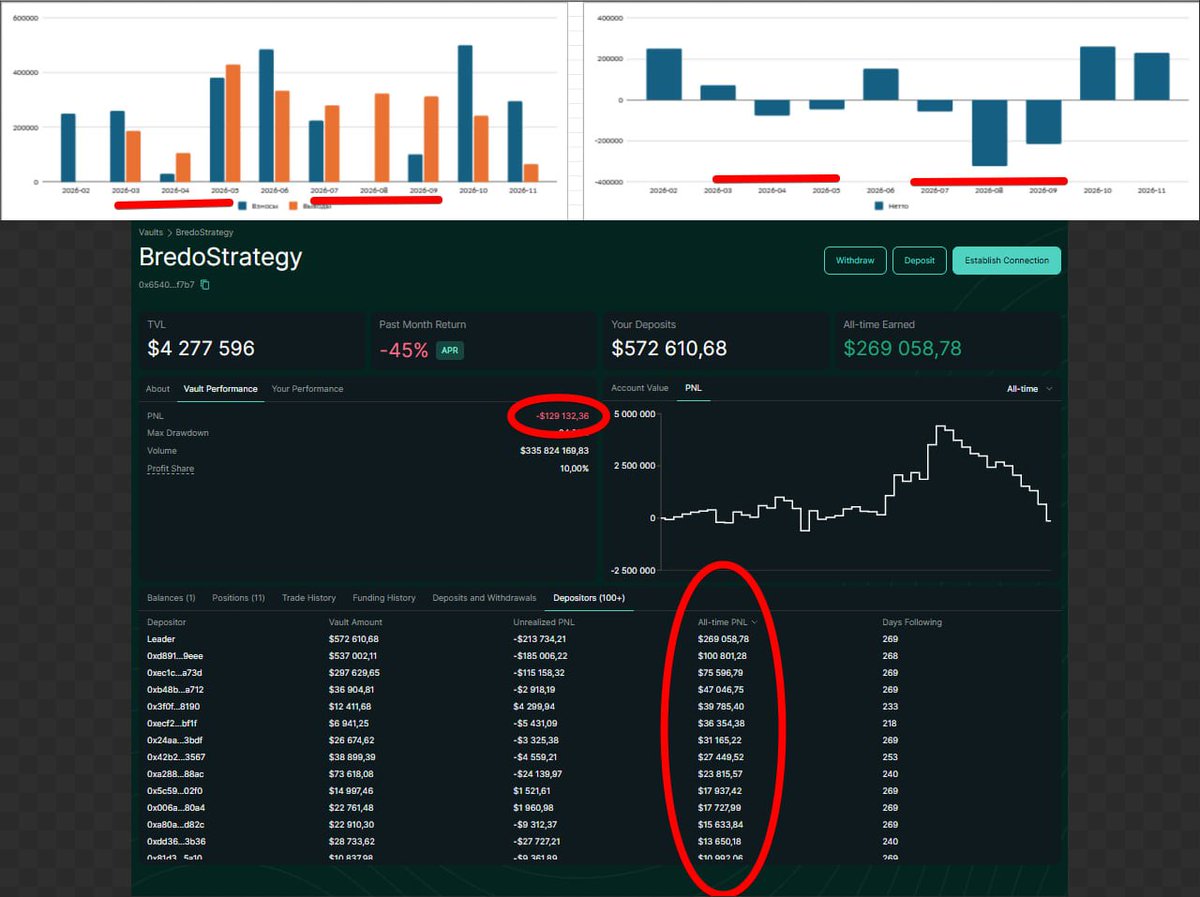
As you can see from the charts, the idea is pretty simple: when the market was near its highs, I was withdrawing significantly more than I was depositing. When the market was falling, I was doing the opposite — adding more capital.
No special treatment, no secret arrangements. And the personal results I'm discussing exclude the management fees I earn from other depositors.
Bitcoin has now fallen below the price at which the Vault was launched nine months ago. The Vault itself has also slipped into negative all-time PnL for the first time since June.
Yet my personal result is still positive. So are the results of dozens of other wallets that followed similar rebalancing strategies, whether inspired by my approach or independently.
From day one, I explained how I personally viewed this Vault.
For me, it was never supposed to be a single deposit that you make once and then simply forget about.
It was always one part of a much larger portfolio. A position divided into smaller pieces, constantly changing in size relative to the rest of my holdings.
Whenever that position grew beyond a certain percentage of my total portfolio, I took profits. Whenever it became relatively smaller due to market declines, I added capital from stablecoins.
That's it. Nothing revolutionary.
And now, nine months later, with BTC below its starting price and the broader market struggling, that approach has kept my personal Vault investment in profit.
Again, this has nothing to do with preferential terms or management fees. It's about how I managed my own capital.
I've said before that I understand what many of you would ideally want me to do: take profits near the top on your behalf and buy back near the bottom.
And I get it.
But there's a fundamental limitation to doing that in an open Vault where capital is constantly entering and leaving.
Imagine you deposit $5 and I deposit $5. Together we have $10.
Our capital doubles to $20.
Then someone comes along and deposits another $20 in a single day. The next day, they withdraw $15.
How exactly am I supposed to manage everyone's individual portfolio allocation in a system like that?
I have no way of knowing how much capital each person holds outside the Vault, how much dry powder they have available, or what percentage of their total portfolio the Vault represents.
The only capital I can make those decisions for is my own effective capital.
If my original $5 grows to $6, $7, or $8, I can decide to take 10% off the table at each predetermined level.
I've described these exact approaches many times before.
And this is precisely why the average investor's result can look so different from the result of someone consistently managing their exposure.
Most people make their largest deposits near market highs, hoping to catch the next leg up.
Then, when the market finally reaches levels with a much more attractive expected return, they have little or no capital left to deploy.
That's investing psychology. And unfortunately, it doesn't seem to change.
I genuinely hope that watching my experience in real time has helped at least some people understand the difference.
Even if you never participated in the Vault, you can still observe two very different approaches over the same nine-month period.
One investor deposits once and waits.
Another treats the Vault as one component of a diversified portfolio, maintains a stablecoin allocation, regularly adjusts exposure, and rebalances whenever the proportions of the portfolio become distorted.
I've taken profits dozens of times throughout this period and talked about doing exactly that in countless posts.
Meanwhile, some people deposited almost $300K in a single transaction, close to the market highs, watched their positions grow beyond $450K, and never took profits even once.
Not even after watching me take profits ten separate times.
Again, I described this entire philosophy from the very beginning.
And now that BTC has dropped below its price at the Vault's launch, I actually see more opportunities to increase exposure, not fewer.
The crypto community is currently drowning in panic and nonsense. I've unfollowed a bunch of channels simply because I got tired of reading it.
It's almost funny watching people who were opening leveraged positions above $80K suddenly declare that "only spot makes sense" now that prices have actually reached much more interesting levels.
Apparently, futures only became dangerous after the market crashed.
Make it make sense.
Anyway, I see opportunity here.
I hope these results help at least a few people reconsider how they approach portfolio management.
I intend to keep adding to the Vault if we see further downside, and to keep taking partial profits during rallies, exactly as I've been saying since day one.
The BredoStrategy Vault is my exposure to an ALT portfolio. It's one part of my overall investment strategy, not my entire portfolio.
There was a point when the Vault was showing almost $5 million in profits.
I deliberately avoided making a big deal out of those numbers. In many cases, I barely mentioned them at all.
Because I knew what would happen: more people would rush in near the highs, chasing performance.
Instead, I repeatedly wrote about taking profits, rebalancing, and diversification.
The Vault was already down around $600K back in June, just four months after its launch.
And the current situation is another clear example of how differently people can manage their money, even when they invest in exactly the same strategy.
The underlying strategy may be shared. The capital allocation decisions are personal. And those decisions matter.
Thanks to everyone who's been following this journey.
We're just getting started.
BredoStrategy Vault
https://t.co/EZLT76Vfpo
yee of couse, every day a poisitive sigral but price like 6 year ago :) every day new patents, widthdraw from CEX and new sigral, parterns, but not for token price.
Moreover, regardless of what might be said, the Chainlink token has no connection to the actual business-level activities of Chainlink’s employees—at least, that is how things stand for now.
ethereum:0x514910771af9ca656af840dff83e8264ecf986ca
#Vault
Sorry for the messy post. I guess I needed to get this off my chest.
I'm not even sure this post is necessary, but after spending the last couple of days debating whether to write it, here we are.
Everything is on-chain. Everything is public. Anyone can verify the numbers, and even ChatGPT can easily turn the data into charts and reports.
As you can see from the charts, the idea is pretty simple: when the market was near its highs, I was withdrawing significantly more than I was depositing. When the market was falling, I was doing the opposite — adding more capital.
No special treatment, no secret arrangements. And the personal results I'm discussing exclude the management fees I earn from other depositors.
Bitcoin has now fallen below the price at which the Vault was launched nine months ago. The Vault itself has also slipped into negative all-time PnL for the first time since June.
Yet my personal result is still positive. So are the results of dozens of other wallets that followed similar rebalancing strategies, whether inspired by my approach or independently.
From day one, I explained how I personally viewed this Vault.
For me, it was never supposed to be a single deposit that you make once and then simply forget about.
It was always one part of a much larger portfolio. A position divided into smaller pieces, constantly changing in size relative to the rest of my holdings.
Whenever that position grew beyond a certain percentage of my total portfolio, I took profits. Whenever it became relatively smaller due to market declines, I added capital from stablecoins.
That's it. Nothing revolutionary.
And now, nine months later, with BTC below its starting price and the broader market struggling, that approach has kept my personal Vault investment in profit.
Again, this has nothing to do with preferential terms or management fees. It's about how I managed my own capital.
I've said before that I understand what many of you would ideally want me to do: take profits near the top on your behalf and buy back near the bottom.
And I get it.
But there's a fundamental limitation to doing that in an open Vault where capital is constantly entering and leaving.
Imagine you deposit $5 and I deposit $5. Together we have $10.
Our capital doubles to $20.
Then someone comes along and deposits another $20 in a single day. The next day, they withdraw $15.
How exactly am I supposed to manage everyone's individual portfolio allocation in a system like that?
I have no way of knowing how much capital each person holds outside the Vault, how much dry powder they have available, or what percentage of their total portfolio the Vault represents.
The only capital I can make those decisions for is my own effective capital.
If my original $5 grows to $6, $7, or $8, I can decide to take 10% off the table at each predetermined level.
I've described these exact approaches many times before.
And this is precisely why the average investor's result can look so different from the result of someone consistently managing their exposure.
Most people make their largest deposits near market highs, hoping to catch the next leg up.
Then, when the market finally reaches levels with a much more attractive expected return, they have little or no capital left to deploy.
That's investing psychology. And unfortunately, it doesn't seem to change.
I genuinely hope that watching my experience in real time has helped at least some people understand the difference.
Even if you never participated in the Vault, you can still observe two very different approaches over the same nine-month period.
One investor deposits once and waits.
Another treats the Vault as one component of a diversified portfolio, maintains a stablecoin allocation, regularly adjusts exposure, and rebalances whenever the proportions of the portfolio become distorted.
I've taken profits dozens of times throughout this period and talked about doing exactly that in countless posts.
Meanwhile, some people deposited almost $300K in a single transaction, close to the market highs, watched their positions grow beyond $450K, and never took profits even once.
Not even after watching me take profits ten separate times.
Again, I described this entire philosophy from the very beginning.
And now that BTC has dropped below its price at the Vault's launch, I actually see more opportunities to increase exposure, not fewer.
The crypto community is currently drowning in panic and nonsense. I've unfollowed a bunch of channels simply because I got tired of reading it.
It's almost funny watching people who were opening leveraged positions above $80K suddenly declare that "only spot makes sense" now that prices have actually reached much more interesting levels.
Apparently, futures only became dangerous after the market crashed.
Make it make sense.
Anyway, I see opportunity here.
I hope these results help at least a few people reconsider how they approach portfolio management.
I intend to keep adding to the Vault if we see further downside, and to keep taking partial profits during rallies, exactly as I've been saying since day one.
The BredoStrategy Vault is my exposure to an ALT portfolio. It's one part of my overall investment strategy, not my entire portfolio.
There was a point when the Vault was showing almost $5 million in profits.
I deliberately avoided making a big deal out of those numbers. In many cases, I barely mentioned them at all.
Because I knew what would happen: more people would rush in near the highs, chasing performance.
Instead, I repeatedly wrote about taking profits, rebalancing, and diversification.
The Vault was already down around $600K back in June, just four months after its launch.
And the current situation is another clear example of how differently people can manage their money, even when they invest in exactly the same strategy.
The underlying strategy may be shared. The capital allocation decisions are personal. And those decisions matter.
Thanks to everyone who's been following this journey.
We're just getting started.
BredoStrategy Vault
https://t.co/EZLT76Vfpo
This will have a bigger impact on @AskVenice new user growth than any ad campaign every could have.
17.4M views and counting for an incredible real world example of what can be built on Venice Studio
Man this is one of the first things I’ve watched and had no idea it was AI. Spent 10 minutes trying to find official release date. Wild world ahead of us, truly out of uncanny valley, event horizon well in the rear-view
As promised, every Thursday we recap the past week in the Vault.
Epoch #38 (267 days)
The Vault launched on February 17 with BTC at $67,960.
—————————————————————
This Week (Epoch)
BTC weekly performance: -6.81% ($78,817 → $73,446)
Vault weekly PNL: -$1,292,974
—————————————————————
Since Vault Launch
BTC performance: +8.07% ($67,960 → $73,446)
Total Vault PNL: +$648,065
—————————————————————
Sadness, pain, despair. It's over. This has never happened before. Except it has. Again and again.
I understand the pain of those who open positions (or deposit into the Vault) during sharp rallies, but don't add during downturns and don't take profits on the way up.
But that's how it's always been, and that's how it always will be after market corrections.
My personal deposit in the Vault is still up more than 100% on the initial capital, just like many others who have been taking profits along the way.
So, what about the market?
From the very first day of the Vault, I've been saying that this shit could last anywhere from a few weeks to several years. Nobody knows when it will end. All we can really do is watch the fundamentals.
In my personal view, with BTC at $73K, the level of "it's all over" sentiment is even higher than it was when BTC was trading at $58K or $63K.
And this whole Huang situation is, IMO, a completely manufactured hit piece.
"On May 13, 2026, short-selling firm Culper Research published an investigation into Jensen Huang's ties to Chinese businesswoman Alice Huang — and explicitly disclosed that it held a short position in NVDA."
But that's not even the point.
Everything is working exactly as it should.
In my view, the market is insanely oversold right now. I can see a lot of people throwing in the towel.
I see opportunities in this, and I'll keep increasing my position in the Vault if the market continues to fall.
Take profits. Rebalance your portfolio.
#Vault
Thank you, everyone.
We're just getting started!
As promised, every Thursday we recap the week in the Vault — Epoch #37 (260 days).
BredoStrategy Vault: https://t.co/EZLT76Vfpo
The Vault launched on February 17, when BTC was at $67,960.
—————————————————————-
BTC since last week: -2.80% ($81,087 > $78,817)
Vault profit since last week: -$1,030,857
—————————————————————-
BTC since Vault launch: +15.98% ($67,960 > $78,817)
Vault profit since launch: +$1,941,039
—————————————————————-
Yes, the week’s result in numbers is terrible.
But first of all, as I already wrote here (https://t.co/0vbKTUd7Ej) and in the two posts below it, the “total profit” of the Vault is a very abstract thing: huge sums usually come in right at the pumps and periodically get withdrawn on the drawdowns, which heavily cuts the “average across the board”. In those posts you’ll find my personal numbers — even now, with BTC at $78K, my share of the Vault profit is down only ~26-28%.
Once again, I suggest re-reading those posts to see that even in a volatile market, when it swings up and down for months, you don’t have to sit at zero or in the red — if you take profits in time, diversify, and rebalance your portfolio.
Right now the market is in a state of extreme apathy. The way I see it, the fundamentals are getting better and better by the day, and prices will inevitably catch up. And despite such a “terrible result” for the past epoch, I can say I’m happy with how I managed the assets.
As I wrote in previous posts, it’s exactly in moments like these that you can see the difference in who manages their “profits” and how. When “everyone is in profit” — one is +104%, another +168%, a third +314% — the first two usually don’t care and don’t really think about why it turned out that way.
From February 19 to June 2 the Vault was in the red — that’s 104 days. Then it made ~$5M in profit. Now we’ve pulled back to +$2M and everyone is apathetic )
Take profits, rebalance your portfolio.
Thank you all. We’re only just getting started!
Really sad to see what’s happening in Paraguay, where over 60% of the population is losing access to their funds held in banks.
As DeFi and stablecoins gain adoption among fintechs, we must remember the bigger mission, which is building a self-sovereign financial system where access to your own money is a fundamental right, not a privilege granted by an intermediary.
As promised, every Thursday we recap the week in the Vault — Epoch #37 (260 days).
BredoStrategy Vault: https://t.co/EZLT76Vfpo
The Vault launched on February 17, when BTC was at $67,960.
———————————————��—————-
BTC since last week: -2.80% ($81,087 > $78,817)
Vault profit since last week: -$1,030,857
—————————————————————-
BTC since Vault launch: +15.98% ($67,960 > $78,817)
Vault profit since launch: +$1,941,039
—————————————————————-
Yes, the week’s result in numbers is terrible.
But first of all, as I already wrote here (https://t.co/0vbKTUd7Ej) and in the two posts below it, the “total profit” of the Vault is a very abstract thing: huge sums usually come in right at the pumps and periodically get withdrawn on the drawdowns, which heavily cuts the “average across the board”. In those posts you’ll find my personal numbers — even now, with BTC at $78K, my share of the Vault profit is down only ~26-28%.
Once again, I suggest re-reading those posts to see that even in a volatile market, when it swings up and down for months, you don’t have to sit at zero or in the red — if you take profits in time, diversify, and rebalance your portfolio.
Right now the market is in a state of extreme apathy. The way I see it, the fundamentals are getting better and better by the day, and prices will inevitably catch up. And despite such a “terrible result” for the past epoch, I can say I’m happy with how I managed the assets.
As I wrote in previous posts, it’s exactly in moments like these that you can see the difference in who manages their “profits” and how. When “everyone is in profit” — one is +104%, another +168%, a third +314% — the first two usually don’t care and don’t really think about why it turned out that way.
From February 19 to June 2 the Vault was in the red — that’s 104 days. Then it made ~$5M in profit. Now we’ve pulled back to +$2M and everyone is apathetic )
Take profits, rebalance your portfolio.
Thank you all. We’re only just getting started!
As promised, every Thursday we recap the week in the Vault — Epoch #36 (253 days).
I posted the recap on Telegram on time but forgot to post it here — my apologies ) Here’s the original Telegram post: [https://t.co/KLC9LlSxJO]
BredoStrategy Vault: https://t.co/EZLT76Vfpo
The Vault launched on February 17, when BTC was at $67,960.
—————————————————————-
BTC since last week: -0.33% ($81,353 > $81,087)
Vault profit since last week: -$14,322
—————————————————————-
BTC since Vault launch: +19.32% ($67,960 > $81,087)
Vault profit since launch: +$2,971,896
—————————————————————-
Well, just as I wrote last week — at some point we’d go 2 or even 3 times down or up in a row... and that’s exactly what happened this week, but Hyperliquid pulled it all out at the last moment.
Volatility creates opportunities. There’s a lot to say about Hyperliquid, LINK, AAVE — I’ll get to it someday )
Thank you all. We’re only just getting started!
Today @Payward, the unified financial infrastructure platform that powers @krakenfx, announced that Digital Asset Special Investments I, LP, a Payward-affiliated investment fund, and its clients acquired AAVE tokens.
The AAVE tokens were acquired through secondary market purchases, and Payward may make additional acquisitions in the future. Payward and Aave are also exploring opportunities to collaborate on future initiatives.
As traditional and onchain markets converge, Payward believes DeFi is an integral part of the global financial system, with Aave playing a leading role in this evolution.
And yes, I get it — ideally you'd want me to "do it for you": take partial profit at the top and add at the bottom, while you just hold the position.
First: that only works cleanly in a closed system, where I always know the vault's dollar balance and control it. In our open setup it can't be done in a balanced way — anyone can deposit or withdraw at any moment, and every dollar that comes in immediately gets exposure to all positions. Add the human greed bug: on the way up people deposit a far bigger share of their cash than on the way down. The biggest deposits have always come at the very top of the pumps; on the drops there's nowhere near as much — and some people pull out hard.
Second: I already do this. If I didn't add on the dips and take profit on the spikes, our positions wouldn't be beating the market — they'd just be "hanging longs". In reality the vault is still well ahead of those longs.
And it's important to really get this — in numbers, on your fingers, with examples.
It's a perfect illustration of how you can buy the same "stocks" or "coins" as your friend, as Buffett, as anyone — and end up with a completely different result. It's never about "when you first bought Bitcoin". More and more people proudly tell you how early they got into BTC… and then something happened. What determines the result isn't even what you bought, but how you took profit and whether you added on the drawdowns.
Even without adding on dips at all — just taking partial profit with a crude "ladder" on the way up — the outcome of $100 in each of the top-100 coins from the previous post would have been dramatically different.
That's why I've been saying it since day one: diversify, rebalance, don't get greedy. Over a long enough horizon, it works.
#Vault — an important one
BTC is up ~10% since the vault launched on Feb 17. For some depositors the vault is "slightly up", for those who deposited at the top it's down. I took profit on every spike and added on every drawdown. Everyone's result is different — most people did nothing with their deposit, and that's a strategy too.
I get that managing a position is harder and more stressful than doing nothing. But as I showed in BredoStrategySubs recently, "just hold for years, never take profit" isn't that great a strategy even in hindsight: $100 into each of the top-100 coins on Christmas 2017 would be worth ~$20K today (2x in 8.9 years, ~8%/yr) — only 9 of 100 coins are in profit, 78 lost 90%+, 26 are dead, and four coins (BNB, LINK, BTC, ETH) made 85% of the result. Entering at the top and diversifying didn't save anyone.
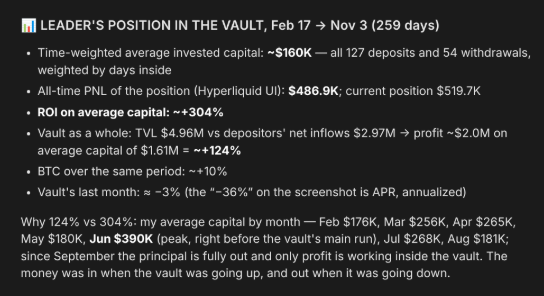
So here's the point. My time-weighted average capital in the vault over these 259 days is ~$160K (every deposit and withdrawal weighted by how many days it sat inside). All-time PNL on the position: $486.9K — roughly +300% on average invested capital.
The vault as a whole did ~+124% on depositors' average capital ($1.6M) over the same period — and that's after a losing last month. The gap between 124% and 300% is "take profit on the way up, add on the way down": my largest exposure was in June, right before the main run, and since September my principal is fully out — only profit is working in the vault. Most people did nothing. That's a strategy too — just with the vault's result, not mine.
A reminder: every deposit and every profit-taking I post in real time, to the minute, in https://t.co/M0Uo0esDyq under #Vault. And there's no magic in my timing — there are depositors in the vault who do this better than I do.
BredoStrategy Vault: https://t.co/EZLT76Vfpo
As promised, every Thursday we recap the week in the Vault — Epoch #36 (253 days).
I posted the recap on Telegram on time but forgot to post it here — my apologies ) Here’s the original Telegram post: [https://t.co/KLC9LlSxJO]
BredoStrategy Vault: https://t.co/EZLT76Vfpo
The Vault launched on February 17, when BTC was at $67,960.
—————————————————————-
BTC since last week: -0.33% ($81,353 > $81,087)
Vault profit since last week: -$14,322
—————————————————————-
BTC since Vault launch: +19.32% ($67,960 > $81,087)
Vault profit since launch: +$2,971,896
—————————————————————-
Well, just as I wrote last week — at some point we’d go 2 or even 3 times down or up in a row... and that’s exactly what happened this week, but Hyperliquid pulled it all out at the last moment.
Volatility creates opportunities. There’s a lot to say about Hyperliquid, LINK, AAVE — I’ll get to it someday )
Thank you all. We’re only just getting started!
As promised, every Thursday we recap the week in the Vault — Epoch #35 (246 days).
BredoStrategy Vault: https://t.co/EZLT76Vfpo
The Vault launched on February 17, when BTC was at $67,960.
—————————————————————-
BTC since last week: -1.13% ($82,282 > $81,353)
Vault profit since last week: -$548,207
—————————————————————-
BTC since Vault launch: +19.71% ($67,960 > $81,353)
Vault profit since launch: +$2,986,218
————————���————————————-
Just yesterday everything looked so beautiful ) But seriously — nothing new once again, volatile out there. The last 2-3 weeks the market has been swinging insanely hard uuuup-dooown-uuuup-dooown.
I already wrote in these posts https://t.co/szGrhdTUcy and https://t.co/C2wpvojfQo what to do to “not suffer too much”... at some point we’ll obviously go 2 or even 3 times in a row dooown or uuup. Long term I’m betting on “uuup”, but short term we could also take a trip down — that’s the squiggle we’re in.
Thank you all. We’re only just getting started!